



Free assessor data is useful for lookup, but it's dangerous when you treat it like a live underwriting feed.
Salt Lake County gives the public real access to valuation and parcel records, and that matters. The county assessor's office is a serious valuation operation with public tools, published parcel resources, and a structured appraisal system behind the scenes. But the public-facing experience is built for access, not for portfolio monitoring, model input quality, or investment execution.
Core takeaways
| Topic | What matters | Why it matters |
|---|---|---|
| Authority | The assessor is the county source for taxable property value | Tax analysis starts here |
| Scale | The office manages a very large property valuation base | Large systems create lag, edge cases, and workflow complexity |
| Freshness risk | Public parcel data may be a snapshot rather than a live state | Recent changes may not appear when you need them |
| Professional workflow | Serious investors usually need aggregated and reconciled data | Raw county records rarely stand alone |
If you want to use the Salt Lake City assessor intelligently, the right move is to understand where the county data is authoritative, where it goes stale, and where commercial aggregation becomes necessary.
Your Guide to Salt Lake City Property Data
The biggest mistake investors make with the Salt Lake City assessor is assuming the free portal is enough for decision-grade analysis.
It isn't. It's a starting point. It helps you identify a parcel, confirm basic assessment details, and inspect public-facing valuation records. That's valuable. But once you move from checking one property to screening dozens, underwriting a neighborhood, or monitoring a portfolio, the limits show up fast.
The public workflow is good for inspection. It's weak for operations.
What the public portal does well
Salt Lake County gives users a practical way to search property valuation data, review parcel-level information, and interact with the assessor's office. For owners, agents, and casual buyers, that's often enough.
Use it when you need to:
- Confirm parcel identity by address or parcel number
- Check assessed value for tax context
- Review visible parcel fields before a call, offer, or comps pass
- Verify which county office owns the record workflow
Where investors get into trouble
Problems start when people use county pages as if they were a normalized property intelligence system.
That creates common failures:
- Freshness gaps because visible records may lag real-world changes
- Field mismatch between parcel, assessment, tax, and market datasets
- Manual bottlenecks when you need more than one-off lookups
- Thin context because assessor records alone don't explain the full investment picture
Practical rule: If the property decision is time-sensitive, treat public assessor data as a checkpoint, not a final answer.
A better mental model is this: county assessor data is one layer in a wider property data stack. If you want a grounded explanation of how those layers fit together, this overview of where real estate data comes from is a useful companion.
What Is the Salt Lake City Assessor and What Do They Do
The Salt Lake City assessor function sits at the county level. For investors, that matters because the office is the starting point for taxable value, parcel records, and the public property data many teams use in early underwriting.
Salt Lake County describes the assessor's job as establishing fair market value for real and personal property under Utah law, and its assessor statistics page gives a sense of the scale involved. That scale is exactly why professionals should be careful with assumptions. County assessment systems are built to value an entire tax roll consistently. They are not built to answer every investment question with current, normalized, decision-ready data.
What the assessor controls
The assessor controls the county's valuation record for tax purposes. The office does not set sale prices, underwrite loans, or replace a deal-specific appraisal.
In practice, the role breaks into three operating functions:
Valuation
The office assigns assessed values that feed the property tax system.Recordkeeping
It maintains parcel-based property characteristics, ownership-linked assessment records, and related county identifiers.Public record access
It provides lookup tools, forms, and contact channels so property owners and data users can review records or raise questions.
That distinction matters in analysis. If a parcel record shows a value, a land use code, or a building characteristic, that field reflects the county's tax administration process. It may still be useful for screening, but it should not be treated as a live view of property condition, listing status, debt position, or current marketability.
Assessed value is not the same as market price
Here, newer investors make expensive mistakes.
- Assessed value is the value used for taxation.
- Market value is the price a buyer may pay in an open market transaction.
- Appraised value is a valuation opinion prepared for a specific use, often lending.
Those figures can be close. They can also diverge for perfectly normal reasons. A county mass appraisal model applies rules across thousands of parcels. A lender's appraisal focuses on one property at one moment. An investor adds another layer, renovation scope, rent assumptions, cap rate targets, and exit timing.
Parcel identity creates another point of failure. Address formats change, ownership names vary, and county parcel numbers do not always line up cleanly with title, servicing, or commercial datasets. If your team works from parcel IDs, this guide to how APNs work in real estate data systems will help you avoid basic matching errors.
For one-off research, the county record is a good reference point. For portfolio screening, lender diligence, or acquisition pipelines, serious teams usually need more: fresher updates, standardized fields across counties, and coverage that works beyond a single parcel search. That is where commercial aggregation adds value. It turns county-source records into data you can query, compare, and use at scale.
How Do You Search Salt Lake City Assessor Records
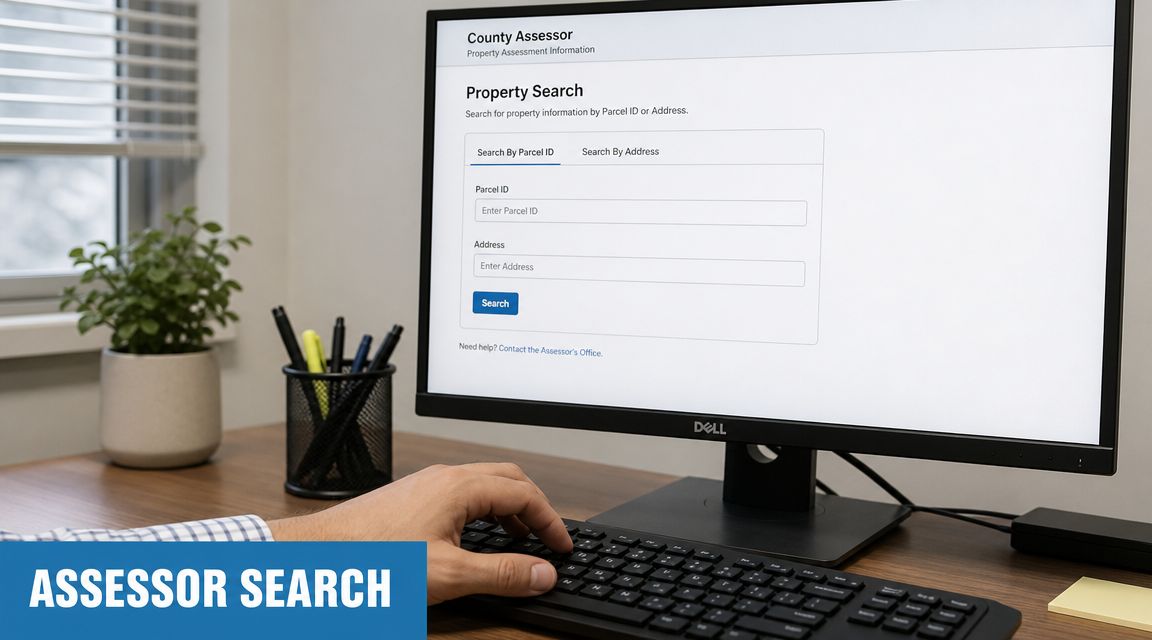
You can search Salt Lake County assessor records through the county's online valuation and parcel tools, usually by address or parcel number.
That's the right first stop when you need to inspect a single property.
The easiest way to search
Most users should start with one of these two inputs:
- Address search if you have the street location
- Parcel ID search if you already know the county parcel number
Address search is easier for casual users. Parcel search is cleaner when you're validating records across systems.
What you'll usually find
The public assessor tools commonly expose a working set of parcel information that can include:
- Owner-facing record details
- Assessed valuation fields
- Parcel identifiers
- Legal description
- Property characteristics tied to the county record
That's enough to answer basic questions like, “Am I looking at the right parcel?” and “What taxable value is visible in the county system?”
The hidden issue is timing
The county's own warning is the part investors need to take seriously. Salt Lake County's parcel viewer says it is a one-time capture and “does not necessarily include the ongoing” changes, according to the county's parcel viewer notice.
That matters more than is generally appreciated.
A stale county-facing record can mislead you on issues like:
- Recent transfers that haven't surfaced in the visible layer
- Property changes tied to remodels, splits, or updated characteristics
- Time-sensitive decisions for lending, insurance, or direct-to-owner marketing
Public assessor search works best for record discovery. It works poorly as a sole source for recent-change detection.
A practical search workflow
When using the Salt Lake City assessor portal, this is the safest order of operations:
- Find the parcel by address or APN.
- Confirm identity fields so you know you're on the right property.
- Review visible valuation and characteristic fields for baseline context.
- Check whether your use case is time-sensitive. If it is, assume the public layer may lag.
- Validate externally before using the record for underwriting, lending, insurance, or outreach.
For a homeowner, that last step may be optional. For an investor buying on compressed timelines, it usually isn't.
What Is the Property Tax Assessment and Appeals Process
Assessment drives the tax bill, but the primary issue for investors is operational. Public assessor data can show the result, while the underlying valuation work, correction cycle, and appeal timing often sit outside the simple parcel lookup.
Salt Lake County values property through a mass appraisal system. For serious analysis, that matters because assessed value is not a hand-entered opinion on one parcel. It is the output of a county-scale process built to value large inventories consistently, then adjusted through review, correction, and appeal. That is useful for taxation. It is less useful if you need a current, investment-grade read on value without checking other datasets.
Here's the cycle in a visual format.
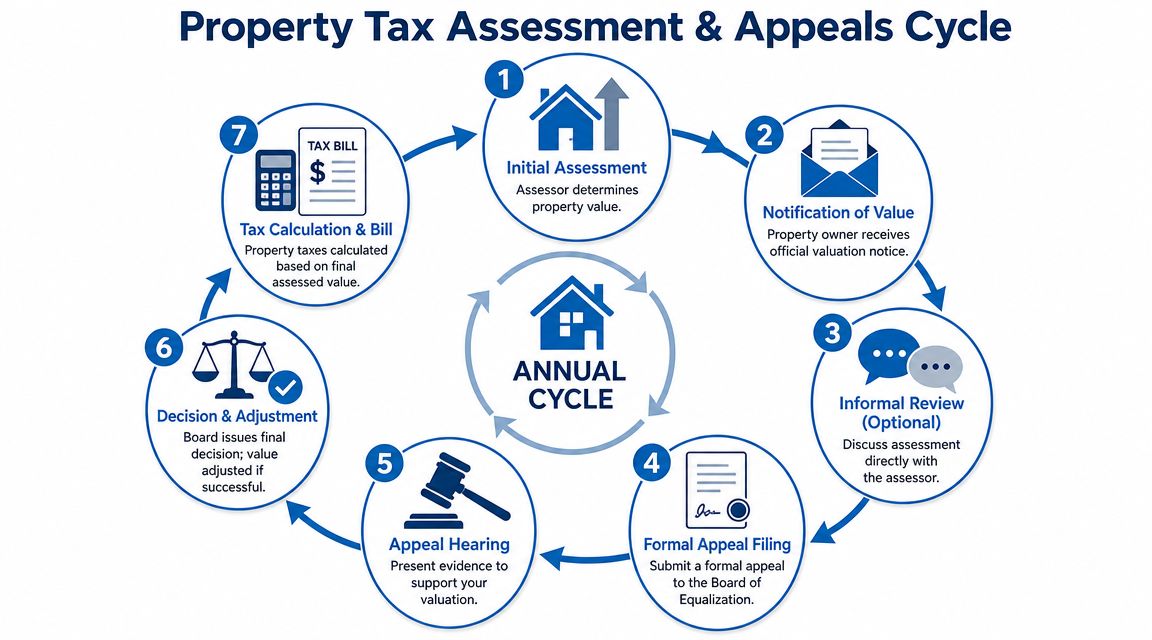
How the cycle works in practice
The sequence is straightforward, even if the documentation behind it is not.
Assessment starts the process
The assessor assigns a value using county appraisal models, parcel characteristics, and market evidence available to the office.The owner reviews the notice and record
During this review, errors usually surface. Incorrect square footage, the wrong property class, missing depreciation, or outdated condition notes can all distort the assessed value.Informal correction may resolve factual issues
Some disputes are not really valuation disputes. They are record-quality problems. If the county file is wrong, the first job is to correct the file.Formal appeal follows if value is still disputed
At that point, the owner needs support for the claim. Comparable sales, photographs, repair evidence, income data for applicable property types, and a clean explanation of the error usually matter more than broad complaints about taxes.Final value sets the taxable basis
Once the assessed value is settled, that value feeds the tax calculation.
What makes an appeal credible
Good appeals are built like underwriting memos. They identify the exact defect, show why it affects value, and attach evidence that can survive review.
Useful arguments usually include:
- Record errors such as incorrect lot size, living area, use type, or improvement details
- Comparable value support showing the assessment is out of line with similar properties
- Condition evidence for deferred maintenance, functional issues, or other factors the county record does not reflect
- Income support when the property type and appeal context call for it
Weak appeals usually rely on conclusion without support. “My taxes are too high” does not give the reviewer anything to test.
For investors, the trade-off is time. If you only need to understand how assessed value feeds into taxation, this explanation of what property tax assessment means is a useful baseline. If you are deciding whether to buy, lend, or dispute value at scale, the harder problem is collecting current evidence fast enough to act before your window closes.
That problem shows up outside Utah too. If you are also dealing with distressed inventory in another market, practical guidance on dealing with Westmoreland back taxes can help frame how tax issues affect payoff, title, and exit timing.
For a quick visual walkthrough, this video is a useful supplement.
Why Using Direct Assessor Data Is Risky for Professionals
Direct assessor data is risky for professional use because the public county layer is built for access, not for production-grade analysis.
The central problem is freshness. Salt Lake County's parcel viewer states that it is a one-time capture and may not include ongoing updates, and the county's parcel-data page makes clear that relying only on static parcel exports can produce stale comps and mis-scored risk models in downstream systems, according to the county's parcel data information.
That one sentence creates most of the operational headache.
The four failure modes
Data staleness
A one-time capture can be useful and still be too old for the task at hand.
If ownership, characteristics, or other parcel-linked details have changed since the capture, a professional user can make the right decision on the wrong record.
Lack of standardization
County data is county-shaped. That means field names, formatting, completeness, and record behavior reflect local government workflow, not investor workflow.
That becomes painful when you want to compare:
- Salt Lake County against another county
- residential against commercial records
- county values against listing, mortgage, lien, or permit signals
Access limits
Public portals are built for human lookup. They usually aren't built for high-volume ingestion, API-first product design, or repeatable portfolio surveillance.
Manual lookup is fine for one parcel. It breaks when your pipeline depends on recurring refreshes.
Missing enrichment
Assessor data answers some valuation and parcel questions. It doesn't answer all the questions professionals act on.
For example, a serious acquisition or servicing workflow may also need:
- mortgage context
- lien context
- ownership history
- contactability
- listing and market overlays
- permits or change indicators
Direct assessor portal versus aggregated platform
| Feature | Salt Lake City Assessor Portal | BatchData Platform |
|---|---|---|
| Primary use | Public parcel and valuation lookup | Operational property data workflows |
| Freshness model | Public-facing records may reflect a snapshot | Aggregated delivery designed for recurring professional use |
| Scale handling | Best for one-off searches | Better suited to bulk analysis and monitoring |
| Standardization | County-native field structure | Standardized property data across broader workflows |
| Enrichment | Limited to assessor-facing record scope | Can combine assessor, tax, ownership, valuation, and related signals |
| Delivery | Human-facing portal workflow | API and bulk data workflows |
The point isn't that county data is bad. It isn't. County assessor data is authoritative for what it is.
The point is that authoritative doesn't automatically mean operational.
A public assessor portal is a reference tool. Professional teams need a data pipeline.
How Investors and Lenders Can Use This Data Effectively
The teams that get better results from Salt Lake City assessor data do not treat it as a finished product. They treat it as one input in a repeatable property data process.
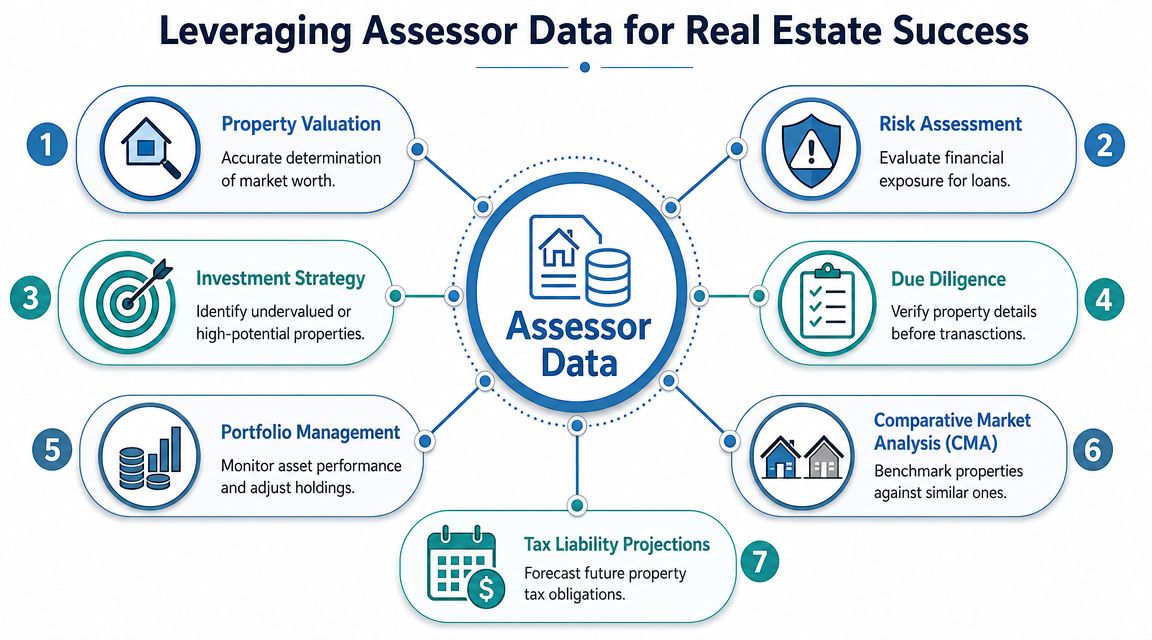
For investment work, the county record is useful because it establishes parcel identity, situs address, tax history, and assessed value. That matters. It does not answer the full investment question, especially if you are screening many properties, refreshing a watchlist, or trying to contact owners at scale.
A practical investor workflow usually looks like this:
- Confirm parcel identity first so every later record ties back to the right property
- Use assessed value carefully as tax context, not as a current pricing signal
- Check recent change risk when a property may have sold, been improved, or been split
- Add ownership and contact layers if the goal is sourcing off-market opportunities
- Run recurring refreshes so your pipeline does not depend on repeated manual lookups
That is the difference between a one-off search and an acquisition system.
For lenders and servicers, the standard is higher because inconsistency creates risk across a book of business. A single county page can support a file review. It is far less useful when a team needs consistent fields, current-enough records, and a way to compare thousands of properties without rebuilding the process each month.
| Use case | Role of assessor data | What else is usually needed |
|---|---|---|
| Underwriting review | Baseline property facts and tax context | Current valuation support, title or lien checks, and broader risk inputs |
| Portfolio monitoring | Reference point for assessed changes over time | Refresh schedules, alerts, and cross-record matching |
| Insurance and collateral review | Property identification and public characteristics | More current condition, hazard, and exposure data |
The effective approach
Strong teams separate county authority from operational usability.
They still use assessor data. They just do not stop there. They reconcile fields across sources, set a refresh cadence that fits the use case, and add the missing context needed for underwriting, acquisitions, servicing, or outreach. In practice, that often means using an aggregated property data platform for API or bulk delivery, including services such as BatchData for recurring access tied to assessor-based workflows.
Copying fields from a county page into a spreadsheet can work for a quick check. It does not hold up as an investment dataset, a lender monitoring process, or a scalable sourcing workflow.
Frequently Asked Questions about Salt Lake City Assessor Data
Is the Salt Lake City assessor the same as Salt Lake County Assessor
For property record purposes, individuals looking for the Salt Lake City assessor are typically working with the Salt Lake County Assessor because county government handles the assessment function.
How current is the public assessor data
You shouldn't assume it's current enough for time-sensitive use. Public-facing parcel and valuation tools can lag real-world changes, so recent transfers, updates, or property changes may require separate verification.
Where can I find historical tax context
For broader market context, Salt Lake County assessor data has been cited as having an effective tax rate that was stable at around 0.58% in both 2019 and 2020, according to ATTOM's Salt Lake County assessor data overview. That's useful as a benchmark for long-term property analysis, but it isn't a substitute for parcel-specific tax review.
What should I do if the assessor record looks wrong
Start with the record details. Check whether the issue is a factual error, a stale field, or a disagreement about valuation. If the discrepancy affects taxes, move into the county review and appeals path with documentation.
Can I use assessor data alone for underwriting or marketing
Not reliably. It works as a core source, but professional decisions usually require fresher validation and more complete data than a public portal alone can provide.
If you need more than one-off parcel lookups, BatchData is worth evaluating as a production data layer. It helps real estate teams move from county-page research to repeatable workflows by combining assessor data with broader property, ownership, and monitoring signals.