






































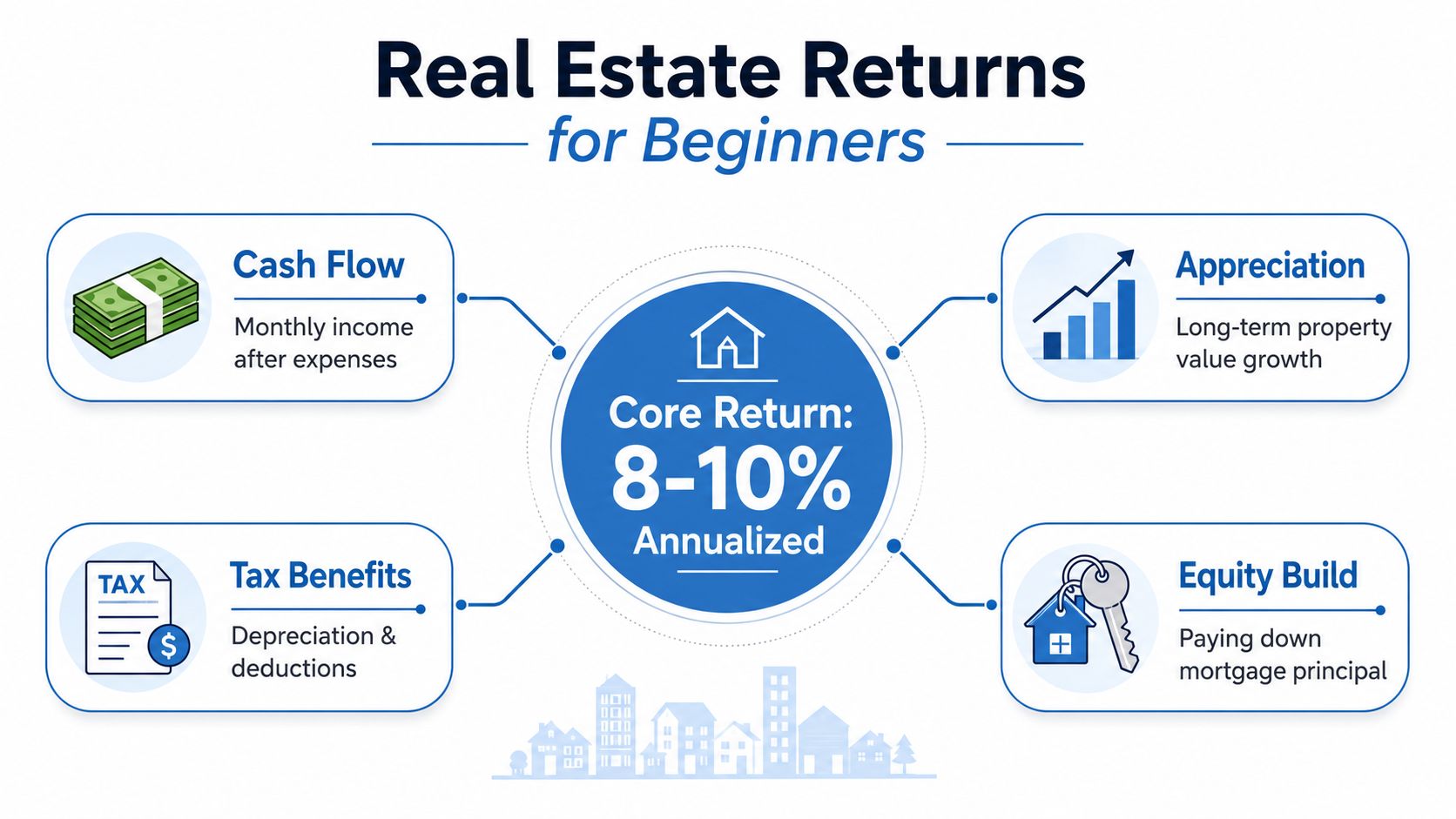
Real estate investing has historically returned roughly 8% to 10% annually over the long run, but that number only makes sense when you split it into cash flow, appreciation, loan amortization, and tax benefits. If you treat property like a quick flip, you'll miss how the substantial money gets built.
- Cash flow pays you while you own the asset.
- Appreciation grows value over time.
- Loan paydown builds equity through forced savings.
- Tax benefits can improve after-tax returns.
The beginner mistake is chasing price growth alone. The better model is to underwrite all four return drivers separately, then ask whether the deal still works if one of them underperforms.
What Real Estate Investing Returns for Beginners
Real estate's long-run benchmark is 8% to 10% annualized return, which is why experienced investors treat it as a moderate-return, long-duration asset, not a fast win. That benchmark matters because it keeps beginners from expecting quick, tidy profits from a property that is supposed to compound slowly over time Real Estate Investing For Dummies.
The four ways the return shows up
Cash flow is the paycheck. It is the money left after operating costs and debt service, and it is the part most beginners look for first. Appreciation is the upside, useful when it arrives, but unpredictable enough that it should never be the only reason you buy.
Loan paydown builds equity through mortgage amortization, which works like forced savings. Every payment reduces principal, even if the property price barely moves. Tax benefits can improve after-tax returns through depreciation and deductions, and in practice they often matter more than beginners expect because they reduce the burden of owning the asset.
A property can still be a reasonable buy with a low-single-digit current return if the debt structure, tax treatment, and vacancy risk are favorable. The point is to evaluate the full stack of returns, not just the monthly spread.
| Driver | How It Builds Wealth | Typical Beginner Reality |
|---|---|---|
| Cash Flow | Monthly profit after expenses and debt | Often thinner than expected in the first deal |
| Appreciation | Value growth over time | Helpful, but you cannot count on it to save a weak deal |
| Loan Paydown | Principal reduction creates equity | Quiet, steady, and easy to overlook |
| Tax Benefits | Depreciation and deductions improve after-tax return | Useful, but not a substitute for a bad acquisition |
For a broader view of cross-border investing, the intro to international real estate overview is a useful companion read because it shows how the same return logic applies in different markets.
The mental model is simple. Buy price matters, but income, financing, and tax treatment decide whether the purchase becomes wealth or just a headache. A beginner who focuses only on appreciation is usually staring at the wrong line item. In higher-rate markets, downside resilience comes from a deal that can survive weak rent growth, a vacancy, and a less friendly refinance.
The Main Ways Beginners Invest in Real Estate
The main question isn't whether real estate works. It's which vehicle fits your money, time, and patience.
The four beginner paths
Long-term residential rentals are the default choice for serious beginners because they teach the full business, tenant screening, maintenance, financing, and tax handling. They do demand capital and attention, but they give you the clearest feedback loop on whether a property really performs. If you want to build a portfolio instead of dabbling, this is the lane you should start in, especially if you're mapping out a long-term portfolio build a real estate portfolio.
Fix-and-flip is a business dressed up as investing. It can work, but it rewards project management, contractor coordination, and exit discipline more than passive ownership. Beginners often underestimate the time and cash it takes to carry a property through delays.
REITs are the index fund version of real estate. They're useful if you want exposure without becoming a landlord, and they're especially practical when capital is limited or time is tight. The trade-off is control, since you're buying into a management team, not a specific building you can inspect line by line.
Syndications are passive equity partnerships where a sponsor runs the deal. Think of them as a pooled investment structure, useful for people who want exposure to larger assets without personally sourcing, financing, or managing them. The downside is that you're relying on someone else's underwriting and execution.
| Vehicle | Capital Needed | Time/Week | Skill Level | Liquidity | Best For |
|---|---|---|---|---|---|
| Long-term rental | Medium to high | Medium | Moderate | Low | Building experience and equity |
| Fix-and-flip | High | High | High | Low | Active operators with deal discipline |
| REITs | Low | Low | Low | Higher than physical property | Investors who want simplicity |
| Syndications | Medium | Low | Moderate | Low | Passive investors who trust sponsors |
The blunt truth is that most beginners should not start with flips. They should start with a vehicle that teaches underwriting and risk control without forcing them to become a full-time project manager.
Key Numbers That Decide Whether a Deal Works
A property can look fine on the surface and still fail the moment debt, vacancy, and repairs show up together. The numbers that matter are the ones that tell you whether the income can carry the loan and leave room for normal slippage, which is why beginners need to understand a few underwriting terms before they start scrolling listings.
The numbers that matter
Net Operating Income, or NOI, is the income left after operating expenses but before debt service. Cap rate is NOI divided by price, and it gives a fast way to compare properties on an unfinanced basis. Cash-on-cash return measures annual pre-tax cash against cash invested, so it shows what your equity is doing after the loan is in place.
Gross rental yield is annual rent divided by property price, which makes it useful for quick market comparison and for screening listing sheets. A 2024 beginner guide reported a median gross rental yield of 8.3%, typical down payments of 15% to 25%, cash-on-cash returns often ranging from 4% to 12%, and net returns after costs and vacancies commonly sitting around 4% to 6% market benchmark guide. Those figures are not a promise, but they give beginners a useful reference point when a listing sounds too good to be true.
Breakeven and debt service
The breakeven point is operating expenses plus annual mortgage payments divided by gross potential income. That number matters because a property can look acceptable on cap rate and still bleed cash once vacancy, repairs, and financing are realistic. DSCR, or debt-service coverage ratio, is NOI divided by total debt service, and a ratio above 1.20x is a common lender benchmark because it leaves a cushion for bad months DSCR benchmark source.
If you want a clean way to sanity-check listings, browse cap rate tools before you fall in love with a property based on the photos.
| Metric | What It Tells You | Why Beginners Care |
|---|---|---|
| Cap Rate | Property income relative to price | Fast apples-to-apples comparison |
| Cash-on-Cash Return | Equity performance after financing | Shows what your money is earning |
| NOI | Income before debt | Core operating strength |
| Gross Rental Yield | Rent relative to purchase price | Easy market-level screening |
| DSCR | Debt cushion | Reveals whether the loan is safe |
A quick internal review of property math also helps once you move from a listing to a purchase decision, especially when you are comparing on-paper returns to actual operating risk. You can review the property analysis framework to keep the same underwriting logic in one place instead of guessing from a broker flyer or a clean-looking rent roll.
The big lesson is simple. A deal that pencils on gross rent can still fail after debt, vacancy, and maintenance.
Financing Options for a First Investment Property
The right loan depends on the strategy, because the financing has to match how the property will behave. A rental that looks safe at one interest rate can become fragile at a higher one, and that's where a lot of first deals fall apart.

Matching the loan to the plan
Conventional investment-property loans are the standard route for long-term rentals. They usually require stronger credit, clearer income documentation, and more cash at closing than a primary residence loan. That makes them boring, but boring is often what you want.
FHA loans only make sense when you're using an owner-occupied strategy like house hacking. They're not a shortcut for buying a pure rental, and that distinction matters because beginners often confuse “lower down payment” with “easier investment loan.”
Portfolio lenders keep loans on their own books, which can create more flexibility on unique properties or less standard borrower profiles. Hard money is built for flips and short timelines, not slow cash-flow rentals. BRRRR-style financing can be useful when you need to buy, improve, rent, and then refinance, but it only works when the after-repair value and rent support the takeout loan.
Why rates change the answer
Higher rates change everything because debt service rises while rent doesn't always keep up. A deal that worked at a much lower mortgage rate may stop working when the payment grows, so the only way to compensate is better rent, a lower purchase price, a larger down payment, or leaner expenses. The 2010s taught a generation of investors to assume easy access to debt, but recent Fed mortgage data and housing affordability pressure have made that assumption weaker higher-rate environment context.pdf).
Lenders want to see reserves for a reason. If you don't have cash for repairs and vacancies, the first surprise can become a default problem.
Most lenders also want to see 6 to 12 months of expenses in reserve, and that requirement isn't paperwork theater. It's a reminder that the property has to survive stress, not just close on schedule.
Before you talk to a lender, gather tax returns, pay stubs or business statements, bank statements, and a clear property target. Also separate pre-qualification, which is a soft check, from underwriting, which is where full verification happens. A friendly “yes” from a loan officer is not the same thing as a closed loan.
A Practical Due Diligence Checklist Before You Close
A property is only as good as the facts you can verify. If the seller's story doesn't survive inspection, title review, and rent validation, the deal is already weaker than it looked on the listing sheet.
The walk-through that actually matters
Start with the income. Confirm the rent roll, read every lease, and talk to tenants when that's legally and practically possible. Then validate the expense side, including property taxes, insurance, utilities, management fees, and reserves, because a property that looks cheap can still carry expensive operating drag.
Next, check title and liens so you know what's attached to the property. Confirm zoning and permitted use, especially if the building has additions, converted space, or mixed use. Permit history matters too, because unpermitted work can create financing, insurance, or resale headaches later.
Physical inspection comes last, but it's the part most beginners remember best. Roof, foundation, HVAC, plumbing, electrical, and drainage all need real attention, not a glance from the driveway.
Who should be involved
- Inspector: Finds physical defects and deferred maintenance.
- Appraiser: Checks value and market support.
- Real estate attorney: Reviews title, closing, and legal exposure.
- Insurance agent: Confirms the property can be insured at a workable cost.
| Red Flag | What It Really Means | Action |
|---|---|---|
| Seller rent numbers don't match leases | Income is overstated | Re-underwrite from documents, not promises |
| Missing permit history | Hidden legal or insurance risk | Ask for records or walk away |
| Foundation or roof issues | Capex may be immediate and large | Price the repair realistically |
| Tenant stories conflict | Occupancy or payment risk may be worse than stated | Verify independently |
| Title problems | Closing may stall or litigation may follow | Have counsel review before moving forward |
A careful due diligence workflow also pairs well with a formal checklist, and a practical version is outlined in this real estate due diligence checklist.
The cleanest rule is this. If you can't verify it, don't underwrite it.
Why Buying for Downside Resilience Beats Buying for Cash Flow
Positive cash flow on day one sounds smart, but in a higher-rate environment it can push beginners into worse tenants, weaker neighborhoods, or fragile assumptions. A property that looks great on paper can still break when vacancy, repairs, or refinancing hit at the same time.
Stress the deal, not your optimism
Use a simple stress test. Model 2x planned vacancy, 1.5x planned repairs, and a +2% interest-rate shock if a refinance is part of the plan. If the deal survives that, you're dealing with a property that has room to absorb mistakes and market noise.
A slightly lower-yield property can still be the better buy if it has a stronger tenant base, longer lease terms, or debt terms that are already favorable. The point isn't to maximize gross return on paper, it's to keep the asset alive when reality gets messy.
Downside resilience beats headline yield when money is expensive.
DSCR, breakeven occupancy, and reserve months are the numbers that tell you whether the property can absorb stress. If those metrics are thin, “good cash flow” is often just a temporary illusion.
The rookie trap is chasing the highest advertised return and ignoring how quickly that return disappears once the loan payment rises or the unit sits empty. A more durable deal can look less exciting and still make more sense in the long run.
Finding Deals Before They Hit the Market
The old beginner playbook, scroll the MLS and wait, leaves too much on the table. The better edge is to combine visible listings with signals that show who's likely to sell soon.
Where the signal lives
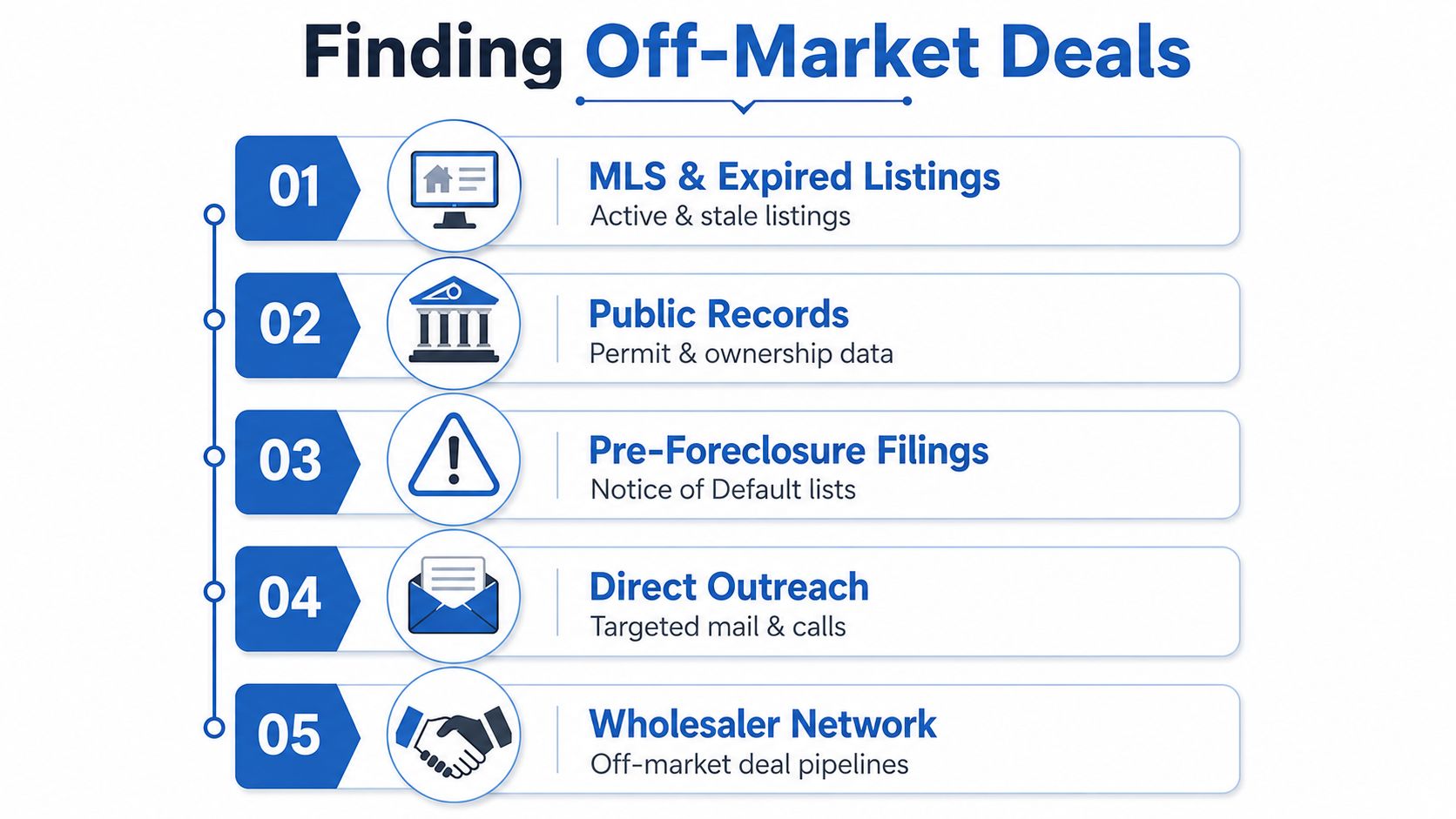
The conventional path is MLS, expired listings, and personal networking. That still matters, but it's no longer enough on its own because inventory and turnover patterns have shifted unevenly, and good deals often get absorbed before they show up in the obvious places off-market signal context.
The modern stack adds public records, permit activity, pre-foreclosure filings, absentee-owner lists, equity data, mortgage data, and owner-occupancy changes. Those signals help you identify owners with a higher likelihood of transacting instead of mailing strangers at random.
| Traditional Sourcing | Data-Driven Sourcing |
|---|---|
| MLS searches | Public records and ownership history |
| Networking calls | Permit and lien signals |
| Generic “off-market” outreach | Targeted owner lists with intent signals |
A practical example is a long-held absentee owner who has meaningful equity and recently pulled permits. That combination can indicate a property entering a transition phase, which is exactly the kind of address worth researching first.
If you want one platform that unifies ownership, mortgage, permit, and contact data, BatchData provides nationwide property records, owner contact information, and verified property signals that can help build a targeted prospect list. The value is not hype, it's reducing the time it takes to separate high-intent owners from everyone else.
Your First 90 Days and the Mistakes to Avoid
Real estate beginners do better when they move in phases. Too many people start with a property search before they've built a model, a lender list, or a target market.
A 30-60-90 day plan
Days 1 to 30: Read, model, and pick one market. Pull comps, study rent ranges, and decide whether you're targeting a rental, a flip, or a passive vehicle like a REIT.
Days 31 to 60: Build a target list using property data, talk to at least two lenders, and run two properties through full underwriting. Use the numbers, not the listing description.
Days 61 to 90: Make your first offer or your first REIT investment, then set up a system to track performance, reserves, and maintenance history.
Seven mistakes that sink beginners
- Buying in a market you don't know: Start where you can verify rents, taxes, and demand.
- Skipping reserves: Keep cash aside so one repair doesn't become a crisis.
- Trusting seller rent claims: Verify every lease and rent roll.
- Underestimating repairs: Get quotes, not guesses.
- Ignoring DSCR: A property can look fine and still fail the debt test.
- Skipping insurance review: Confirm the property is insurable at a workable price.
- Over-leveraging on a flip: Treat flips like a business with timing risk, not a shortcut to wealth.
For next steps, keep one solid beginner book on your desk, find a local investor meetup, use a property data platform for screening addresses, and bring a lender checklist to every financing conversation. The fastest progress comes from combining education, local relationships, and clean data.
If you want to find better deals faster, BatchData gives investors property records, ownership history, permit signals, and verified contact data in one place. That makes it easier to build a real target list instead of guessing at who might sell. Visit BatchData if you want cleaner underwriting inputs and a faster way to move from market research to outreach.