



A 2025 review found that bedrooms were missing from 53.1% of property records, proving that real estate historical data isn't automatically a complete property timeline. Real estate historical data is digitized property-level information that captures past transactions, ownership transfers, valuations, and related events over time.
The practical answer is to treat historical data as a reconstructed evidence trail, not a single authoritative file. County records, assessor rolls, mortgage filings, permits, listings, and surveys each describe different parts of a property's past, with different update schedules and geographic weaknesses.
- A record count isn't a quality score. Field completeness and source provenance matter more.
- Repeat-sales indexes are stronger for measuring appreciation because they compare the same homes across transactions.
- Production pipelines need multiple source types, explicit missingness handling, versioning, and address reconciliation.
- Vendor selection should start with geography and attributes, then test API behavior, delivery formats, and compliance.
The difference between a useful dataset and a fragile one is usually hidden in the fields that aren't there.
What Is Real Estate Historical Data
The most common misconception is that real estate historical data is a clean timeline showing every sale, owner, valuation, lien, permit, and property change in order. In production, that timeline is assembled from records created by different offices for different purposes, and the gaps are part of the dataset.
A county recorder may preserve deeds and transfers. An assessor may maintain parcel characteristics and assessed values. Mortgage records can reveal financing events, while permits may identify construction or alteration activity. Listing data adds market exposure and asking-price context, but it doesn't replace a recorded sale.
The origins of real estate data matter because a vendor's normalized table can conceal the differences between these sources. A sale date may mean the contract date, recording date, or a date supplied by a listing feed. An ownership change may appear as a deed event in one jurisdiction and as an assessor update in another.
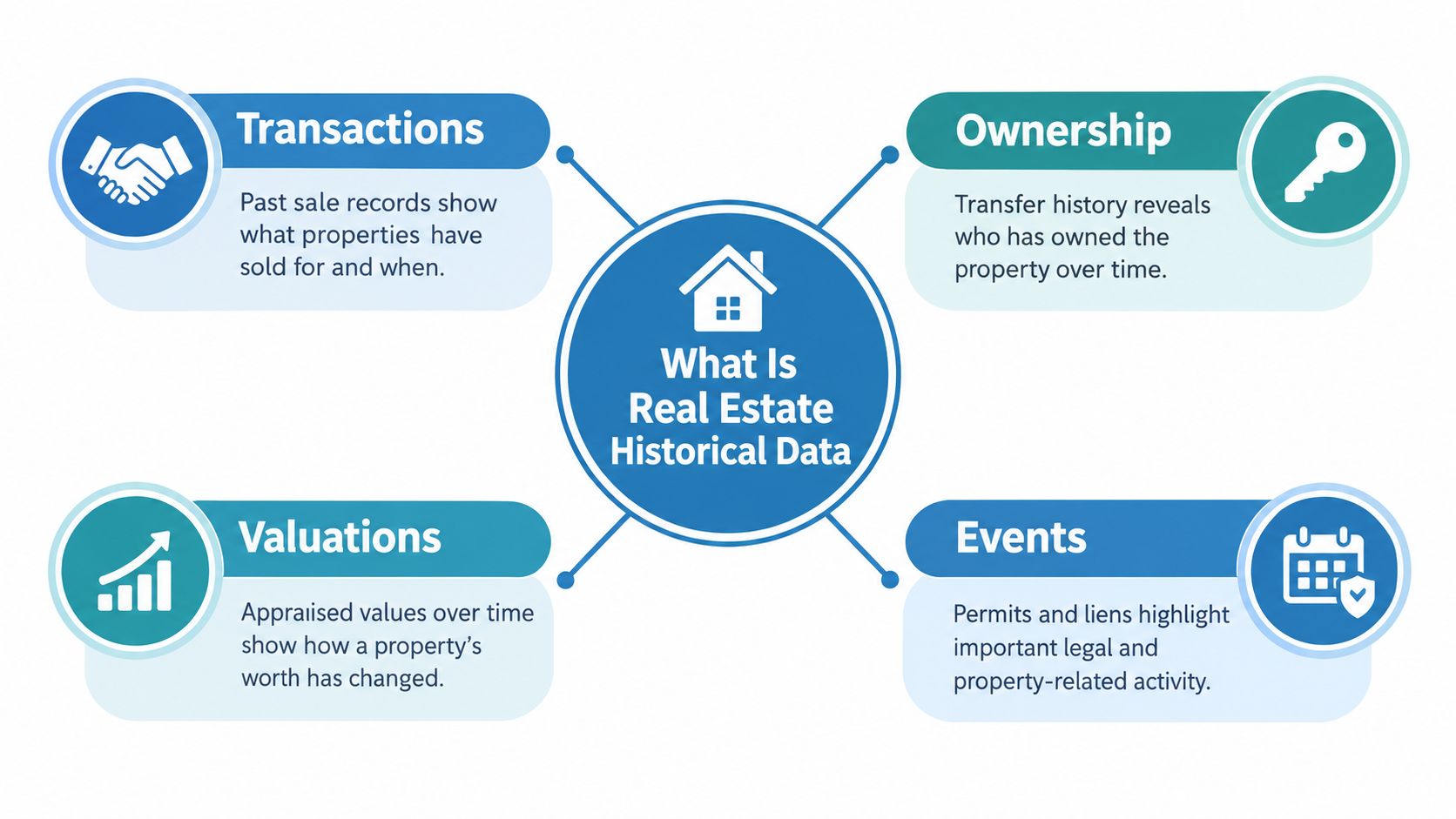
Four record families
A workable property timeline usually combines four categories:
- Transactions: Prior sales, recording dates, consideration amounts where available, and buyer or seller details.
- Ownership: Deeds, transfers, vesting changes, and chain-of-title relationships.
- Valuations: Assessed values, appraisals, estimated market values, and index-linked changes.
- Events: Mortgages, liens, permits, foreclosures, renovations, and other recorded actions.
The Philadelphia Fed's Historical Housing Prices Project demonstrates how historical depth can be built from unconventional records. It assembled housing-price series for 30 major U.S. cities from 1890 to 2024, using 2.7 million newspaper listings that recorded each unit's sales price, location, and size. The project covers metros including Boston, Los Angeles, New York, and Philadelphia, creating one of the longest city-level real estate datasets available in the United States. The Philadelphia Fed describes the historical housing project and its source construction.
Practical rule: Ask what event created each field, who recorded it, when it entered the system, and what can be absent. A polished schema doesn't prove complete provenance.
Why Coverage Gaps Matter More Than Record Counts
A large property corpus can still produce biased analysis when missing fields follow geographic or historical patterns. A review of nationwide property records found missing lot size in 15.1% of records, building valuation in 21.4%, living area in 28.6%, bathrooms in 33.1%, bedrooms in 53.1%, and total rooms in 60.1%. The review documents field-level missingness and geographic clustering.
These gaps affect longitudinal comparisons. If older records omit living area or bedrooms more often, a model can interpret incomplete documentation as a change in the property. A county that records bathrooms consistently may also appear different from a neighboring county that leaves the field blank. The result reflects administrative practice as much as housing stock.
Selective history creates analytical bias
The fields used in underwriting often have the weakest continuity:
- Physical attributes support valuation and comparable selection, yet bedrooms, bathrooms, rooms, and living area may be absent.
- Ownership attributes can be split across assessor systems, recorder documents, and later vendor-normalized records.
- Value fields describe different concepts, including assessed value, appraised value, listing price, and transaction price. They should not be combined without preserving their definitions.
- Event fields depend on local recording rules. Additions, conversions, liens, and informal changes may never appear in the historical record.
Selective missingness creates a larger risk than a low record count. Availability can vary by county and cluster by state, allowing a model without a missingness indicator to learn local administrative habits as if they were property characteristics. Coverage outside mature markets may therefore be weaker than a vendor's record total suggests.
Official housing measures can miss meaningful changes in the housing stock. The U.S. Census Building Permits Survey excludes additions, alterations, conversions, and ADU-style unit creation. Newer Address Count Listing Files released for 2020, 2023, 2024, and 2025 were introduced because the older measure could be incomplete and misleading, as noted in the academic review of nationwide property data.
For production pipelines, store three values for each important attribute: the normalized value, a presence or absence flag, and the source with its observation date. Measure field coverage by geography before comparing property outcomes. A smaller county dataset with stable definitions can outperform a larger corpus whose historical depth and recording practices change across jurisdictions.
Common Data Sources and Provenance Differences
No single source answers every historical property question. County recorders establish legal events, assessors describe taxable property, lenders expose financing activity, listings show market behavior, and permits document physical change.
The right source depends on the decision being made. An underwriting system needs ownership, liens, valuations, and property characteristics. A market index needs consistent price observations. A renovation workflow needs permit and attribute-change signals. Combining sources is usually more reliable than treating a vendor's unified record as a canonical truth.
Data Source Comparison
| Source | Best For | Coverage Limitation |
|---|---|---|
| County recorder documents | Deeds, transfers, mortgages, liens, chain of title | Recording practices and searchable history vary by jurisdiction |
| County assessor rolls | Parcel identity, assessed values, taxable characteristics | Assessment timing and field definitions differ locally |
| Mortgage and lender records | Financing events, liens, refinance activity | Not every financing event is represented in the same feed |
| MLS and market listings | Listing activity, asking prices, exposure history | Listings aren't completed sales and access is often restricted |
| Building permits | Construction, alterations, conversions, permitted improvements | Unpermitted work and excluded event types remain invisible |
| Historical indexes | Market appreciation and cycle analysis | Aggregate indexes don't provide a complete property-level timeline |
El Dorado County illustrates the practical split between systems. Its assessor services include historical parcel details, older records from 2018 and prior, change-of-ownership history, secured and unsecured assessment rolls from 2018 to present, and two-year transfer and sale lists from 2021 to present. The county's data-request documentation shows how parcel and transfer history can be divided by record type.
Provenance beats convenient normalization
A vendor should identify the source agency, field meaning, observation date, and transformation applied to each attribute. “Sale price” without a definition is not production-ready. Neither is “owner” if the system doesn't distinguish a vesting entity, mailing contact, trust, or beneficial owner.
For market-level analysis, repeat-sales indexes are technically stronger than raw averages because they compare the same home across transactions and reduce distortion from changing property mix. FHFA's weighted repeat-sales methodology extends back to the mid-1970s, covering all 50 states and more than 400 U.S. cities. FHFA explains its House Price Index methodology.
Integration Patterns That Actually Work
The integration pattern should follow the product's latency requirement, not the vendor's preferred delivery method. Live applications need low-latency lookups, analytical models need stable bulk snapshots, and serious operators usually need both.
A useful architecture separates raw preservation, normalized history, and serving tables. Store the original record and metadata first. Normalize addresses, identifiers, dates, and event types in a second layer. Expose only validated, query-appropriate records to underwriting, monitoring, or customer-facing applications.
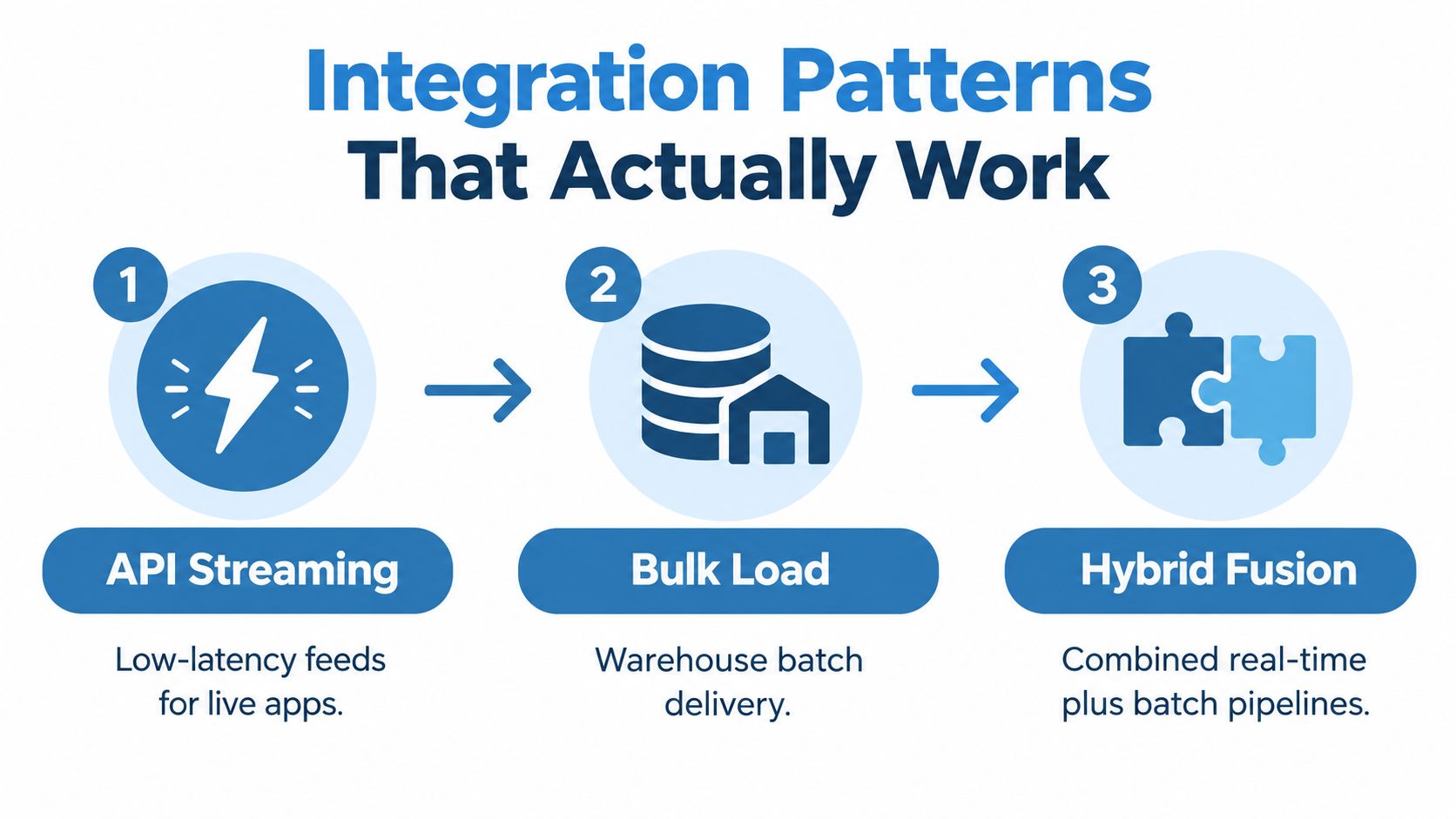
Three workable patterns
API streaming fits applications that need a current property response during a user action, such as address enrichment, eligibility checks, or a portal search. The trade-off is dependency on latency, rate limits, transient failures, and response-schema changes.
Bulk load fits warehouse analysis, model training, portfolio refreshes, and reproducible reporting. S3, Snowflake, and flat-file delivery can support large historical snapshots, but the team must manage incremental changes, late-arriving records, and backfills.
Hybrid fusion is the default choice for mature systems. The warehouse holds versioned history, while APIs serve recent lookups or targeted enrichment. Registry, survey, and real-time signals can be fused because no one source maintains a complete and continuously current view. The need for this model is visible in official data disruptions, including the BLS report that the October 2025 U.S. CPI housing component had completely missing rent values after collection stopped during the 2025 funding lapse and wasn't backfilled. The transparency review discusses registry gaps and the case for hybrid historical datasets.
A Snowflake implementation should land immutable raw files, record delivery manifests, validate row and field counts, then publish a new curated version. Teams evaluating Snowflake data integration patterns should also define what happens when a source sends corrections. Overwriting history destroys auditability. Append a correction, retain the prior value, and identify which version feeds each downstream decision.
Cleaning, Versioning, and Compliance Best Practices
Trustworthy real estate historical data requires operational discipline after ingestion. The cleaning process should preserve the original evidence while producing a normalized layer that downstream models can use consistently.
Build a repeatable control sequence
Standardize addresses first. Normalize casing, abbreviations, unit designators, postal fields, and street components. Keep the raw address beside the standardized form because aggressive normalization can merge distinct units.
Reconcile duplicate entities. Use parcel identifiers where stable, then combine address, owner, geography, and document relationships. Don't merge records solely because two addresses look similar. A false merge corrupts ownership history and contaminates comparable selection.
Track schema drift. Record new, renamed, removed, and redefined fields at every delivery. A column that remains present can still change meaning, so validate distributions and enumerated values, not just column names.
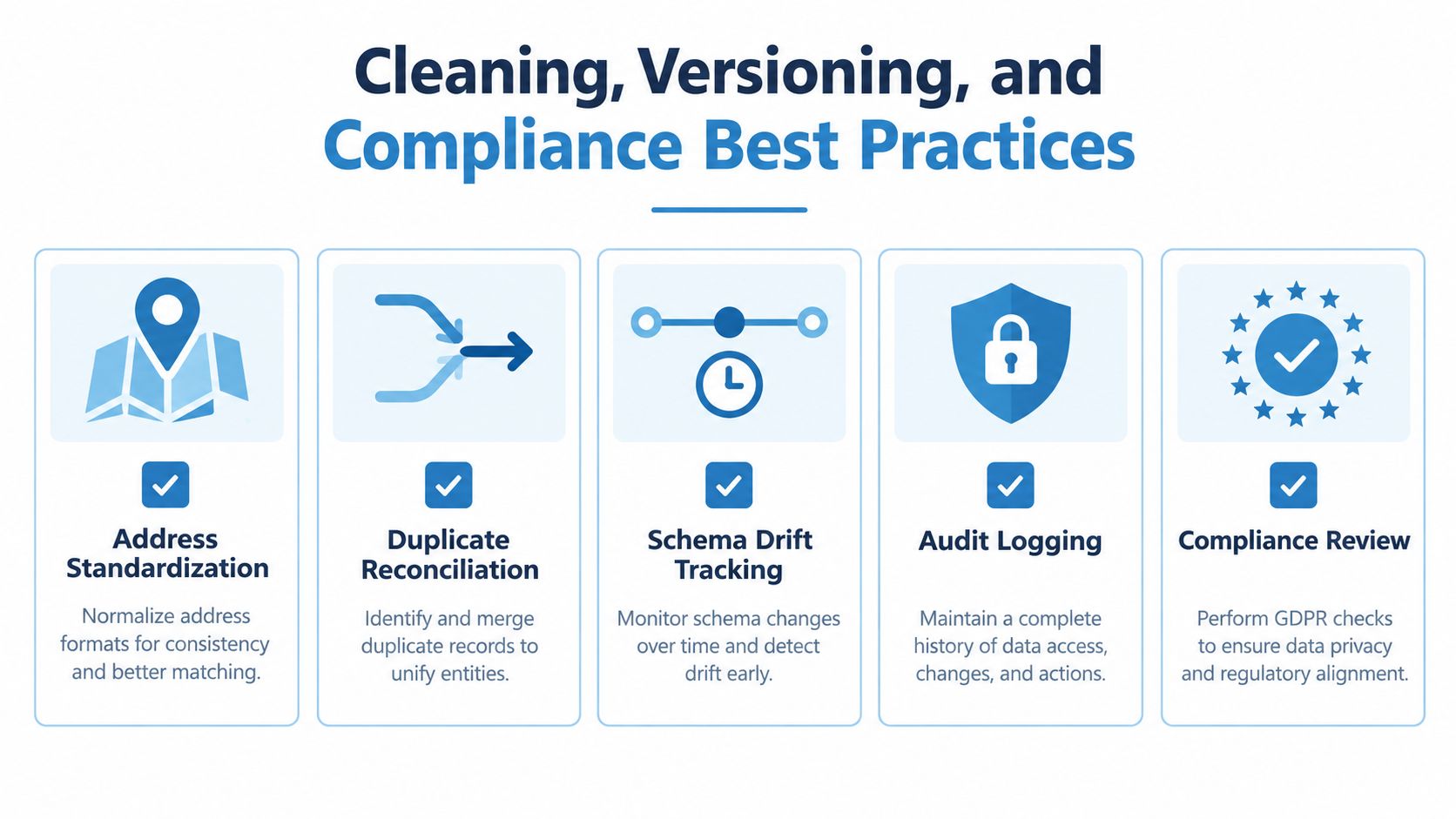
Preserve versioned snapshots. Store ingestion time, source time, source identifier, transformation version, and correction status. A valuation or underwriting decision should be reproducible from the exact dataset available when the decision occurred.
Apply compliance review before activation. Restrict access to personal information, document permitted uses, enforce retention rules, and separate operational contact data from analytical tables. For international operations, assess GDPR obligations and local registry restrictions instead of assuming public availability means unrestricted use.
Test the pipeline like a financial system
A quality gate should fail a delivery when:
- Identity counts shift unexpectedly: Investigate sudden changes in parcels, owners, or documents.
- Dates violate event logic: A recording date shouldn't precede a stated transaction date without an explainable source convention.
- Values change without lineage: Every correction needs a source record and reason.
- Geographic coverage changes: A missing county or newly added jurisdiction can distort portfolio metrics.
- Null patterns move sharply: A sudden reduction in missingness may indicate a schema or mapping change, not better records.
The data quality assurance approach should include automated tests and human review for exceptions. Don't “fix” missing values by filling them with zero. A missing bedroom count isn't a zero-bedroom property, and an absent lien record isn't proof that no lien exists.
Core Analytic Use Cases and How to Choose Vendors
Historical data earns its place in a stack when it changes a decision. It supports valuation models, underwriting, portfolio monitoring, due diligence, servicing, and targeted outreach, but each use case needs a different evidence standard.

For valuation, prioritize repeat-sale consistency, property attributes, transaction context, and geographic comparability. For underwriting, ownership lineage, liens, mortgages, assessed values, and recent event changes matter more than an attractive national coverage claim. Portfolio monitoring needs stable identifiers and change detection, while marketing workflows require verified, permission-aware contact enrichment rather than raw recorder data.
FHFA's flagship index uses purchase-only data from Fannie Mae and Freddie Mac, while additional FHFA indexes incorporate refinances, FHA-insured mortgages, and real property records. FHFA says the index incorporates tens of millions of home sales and can be broken out at national, census division, state, metro area, county, ZIP Code, and census tract levels. FHFA's House Price Index reports explain its data construction and geographic granularity.
The historical context is useful because it shows why one period or source shouldn't dominate a model. FHFA's U.S. house price index reached a record monthly decline of -1.80% in November 2008, an all-time monthly increase of 1.80% in June 2021, and by June 2026 was unchanged month over month but 2.1% higher year over year. FHFA's dataset page provides the long-run index context.
Vendor selection should be a technical evaluation, not a feature checklist:
- Geographic depth: Can the provider identify the counties, metros, and property types your portfolio contains?
- Attribute provenance: Are source, field definition, observation date, and confidence available?
- Historical continuity: Does the provider preserve prior values and corrections, or only return the latest state?
- Delivery behavior: Can it support both low-latency API calls and warehouse-ready bulk delivery?
- Identity resolution: How does it link parcels, units, owners, documents, and changing addresses?
- Compliance posture: Are usage rights, privacy controls, retention, and audit records documented?
- Operational support: Can the provider explain a coverage exception and help reconcile a failed match?
For example, BatchData offers recorder and mortgage data covering deeds, mortgages, and liens across more than 150 million U.S. properties, along with transaction history and property attributes delivered through APIs and bulk formats. Evaluate that type of platform against your own county mix, freshness requirements, matching tests, and permitted use cases rather than accepting coverage language without validation.
The practical standard is simple: a vendor should help you explain where a record came from, what it means, what it omits, and which version informed a decision.
Build a small validation sample across your target jurisdictions, compare recorder, assessor, permit, and market records, then test missingness and update behavior before committing to a production contract. For a unified approach to property history, valuations, ownership, and related records, visit BatchData and assess the API and bulk-delivery options against your pipeline requirements.