





































SEO Title: How to Find Property Owner Contact Information (Fast)
Meta Description: The definitive guide to finding accurate property owner contact information. Learn to use public records, skip tracing, and data platforms for real estate outreach.
Meta Keywords: property owner contact information, find property owner, property owner data, real estate contact data, skip tracing real estate, llc owner lookup, property owner lookup
Finding reliable property owner contact information is the single greatest bottleneck for real estate investors and marketers, but the solution is a straightforward two-step process: start with foundational public records, then enrich that data with verified phone numbers and emails. Over 74% of right-party contact attempts succeed when this method is used correctly.
This guide provides the exact methods to turn a property address into a fully actionable lead. The secret isn't a single database; it's a systematic approach to data layering and verification.
- Key Takeaways:
- Core Method: Combine public records (for ownership proof) with skip tracing (for contact details).
- Key Challenge: Corporate ownership (LLCs) hides individual contact info, requiring advanced tracing.
- Critical Metrics: Aim for a 70-90% hit rate and over 70% right-party contact accuracy.
- Legal Compliance: TCPA and CAN-SPAM rules are non-negotiable; fines are severe.
This breakdown covers the sources, methods, and legal frameworks for acquiring and using property owner data at scale.
How Do You Get Accurate Property Owner Data?
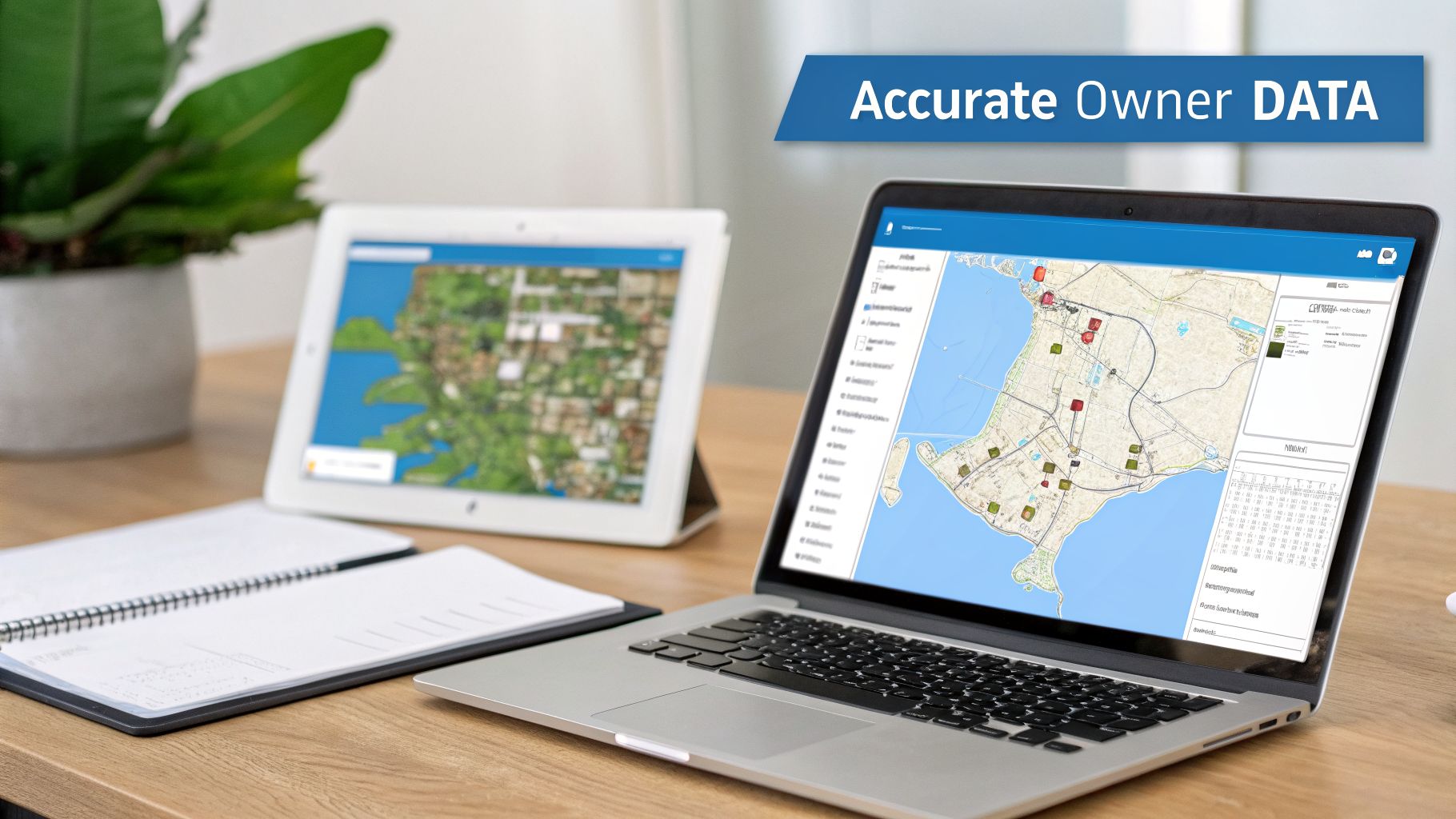
Accurate property owner data is acquired by combining foundational public records with commercial data enrichment, a process known as skip tracing. This turns a legally verified owner name and mailing address into an actionable profile with phone numbers and emails needed for direct outreach.
This process is how modern real estate operations scale from analyzing a few properties to contacting thousands.
Public Records: The Foundational Layer
Public records are the government-verified data from county assessor and recorder offices that serve as the skeleton of your ownership profile. This is the non-negotiable starting point for all property data acquisition.
This source provides the essential, legally-verified facts:
- The full legal name of the owner.
- Their official mailing address, which often differs from the property's physical address.
- Basic property characteristics like square footage and year built.
- Recent sales history and tax assessment values.
This is your ground truth for ownership. However, a name and mailing address are insufficient for scalable outreach, which is where specialized contact sourcing tools become necessary.
Data Enrichment: The Actionable Layer
Data enrichment, or skip tracing, is the process of appending verified contact details like phone numbers and emails to a public record profile using massive commercial databases. This step transforms raw data into actionable leads.
The goal is to move beyond knowing who owns a property to knowing how to actually reach them. BatchData, for example, covers 155+ million property owners nationwide and achieves a 74% right-party contact rate by adding verified mobile numbers, landlines, and emails directly to property records.
Contact information is worthless if it's wrong. Verification is the final, critical step to ensure you are contacting the correct individual and remaining compliant. For a deep dive, see this guide on the 7 ways to verify property owner contact data.
Comparison: Data Source Effectiveness
| Data Source | Information Provided | Accuracy | Best Use Case | Cost/Effort |
|---|---|---|---|---|
| County Assessor | Owner name, mailing address, tax data | Very High | Verifying legal ownership | Low |
| Title Records | Ownership history, liens, easements | High | Due diligence, clearing title | High |
| MLS (via Agent) | Listing status, agent info, photos | High (for listed properties) | Sourcing on-market deals | Medium |
| Skip Tracing Platform | Phone numbers, emails, relatives | 60-80% (Varies) | Direct marketing, off-market outreach | Medium |
No single source provides a complete picture. A professional workflow requires combining them to build a comprehensive and actionable contact profile.
Where Does Foundational Property Data Originate?
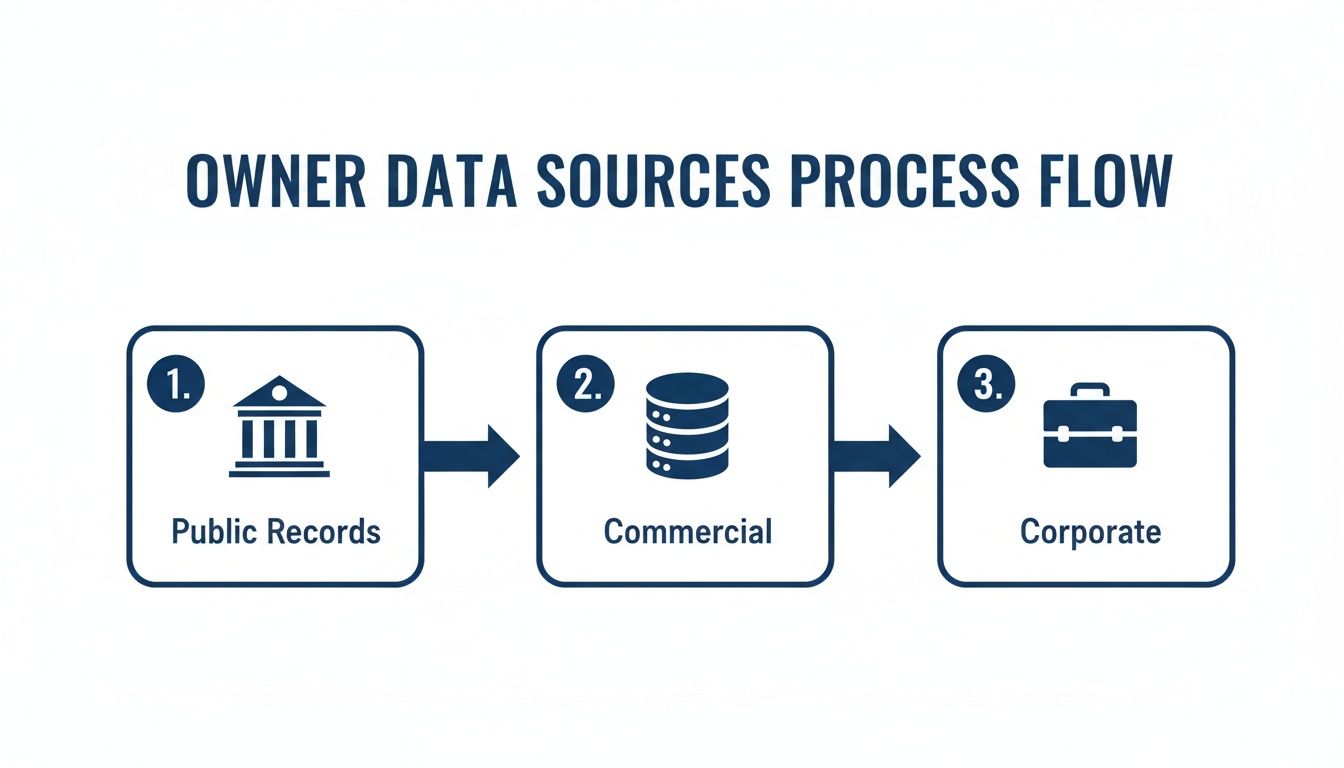
Foundational property owner contact information originates from a mix of public government records and private commercial databases, each providing a distinct piece of the puzzle. Understanding the limitations of each source is what separates a dead-end lead list from an actionable one.
The raw data's origin dictates its utility and accuracy for outreach.
Public Records
Public records are the legally recognized data pulled directly from government bodies like county assessor and recorder offices. This is the bedrock of ownership verification.
- Deeds and Titles: The official paper trail proving who legally owns a property.
- Tax Records: The owner's name and, crucially, the mailing address where tax bills are sent. This is often the first clue for tracking an absentee owner.
- Property Characteristics: The basics, like lot size, square footage, and assessed value.
While untouchable for verifying legal ownership, these records are notoriously poor for direct outreach as they rarely contain a phone number or email. They were designed for administration, not marketing. For a deeper dive, explore where real estate data comes from.
Commercial Data
Commercial data consists of proprietary databases built by private companies for specific industry needs, offering a more market-focused view than public records.
- Title Plants: Massive databases run by title insurance companies containing detailed histories of property titles, including liens, encumbrances, and the entire chain of ownership. They are built for underwriting risk.
- Multiple Listing Service (MLS): The primary database for real estate agents listing properties for sale. Access is restricted, but the data includes transaction history, listing photos, and agent contacts. Its scope is limited to properties on the market or recently sold via an agent.
Corporate Ownership
Corporate ownership, typically through a Limited Liability Company (LLC), is a structure that legally separates the property from an individual owner, obscuring their personal contact information. This is a major challenge for modern real estate investors.
An LLC name on a deed acts as a privacy shield. The registered mailing address often leads to a registered agent's office, not the actual decision-maker. This data fragmentation is intentional; LLCs are designed for asset protection and owner privacy. Tracing ownership through this corporate veil requires piecing together scattered business filings, a task that is nearly impossible to perform manually at scale.
This trend is not minor. Corporations own 8.9% of residential parcels in the United States, a figure that jumps to over 20% in real estate hotspots like St. Louis and Franklin County, Ohio. You can learn more about the corporate ownership of residential land in this detailed report.
How Do You Navigate the Legal Rules for Outreach?
Navigating outreach laws requires strict adherence to the Telephone Consumer Protection Act (TCPA) for calls and texts and the CAN-SPAM Act for emails. Getting the rules wrong is not an option; a single misstep can lead to crippling fines and permanent brand damage.
Compliant outreach ensures your messages are delivered effectively and your business operates without legal risk.
TCPA and DNC
The TCPA and Do Not Call (DNC) Registry are federal regulations that dictate how and when you are legally permitted to contact consumers via telephone.
The TCPA restricts the use of automated technology—like auto-dialers or pre-recorded messages—to call or text a cell phone without prior express written consent. Fines range from $500 to $1,500 per violation. The critical takeaway is that mobile numbers require a higher level of consent than landlines, making phone type identification (wireless vs. landline) a non-negotiable data point.
Simultaneously, you must scrub contact lists against the National DNC Registry and any applicable state-level lists before initiating marketing calls.
CAN-SPAM Act
The CAN-SPAM Act is the primary federal regulation governing commercial email, establishing rules for content, sender transparency, and recipient opt-out mechanisms.
Key requirements include:
- No Deceptive Subject Lines: The subject must honestly reflect the email's content.
- Clear Identification: The email must be clearly identified as an advertisement.
- Valid Physical Address: Every email must contain your valid physical postal address.
- Simple Opt-Out: You must provide a clear and easy way for recipients to unsubscribe, and all requests must be honored promptly.
Violating these rules damages your email sender reputation, leading to poor deliverability and landing your messages in spam folders. A compliant workflow requires using a data provider like BatchData that integrates DNC scrubbing and phone type identification directly into its platform.
How Do You Integrate This Data Into a Workflow?
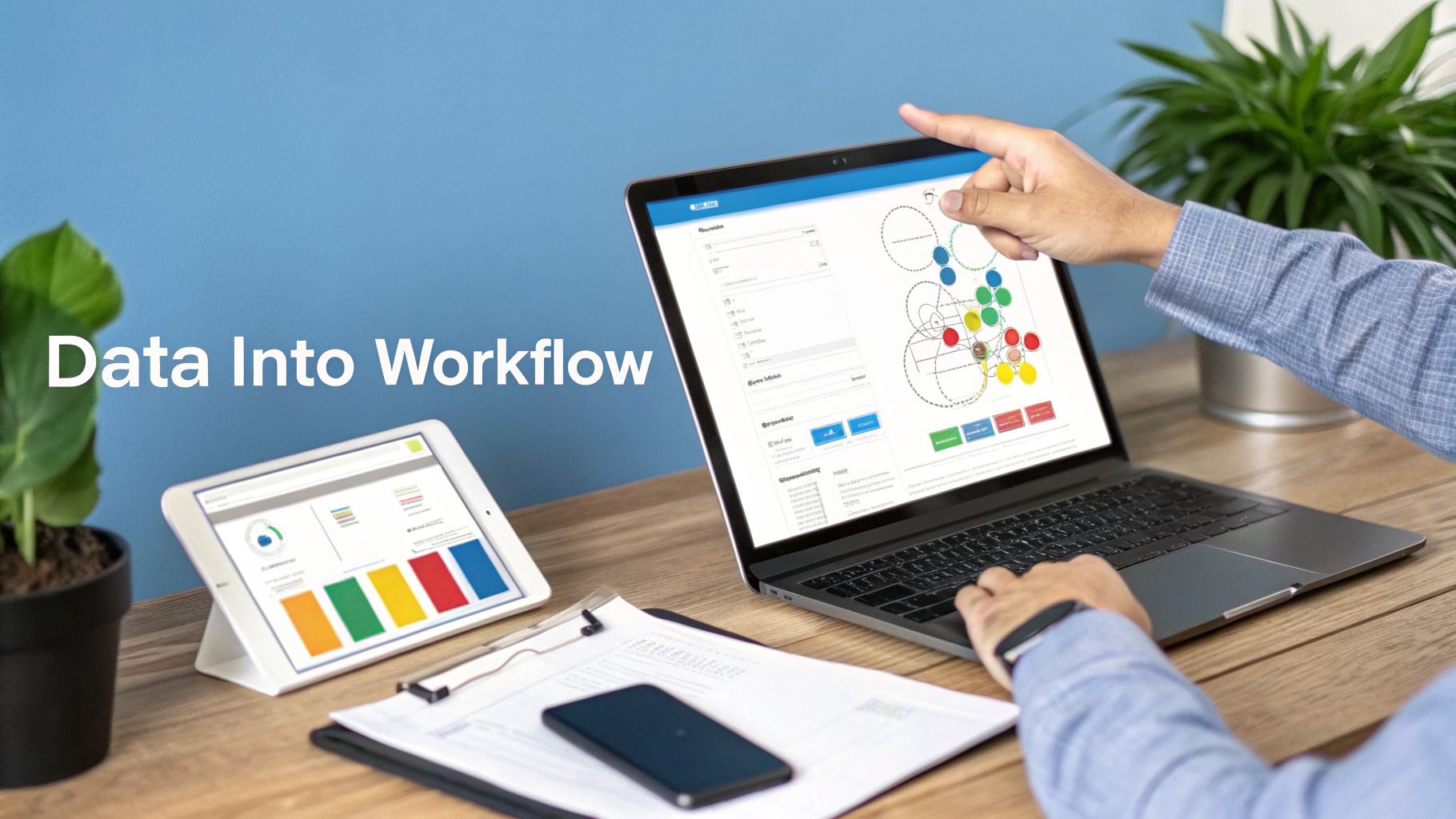
Raw data is integrated into a workflow through either a real-time API for on-demand needs or bulk data delivery for large-scale campaigns and analytics. The right method depends entirely on your business model, operational scale, and existing tech stack.
Actionable data flows seamlessly into the tools your team already uses daily.
API Integration
An API (Application Programming Interface) provides a direct, live connection between your software and a data provider, allowing for instant, one-by-one record enrichment.
This is the standard for:
- On-Demand Enrichment: Instantly adding owner contacts to new leads in your CRM.
- Proptech Applications: Powering user-facing features that require immediate, accurate information.
- Dynamic Workflows: Triggering automated actions, like sending a personalized email, the moment a new high-value property is identified.
An API-first approach shifts your strategy from reactive to proactive, ensuring you pull fresh, accurate data precisely when needed.
Bulk Delivery
Bulk data delivery is the method for acquiring huge volumes of information efficiently, typically as flat files (CSV) or through a direct database connection.
This approach is correct for:
- Training machine learning models to predict market trends.
- Executing large-scale direct mail, email, or cold calling campaigns.
- Performing portfolio analysis and risk assessment across thousands of properties.
Data platforms provide bulk files via Amazon S3 or direct pipelines through services like Snowflake Data Sharing, giving data science and marketing teams the raw material they need without API call limits.
Comparison: Data Integration Methods
| Integration Method | Primary Use Case | Speed | Data Volume | Technical Skill |
|---|---|---|---|---|
| API Integration | Real-time application enrichment | Milliseconds | Low (per call) | High (Developer) |
| Bulk Delivery (Files) | Large marketing campaigns | Hours/Days | Very High | Low (Analyst) |
| Bulk Delivery (Database) | Advanced analytics & BI | Near Real-Time | Very High | High (Data Engineer) |
Many successful businesses use a hybrid approach. For example, an investor might identify 5,000 high-equity properties using a bulk file, then use an API to enrich each record with the most current property owner contact information just before launching a campaign. This workflow provides both scale and accuracy.
Frequently Asked Questions
Here are direct answers to the most common questions regarding the acquisition and use of property owner contact information.
How accurate is skip-traced contact data?
The accuracy of skip-traced data depends on the provider and data freshness. A top-tier platform can achieve a 70-90% hit rate for finding contact information, with right-party contact (RPC) accuracy exceeding 70%. However, data decays quickly; a phone number that is valid today may be disconnected in six months. Ongoing verification is critical. The best providers refresh their databases daily or weekly and supply confidence scores or multiple contact points per owner to increase connection probability.
Is it legal to contact property owners using this information?
Yes, it is legal, provided your outreach methods are compliant with federal and state regulations. Legality is not about having the data; it's about how you use it.
- TCPA: Prohibits using auto-dialers or automated texts to cell phones without prior express written consent. Knowing the phone type (mobile vs. landline) is essential.
- DNC Lists: You must scrub calling lists against National and State Do Not Call registries before making unsolicited marketing calls.
- CAN-SPAM: For emails, you must provide a clear opt-out, list your physical address, and use non-deceptive subject lines.
Fines for violations can be severe, ranging from $500 to $1,500 per incident. Using a data service with built-in compliance tools is a business necessity.
How can I find owner information for just a few properties?
For a small number of properties, a full data platform subscription is unnecessary. Use one of these targeted methods instead.
| Method | Best For | Pros | Cons |
|---|---|---|---|
| County Records Search | Verifying ownership on 1-5 properties | Free, highly accurate for owner name | No contact info, time-consuming |
| Pay-Per-Search Services | Enriching a small list (5-50 properties) | Quick turnaround for contact details | Can be costly per record, data ages |
| Freelance Skip Tracers | One-off, hard-to-find owners | Specialized expertise, good for LLCs | Vetting is difficult, variable quality |
For one or two properties, start with the county assessor's website. If you need a phone number, a pay-per-search skip tracing service offers the best balance of speed, cost, and accuracy for small volumes.
Ready to stop guessing and start connecting? BatchData provides the most accurate, compliant, and scalable property owner contact information in the industry. Integrate our data directly into your workflow and turn insights into action.
Explore our data solutions at https://batchdata.io.