






































An Oakland County property tax search is more than a simple lookup; it's a critical financial analysis, as the county's 1.32% effective tax rate ranks it in the top 10% nationally. The key to navigating this high-cost environment is knowing exactly which official portal to use for financial data versus property assessment details. This guide delivers the precise steps for using each tool, decoding your tax bill, and benchmarking against regional trends to understand the true cost of ownership.
Core Takeaways:
- Two-Portal System: Use the Treasurer's Office for payments and delinquencies; use Access Oakland for assessment data, sales history, and parcel maps.
- Key Metrics: Your tax bill is calculated from the Taxable Value (TV), not the State Equalized Value (SEV). New buyers face a TV "uncap," often leading to a significant tax increase.
- Cost Context: Oakland County's median annual tax bill exceeds $4,200, nearly $1,200 higher than neighboring Wayne County, driven by high property values that fund premium public services.
This breakdown provides the framework for conducting a comprehensive Oakland County MI property tax search, moving beyond a simple query to a strategic financial assessment.

Where do I find Oakland County property tax information?
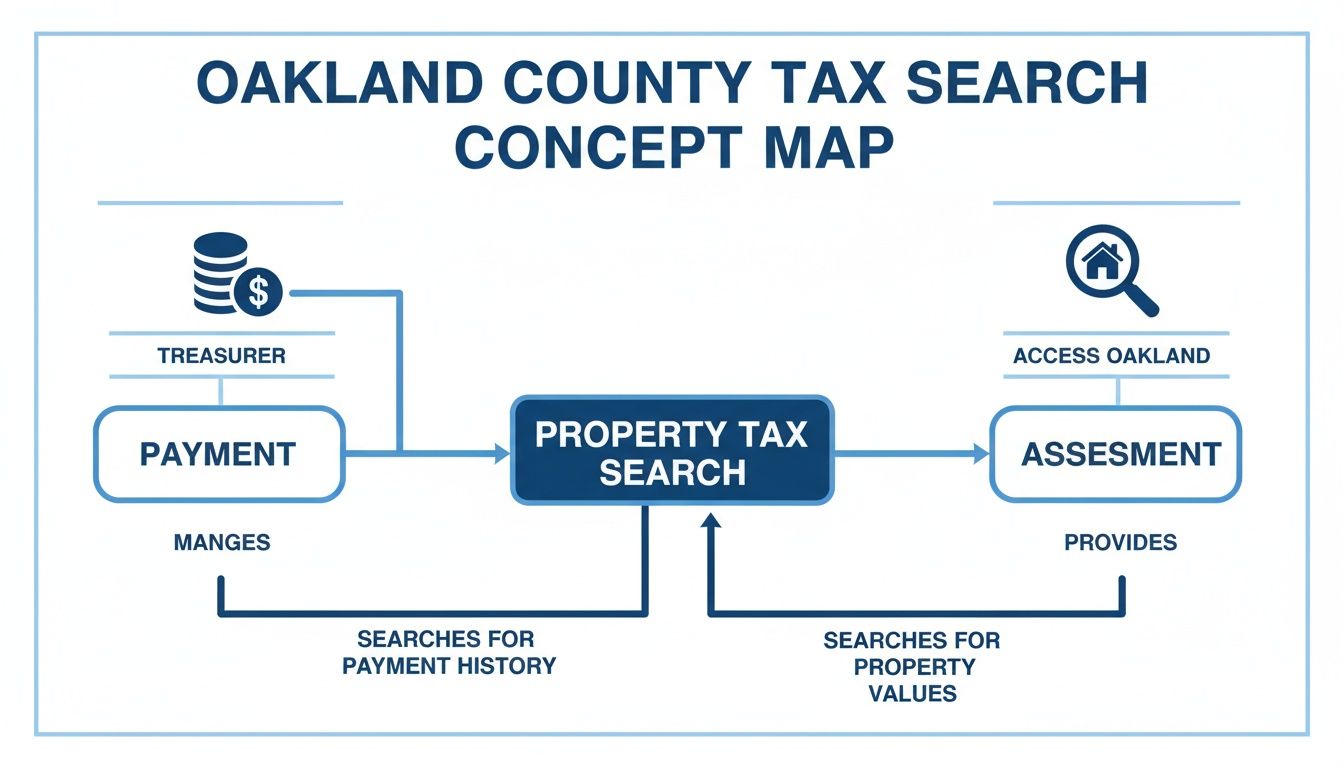
The direct answer is that Oakland County splits its property tax information across two distinct digital platforms. One portal is designed for financial transactions (paying bills and checking status), while the other is a comprehensive database for property characteristics and assessment history. Using the correct portal for your specific query is the most efficient approach.
The 2 Key Official Portals
Your entire search will revolve around two government websites. Understanding their designated roles will prevent wasted time.
- Oakland County Treasurer's Office: This is the primary portal for all financial data. It provides current and delinquent tax amounts and payment status. Use this if your question is, "What is owed?" or "Was the bill paid?"
- Access Oakland Property Gateway: This is the county's comprehensive property data hub. It contains assessment details, sales history, parcel maps, and physical property characteristics (e.g., square footage, year built).
The Parcel ID number (also known as a SIDWELL number in Michigan) is the single most effective piece of information for any search. While address and owner name searches are available, the Parcel ID is a unique identifier that eliminates ambiguity and guarantees you are viewing the correct property record.
Oakland County Property Tax Portal Quick Reference
| Portal/Tool | Primary Information | Best Use Case |
|---|---|---|
| Oakland County Treasurer's Office | Current & delinquent tax amounts, payment status, payment history. | Homeowners paying bills, investors verifying tax status. |
| Access Oakland Property Gateway | Assessed & taxable value, sales history, parcel maps, property characteristics. | Investors, agents, and anyone needing a full property profile. |
| BatchData | Nationwide, API-driven access to tax, assessment, and property data. | Professionals needing bulk data for automated workflows. |
How do I perform an Oakland County MI property tax search?
You perform an Oakland County MI property tax search by using the county’s two dedicated online portals, each serving a different function. The Treasurer's Office portal is for financial inquiries, while the Access Oakland gateway is for deep property research.
Treasurer's Office Payment Portal
This is the designated tool for financial checks. Its sole purpose is to provide the payment status of property taxes.
Upon visiting the Oakland County Treasurer's tax search page, you can search by address, owner name, or Parcel ID.
- The Parcel ID is the most reliable search method as it is a unique identifier.
- Address or owner name searches can produce multiple results, requiring you to verify the correct property.
The search result displays current amounts due, a history of past payments, and details on any delinquent taxes. It is a transactional tool focused exclusively on the property's financial ledger.
Access Oakland Property Gateway
For data beyond the tax bill, Access Oakland is the superior tool. This platform provides a complete property profile essential for due diligence.
The search begins identically—with a parcel ID, address, or owner name—but the results are far more detailed.
Data available on Access Oakland includes:
- Assessment Data: The current Assessed Value (SEV) and Taxable Value, which are the foundational figures for tax calculation.
- Sales History: A log of transaction dates and prices, crucial for market analysis.
- Property Characteristics: Details such as square footage, year built, and lot dimensions.
- Interactive Maps: GIS-powered maps for visualizing parcel boundaries and neighborhood context.
An investor, for example, would use Access Oakland to pull the SEV and sales history to project future tax liability after an "uncapping" event. You can learn more about how these identifiers work by reading our guide on the role of the APN in real estate.
How do I read an Oakland County tax bill and assessment?
You read an Oakland County tax bill by first identifying the State Equalized Value (SEV) and the Taxable Value (TV). Your tax liability is calculated using the Taxable Value, which is multiplied by the millage rate. Understanding this formula is essential for verifying your bill and anticipating future costs.
Key Tax Terminology
To interpret your tax documents correctly, you must understand these core terms.
- State Equalized Value (SEV): The assessor's determination of 50% of your property’s fair market value. It serves as the baseline valuation.
- Taxable Value (TV): The value used to calculate your actual tax bill. Under Michigan's Proposal A, annual increases to TV are capped at the rate of inflation or 5%, whichever is less, until the property is sold. Upon sale, the TV "uncaps" and resets to the SEV, often resulting in a significant tax increase for the new owner.
- Millage Rate: The tax rate, where one mill equals $1 of tax for every $1,000 of Taxable Value. A total millage rate of 40 mills means you pay $40 for every $1,000 of your property's TV.
If your assessment appears incorrect, a guide on how to dispute a tax assessment outlines the formal process. Further reading on what property tax assessment really means can provide deeper context.
Summer vs. Winter Bills and Payment Deadlines
Oakland County property owners receive two tax bills annually. The summer tax bill is typically larger and funds county and school operations. The winter tax bill covers costs for the local municipality, library, and other special assessments.
Deadlines are locally determined and strictly enforced. For example, Royal Oak's summer taxes are due between July 1 and July 31. Late payments incur a 0.5% monthly penalty starting August 1. Unpaid balances are turned over to the County Treasurer on February 28 of the following year, triggering more severe penalties.
What is Oakland County's tax landscape?
The tax landscape in Oakland County is defined by high property values that fund premium public services, resulting in one of the highest median tax bills in Michigan. An Oakland County MI property tax search reveals a direct correlation between the area's affluence—driven by top-tier schools and the "Automation Alley" tech corridor—and its significant tax burden.
Regional Tax Benchmarking
Comparing Oakland County to its neighbors reveals significant differences in the financial burden on property owners.
Oakland County vs. Neighboring Counties Property Tax Comparison
| County | Median Home Value | Median Annual Property Tax | Effective Tax Rate |
|---|---|---|---|
| Oakland County | $320,400 | $4,241 | 1.32% |
| Macomb County | $230,900 | $3,371 | 1.46% |
| Wayne County | $177,900 | $3,059 | 1.72% |
Although Wayne County has the highest effective rate, Oakland County's high property values mean its homeowners pay the highest absolute dollar amount. The median tax bill in Oakland is nearly $1,200 higher than in Wayne County, a critical metric for calculating long-term holding costs for investors.
Michigan State Tax Context
At the state level, Oakland County consistently ranks among the most expensive for property taxes. Its median tax of $4,241 is substantially higher than other major Michigan counties like Ingham County ($3,488) or Kalamazoo County ($3,378). Statewide policies, such as the 6-mill State Education Tax and various homestead exemptions, also factor into the final tax liability.
Monitoring these trends is crucial, as rising property values in Oakland County consistently lead to increased tax liabilities, impacting both affordability for homebuyers and returns for investors. Exploring broader real estate investment tax benefits is also a necessary step for any serious property owner.
Why are manual tax searches inefficient for professionals?
Manual tax searches are inefficient because government portals are designed for single-property lookups, creating a severe operational bottleneck for professionals who operate at scale. A manual Oakland County MI property tax search is slow, prone to human error, and lacks the bulk data access and integration capabilities required by modern investors, lenders, and proptech firms.

The Integration and Scalability Problem
The fundamental failure of manual searches is the lack of an Application Programming Interface (API). Professional real estate operations rely on automated workflows that pipe data directly into their proprietary software for underwriting, risk analysis, and portfolio management. Without an API, these workflows fail.
- Mortgage Lenders require API access to instantly pull tax liabilities for loan origination and escrow management.
- Proptech Companies need to embed tax history and assessment data to provide a comprehensive user experience.
- Institutional Investors use APIs to automatically monitor entire portfolios for tax delinquencies.
The manual process is a disconnected system that cannot meet modern business demands. Enterprise-grade data platforms like BatchData solve this by providing unified, API-driven access to over 155 million property records.
Manual Search vs. Enterprise Data Platform
| Feature | Manual County Search | Enterprise Data Platform (e.g., BatchData) |
|---|---|---|
| Data Access | Single property lookup only | Bulk data delivery via API |
| Scalability | Not scalable; requires high manual effort | Built for high-volume, automated workflows |
| Integration | No API; cannot integrate with software | Low-latency APIs for seamless integration |
| Data Scope | Fragmented across individual municipalities | Unified access to nationwide property records |
| Use Cases | Homeowner bill check, single-property due diligence | Portfolio monitoring, underwriting, proptech app development |
For professionals in the Oakland County real estate market, relying on manual searches is an obsolete practice. The competitive standard has shifted to leveraging structured, unified data sources that fuel intelligent, scalable operations.
What are common questions after an Oakland County property tax search?
After retrieving the initial records, property owners and investors typically face a new set of practical questions regarding payment, penalties, and appeals.
How can I pay my Oakland County property tax bill?
Payment options are determined by your local city or township.
- Online: Most municipalities offer an online portal for payment via credit card (which typically incurs a fee) or e-check.
- Mail: A check can be mailed to your local treasurer's office. Ensure it is postmarked by the due date.
- In-Person: Payments can be made at your city or township hall, many of which have secure after-hours drop-boxes.
- Escrow Account: If you have a mortgage, your lender likely handles tax payments on your behalf.
What happens if I pay my property tax late?
Late payments trigger immediate penalties. A 1% interest charge is added the day after the due date, with an additional 1% added on the first of each subsequent month. If taxes remain unpaid by March 1 of the following year, they become delinquent and are transferred to the Oakland County Treasurer. A 4% administration fee is added, and the interest rate increases to 1% per month, retroactively applied to the previous March, initiating the foreclosure process.
How do I appeal my property's assessed value?
If you believe your property's Assessed Value (SEV) exceeds 50% of its true market value, you must first appeal to your local Board of Review, which typically convenes in March. This is a mandatory first step; you cannot bypass it and go to the state. Missing this March window forfeits your right to appeal for the year. To support your case, you need evidence, such as recent comparable sales data (comps), a formal appraisal, or photos documenting your property's condition. If the local board denies your appeal, the next step is the Michigan Tax Tribunal.
Where can I find historical property tax data?
Access Oakland is the best official resource for historical assessment and sales data. However, analyzing trends or multiple properties on this platform is a slow, manual process. Professionals requiring long-term analysis typically use third-party data platforms that aggregate and standardize years of tax data, making it simple to analyze trends, especially the tax impact after a property sale "uncaps" the taxable value.
For professionals who need to move beyond single lookups, BatchData offers a robust solution. Our platform provides unified, API-driven access to nationwide property tax and assessment data, turning the slow, manual process of an Oakland County MI property tax search into a scalable, automated workflow for underwriting, portfolio monitoring, and investment due diligence. Learn how our data can power your business at BatchData.