





































SEO Title: Asset Recovery Solutions: A Guide to Data & Workflows
Meta Description: Learn how data-driven asset recovery solutions work. This guide covers key workflows like skip tracing, lien enforcement, and distressed asset disposition.
Meta Keywords: asset recovery solutions, asset recovery, skip tracing, lien enforcement, distressed asset disposition, real estate data, debt collection
Over $80 billion in distressed real estate assets exist in the U.S. annually, and asset recovery solutions are the strategic processes and technologies used to reclaim value from them. These solutions are not about passively collecting bad debt; they are a data-driven system for turning defaulted loans and underperforming properties back into recoverable revenue. This involves workflows like finding asset owners, enforcing liens, and managing property sales to achieve the highest possible return.
- Core Function: Turns non-performing assets into liquid revenue.
- Key Workflows: Skip tracing, lien enforcement, and asset disposition.
- Foundation: Relies on real-time property, ownership, and lien data.
- Primary Goal: Maximize net recovery value, not just minimize loss.
This guide breaks down the specific workflows, data requirements, and KPIs that define modern, high-performance asset recovery.
What Are Asset Recovery Solutions?
An asset recovery solution is a systematic, data-fueled strategy for identifying, securing, and liquidating distressed assets to maximize financial return. This approach replaces slow, manual collection efforts with automated, high-precision workflows, a critical shift given the $80 billion in distressed U.S. real estate assets each year. It’s a complete pivot from chasing bad debt to strategically extracting value from non-performing portfolios.
Legacy methods involved manually searching fragmented public records and executing slow legal processes, resulting in low recovery rates and high operational costs. The modern paradigm is built on unified data platforms that provide comprehensive, real-time intelligence.
The Modern Approach
Modern recovery solutions use massive datasets to automate and accelerate every stage of the recovery lifecycle. The process becomes less about manual investigation and more about data science—using signals to predict outcomes and optimize actions. The core principle mirrors concepts like IT Asset Disposition (ITAD) explained, which focus on extracting maximum value from any underutilized asset.
The cornerstones of a modern strategy are:
- Data-Driven Workflows: Using unified platforms for instant access to property details, owner contacts, and lien data to execute skip tracing and enforcement with precision.
- Strategic Prioritization: Employing analytics to identify assets with the highest probability of successful recovery, focusing resources where they will have the greatest impact.
- Compliance and Risk Management: Leveraging scrubbed, compliant data to navigate complex regulations like the FDCPA and TCPA, minimizing legal exposure.
The core difference is stark: legacy recovery asks, “How do we minimize our loss?” Modern asset recovery solutions ask, “How do we maximize our return?” This is a strategic shift from defense to offense.
Core Components
The table below breaks down the primary types of asset recovery in real estate and financial servicing. Each process depends entirely on accurate, current data to succeed.
| Component | Target Asset | Primary Objective |
|---|---|---|
| Lien Enforcement | Real Property | Force the sale of a property to satisfy an outstanding debt or judgment. |
| Foreclosure | Mortgaged Real Estate | Reclaim ownership of a property due to borrower default on a mortgage. |
| Repossession | Tangible Collateral | Physically secure and reclaim assets (e.g., vehicles, equipment, real estate). |
| Distressed Asset Disposition | Recovered Properties | Liquidate or sell recovered assets efficiently to maximize financial returns. |
How Do Asset Recovery Workflows Function?
Successful asset recovery is a systematic process of executing well-defined, data-driven workflows designed to find, secure, and liquidate assets efficiently. These are not vague processes but specific, step-by-step plays that rely on high-quality, accurate data to turn non-performing assets back into cash. Without a solid data foundation, the entire recovery strategy fails.
The process follows a clear three-part sequence: gather data, trace the asset, and recover the value.

Data is the fuel for the entire operation. Let’s break down the four most critical workflows.
1. Skip Tracing: Locating People and Assets
Skip tracing is the process of finding a person, typically a debtor, who has “skipped town.” It is the foundational first step in nearly every recovery playbook because you cannot recover an asset or collect a debt from a person you cannot find. Modern skip tracing uses massive databases to pinpoint an individual’s current location and contact information.
- Goal: Obtain a verified phone number, email, and current address.
- Input: Full name, last known address, DOB, or related property information.
- Output: A complete, actionable profile with contact information for communication or legal service.
Platforms like BatchData dramatically accelerate this process, shrinking the time-to-contact from weeks to minutes by providing scrubbed phone numbers and emails linked directly to property records.
2. Lien Enforcement: Compelling Payment
When a debtor is located but uncooperative, lien enforcement is the legal process used to force the sale of a property to satisfy a debt secured by a lien. This is a strategic legal action taken after other collection attempts have failed and must be executed in strict compliance with state laws.
The global asset recovery services market was valued at $6.28 billion in 2024 and is projected to reach $12.01 billion by 2034, growing at a 6.2% CAGR. For real estate professionals, this means tapping into 155 million U.S. property records to identify pre-foreclosures and unlock billions in equity using accurate owner and lien data. You can find more detail in the full research report on asset recovery services.
3. Repossession: Securing Physical Property
Repossession is the physical act of seizing property when a borrower defaults on a secured loan. While often associated with vehicles, it is a crucial workflow in real estate for foreclosures or when contracts grant the right to take back the asset. This is where digital data-gathering meets physical-world execution, and compliance is paramount to avoid liability.
The process involves three key steps:
- Legal Validation: Confirming the undisputed right to repossess based on the loan agreement.
- Location and Securing: Using data to verify the property’s location and coordinating with agents for safe recovery.
- Condition Reporting: Documenting the asset’s condition at the time of seizure to mitigate future claims.
4. Distressed Asset Disposition: Maximizing Returns
The final workflow is distressed asset disposition—the strategic sale of a recovered asset to convert it back into cash. The goal is not merely to sell, but to achieve the highest possible net recovery. This requires sharp market analysis, accurate valuation, and choosing the optimal sales channel.
| Disposition Method | Best For | Key Characteristic |
|---|---|---|
| Auction Sales | Quick liquidation | Commonly used for foreclosed homes to generate fast cash flow. |
| Brokerage Sales | Maximizing market exposure | Listing on the open market (MLS) to reach the largest buyer pool. |
| Direct-to-Investor Sales | Speed and certainty | Tapping into a pre-vetted network of investors for a faster, off-market sale. |
The right strategy depends on the market, the asset’s condition, and financial objectives. Accurate automated valuation models (AVMs) and comparable sales data are critical for setting a competitive price that maximizes returns.
What Data Powers Modern Asset Recovery?
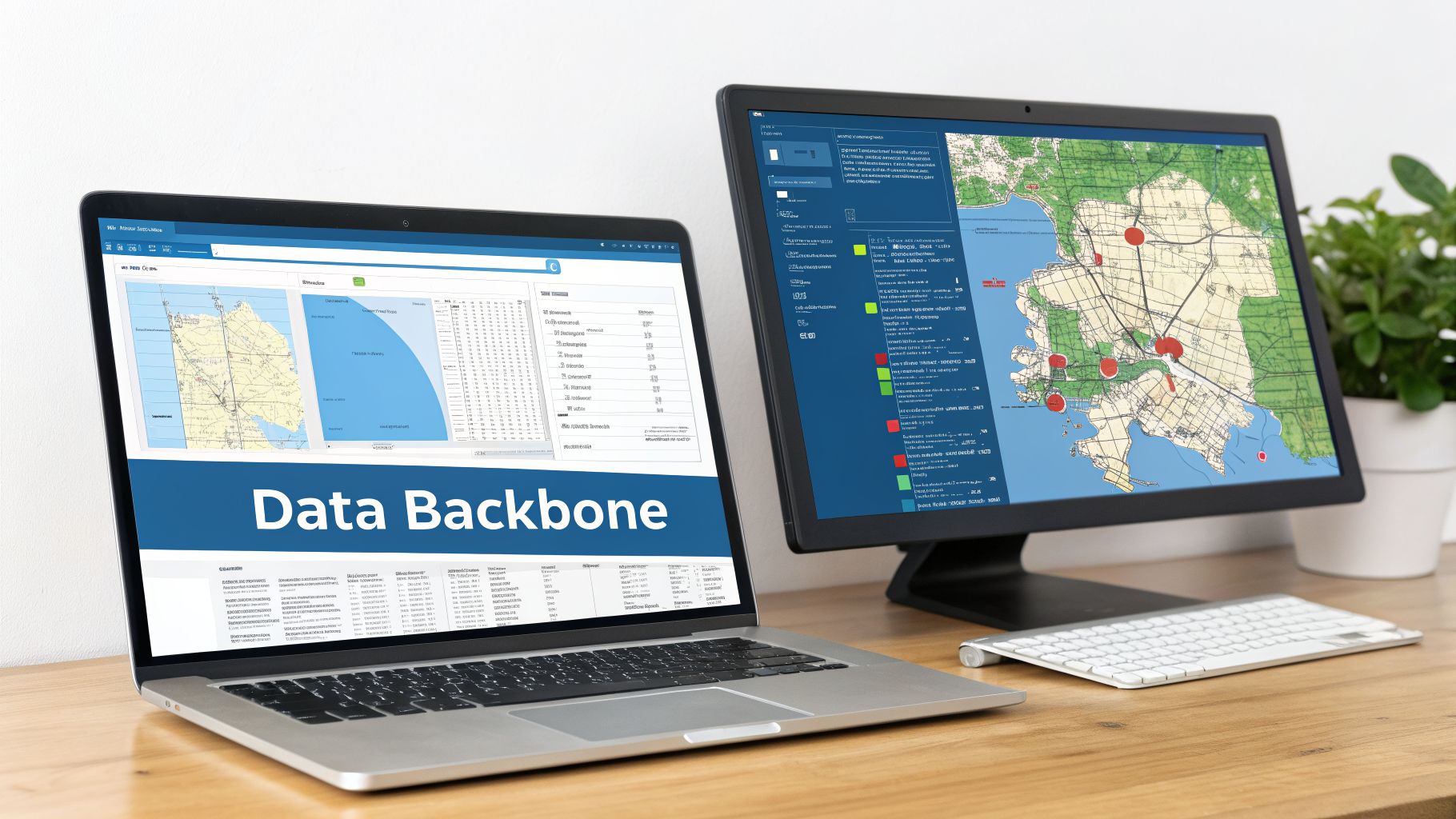
Every successful asset recovery operation runs on accurate, deep, and timely data. Relying on outdated or fragmented public records is a direct path to failure. Modern recovery demands a unified data ecosystem that connects disparate information points into a single, reliable source of truth. The quality of your data directly dictates the speed and success rate of your entire operation.
Core Data Categories
The engine of a modern asset recovery platform is fueled by four essential data types. Together, they create a complete picture of an asset, its owner, and its financial standing.
- Property Data: The foundational layer, including property characteristics (square footage, bed/bath), tax assessment history, parcel numbers (APNs), and transaction history.
- Ownership & Contact Data: Mission-critical information linking a property to its owner, including verified phone numbers, emails, and current mailing addresses.
- Lien & Mortgage Data: A detailed view of the property’s debt stack, including every recorded lien, mortgage, and judgment with its position, amount, lender, and recording date.
- Market Signals: Real-time triggers that initiate recovery workflows, such as pre-foreclosure filings, auction schedules, MLS listings, and recent building permits.
The real power comes from having this data connected. A platform that links a pre-foreclosure alert directly to a property’s lien stack and the owner’s verified phone number creates an actionable intelligence system, not just a database.
The Function of Each Data Attribute
Each data point serves a distinct, vital function. Accurate lien data, for instance, prevents teams from wasting months chasing an asset with a high gross value but no recoverable equity due to senior liens. Similarly, verified contact data is critical; studies show that contact rates increase by over 40% when using phone numbers that have been recently verified. For asset recovery solutions, this is the difference between immediate contact and weeks of fruitless effort.
Advanced platforms also use this data to perform sophisticated geospatial analysis, which can dramatically improve property valuations. You can learn more about how geospatial analysis enhances automated valuation models to see this in practice.
Data Source Comparison: Legacy vs. Modern
Modern, unified platforms offer a decisive advantage over outdated, fragmented data sources.
| Feature | Legacy Data Providers | Modern Platforms (e.g., BatchData) |
|---|---|---|
| Data Accuracy | Often outdated, with high error rates | Daily updates, with 95%+ accuracy |
| Data Delivery | Manual exports, slow FTP transfers | Low-latency APIs, bulk cloud delivery |
| Data Scope | Siloed; property or contact data only | Unified; 1,000+ attributes in one system |
| Timeliness | Monthly or quarterly updates | Real-time feeds and daily refreshes |
From Raw Data to Actionable Intelligence
The most effective asset recovery solutions use flexible data delivery methods to get information into users’ hands. Low-latency APIs feed data directly into a CRM or portfolio management system, triggering automated workflows the moment a market signal appears. For large-scale analysis, bulk data delivery via cloud platforms like AWS S3 or Snowflake allows organizations to build proprietary data warehouses, creating a powerful competitive advantage.
How Do You Measure Asset Recovery Success?
Measuring the success of an asset recovery operation requires focusing on hard numbers that reveal its true profitability and efficiency. True operational insight comes from key performance indicators (KPIs) that expose the efficiency, profitability, and speed of your entire recovery pipeline, moving beyond simple counts of recovered properties.
Key Performance Indicators (KPIs)
To get a clear picture of your operation’s health, you must track KPIs that measure value, time, and cost.
-
Recovery Rate: This is the percentage of an asset’s total outstanding value that is successfully recovered, calculated as
(Total Value Recovered / Total Outstanding Debt) * 100. It is the ultimate report card on strategic effectiveness. -
Time-to-Recovery: This metric tracks the number of days from default to the final liquidation of the asset. It is a pure measure of operational speed, where a lower number means faster cash flow and reduced holding costs.
-
Net Recovery Value: This is the bottom-line profitability, calculated as
Total Value Recovered - All Recovery Costs. This KPI reveals the true financial return after accounting for all expenses, including skip tracing, legal fees, and disposition costs.
A low Net Recovery Value despite a high Recovery Rate is a major red flag, indicating that operational costs are consuming your returns. This often points directly to inefficient workflows or poor-quality data.
The Role of Legal and Compliance
In asset recovery, non-compliance with regulations like the Fair Debt Collection Practices Act (FDCPA) and the Telephone Consumer Protection Act (TCPA) can turn a profitable operation into a legal and financial disaster, with penalties exceeding $40,000 per incident.
Compliant, scrubbed contact data is non-negotiable. A data provider must filter for:
- Known litigators and individuals who frequently file TCPA lawsuits.
- Numbers on the National Do Not Call Registry.
- Phone lines that have been reassigned to new owners.
This focus on compliance is a key reason North America holds over 35% of the $7.7 billion global asset recovery services market. For U.S. mortgage lenders and real estate servicers, who recovered an estimated $50 billion in 2024, using compliant data from over 155 million properties is critical. You can find deeper market analysis in the full business research insights on asset recovery and the Investor Pulse Reports.
How Do You Implement an Asset Recovery Solution?
Implementing or upgrading an asset recovery solution is a strategic overhaul that requires a clear roadmap connecting technology, data, and business goals. The process transforms a complex objective into a series of data-driven steps, starting with a clear definition of your specific recovery objectives. Whether you are a mortgage servicer identifying early defaults or an investor hunting for distressed properties, your goals will dictate the necessary data and tools.

The Implementation Roadmap
A structured game plan is essential to avoid common pitfalls like choosing the wrong data provider or underestimating integration complexity.
- Define Goals & KPIs: Establish a clear primary objective (e.g., reduce time-to-recovery) and define the specific KPIs, like Net Recovery Value, that will measure success.
- Audit Current Process: Map your existing workflow to identify bottlenecks, such as data sourcing, owner verification, or legal paperwork, to pinpoint where a new solution must add value.
- Identify Critical Data Needs: Based on your audit, list your non-negotiable data points, which will almost certainly include complete property records, verified owner contacts, and current lien data.
- Evaluate and Select a Data Partner: This is your most critical decision. Use a strict evaluation framework to compare providers, as your data partner will power the entire operation.
- Plan Integration & Onboarding: Map the data flow into your systems (e.g., API vs. bulk files) and ensure your chosen partner provides strong technical support to facilitate a smooth transition.
How to Evaluate a Data Platform
Choosing a data partner is about finding the right data, delivered in a way that fuels your specific workflow. The global asset recovery sector is projected to grow from $10.59 billion in 2021 to $14.73 billion by 2025, with an 8.6% CAGR expected through 2033. This growth reflects the opportunity to reclaim value, as seen in the $300 billion in home equity lost to foreclosures last year—a trend detailed in our Investor Pulse reports.
The right data platform provides actionable intelligence, not just information. It connects the dots between a distressed asset and the means to recover its value within a single, unified system.
Use this framework to evaluate any potential data partner.
| Evaluation Criteria | What It Solves | Key Questions to Ask |
|---|---|---|
| Data Coverage & Accuracy | Eliminates blind spots and bad leads. | Do you cover 99%+ of U.S. properties? How often are records updated? |
| Flexible Delivery Mechanisms | Ensures data fits existing systems. | Do you offer low-latency APIs and bulk delivery options (e.g., S3, Snowflake)? |
| Integrated Enrichment | Accelerates workflows like skip tracing. | Is skip tracing built-in, or is it a separate, manual process? |
| Support & Onboarding | Reduces implementation friction. | Do you offer white-glove service and dedicated technical support? |
In 2025, U.S. investors successfully recouped an estimated $85 billion from distressed assets using such data-driven platforms, as detailed in the full report on the asset recovery market.
What Are the Most Common Questions About Asset Recovery?
This section provides direct answers to the most common questions about asset recovery solutions, cutting through industry jargon to clarify key concepts.
What is the difference between asset recovery and debt collection?
The distinction is simple: asset recovery is asset-centric, while debt collection is cash-centric. Asset recovery focuses on reclaiming the value of a specific physical or financial asset, like a house, often by taking possession and liquidating it. In contrast, debt collection focuses on obtaining a cash payment from a debtor for a debt that may not be tied to any specific collateral.
| Comparison | Asset Recovery | Debt Collection |
|---|---|---|
| Focus | The specific asset (e.g., property) | The owed cash amount |
| Goal | Reclaim and liquidate the asset | Secure a monetary payment |
| Nature | Asset-centric | Cash-centric |
How do AI and machine learning impact asset recovery?
AI and machine learning are revolutionizing asset recovery solutions by making predictive analytics accessible. These models analyze thousands of data points to predict which defaulted loans have the highest probability of successful recovery, allowing teams to allocate resources with surgical precision. AI also automates data analysis, flagging properties that show early warning signs of distress, such as new liens or pre-foreclosure notices.
AI’s greatest contribution is enabling a shift from reactive to proactive strategies. Instead of merely responding to defaults, teams can use predictive models to anticipate risk and allocate resources more intelligently, maximizing net recovery value.
Can small investors use these solutions?
Yes. The democratization of high-quality data has leveled the playing field, giving small investors and firms access to the same comprehensive data once reserved for large institutions.
- Flexible API Access: Allows smaller proptech firms and solo investors to integrate property, ownership, and lien data into custom tools without a massive upfront investment.
- Subscription Models: Provide cost-effective access to premium data, enabling smaller teams to find distressed assets, run skip traces, and execute recovery strategies as effectively as larger competitors.
This accessibility means even a boutique investment firm can compete directly with established players in the asset recovery space.
Ready to power your recovery strategy with the industry’s most accurate and comprehensive real estate data? BatchData provides the unified data ecosystem you need—from property and lien details to verified owner contacts—all accessible via flexible APIs and bulk delivery. Start building with BatchData today.