





































Your direct mail campaigns might be failing because of one core issue: bad data. If your mailing list is outdated, inaccurate, or incomplete, you’re wasting money on undeliverable mail and irrelevant targeting. Here’s what you need to know:
- Undeliverable Mail: Address data decays at over 2% per month. Without regular updates, up to 20% of your mail may never reach its destination.
- Wrong Targeting: Poor data leads to irrelevant messaging. Personalization boosts response rates, but only if your data is accurate.
- Cost Impact: Failed deliveries, manual corrections, and missed opportunities cost businesses billions annually.
To fix this:
- Audit Your Mailing List: Identify errors, duplicates, and outdated records.
- Use Address Verification Tools: Validate addresses against USPS databases to improve deliverability.
- Leverage NCOA Services: Update addresses for people who have moved.
- Enrich Data: Add missing details like property and transaction data for better targeting.
- Automate Updates: Use real estate APIs to keep data current and reduce manual work.
Clean data ensures your campaigns reach the right audience, improving response rates and maximizing ROI.
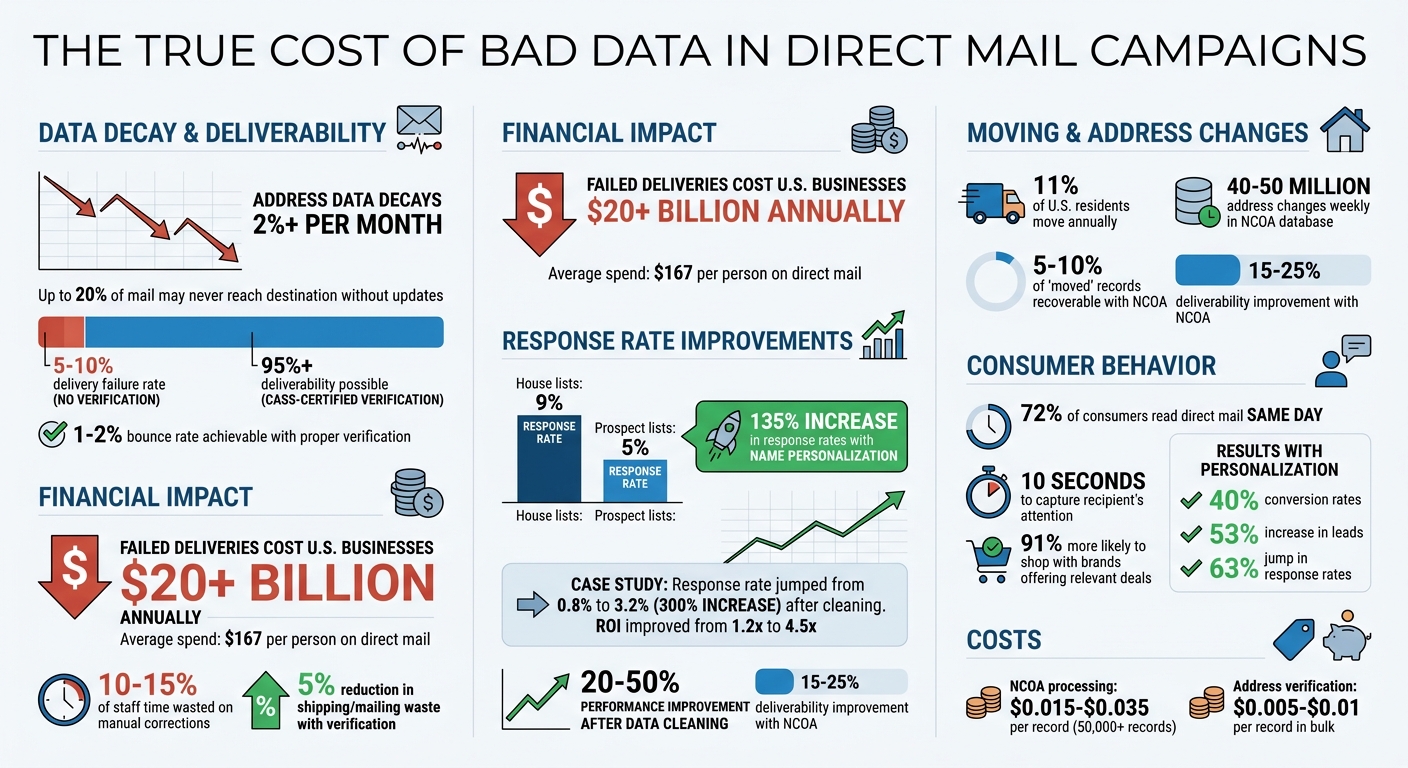
Impact of Bad Data on Direct Mail Campaign Performance
The 509% ROI Breakdown: What actually makes direct mail work!?
sbb-itb-8058745
How Bad Data Reduces Direct Mail Response Rates
Poor-quality data doesn’t just waste postage – it sabotages your entire campaign. If your mailing list is riddled with outdated addresses, missing information, or errors, your mail won’t reach the right people or resonate with them. This leads to two big issues: undeliverable mail that drains your budget and ineffective targeting that reduces engagement. Let’s break down how these problems affect your direct mail efforts.
Undeliverable Mail and Outdated Information
Address data doesn’t age well. In fact, it deteriorates at a rate of over 2% per month due to factors like people moving, street name changes, or new developments. As BatchData puts it:
"Address data decays at a blistering rate of over 2% per month, rendering a new lead list unreliable in under a year without constant cleansing."
Even if your list starts fresh, it can become unreliable in less than a year without regular updates. Companies that skip address verification may see failure rates as high as 5% for their mailings. On the other hand, effective validation processes can bring "Return to Sender" rates down to 2% or less.
Incomplete addresses – like those missing apartment or suite numbers – or ambiguous details, such as unfamiliar city names or street aliases, only add to the problem. Without automated tools to verify and clean up this data, organizations end up wasting 10–15% of staff time on manual corrections.
Wrong Targeting and Low Engagement
When your data is inaccurate, your mail often ends up in the wrong hands. Outdated or incorrect segmentation leads to irrelevant messages that recipients ignore. For example, sending home improvement offers to renters or investment opportunities to someone who’s moved is a clear waste of resources.
Personalization can make a huge difference. Including a recipient’s name in direct mail increases response rates by 135%. However, flawed data can hurt even the best campaigns. House lists typically see a 9% response rate, while prospect lists average about 5%. Both numbers drop if your segmentation is based on bad information.
Another issue arises when your mailing list doesn’t align with your conversion tracking. As Lob explains:
"Dirty address data is one of the fastest ways to break matchback. If your mailing list and your conversion data do not normalize to the same format, you miss matches that should count."
Considering you might spend around $167 per person on direct mail, keeping your data clean is essential. Without accurate targeting, you’re throwing money at a campaign that won’t deliver the results you need. Start fixing these issues by auditing your mailing list for errors and inconsistencies.
How to Find and Fix Data Quality Problems
Once you’ve identified your campaign’s data issues, it’s time to address them. Start by thoroughly examining your mailing list for outdated addresses, duplicates, and incomplete records. Then, use data solutions to clean and update your records. The first step? Audit your mailing list to uncover problem areas before applying any fixes. If you find missing contact information, you may need to skip trace property owners to complete your records.
How to Audit Your Mailing List
Begin by exporting your mailing list into a spreadsheet. Go through each field – like name, address, phone number, and email – and check for blanks, duplicates, or inconsistencies. Typically, you’ll find 3–10% of your entries fall into these categories. Use spreadsheet functions to standardize the data and make corrections.
Next, look for formatting inconsistencies. For example, are some addresses written as "Street" while others use "ST"? Do some records say "Apartment" while others use "Apt"? These small differences can lead to confusion for postal systems and verification tools. Also, check for missing ZIP codes or invalid address formats.
Pay attention to the age of your list. If it’s over a year old, you may find that more than 20% of the addresses are no longer valid. For instance, a real estate investor reviewing a 10,000-record list might discover that 25% of the addresses are undeliverable, which can significantly lower response rates.
Lastly, calculate your bounce rate. If it’s higher than 5%, it’s a clear sign your list needs refinement. Aim to get your bounce rate below 2% by focusing on segments with complete and verified details. This can have a direct impact on improving your response rates.
Using Address Verification and NCOA Services
Address verification tools are essential for standardizing and validating your mailing list. These tools compare your data against USPS databases with over 98% accuracy, correcting typos, adding ZIP+4 codes, and ensuring each address is a legitimate delivery point. Without proper verification, companies can face delivery failure rates of 5–10%. With verification, "Return to Sender" rates can drop to 1% or less.
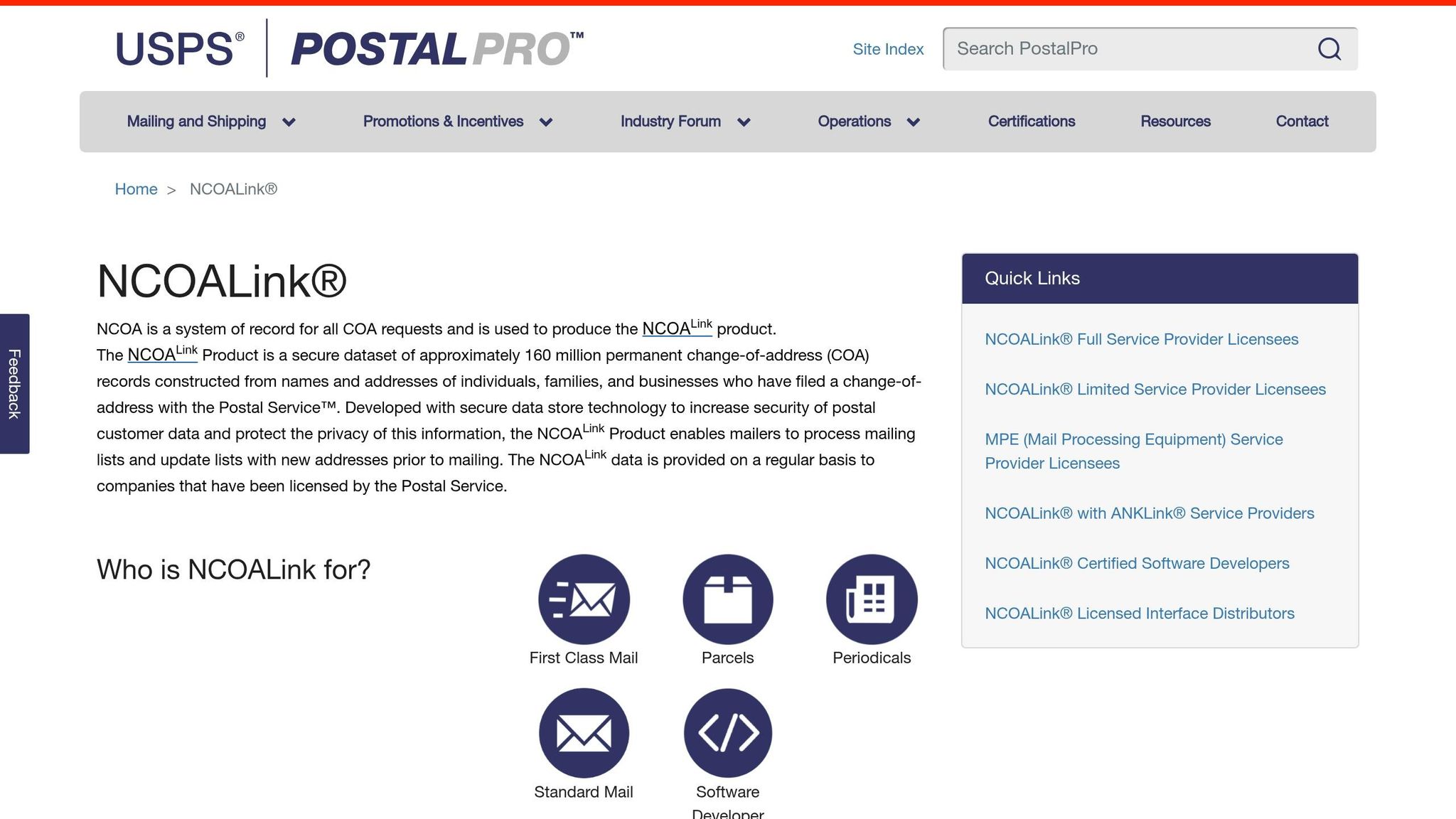
The National Change of Address (NCOA) service is another critical tool. This USPS-managed database is updated weekly with 40–50 million address changes. Licensed vendors can process your list in batches, matching old addresses to new ones while providing move dates and confidence scores. Since 11% of U.S. residents move each year, using NCOA can recover 5–10% of "moved" records and improve deliverability by 15–25%.
Once you’ve identified errors in your list, automated tools can help verify and update your records. Keep in mind the costs: NCOA processing typically runs between $0.015 and $0.035 per record for high-volume lists (50,000+ records), while address verification costs about $0.005–$0.01 per record in bulk.
Here’s an example: A real estate investment firm audited a 20,000-record mailing list using NCOA and CASS verification. They discovered 18% of the addresses were undeliverable. After cleaning the list, their response rate jumped from 0.8% to 3.2% – a 300% increase. This translated into 12 qualified leads per 1,000 pieces, compared to just 3 before. Their ROI soared from 1.2x to 4.5x, saving $15,000 on returns and improving targeting.
To maintain a healthy mailing list, audit it quarterly or before major campaigns. Since address data decays at a rate of over 2% per month, running a full NCOA and verification check every six months is a smart move. Track key metrics like deliverability rate (aim for 95% or higher), bounce rate (keep it under 2%), and response rate before and after cleaning to measure your progress. Most marketers report a 20–50% improvement in performance after implementing these practices.
Improving Data with Skip Tracing and Enrichment
Once your mailing list has been thoroughly cleaned and verified, the next step is to bridge any gaps with skip tracing and data enrichment. Missing details – like outdated addresses or absent phone numbers – can seriously limit how effectively you reach your audience. These techniques help transform incomplete records into well-rounded, actionable databases, leading to stronger targeting and improved response rates.
What Skip Tracing Brings to the Table
Skip tracing is all about tracking down updated contact information for individuals who are otherwise hard to reach. It pulls data from public records, credit databases, and other sources to find current addresses, phone numbers, and email details. This is particularly helpful when county records are outdated or when property owners have relocated without updating their information.
For example, county property records often lag behind real-time updates. One user found that 13.4% of mailing addresses (3,225 out of 23,973) differed from the "Golden Address" listed in standard property databases. Skip tracing providers often have access to more recent and accurate data than public records.
Before diving into skip tracing, make sure your data is already cleaned to avoid wasting resources on redundant searches. Assigning unique IDs to each record ensures that skip-traced results can be seamlessly matched back to your CRM. To further streamline your efforts, pre-filter your list by removing deceased individuals or properties with low equity. This way, you focus your budget on leads with higher potential. Use basic skip tracing for initial screening and save premium-level searches for your top-priority prospects.
Once skip tracing confirms accurate contact details, the next step is to build out a more comprehensive profile through data enrichment.
Enhancing Targeting with Data Enrichment
Data enrichment helps fill in the blanks by adding valuable details like property attributes, financial information, and demographic data to your list. This allows you to create more precise audience profiles and craft personalized messaging. Instead of sending a one-size-fits-all postcard, you can tailor your outreach based on factors like equity levels, property type, or neighborhood trends.
Enrichment data might include property details (square footage, year built, special features), financial and legal records (mortgages, liens, tax assessments), ownership history, neighborhood statistics (school ratings, crime levels), and market activity (e.g., whether a property is already sold or under contract).
To maximize efficiency, enrich your data before skip tracing. Start by using property search tools to filter your list based on equity levels or property characteristics. For instance, if you’re targeting distressed properties, prioritize adding data like tax delinquency or lien information before paying for updated contact details. You can also segment your list by geography or property type to create more focused, relevant messaging.
Once your data is enriched, leverage variable data printing to create personalized mailers. Include hyper-specific details like localized maps, property-specific offers, or equity estimates. Since direct mail pieces only have about 10 seconds to capture a recipient’s attention, personalization can make all the difference. Focus your outreach on records with the latest updates and verified contact information to boost response rates.
Using Real Estate APIs to Keep Data Accurate
Real estate APIs are game-changers when it comes to maintaining accurate and actionable data. After enriching your data, the next hurdle is keeping it up-to-date. With roughly 5.6 million home sales happening annually in the U.S., property ownership details can change in a flash. That means your carefully curated list can become outdated in just a few weeks – especially if you’re running high-response direct mail campaigns. Real estate APIs tackle this issue by automating data validation and giving you continuous access to updated property and contact information. This eliminates the need for time-consuming manual updates, saving both time and money.
Real-Time Data Updates and Validation
APIs provide direct access to detailed property databases, delivering current ownership records, verified addresses, and transaction histories exactly when you need them. Unlike quarterly updates from county records, APIs such as ATTOM Data and HouseCanary pull live data and validate addresses against USPS standards in seconds. This real-time capability ensures you catch critical changes – like recent foreclosures, ownership transfers, or vacant properties – that could otherwise lead to undeliverable mail.
For example, in Q1 2024, REI BlackBook integrated ATTOM’s Property API into their CRM, refreshing data for 250,000 investor leads. The results? Their bounce rates dropped from 28% to just 4.2%, while direct mail response rates climbed by 42% (from 1.8% to 2.56%). This improvement generated an additional $1.2 million in deals. APIs achieve over 95% accuracy by flagging outdated information and standardizing addresses, increasing deliverability by 30–50%. With this level of precision, your leads are always primed for seamless CRM integration.
Connecting APIs with CRM Systems
Integrating APIs with your CRM takes data validation to the next level. By using webhooks or middleware platforms, you can create workflows that automatically pull fresh data whenever a new lead enters your system. For instance, if you import a property address into platforms like Salesforce or HubSpot, an API call can instantly enrich that record with updated owner contact details, equity estimates, and property specifics – no manual effort required.
In September 2023, InvestorFuse used HouseCanary’s API with Zapier to sync 150,000 mailing records in real time through their CRM. This automated process achieved 95% data accuracy and boosted appointment settings by 35% (from 120 to 162 per campaign). To maintain this accuracy, schedule regular validation tasks – like weekly NCOA checks or nightly database cleanups – that keep your records fresh. This setup can reduce manual data work by 80%, ensuring every campaign launches with verified, up-to-date information. For high-value lists, you can even configure your CRM to flag recent ownership changes or property sales, helping you adjust your targeting before wasting money on outdated contacts. These automated updates make it easier to fine-tune your campaigns, improving their precision and boosting response rates.
How to Build a Data-Driven Direct Mail Strategy
After setting up real-time data validation through APIs, the next step is crafting a strategy that keeps your campaigns performing at their best. This involves establishing routines to combat data decay and implementing tracking systems to measure what’s working. Without these measures, even the most accurate data will lose its impact over time. By leveraging the improved accuracy gained from skip tracing and API integrations, a systematic approach ensures your campaigns maintain their momentum.
Now that your data is accurate and up-to-date, it’s time to focus on regular audits and personalized messaging to transform your campaign into a fully data-driven effort. Clean data alone isn’t enough – it’s the strategy you build around it that drives results.
Regular Data Audits and Updates
Mailing list data starts deteriorating the moment it’s collected. Regular audits are the key to slowing this process. Conducting quarterly audits is a good practice, but monthly audits deliver the best outcomes.
During these audits, use Delivery Point Validation (DPV) codes from your address verification API to confirm address deliverability. A DPV Code "Y" indicates the USPS delivers to that exact address, while other codes highlight issues like missing suite numbers or undeliverable addresses. Additionally, segment your mailing list by property type using metadata flags to improve cost efficiency and avoid unnecessary freight charges.
This proactive approach minimizes waste and optimizes resource allocation. In fact, using robust verification processes can cut shipping and mailing waste by up to 5% while freeing up 10-15% of staff time for more strategic tasks. Instead of spending time addressing returned mail, your team can focus on refining campaign strategies and building stronger customer relationships.
Once your data is consistently updated and reliable, the next step is creating mailers that feel personal and relevant to your audience.
Personalization and Campaign Tracking
Generic mailers tend to get overlooked. While 72% of consumers read direct mail right away or on the same day, they only do so when it feels relevant. Personalization is the game-changer here – it’s not just about adding a name to the envelope. Use your enriched data to segment your audience by factors like past purchases, property equity, or transaction history, and then craft offers tailored to each group.
Personalization pays off: 91% of consumers are more likely to shop with brands offering relevant, targeted deals. But even the best offers won’t work if the addresses or profiles are outdated. To connect offline mail with digital analytics, include tools like QR codes, pURLs, or unique promo codes to track recipient engagement.
For accurate attribution, rely on delivery confirmation data instead of mail send dates. This ensures your analysis reflects when the mail actually reached recipients. Tailor your attribution windows to match campaign goals: 1-3 weeks for promotions, 2-4 weeks for retention efforts, and 6-8 weeks for acquisition campaigns. By integrating digital tracking and direct mail strategies, you can see results like 40% conversion rates, a 53% increase in leads, and a 63% jump in response rates.
Conclusion
Poor data quality affects every part of your direct mail campaigns. With mailing lists deteriorating at a rate of over 2% per month, the impact is clear: wasted money and missed chances to connect with potential customers. In fact, failed deliveries cost U.S. businesses more than $20 billion annually.
The fix? A three-step approach: verify, enrich, and automate. Using CASS-certified address verification can achieve 99%+ deliverability, while also reducing shipping waste by up to 5%. Skip tracing and data enrichment add 1,000+ property attributes per verified address, turning generic mail into personalized outreach that resonates. Real-time APIs block bad data from entering your system, and regular audits ensure your database stays accurate and effective.
These steps don’t just improve deliverability – they boost performance. As Lob explains:
"When matchback is accurate, you can report ROI with confidence and make smarter decisions about future campaigns. When it is not, performance gets distorted and optimization becomes guesswork." – Lob
Clean data brings more than just better delivery rates. It saves 10-15% of staff time by reducing the need for manual updates, allowing your team to focus on strategic tasks. It also ensures accurate matchback analysis, so you can confidently attribute sales and fine-tune future campaigns. Most importantly, it guarantees your message reaches the right audience every time.
FAQs
How often should I clean my mailing list?
Keeping your mailing list up-to-date is crucial. With a typical 2% monthly data decay rate, cleaning your list every month helps maintain accuracy. This not only ensures your emails reach the right audience but also boosts deliverability, giving your campaigns a better chance of success.
Which data fixes improve response rates the fastest?
The quickest way to boost response rates is by ensuring your contact details are accurate and up-to-date. This can be done through skip tracing and real-time data validation. Tools like BatchData’s skip tracing API make it easy to verify phone numbers, emails, and property ownership details. Real-time validation ensures your contact information stays current, cutting down on outdated data. The result? Better reach rates for property owners and a noticeable improvement in campaign responses.
How can I track ROI from direct mail accurately?
To measure ROI effectively, pay attention to critical metrics such as cost per lead, match rates, and conversion rates. Leverage tools like skip tracing and real-time APIs to maintain accurate and verified contact information. It’s also essential to routinely validate and update your data to minimize errors.
Using matchback analysis with clearly defined attribution windows and clean data allows you to properly link sales back to specific campaigns. This ensures your ROI calculations are as accurate and dependable as possible.