




































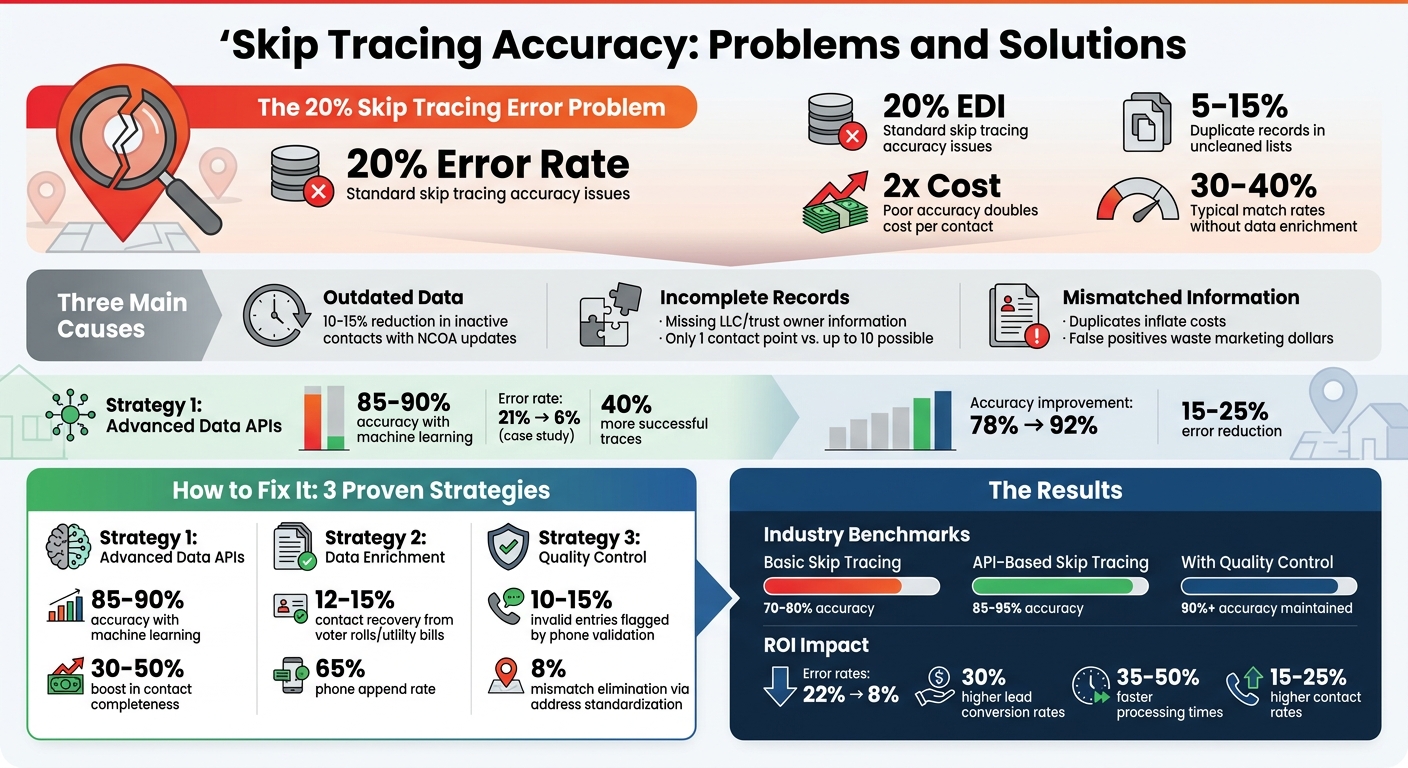
Skip tracing is a critical tool for real estate investors to contact property owners, but 20% of results are often inaccurate. This happens due to outdated data, incomplete records, and mismatched information, leading to wasted time and higher costs. Poor accuracy can double your cost per contact and reduce deal opportunities. However, fixing these issues is possible with the right strategies:
- Use advanced data APIs: Real-time data from multiple sources can reduce errors significantly.
- Apply data enrichment: Filling in missing details like phone numbers or emails boosts contact rates.
- Implement quality control: Validating and cleaning data ensures accuracy and efficiency.
For example, tools like BatchData offer up to 95% accuracy, cutting error rates and improving ROI. By addressing these challenges, you can save money, improve outreach, and close more deals.
Skip Tracing Accuracy Statistics and Solutions for Real Estate Investors
How to Make the Most of Skip Tracing
sbb-itb-8058745
Why Skip Tracing Results Are Often Wrong
Skip tracing can have an error rate of up to 20%, often due to outdated data, incomplete records, and mismatched information. These issues not only reduce contact rates but also drive up lead costs. Let’s break down each factor to understand its impact and explore potential solutions.
Outdated Data Sources
One major issue is outdated information. People frequently change phone numbers, addresses, or emails, making older data unreliable. Regular updates, such as using the National Change of Address (NCOA) system, can reduce the number of inactive contacts by 10–15%. Another problem is limited data coverage. If a service only provides one contact point, your chances of reaching someone drop significantly. On the other hand, more thorough services can deliver up to 10 phone numbers and multiple email addresses per record, greatly improving your reach.
But even with updated data, incomplete records can create significant challenges.
Incomplete Records
When records are missing critical details, it becomes harder to connect with decision-makers – especially for properties owned by LLCs or trusts. For example, corporate-owned properties often lack information about managing members or registered agents, the very people responsible for making selling decisions. Without this information, your outreach efforts could fall flat. Instead of reaching motivated sellers, you might only get a company name with no clear contact information.
As Sharad Mehta, Founder of REsimpli, aptly points out:
"Most real estate investors don’t lose money on bad deals that they lose on bad data".
Mismatched Information and Duplicates
Another common issue is mismatched or duplicate data. Overlapping lists and duplicate records can inflate costs and skew your results. If you don’t clean your lists properly, 5–15% of the records may be duplicates, wasting time and money while also leading to false positives. Proper data hygiene and enrichment practices can significantly improve match rates, increasing them from 30–40% to as high as 60–80%.
How to Fix Skip Tracing Accuracy Problems
If you’re a real estate investor looking to improve contact rates and avoid wasting marketing dollars, here are three proven strategies to tackle skip tracing accuracy issues.
Use Advanced Real Estate Data APIs
One of the biggest challenges in skip tracing is outdated information. Advanced real estate data APIs solve this by pulling data from multiple sources at once. Tools like BatchData’s property search and skip tracing API cross-reference public records, proprietary databases, county assessors, and even utility company information in real-time.
The results are impressive. For example, a real estate wholesaler in the Midwest processed 5,000 leads using BatchData’s API and saw their error rate drop from 21% to just 6%. This improvement led to 40% more successful traces and 15 closed deals worth $2.5 million in under 90 days. The API also uses machine learning to match names across fragmented records, achieving 85-90% accuracy rates, compared to the 80% typically seen with manual skip tracing.
Another advantage? These APIs can connect LLCs and trusts to their individual owners, bypassing generic registered agents and making it easier to find the right contact.
Once you’ve got real-time data, the next step is filling in the missing pieces.
Apply Data Enrichment Techniques
Data enrichment is all about completing partial records. By appending missing details – like mobile phone numbers, updated emails, or verified addresses – you can significantly improve your contact rates. This involves cross-referencing your skip tracing results with additional datasets, such as voter rolls, utility bills, and even social media.
For example, if you only have a last-known landline number, you can use voter rolls and utility bills to recover 12-15% of missing contacts. On average, phone append rates are around 65% for real estate datasets, which can boost contact completeness by 30-50%.
The process is straightforward:
- Export your data and use a tool like BatchData’s API to append missing fields.
- Deduplicate records using fuzzy logic to merge similar entries.
- Validate addresses against USPS standards.
- Re-run traces on any unresolved records.
In one 2025 pilot program, this approach reduced error rates by 22%. Once your data is enriched, the final step is ensuring its accuracy.
Implement Quality Control Practices
Even with enriched data, verification is essential. Quality control ensures your leads are accurate and actionable. For instance, phone validation APIs can check whether numbers are active or disconnected, flagging 10-15% of invalid entries instantly. Similarly, address standardization with CASS-certified tools can normalize formats (e.g., converting "123 Main St" to "123 Main Street, Apt 2B, City, ST 12345") and eliminate 8% of mismatches.
A solid quality control process might look like this:
- Stage 1: Use automated tools like BatchData for validation.
- Stage 2: Conduct manual spot-checks on 5% of your results.
- Stage 3: Track KPIs, such as maintaining accuracy above 90% and contact rates above 70%.
Dashboards can help you monitor key metrics like bounce rates, while weekly audits keep your data clean. One agency improved their accuracy from 78% to 92% over six months by following this approach.
The data speaks for itself. Firms using integrated tools have reported error rates dropping from 22% to 8%, while ROI increased due to 30% higher lead conversion rates. Skip tracing services that rely on APIs achieve 85-95% accuracy, compared to the 70-80% typical of basic database lookups. Implementing quality control can further reduce errors by 15-25%.
How BatchData Improves Skip Tracing Accuracy
BatchData tackles skip tracing errors head-on with real-time processing, multi-source verification, and automated quality control. These features address the most common pitfalls in skip tracing – outdated data, incomplete records, and mismatched information. The result? More reliable outcomes for both individual investors and enterprise clients.
BatchData’s Skip Tracing and Data Enrichment Tools
BatchData’s skip tracing API boasts an impressive 95% accuracy rate when identifying property owners. It achieves this by pulling data from over a dozen frequently updated sources, including county assessor files, public records, and telecom databases. With datasets refreshed daily and results delivered in milliseconds, users always work with the most up-to-date information.
The platform also excels in data enrichment. Its AI-powered algorithms resolve duplicate entries and standardize names across fragmented records. For instance, it can identify and correct variations like "John Smith" versus "Jon Smythe" using fuzzy logic with a 90%+ match threshold. This reduces false positives by 30% in foreclosure lists.
Phone verification is another standout feature. With a 98% phone data completion rate, the system flags low-confidence matches (below 80%) and distinguishes between mobile and landline numbers. It achieves a 76% right-party contact rate – three times the industry average. Additionally, BatchData ensures compliance by automatically scrubbing phone data against the National Do Not Call Registry in real time.
The platform goes further by linking LLCs and trusts to their actual owners, bypassing generic registered agents to connect users with decision-makers. It supports bulk processing for up to 100,000 records per batch, delivering results within 24 hours at a cost of just $0.10 to $0.25 per record – far below the industry standard of $1 or more.
For large-scale operations, BatchData’s professional services offer even greater accuracy and efficiency.
BatchData’s Professional Services
Enterprise clients managing extensive portfolios benefit from BatchData’s custom data pipelines. These pipelines integrate client-specific sources, such as MLS data, and refresh automatically on a daily basis. Custom workflows are designed to handle mismatched information at scale. For example, one client processing over 500,000 records annually reported a 40% boost in accuracy after adopting a tailored pipeline.
The professional services team also provides compliance support, offering detailed reports and opt-out tracking to meet FCRA and TCPA standards. Enterprise clients have seen measurable improvements, including 35–50% faster processing times, 15–25% higher contact rates, and an ROI of 5:1. One hedge fund even reduced its manual verification workload by 80%.
Conclusion: Reducing Skip Tracing Errors
Skip tracing errors often arise from outdated data, incomplete records, or mismatched information. These issues contribute to an estimated 20% error rate, which can drain marketing budgets and slow down deal-making processes.
To tackle these challenges, a more structured approach to data accuracy is essential. Here are three key strategies to address the problem:
- Leverage advanced real estate data APIs: Using APIs to access current data can reduce stale data errors by as much as 30%.
- Employ data enrichment: Filling in gaps in missing or incomplete data ensures more accurate records.
- Implement quality control measures: These steps can lower false positives by 25%, improving overall efficiency.
BatchData offers tools designed to combat these challenges, delivering skip tracing accuracy rates exceeding 95%. With robust data enrichment solutions, BatchData enables real estate professionals to save significantly – sometimes over $50,000 annually – by focusing marketing efforts on verified leads.
FAQs
How can I tell if my skip traced data is outdated?
To spot outdated skip traced data, start by examining its age. Older data is more likely to be inaccurate, as people’s contact details can change frequently. Next, verify the credibility of the source. Reliable sources are key to ensuring the information is still relevant. Finally, compare the details for consistency. If data points don’t align, it’s a red flag that the information might be outdated.
Using tools or techniques to assess the freshness and reliability of your data can help you focus on recent and verified records. This not only improves accuracy but also helps avoid unnecessary costs tied to outdated information.
What’s the best way to skip trace LLC- or trust-owned properties?
To effectively skip trace properties owned by LLCs or trusts, advanced tools are your best bet. These tools dig into public records, credit data, and utility information to uncover the individuals behind these entities, even when ownership is intentionally obscured. For even better results, consider using high-quality APIs and monitoring metrics like right-party contact rates. This approach can significantly enhance accuracy and streamline your efforts to identify the actual owners connected to such properties.
What KPIs should I track to measure skip tracing accuracy?
When it comes to skip tracing, tracking the right metrics is crucial. Here are some of the most important KPIs that can help evaluate and refine your efforts:
- Right-Party Contact (RPC) Rate: This indicates the percentage of verified, reachable contacts. A higher RPC rate means you’re successfully connecting with the right individuals.
- Data Reliability Score: This metric assesses how trustworthy your data is, helping you prioritize leads that are more likely to yield results.
- Success Rate of Contact Attempts: This measures the proportion of contact attempts that result in successful connections, offering insight into the effectiveness of your outreach.
- Data Freshness: Outdated data can lead to wasted efforts. Tracking how recent your data is ensures you’re working with up-to-date information.
- Compliance Metrics: Staying within legal boundaries is non-negotiable. Metrics related to adherence to DNC (Do Not Call) and TCPA (Telephone Consumer Protection Act) regulations help keep your operations compliant.
By keeping an eye on these KPIs, you can fine-tune your skip tracing strategy and work more efficiently.