








































Address verification ensures that a physical address is valid and deliverable by cross-checking it against trusted databases like USPS. It goes beyond formatting by confirming if mail can reach the address, using tools like Delivery Point Validation (DPV). This process is vital for industries like real estate, e-commerce, and logistics, where undeliverable mail costs U.S. businesses over $20 billion annually.
Key Points:
- Validation vs. Verification: Validation standardizes address formatting; verification ensures an address exists and is deliverable.
- Benefits: Reduces errors, improves delivery rates, and saves costs (e.g., $10–$30 per failed delivery).
- Methods: Real-time APIs for immediate feedback during data entry, and batch processing for large datasets.
- Applications: Real estate analytics, e-commerce checkout optimization, and targeted marketing campaigns.
Address verification is essential to maintain accurate data, streamline operations, and avoid costly errors. Whether through real-time tools or batch systems, it ensures businesses can rely on their address data for better decision-making.
The 3 Main Steps of Address Verification
sbb-itb-8058745
Address Verification vs. Address Validation
Address Validation vs Address Verification: Key Differences
Key Differences Between Verification and Validation
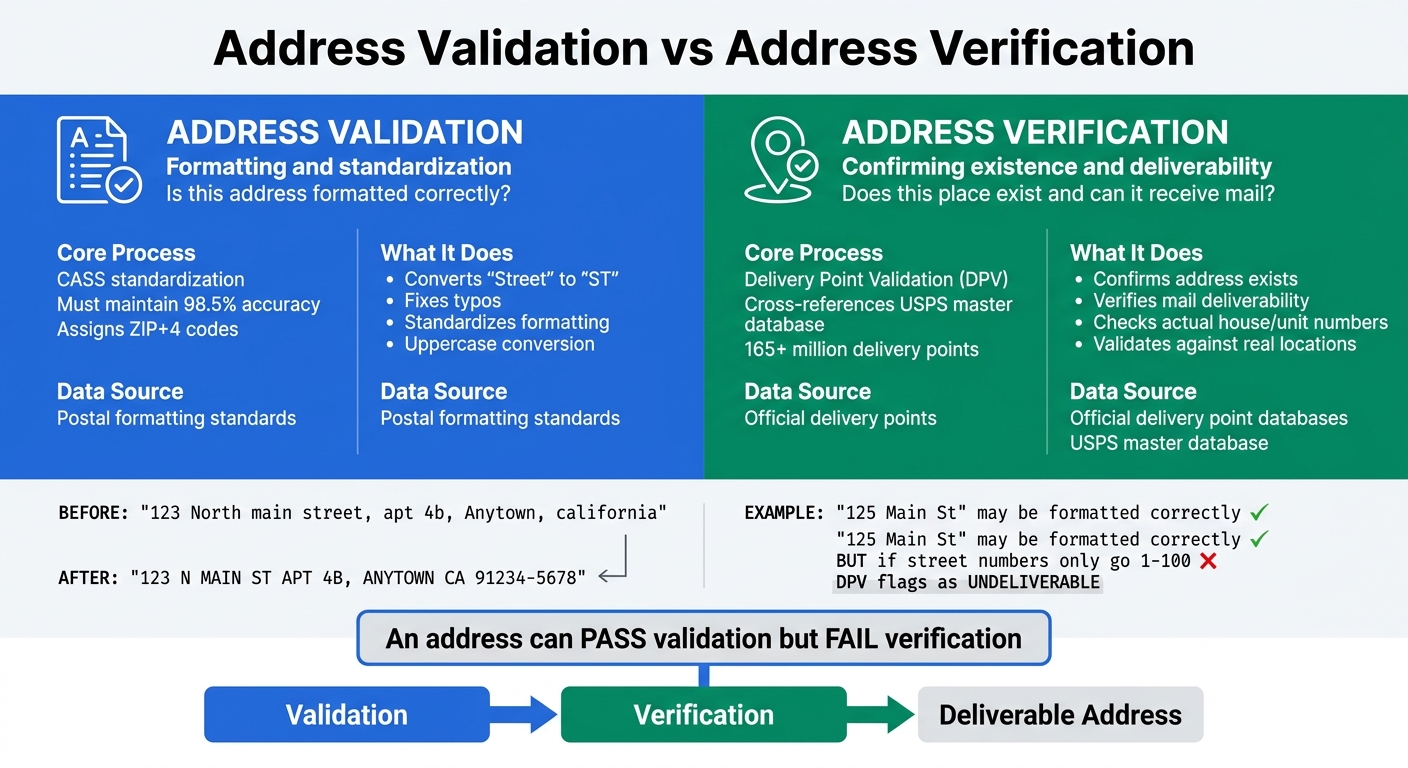
While people often confuse the two, address validation and verification are distinct processes with unique goals. Address validation ensures that an address is properly formatted according to postal guidelines. For instance, it standardizes addresses by converting "Street" to "ST" or fixing typos. This process relies on CASS-certified software, which must maintain at least 98.5% accuracy when standardizing addresses and assigning ZIP+4 codes.
Address verification, on the other hand, goes a step further. It checks if a specific address exists and can actually receive mail. This is done using Delivery Point Validation (DPV), which cross-references addresses against the USPS’s master database of over 165 million delivery points.
"Address validation focuses on whether an address is written correctly according to postal rules… Verification answers a different question: is this a real place that can receive mail?" – Lob
An address can meet validation requirements but fail verification. For example, "125 Main St" might be formatted correctly, but if the range of house numbers on that street only goes from 1 to 100, DPV will flag it as undeliverable.
Here’s a quick comparison of the two:
| Feature | Address Validation | Address Verification |
|---|---|---|
| Primary Goal | Formatting and standardization | Confirming existence and deliverability |
| Core Process | CASS standardization | Delivery Point Validation (DPV) |
| Key Question | "Is this address formatted correctly?" | "Does this specific place exist and can it receive mail?" |
| Data Source | Postal formatting standards | Official delivery point databases |
These differences determine how validation and verification are used in real-world scenarios.
When to Use Verification Over Validation
Knowing when to choose verification is essential, especially when accurate deliverability matters most. Address verification is critical for tasks like direct mail campaigns, legal notices, or scheduling service appointments. It ensures that mail reaches the intended recipient and supports informed decisions in areas like real estate.
Verified addresses are crucial for ownership records, tax documents, and sales data. Mortgage lenders and insurance companies also rely on verified addresses for accurate Automated Valuation Models (AVMs) and risk evaluations.
If an address passes CASS validation but fails DPV, don’t discard it outright. Instead, flag it for manual review. Often, this indicates a missing secondary unit number, which can be added to make the address usable.
To maintain up-to-date records, use APIs to run both validation and verification regularly. Since the USPS updates its database monthly and CASS-certified vendors must use data no older than 105 days, this approach ensures your CRM and marketing data remain accurate.
How Address Verification Works
Parsing and Standardizing Addresses
Address verification begins by breaking down an address into its individual components: street number, street name, city, state, and ZIP code. This process, known as parsing, takes raw input like "123 North main street, apt 4b, Anytown, california" and organizes it into structured fields.
The CASS™ (Coding Accuracy Support System) steps in next to standardize the address. It converts text to uppercase, shortens street names (e.g., "Street" becomes "ST"), and adds ZIP+4 codes to specify delivery areas. This standardization not only ensures accuracy but also qualifies businesses for USPS postage discounts. For example, after CASS processing, "123 North main street, apt 4b, Anytown, california" transforms into "123 N MAIN ST APT 4B, ANYTOWN CA 91234-5678."
Once the address is standardized, it moves on to a deliverability check.
Verification Against Authoritative Databases
The next step involves DPV® (Delivery Point Validation), which verifies the standardized address against the USPS master database. This database contains over 165 million delivery points and determines whether a mail carrier delivers to the specific location.
"If CASS is the grammar checker, DPV is the fact-checker. It answers the most important question: ‘Does the mail carrier actually stop at this specific address?’" – BatchData
Even if an address is correctly formatted through CASS, it might fail DPV if, for instance, the house or unit number doesn’t exist. To further refine the process, tools like LACSLink® and SuiteLink® are often used to confirm deliverability and update outdated addresses.
Next, it’s important to understand how real-time and batch verification methods differ to choose the right approach for your needs.
Real-Time vs. Batch Verification
Address verification can be handled in two main ways: real-time APIs or batch processing. Each method serves a different purpose.
- Real-time verification happens instantly as users input their addresses, such as during checkout or in web forms. These APIs process each address in milliseconds, offering immediate feedback and improving e-commerce conversion rates by 15–25%.
- Batch verification is designed for processing large datasets all at once. Instead of verifying addresses one by one, you upload an entire file – potentially containing millions of entries – and receive standardized results within minutes or hours. This approach is ideal for tasks like database audits, CRM migrations, or preparing mailing lists.
| Attribute | Real-Time API | Batch Processing |
|---|---|---|
| Primary Use Case | Point-of-entry (web forms, checkout) | Cleansing existing large datasets |
| Data Flow | Processes addresses individually | Processes addresses in bulk |
| Speed | Milliseconds per address | Minutes to hours for entire files |
| User Experience | High (immediate feedback/suggestions) | Low (internal background process) |
| Best For | UX enhancement, fraud prevention | Database audits, list preparation |
Keep in mind that the free USPS Web Tools API has a default limit of 60 requests per hour (as of January 2026), which makes it unsuitable for high-volume commercial use. Commercial providers, on the other hand, can handle thousands of requests per minute and offer both real-time and batch options with formal service-level agreements.
Applications of Address Verification in Real Estate and PropTech
Address verification plays a crucial role in real estate and PropTech, driving better analytics, smoother operations, and more precise marketing strategies.
Improving Data Quality for Real Estate Analytics
Address verification reduces errors in real estate data by 20–30%, creating a solid foundation for accurate property analytics. By standardizing addresses and verifying them against USPS databases, businesses can access over 1,000 property attributes, including ownership details, tax history, and sales comparables. These insights are indispensable for investment decisions and market analysis.
For instance, in early 2024, Zillow adopted USPS CASS-certified address verification for 110 million listings. This reduced invalid property entries by 28%, improved search accuracy, and increased user engagement by 15% [Zillow Engineering Blog, April 2024]. Mortgage lenders and insurers also benefit, as verified addresses ensure Automated Valuation Models (AVMs) pull accurate comparable sales data, avoiding skewed property valuations.
The financial impact is hard to ignore. Poor address data leads to $1.2 billion in annual losses from misdirected marketing budgets. Address verification, particularly through CASS certification, can cut these errors by 80–90%, achieving match rates as high as 99%. Real estate firms have reported a 25% improvement in portfolio accuracy when using verified data to match comparable properties for ROI projections.
Streamlining PropTech Operations
Address verification doesn’t just improve data accuracy – it also simplifies daily operations. Property management platforms and real estate apps use verified addresses to automate workflows, reducing the need for manual intervention. Real-time verification APIs can save up to 50% of staff time on tasks like tenant onboarding, lease creation, and maintenance requests. This operational efficiency also ensures data integrity, which is essential for analytics.
In February 2025, CoStar Group introduced real-time address verification for 2 million commercial properties. This cut data entry errors by 42%, improved analytics accuracy for their 15,000 subscribers, and streamlined data synchronization [CoStar Annual Report, 2025]. For multi-family properties, where address discrepancies can delay 15–20% of operational tasks, automated verification ensures service tickets and lease documents are accurate.
Batch verification offers similar benefits for bulk tasks. A PropTech startup reported cutting onboarding time for new property inventories in half by using BatchData’s batch API, which processed thousands of addresses overnight and reduced failed MLS database uploads by 60%.
Better Customer Targeting in Home Services
Address verification is a game-changer for home services marketers in industries like roofing, solar, and landscaping. By accurately targeting homeowners, marketers can boost campaign ROI by 35% through improved lead generation. Verified addresses exclude PO boxes and certain apartment units, focusing efforts on single-family homeowners who are more likely to need these services.
For example, in 2023, RoofQuote used BatchData’s address verification to clean 500,000 homeowner records. This effort increased lead conversion rates from 4.2% to 11.7% in just six months, resulting in $1.8 million in additional revenue [BatchData Case Studies, November 2023]. Solar installation companies also benefit – one 2025 case study showed that excluding non-viable properties improved targeting precision and increased conversions by 28%.
Verified addresses also allow marketers to differentiate between property types. A landscaping company used verified data to target 50,000 homeowners, achieving 22% higher engagement compared to campaigns relying on unverified lists.
Key Technologies and Tools for Address Verification
Handling addresses accurately is vital, and modern tools and technologies have made this process even more efficient. With robust API integrations and batch processing systems, address verification now ties directly to authoritative sources like USPS and property tax records. Here’s a closer look at the key technologies driving this field forward.
Real-Time APIs and Autocomplete Features
Real-time APIs are game-changers for address validation. They verify user-entered addresses instantly, delivering results in under 200 milliseconds. This quick feedback ensures errors are caught at the source – whether it’s an e-commerce checkout, CRM, or property search form. Autocomplete features can reduce typing errors by up to 50%, which is a huge boost for PropTech apps looking to improve user experience and conversion rates.
For instance, start typing "123 Main St", and the API suggests a verified, standardized option like "123 Main Street, Springfield, IL 62701." These suggestions are based on CASS-certified USPS data, which boasts 99.9% accuracy. Beyond just validation, these APIs provide additional metadata like DPV (Delivery Point Validation) codes, vacancy flags, residential or commercial designations, and geocoordinates. This extra data helps PropTech teams streamline workflows and build smarter, more efficient applications.
BatchData’s commercial APIs stand out by handling over 10,000 requests per minute with 99.9% uptime, backed by formal SLAs. This reliability ensures seamless integration for businesses that rely on real-time address verification.
Batch Verification for Bulk Data Processing
When it comes to processing large datasets, batch verification is the go-to solution. It’s perfect for tasks like cleaning up outdated databases, migrating legacy data, or prepping mailing lists for campaigns. Tools like BatchData can process 1 million addresses in under 10 minutes, standardizing formats, assigning ZIP+4 codes, and flagging undeliverable addresses.
The process is straightforward: upload a CSV file of raw addresses, set validation thresholds, and download the cleaned, standardized results. For real estate firms, running batch cleanses at least quarterly is essential to maintain data integrity and address changes caused by moves, new developments, or street renaming.
BatchData’s batch tools also go a step further by integrating property data enrichment, adding layers of insight to the cleaned addresses.
BatchData‘s Address Verification Tools
BatchData’s Address Verification API is a comprehensive solution that combines USPS-standardized validation with property data enrichment. It can append over 1,000 property attributes – like ownership details, tax history, and sales comparables – to each verified address. This makes it a powerful tool for real estate professionals who need more than just address validation.
The API also supports subunit validation, ensuring that apartment or condominium unit numbers are confirmed. This is especially useful for PropTech platforms managing dense urban inventories. Developers will appreciate the platform’s RESTful API design, detailed documentation, and SDKs in popular languages like Python and JavaScript, allowing integration into existing systems in just hours.
Pricing is competitive, starting at $0.01 per verification, with discounts for high-volume usage dropping the cost to $0.005 per record for 1 million+ records. There’s even a free tier available for those processing under 1,000 verifications per month.
Emerging Trends in Address Verification for 2026
The world of address verification is undergoing a transformation, fueled by advancements in artificial intelligence, expanding global reach, and smarter data integration. While traditional methods still have their place, these new trends are pushing the limits of what’s possible, offering better accuracy and deeper insights into property data.
AI-Driven Address Parsing and Validation
Machine learning is stepping in to replace outdated rules-based systems for address parsing. Instead of relying on rigid, manually programmed patterns, AI models can process unstructured data and accurately identify components like premise, street, and locality. This is a game-changer, especially in regions where address formats are inconsistent or less standardized.
The impact is measurable. AI-driven parsing has led to an average 7.25% improvement in verification accuracy worldwide, with notable gains of 19% in markets like Indonesia and 8% in the U.S..
"AI Parser enables greater address match and uplift rates, on average delivering a 7.25% increase in capabilities across countries and territories".
For real estate investing businesses, this translates to fewer delivery issues and cleaner data. AI systems also adapt to ambiguous or misspelled inputs without requiring constant manual updates. When paired with multi-source verification – drawing data from proprietary databases, USPS CASS records, and census geocoding – these systems ensure high accuracy even under challenging conditions.
This leap forward in AI technology is helping to address both global and localized challenges in the field.
Global Coverage and Subunit Validation
Address verification tools are now capable of handling data from 247 countries, with street-level precision available for 81 of them. The adoption of the UPU S42 standard ensures consistent address formatting across the globe. For real estate firms operating internationally, this means they can verify owner addresses using standardized templates. Transliteration features also make it easier to process non-Latin scripts, such as Kanji or Cyrillic, ensuring uniform data storage.
An additional layer of precision comes with subunit-level validation, which confirms details like apartment or suite numbers. This is especially critical in densely populated areas where delivery errors are more common.
Another exciting development is provisional address validation, which allows verification of properties still under construction – long before they’re listed in official postal records.
"Verifying provisional addresses provides a significant competitive advantage, allowing you to target properties before they hit the open market".
For investors, this means early access to opportunities as soon as building permits are issued, giving them a head start in competitive markets.
Integration of Multi-Source Data Pipelines
Modern address verification systems now rely on integrated, multi-source data pipelines for a comprehensive approach. These systems perform parallel lookups across various databases, including public records (like voter registration and property taxes), third-party providers (such as credit bureaus), and direct consumer data (like shipping receipts or mobile app interactions). This cross-referencing helps counter a 2% monthly data decay rate that can otherwise erode reliability.
Verified addresses now unlock access to over 1,000 property attributes, including details like mortgage history, tax records, and sales comparisons. For real estate investors, vacancy indicators and "no mail receptacle" flags can signal high-potential off-market deals. With the global address verification market expected to hit $2.76 billion by 2030, growing at a rate of 12.63% annually, these multi-source systems are quickly becoming essential.
For large-scale operations, many are moving toward self-hosted reference datasets that consolidate data from over 1,500 authoritative sources into a single, standardized structure. This approach eliminates the delays and costs tied to API usage, while giving businesses full control over their data – crucial for analytics and large-scale property management.
These trends are paving the way for even more advanced innovations in address verification.
Conclusion
Address verification is more than just a process – it’s a key driver for improving efficiency and profitability. For real estate and proptech businesses, it transforms raw location data into actionable insights, such as ownership details, tax records, and sales comparisons. This empowers companies to make smarter, data-driven decisions.
Automating address verification delivers tangible benefits. By freeing up 10–15% of staff time, companies can redirect resources to revenue-generating activities. It also ensures over 99% deliverability rates, significantly cutting shipment rework costs, which can range from $10 to $30 per incident. With address data decaying at a rate of 2% per month, failing to verify can lead to as much as 5% shipment failure rates. A robust verification system not only prevents these losses but also lays the groundwork for long-term gains.
"A validated address is non-negotiable in finance and real estate. It ensures legally binding documents are delivered successfully, creating an auditable trail that mitigates costly disputes." – BatchData
But the benefits go beyond operational savings. Features like provisional address tracking allow businesses to identify opportunities in new construction and off-market deals before competitors. Additionally, streamlined address entry systems can improve checkout conversion rates by 15–25%. To maintain accuracy and compliance, it’s crucial to clean mailing lists at least every 95 days, aligning with USPS Move Update standards and countering data decay.
As tools like AI parsing, global data coverage, and multi-source pipelines become more accessible, the gap between companies with and without robust verification systems will continue to grow. The real challenge isn’t deciding whether to adopt address verification – it’s how quickly you can implement it to gain a competitive edge.
FAQs
What should I do when an address validates but fails DPV?
If an address passes standard validation but fails DPV, take a closer look at the DPV confirmation indicator. This flag highlights potential issues with deliverability. A failure here means the address might not actually be deliverable, even though it initially seems valid. To address this, you may need to perform extra validation steps or manually verify the address to confirm its accuracy and ensure it can be delivered to.
How often should I re-verify addresses to stay USPS Move Update compliant?
To keep up with USPS Move Update compliance, make sure to re-verify your addresses at least every 95 days, which is about once every three months. Regularly updating your address data not only ensures accuracy but also keeps you aligned with USPS regulations.
When should I use real-time address verification vs. batch verification?
When accuracy is needed on the spot – like during online checkouts or registration – real-time address verification is the way to go. It instantly catches and prevents incorrect addresses from being entered into your system, saving time and avoiding potential delivery issues.
On the other hand, batch verification works best for handling large datasets, such as mailing lists or customer databases. By processing addresses in bulk, it standardizes and corrects data over time, ensuring your records stay reliable without requiring immediate updates.


