


































Utility provider data mapping connects properties to their utility providers – electricity, water, gas, and more – by organizing fragmented data into a standardized, API-ready format. This helps real estate professionals save time, reduce errors, and improve decision-making. Here’s why it matters:
- Streamlines Operations: Automates tasks like tenant utility onboarding, saving hours of manual work.
- Cost Efficiency: Cuts utility bill processing costs by up to 65% annually.
- Data Accuracy: Reduces error rates from 3-5% to under 1%.
- Informed Decisions: Links utility data with property details (e.g., square footage) for better risk assessment and compliance reporting.
To implement this, focus on:
- Core Data: Property addresses, service IDs, meter numbers, and tariffs.
- Standardization: Use uniform address formats and geocoding for reliability.
- APIs: Build endpoints for utility lookups and historical data retrieval.
- Data Quality: Validate records through automated checks and regular updates.
Utility mapping ensures accurate, real-time data integration, benefiting property managers, investors, and brokers alike.
Planning for Utility Provider Data Mapping
Defining Use Cases and Goals
Start by clearly identifying the problem you’re addressing. Your use case will guide every decision, from the data you collect to how often it’s updated.
Common use cases include tenant utility onboarding, energy efficiency scoring, and cost allocation analysis. Each one demands a different level of data detail. For example:
- Onboarding tenants requires basic details like the provider name and service address to establish connections.
- Energy efficiency scoring needs interval-level meter data – detailed usage readings at specific time intervals – to assess consumption patterns.
- Cost analysis involves pulling tariff structures, demand charges, and time-of-use tiers to break down spending across a property portfolio.
Defining your use case early helps determine whether you need simple billing totals or detailed interval data. This decision directly impacts the real estate API endpoints you’ll build and the data storage you’ll need.
When your use cases are clear, identifying the core data elements becomes much simpler.
Identifying Core Data Requirements
Pinpointing the essential data elements is critical for effective mapping. Every implementation hinges on two main categories of identifiers: property-level and utility-level. These identifiers are the backbone of API endpoints, ensuring smooth utility provider mapping.
| Core Data Element | Description | Example |
|---|---|---|
| Property Address | Physical location of the utility service | 123 MAIN ST |
| Service Identifier (SAID) | Utility service agreement ID | 3-000-1111-22 |
| Billing Account | Utility billing account ID | 2-000-1111-22 |
| Meter Numbers | Physical meter IDs at a service point | 10-000-00001 |
| Service Class | Residential or commercial classification | res-electric, comm-gas |
| Service Tariff | Specific utility rate schedule | E19 |
| Provider ID | Unique ID for the utility company | State commission database |
Don’t overlook Community Choice Aggregators (CCAs) or third-party energy suppliers. Including these in your data model from the beginning is crucial, especially in states like California where CCAs are common.
Assessing Data Coverage and Gaps
Once your use cases and core data elements are set, it’s time to evaluate your data’s completeness. A gap analysis is key to ensuring reliable mapping. Coverage can vary widely by region, and advanced features may only be available for specific utilities like PG&E, SCE, or National Grid. Before moving forward, cross-check your target property locations against the supported providers for any API or data service you plan to use.
To quickly identify gaps, bulk validate your data using CSV uploads (up to 10,000 rows). This method flags issues like "Provider Does Not Exist" or "Inexact Match", helping you pinpoint where data needs to be normalized or filled in. In cases where API coverage is lacking, OCR extraction from scanned utility bills can help capture key fields such as account numbers, usage data, and meter readings.
"If an attribute in a block is null, it either hasn’t been found yet or doesn’t exist." – UtilityAPI
This is important because some APIs intentionally limit the data they load by default to reduce system strain. For utilities like Essex Powerlines or Welland Hydro, you’ll need to request expanded data blocks with parameters like expand_meter_blocks to ensure you’re not mistaking missing data for a complete record.
sbb-itb-8058745
Preparing and Structuring Datasets
Standardizing Property Data
To ensure property data is both reliable and consistent, standardization is key. Every property address should follow a uniform format, such as "123 MAIN ST", to avoid discrepancies. Adding geocoded coordinates and parcel IDs helps anchor property records against changes like street renaming or ZIP code updates. Cross-referencing with trusted third-party sources – like county assessor databases or property datasets – further enhances accuracy before attempting any utility matches. Tools like BatchData can enhance property profiles by enriching address components, parcel IDs, and ownership details in real-time, making utility mapping more dependable.
Once property data is standardized, the next step is to focus on gathering and normalizing utility provider data.
Sourcing and Normalizing Utility Provider Data
Utility provider data often comes in raw formats. Prioritize structured feeds such as Green Button, EDI 810/867, or provider web services. Use PDF and OCR extraction methods only as a fallback. For context, a single extraction session can handle up to 6,000 files, including PDFs as large as 150 MB.
After collection, normalize the data using a four-group schema:
- Document-level fields: Include provider ID and account number.
- Service point and meter details: Capture meter IDs and read dates.
- Rate and usage structures: Account for tariffs, tiers, and time-of-use schedules.
- Charge details: Include taxes, fees, and demand charges.
Consistent meter naming is also critical when working at scale. A naming template like {PropertyCode}-{Area}-{UtilityType}-{MeterIndex} ensures comparability across a large portfolio. For properties with multiple meters, your schema should support repeatable arrays to capture each meter’s usage and service address individually, avoiding a collapsed summary record.
Additionally, real estate APIs should align with the RESO Data Dictionary, which standardizes lookups for utility availability. With an 88% adoption rate across 303 organizations, the "Utilities" field provides a solid baseline for interoperability.
Maintaining Data Quality and Consistency
Once utility data is sourced and normalized, maintaining its accuracy and consistency becomes a continuous effort. Automated validation rules should be built into your data pipeline, starting with deduplication – ensuring each property has exactly one unique record tied to a single service identifier.
Key validation steps include:
- Date sanity checks: Verify the billing period end date follows the start date, and the due date is after the period end.
- Math verification: Cross-check whether usage × rate + charges + taxes equals the billed total.
- Usage anomaly flags: Highlight readings that deviate significantly from prior periods or year-over-year data.
To prevent misinterpretation of data fields across teams, maintain a data dictionary. This document should define every field – such as address components, provider IDs, tariff codes, and unit types (kWh, therms, gallons) – and clarify how each is used in your systems. A comprehensive data dictionary is crucial for avoiding costly mapping errors and ensuring consistency across all teams and services.
Implementing Utility Mapping with Real Estate APIs
Designing API Endpoints for Utility Mapping
To implement utility mapping effectively, start by creating well-structured API endpoints. Organize these endpoints around clear resource paths. For example:
- Use
/metersfor searching utility connections. /meters/{id}for retrieving details about a specific meter./billsor/intervalsto access historical usage data.
Make sure endpoints are designed to return only the requested data by default. To provide more flexibility, include expansion parameters, such as expand_meter_blocks=true, which allow users to load additional details when needed. For high-demand scenarios, incorporate multi-location query support, enabling a single API call to search multiple ZIP codes, counties, or cities at once.
Once these endpoints are in place, the focus shifts to accurately linking properties with their utility providers.
Linking Properties to Utility Providers
After setting up the endpoints, the next step is ensuring properties are correctly associated with their utility providers. To maintain consistency, use unique identifiers like APN (Assessor’s Parcel Number) or FIPS (Federal Information Processing Standards) codes instead of relying on variable address strings. When identifier matching isn’t successful, address comparisons can step in. Cross-reference fields like service_address and billing_address, and use geospatial data to identify the right provider.
"Assessor data is the foundational layer… Our unified API allows you to access all these datasets through a single integration, so you can start with assessor data and easily add more data types as your needs grow." – BatchData
If direct matching still fails, proxy-based fallback logic can help bridge the gap. For instance, property features like square footage, the presence of a pool, or registered electric vehicles can hint at the type of utility service and help refine the search for the correct provider.
Adding Data Enrichment to Your API
Once properties are properly linked, you can take things further by enriching the API response with additional property insights. This can be achieved through two main approaches:
- On-demand lookups: A
/[property-enrichment](https://batchdata.io/property-enrichment)endpoint can provide details like roof specifications, ownership data, equity information, and contact details alongside utility service data – all within a single response. - Batch updates: For larger workflows, bulk data delivery (via CSV, JSON, or Parquet files over SFTP) is more efficient, especially when dealing with tens of thousands of records.
BatchData supports both methods, offering access to data on over 155 million U.S. properties from 3,200+ sources. By leveraging the standardized addresses and geocoding established earlier, BatchData’s prebuilt joins between assessor information and utility or solar characteristics significantly reduce integration time. What might typically take months can be completed in just days. Additionally, their professional services team can help with custom workflows when standard address matching falls short. Automated validation combined with human QA for edge cases ensures a high level of accuracy in every data run.
Instant Utility Data You Can Trust and Verify with Woolpert

Monitoring and Maintaining Mapping Accuracy
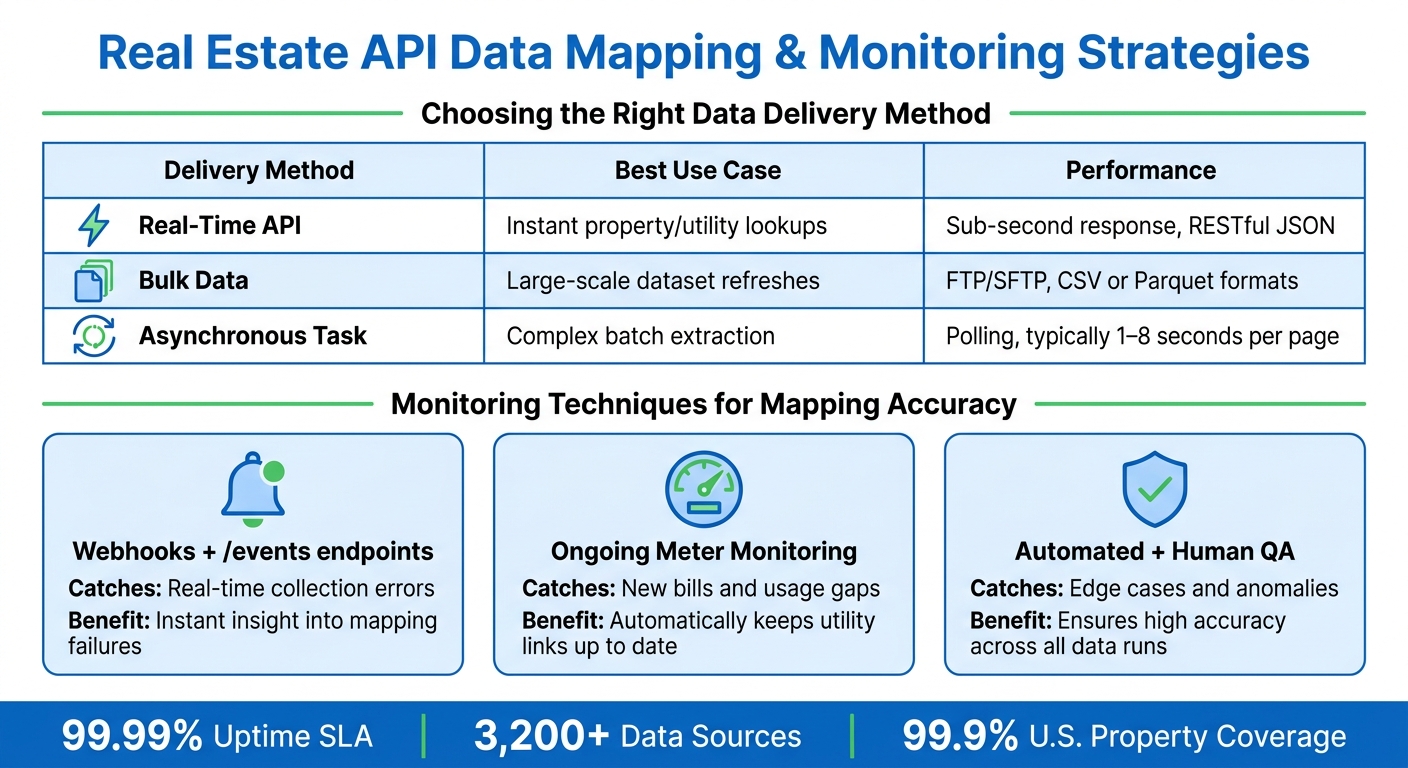
Utility Provider Data Mapping: Delivery Methods & Monitoring Techniques Compared
Building Test Datasets and Validation Processes
Once your utility mapping system is live, it’s crucial to rigorously test it. Start by creating test datasets that address edge cases like properties with multiple meters, mismatched addresses, or parcels that straddle service boundaries. These scenarios will push your mapping logic to its limits before it’s exposed to real-world use.
To ensure accuracy, compare your API results with trusted utility service area datasets. Deduplication is equally important – duplicate entries in your test data can distort validation outcomes. Clean up your test data by standardizing address formats and provider details to avoid unnecessary failures. These practices feed into a cycle of continuous monitoring, helping identify and resolve issues early.
Tracking API Performance and Mapping Errors
Keeping a close eye on API performance is essential for catching errors quickly. Use webhooks and /events endpoints to receive instant notifications whenever data collection encounters a problem. This setup allows you to address mapping failures as they happen.
For utility-specific monitoring, an ongoing-monitoring command can automatically track new bills or interval data as they appear, eliminating the need for manual checks to detect outdated links. Property data APIs offer a 99.99% uptime SLA and lightning-fast response times, while BatchData updates assessor data every 24 hours. Combining automated validation with human quality assurance for tricky edge cases ensures you maintain top-tier accuracy.
| Monitoring Method | What It Catches | Benefit |
|---|---|---|
Webhooks + /events endpoints | Real-time collection errors | Instant insight into mapping failures |
| Ongoing meter monitoring | New bills and usage gaps | Automatically keeps utility links up to date |
| Automated + human QA | Edge cases and anomalies | Ensures high accuracy across all data runs |
Real-time monitoring is just the first step – schedule regular dataset updates to keep your mapping accurate over time.
Updating and Refreshing Datasets
Utility mapping systems can degrade over time as service areas shift, companies merge, and property records evolve. To avoid these pitfalls, schedule regular audits – quarterly at a minimum – to catch outdated provider links or stale address data before they cause problems for API users.
For real-time integrations, use RESTful APIs to fetch updated data. For bulk workflows, set up scheduled SFTP or FTP deliveries that include historical snapshots to maintain accurate property-to-provider links. With access to BatchData’s extensive coverage of 3,200+ data sources spanning over 99.9% of U.S. properties, you can safeguard your mapping pipeline from disruptions and ensure it remains reliable.
Compliance and Scaling Considerations
Data Governance and Privacy
Privacy regulations for utility data differ across the U.S., so your API must address these variations carefully. For example, in California, aggregated data for buildings meeting the active account threshold is considered non-confidential, but consent is required for other cases. This distinction plays a key role in defining access rules.
To streamline workflows, incorporate electronic authorization into your API. This allows building owners or their agents to grant data permissions digitally. Additionally, automate the identification of covered buildings – properties without residential accounts or those with 5 or more active accounts – as these are subject to mandatory data sharing under benchmarking laws. Keep in mind, California utilities are required to deliver aggregated data within 4 weeks of a valid request, so your pipeline should account for this timeline.
By prioritizing privacy, you’ll be better positioned to navigate the complexities of state and regional regulatory frameworks.
State-Level Regulations and Regional Differences
Beyond privacy, state-level regulations add another layer of complexity. Some states have deregulated energy markets with multiple providers, while others rely on single monopoly utilities with tightly controlled data access. Local jurisdictions may also enforce additional benchmarking disclosure requirements.
To manage these differences, implement a canonical data model as a stable translation layer. Use semantic versioning to prevent unintended data inconsistencies. For example, properties under 50,000 square feet with 16 or fewer residential accounts are often exempt from public energy benchmarking disclosure. Your mapping logic should account for these exemptions.
Understanding these regional details is essential before scaling operations effectively.
Scaling for High-Volume API Requests
Once compliance is addressed, the next step is scaling your API to handle high request volumes. Synchronous API calls can create bottlenecks as demand grows. To avoid this, use asynchronous processing for batch operations, which helps maintain system responsiveness. For large dataset updates, bulk delivery via SFTP in formats like CSV or Parquet is far more efficient than relying on repeated real-time calls.
| Delivery Method | Best Use Case | Performance |
|---|---|---|
| Real-Time API | Instant property/utility lookups | Sub-second response, RESTful JSON |
| Bulk Data | Large-scale dataset refreshes | FTP/SFTP, CSV or Parquet formats |
| Asynchronous Task | Complex batch extraction | Polling, typically 1–8 seconds per page |
BatchData’s infrastructure ensures a 99.99% uptime SLA for its real-time property APIs. It pulls from over 3,200 data sources, covering 99.9% of U.S. properties. For enterprise workflows, consider combining automated post-extraction validation – such as checks for billing period overlaps, usage plausibility, and charge reconciliation – with human review for any edge cases that fail automated rules.
Conclusion and Key Takeaways
Utility provider data mapping isn’t just a technical feature – it’s a critical operational tool. When executed correctly, it links every property record to its respective electricity, gas, water, and other service providers using standardized, API-ready formats. This framework enables faster transactions, improves underwriting accuracy, and streamlines move-in/move-out workflows for portfolios of any size across the U.S.
The groundwork for successful utility mapping begins long before the first API call. Proper planning is essential to avoid unnecessary rework and to ensure the mapping process aligns with operational goals. By defining clear use cases and data requirements early on, brokerages can reduce unexpected challenges, investors can integrate utility details into cost models, and property managers can dedicate their time to high-value tasks rather than routine calls.
On the technical side, reliable utility mapping systems depend on standardized address and parcel identifiers, enriched API responses with provider details and confidence scores, and robust error-handling mechanisms that deliver partial results rather than failing silently. Regular validation and scheduled updates are also crucial to maintaining high data accuracy. Without ongoing enrichment, industry data suggests that 20–30% of contact and property records in real estate CRMs can degrade over time.
Compliance is another critical factor woven through every aspect of utility mapping. Features like role-based access, audit trails, and jurisdiction-aware field controls are essential, especially as privacy laws expand beyond states like California to include Virginia and Colorado. Keeping engineering, data, and legal teams aligned ensures that utility mapping frameworks stay compliant with evolving regulations.
BatchData offers a tailored solution for these challenges. With data spanning 155 million+ U.S. properties, coverage from 3,200+ providers, and a 99.99% uptime SLA on its real-time APIs, BatchData provides the reliability needed for effective utility mapping. Its services include property and contact data enrichment, address standardization, bulk delivery, and customized tools that allow teams to focus on smarter analytics rather than raw data management. A strong utility mapping system empowers real estate professionals to act quickly and make well-informed decisions.
FAQs
What’s the fastest way to match a property to the correct utility provider?
If you’re looking for the fastest way to connect a property with its utility provider, a utility lookup API is your go-to solution. These tools allow you to enter an address and quickly identify providers for services like electricity, gas, water, and internet. BatchData’s RESTful APIs take it a step further by enriching property data, automating workflows, and keeping your systems updated with precise, real-time information. This means smoother operations and better decision-making.
Which utility identifiers matter most when building a mapping API?
When working with a mapping API, the most important identifiers are those that connect a utility service to a specific property. These include:
- A unique site ID such as a siteId or an Assessor’s Parcel Number (APN).
- At least one meter identifier, like meterId or meterNumber.
To make sure the integration between utility and property data is precise, it’s also essential to include provider information. This could be details like providerId, providerName, or even a website link. These elements help maintain accuracy and reliability in data connections.
How do I keep utility mappings accurate as providers and service areas change?
BatchData simplifies the challenge of keeping utility mappings accurate in a constantly shifting landscape of providers and service areas. By pulling from over 3,000 sources, it cross-references utility records and county databases in real time. Its automated normalization engine ensures that even fragmented inputs are transformed into consistent JSON schemas. This means your mappings stay uniform and current, no matter how provider boundaries or data formats evolve.