




































Contractual obligation tracking is essential for managing responsibilities in agreements, especially in real estate. Without proper systems, businesses risk financial losses, legal issues, and missed deadlines. Key takeaways include:
- What it is: Monitoring commitments, deadlines, and responsibilities in contracts.
- Why it matters: Poor tracking costs companies up to 9% of annual revenue. In 2024, U.S. regulators levied $4.6 billion in compliance fines.
- Common issues: 78% of organizations don’t track obligations systematically, and manual processes (e.g., spreadsheets) cause 92% of errors.
- Solutions: Use centralized systems, automated alerts, and verified data to prevent missed deadlines and ensure compliance.
A reliable tracking system with features like searchable repositories, automated reminders, and dashboards can protect revenue and simplify management. For real estate, this means avoiding costly mistakes like missed rent increases or renewal deadlines. Accurate data and clear accountability are the foundation for effective obligation tracking.
Key Concepts and Obligation Types
Core Terms You Need to Know
To effectively manage obligations in real estate contracts, it’s crucial to understand the key terms that surface repeatedly. Misinterpreting these terms can lead to missed deadlines, financial losses, or legal troubles.
- Contractual obligation: A legally binding responsibility to either perform an action (positive obligation) or refrain from doing something (negative obligation), such as adhering to a non-compete clause or avoiding unauthorized property changes.
- Milestone: A defined date tied to a specific deliverable or project phase, like the completion of inspections or a tenant’s build-out deadline.
- SLA (Service Level Agreement): A contractually agreed-upon performance standard, such as a landlord’s required response time for maintenance issues.
- Notice period: The required advance notice one party must give the other before making a change, like canceling a lease, which often requires 30–90 days’ written notice.
- Renewal window: A critical time frame – commonly 30, 60, or 90 days before a contract’s expiration – during which action must be taken to renew or terminate the agreement before it auto-renews.
Additionally, there are express obligations, which are explicitly stated in the contract, and implied obligations, which stem from common law or industry practices, such as the assumption that a property will be suitable for its intended use. Another key distinction lies in liability: joint liability means all parties share full responsibility for a debt, while several liability holds each party accountable only for their portion.
These terms form the foundation for understanding the various types of obligations found in real estate contracts.
Common Obligation Types in Real Estate Contracts
Real estate contracts include a range of obligations, each with unique responsibilities and risks. Here’s a breakdown of the most common types:
| Obligation Type | Real Estate Examples | Typical Owner |
|---|---|---|
| Financial | Rent payments, late fees, earnest money deposits, prorated taxes | Finance / Accounts Payable |
| Regulatory | Zoning compliance, HOA covenants, proof of insurance | Legal / Compliance |
| Reporting | Maintenance logs, usage reports, financial audits | Operations / Property Management |
| Performance | Repair timelines, maintenance standards, facility uptime | Operations / Facilities |
| Renewal/Termination | Auto-renewal triggers, opt-out deadlines, termination notices | Legal / Procurement |
Unilateral obligations, often found in options contracts, are another key consideration. These obligations bind only the property owner to specific terms if the buyer decides to act. While they may seem straightforward, they can pose serious legal risks if overlooked.
What Goes Wrong Without Proper Tracking
Failing to track obligations properly can lead to measurable and costly consequences. For instance:
- 78% of organizations do not systematically track their contractual obligations.
- 71% of businesses cannot locate at least 10% of their contracts.
- Around 40% of organizations lack clarity on who is responsible for specific contract-related tasks.
In U.S. real estate, missing renewal windows can trap businesses in unfavorable lease terms for another cycle. Ignoring time is of the essence clauses – strict deadlines that are legally enforceable – can result in immediate contract breaches. Additionally, revenue leakage, such as uncollected rent credits or unenforced price escalations, quietly erodes value without obvious signs.
Many of these issues arise because obligations often remain buried in signed PDFs, leaving necessary actions unaddressed. As Austin Miller, a CLM expert at DocuSign, explains:
"Contractual obligations are the heartbeat of any commercial relationship. They ensure that the value negotiated during the signing phase… is actually realized."
The first step toward resolving these challenges is achieving clarity – understanding what obligations exist, assigning ownership, and identifying when action is required.
sbb-itb-8058745
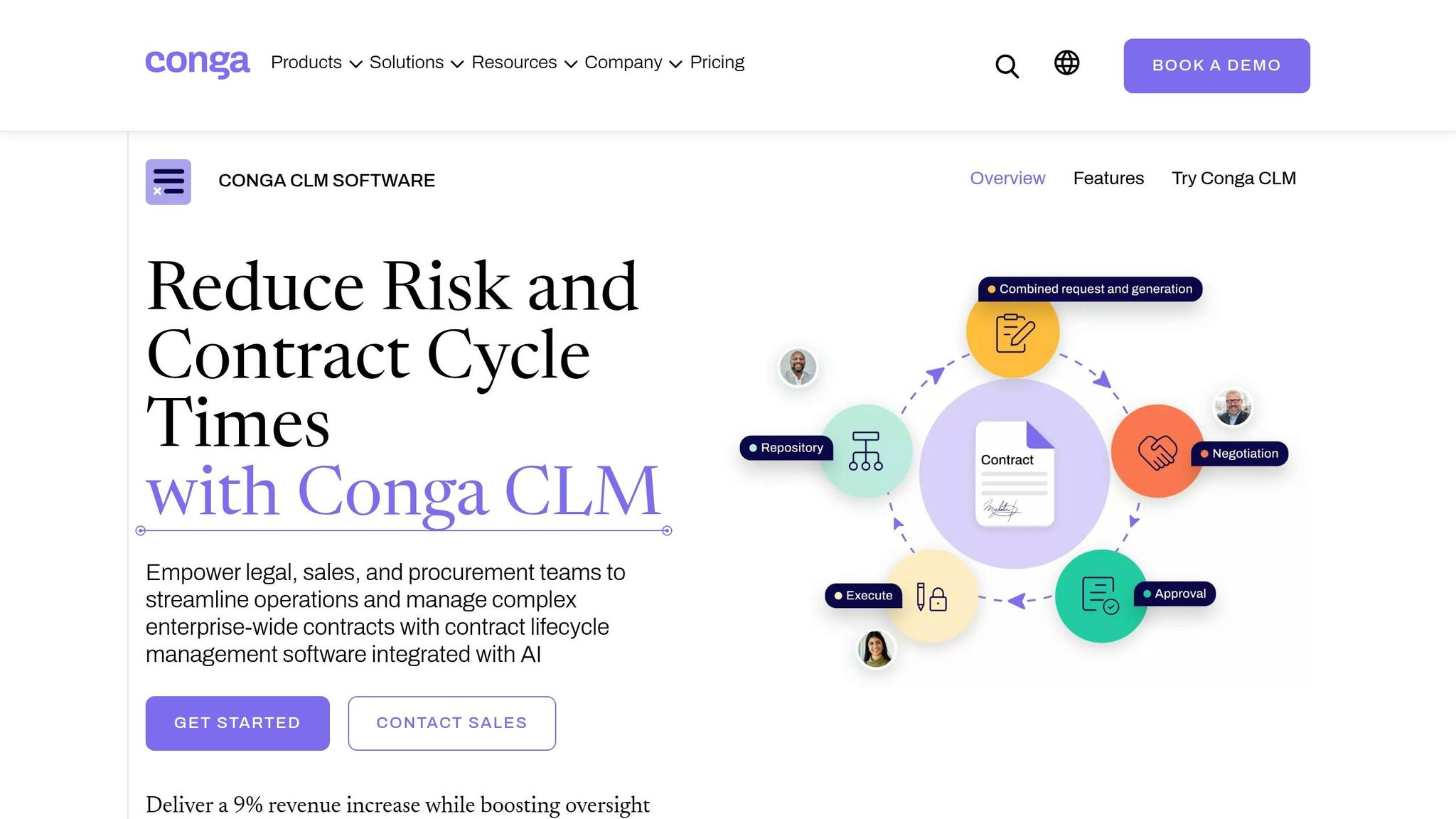
Conga CFS – Obligation Management Tutorial
Key Features of a Contractual Obligation Tracking System
Creating a system that actively manages obligations – rather than just storing them – is essential to avoiding costly oversights. A well-designed tracking system ensures obligations are visible, assigned, and addressed before deadlines creep up. Here’s how its core features work together to keep everything on track.
A Central Repository for Contracts and Obligations
At the heart of any effective tracking system is a centralized, searchable hub for all contracts and amendments. Without this, contract data often ends up scattered – studies show it can be spread across as many as 24 different systems within a single organization. This fragmentation increases the risk of missed obligations.
A strong repository includes metadata tagging (e.g., contract type, jurisdiction, effective date) and full-text search capabilities, making it easy to locate specific clauses when needed. Many systems now incorporate AI-powered extraction tools that use natural language processing to automatically identify and extract key details like dates, dollar amounts, and performance conditions. This can slash manual review time from over 45 minutes per contract to under 2 minutes.
Automated Alerts and Workflows
While a repository addresses storage issues, automated alerts tackle the challenge of timing. The key takeaway?
"The date that actually matters isn’t the renewal date [it’s the notice period]." – PactAlert
Automated systems use tiered notifications to provide reminders well in advance of deadlines, not just on the due date. For example, a typical alert schedule for real estate contracts might look like this:
| Event Type | First Alert | Second Alert | Final Alert | Escalation |
|---|---|---|---|---|
| Renewal | 90 days prior | 60 days prior | 30 days prior | 14 days prior |
| Payment | 14 days prior | 7 days prior | 2 days prior | Day of |
| Deliverable | 14 days prior | 7 days prior | 3 days prior | Day before |
| Compliance Report | 21 days prior | 10 days prior | 5 days prior | 2 days prior |
(Source: Signeasy Notification Schedule Template)
If a deadline goes unacknowledged, escalation routing ensures it doesn’t get overlooked. The system automatically forwards the alert to a backup or manager, which is especially helpful during staff transitions or busy periods. This feature alone can reduce missed deadlines by 30–50%.
Dashboards and Reporting Tools
Dashboards offer a real-time snapshot of obligation statuses, eliminating the need to sift through spreadsheets. Legal teams and property managers can filter obligations by property, region, or owner to quickly identify what’s overdue, at risk, or due in the next 30, 60, or 90 days.
Features like exception monitoring, individual task assignment, and integrated audit trails make compliance and dispute resolution far simpler. According to the World Commerce & Contracting organization, effective contract management can help companies save an average of 9% of their annual revenue. Dashboards play a pivotal role in achieving this kind of efficiency, laying the groundwork for smooth system implementation.
How to Implement Contractual Obligation Tracking: A Step-by-Step Framework
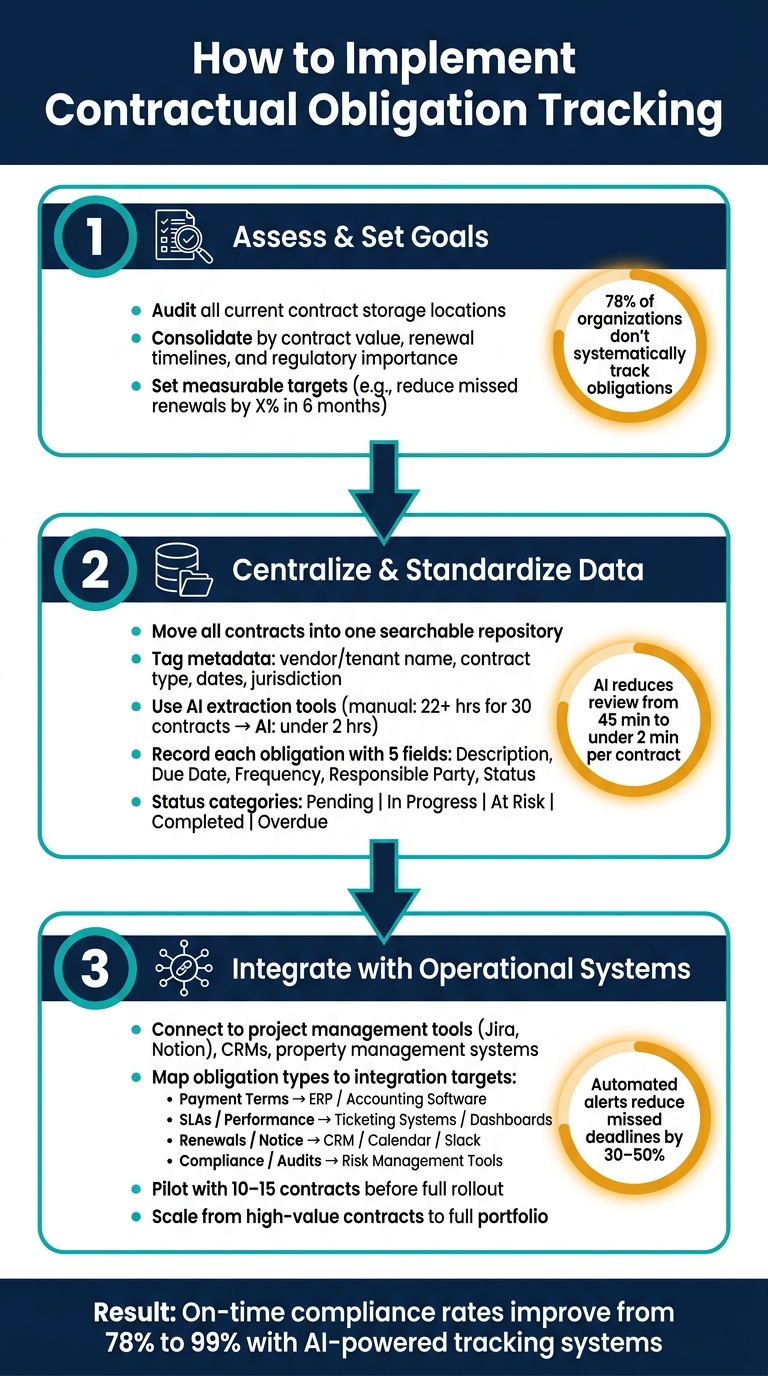
How to Implement Contractual Obligation Tracking: A Step-by-Step Framework
Building an effective system to track contractual obligations requires a structured approach, moving from scattered documents to a fully operational setup.
Step 1: Assess Current Processes and Set Clear Goals
Begin by examining how you currently store and manage contracts. Identify all storage locations and consolidate contracts based on factors like contract value, renewal timelines, and regulatory importance.
Next, establish specific, measurable goals. Instead of aiming for general improvements like "better contract visibility", set concrete targets – such as reducing missed renewal deadlines by a certain percentage within six months. These goals will help guide your strategy and provide a way to measure success later.
Once you’ve taken inventory, centralize your data to create a standardized tracking process.
Step 2: Centralize Contracts and Standardize Data
After assessing your contracts, move them into a single, searchable repository. This step isn’t just about storage – it’s about structuring your data for easy access and analysis. Tag each contract with important metadata, such as vendor or tenant name, contract type, effective and expiration dates, and jurisdiction.
Leverage AI-powered tools to streamline this process. These tools can extract obligations and convert relative deadlines into specific dates, saving significant time. For example, manual data extraction for 30 contracts can take over 22 hours, but AI tools can reduce this to under 2 hours. Steve Storck, Purchasing Manager at Denison University, shared his experience with AI tools:
"The AI is really easy to use. I just click the button, and it pulls all the key terms out of the contract."
Every obligation should be recorded in a standardized format, including at least these five fields: description, due date, frequency, responsible party, and status. Use clear status categories like Pending, In Progress, At Risk, Completed, and Overdue, so anyone reviewing the dashboard can quickly understand progress.
It’s also essential to assign each obligation to a specific person – not just a department – to ensure accountability.
Once your contracts are centralized and obligations are clearly defined, integrate this system into your day-to-day operations for real-time management.
Step 3: Connect Tracking with Your Operational Systems
A tracking system that operates in isolation is unlikely to be effective. Integration is key – connect your obligation records to tools your team already uses, such as project management platforms like Jira or Notion, CRMs, or property management systems.
For real estate teams, integrating enriched property and contact data into operational systems can ensure instant access to accurate information when alerts are triggered. Tools like BatchData can provide verified property ownership records and contact details, eliminating the need for manual lookups.
Before rolling out the system across your organization, test it with a small set of 10–15 contracts. This pilot phase will help uncover any integration issues or workflow challenges. Once the system is validated, expand in stages – starting with high-value contracts before scaling to the full portfolio.
| Obligation Type | Typical Owner | Integration Target |
|---|---|---|
| Payment Terms | Finance / Accounts Payable | ERP / Accounting Software |
| SLAs / Performance | IT / Operations | Ticketing Systems / Dashboards |
| Renewals / Notice | Legal / Procurement | CRM / Calendar / Slack |
| Compliance / Audits | Legal / InfoSec | Risk Management Tools |
Real Estate Use Cases for Contractual Obligation Tracking
Real estate contracts are packed with critical financial triggers, notice periods, and regulatory requirements. Missing a single obligation can lead to significant financial consequences, often outweighing the effort required to track these commitments effectively.
Lease Administration and Rent Management
Managing rent escalations – whether tied to fixed steps, CPI adjustments, or market resets – requires precision. Trigger dates must be accurately tracked to avoid underbilling tenants or overcharging them. Without automated systems to flag these dates, landlords risk revenue losses, while tenants may end up paying more than they should.
Common Area Maintenance (CAM) reconciliations add another layer of complexity. Most leases require landlords to provide annual reconciliation statements within a specific timeframe. Tenants, in turn, often have 12–18 months to exercise their audit rights. Missing these deadlines can lead to forfeited revenue for landlords or waived audit rights for tenants.
"Missing a critical date in a commercial lease is not an administrative inconvenience – it is a legal and financial event." – Lextract
Beyond rent, obligations like Tenant Improvement (TI) allowance draw deadlines and security deposit returns are also crucial. Centralizing these tasks reduces document fragmentation, simplifies enforcement, and helps both parties avoid unnecessary disputes. This approach minimizes financial and operational risks throughout the lease term.
Renewals, Options, and Terminations
Tracking key dates is essential for managing renewals, options, and terminations. For every lease, three dates must be monitored: the Notice Date, the Renewal Date, and the Expiration Date. Treating these as a single "end date" often leads to missed renewal options or unintended auto-renewals. Automated alerts set well before notice deadlines provide ample time for negotiations and prevent costly mistakes.
Break clauses present additional risks. Courts have invalidated early termination rights over minor errors, such as late notices or incorrect formats. To mitigate these risks, systems should log delivery confirmations and ensure compliance with all notice requirements.
"Auto-renewal dates don’t feel pressing until you’re 48 hours past the opt-out window and locked into another year of unfavorable terms." – Ironclad
Compliance and Risk Management Across U.S. Jurisdictions
For real estate firms operating in multiple states, compliance becomes even more challenging. Regulatory obligations tied to lease milestones vary by jurisdiction, making manual tracking nearly impossible.
"Many real estate companies operate across state lines, with varying regulatory obligations tied to lease milestones. Having a system in place that tracks and reminds you about these requirements improves operational performance and protects you from fines." – John VanDuzer, Partner, James Moore
ASC 842 compliance is another critical area, requiring precise tracking of lease modifications and options for accurate financial reporting. A centralized tracking system can serve as a single source of truth for finance, legal, and asset management teams, particularly during audits or property acquisitions.
Insurance renewals and scheduled inspections are additional obligations that can quietly fall through the cracks. If a property temporarily loses compliance with its certificate of insurance, it risks voiding coverage at critical moments. Assigning specific individuals to monitor these milestones ensures continuous compliance and avoids lapses.
| Real Estate Obligation Type | Key Tracking Focus | Primary Stakeholder |
|---|---|---|
| Financial | CPI escalators, CAM reconciliations, late fees | Finance / Accounts Payable |
| Temporal | Renewal windows, termination notice periods | Legal / Asset Management |
| Compliance | Insurance renewals, ASC 842 reporting, inspections | Legal / Compliance |
| Performance | Maintenance SLAs, delivery of tenant improvements | Operations / Project Management |
accurate property records and verified contacts are essential for managing obligations in a timely manner. By integrating enriched data into tracking systems, real estate firms can ensure operational efficiency and maintain compliance, reinforcing the importance of strategic obligation management.
Conclusion
Tracking contractual obligations isn’t just a good practice – it’s a critical financial safeguard. Consider this: organizations lose an average of 9% of their annual revenue due to poor contract management, and 95% lack full visibility into their commitments. These statistics underscore a widespread issue that can’t be solved with spreadsheets or basic calendar reminders.
The main takeaway here is simple: obligations are actions, not just dates on a calendar. Without clear ownership, tiered alerts, and an escalation process, renewal dates remain just that – dates. Shifting from reactive tracking to proactive management makes a world of difference. Automated reminders at intervals like 90, 60, 30, and 7 days can transform how commitments are handled, turning chaos into consistency. This proactive approach not only minimizes risks but also builds a framework for greater operational efficiency.
"The companies that don’t lose 9% of revenue on this aren’t smarter. They just have a system." – PactAlert
An effective system relies on three key elements: centralization, AI-powered data extraction, and seamless operational integration. AI tools speed up contract reviews and improve on-time compliance rates from 78% to 99%. For real estate firms handling lease escalations, CAM reconciliations, multi-state compliance, or loan covenants, this efficiency can mean the difference between smooth operations and costly errors.
At the heart of this efficiency is accurate, enriched data. Verified property and contact information – like that provided by BatchData – Ivo Draginov – ensures that every alert and task is based on up-to-date records. This means deadlines and assignments reflect the current reality, not outdated or incomplete information, helping organizations stay ahead of their commitments.
FAQs
What obligations should I track first?
Start by keeping a close eye on obligations that have the biggest or most immediate impact on your business. These include renewal dates, payment schedules, and delivery milestones – all of which directly influence compliance, cash flow, and daily operations. Don’t forget to monitor notice periods for cancellations or terminations to avoid unwanted automatic renewals. Tracking project deliverables is equally important to stay on schedule and keep clients happy. Focusing on these key areas helps streamline your processes and reduce potential risks.
How do I convert notice periods into exact dates?
To figure out exact dates based on notice periods, simply add the notice duration (like 30, 60, or 90 days) to the starting point – this could be the contract’s start or renewal date. For instance, if a 60-day notice is needed before a contract renewal on June 30, 2026, count backward 60 days to pinpoint the deadline: May 1, 2026. This approach helps you stay on top of deadlines and avoid missing important notices.
How can I keep owner and contact data accurate over time?
To keep owner and contact data accurate, it’s important to take a proactive approach. Start by scheduling regular updates and implementing verification processes to catch errors early. Automated alerts can also help flag outdated or incorrect information.
Centralizing your data and assigning clear ownership for maintaining it ensures everyone knows their responsibilities. Using tools to track these responsibilities can further minimize mistakes. Regular reviews are another key step – they help prevent data from becoming outdated and reinforce accountability.
You might also consider using contract lifecycle management (CLM) systems. These systems can automate reminders and updates, making it easier to maintain accurate data over time.


