
In real estate, accurate and fast property data is a game-changer. This guide highlights the top 10 property data providers that help investors identify opportunities, assess risks, and make informed decisions. From detailed ownership records to predictive analytics, these platforms cater to various needs, including residential, commercial, and rental investments.
Key Takeaways:
- BatchData: Offers over 1,000 data points per property, advanced analytics, and real-time API integration.
- ATTOM Data Solutions: Covers 158 million properties with predictive tools like “Propensity to Default” scores.
- CoreLogic: Features 5.5 billion property records and AI-powered valuation tools for precise insights.
- CoStar: Focuses on commercial real estate with detailed lease and sales data.
- PropStream: Provides 160 million property records with lead generation and AI-driven insights.
- Zillow: Known for its Zestimate tool and market heat index for residential properties.
- Realtor.com: Offers real-time MLS data with market hotness rankings and lead delivery APIs.
- DataTree: Backed by First American, it delivers detailed property searches and interactive mapping.
- Green Street: Specializes in commercial real estate with market forecasts and price indices.
- HouseCanary: AI-driven insights for residential investments, covering 136 million properties.
Quick Comparison:
| Provider | Property Coverage | Key Features | API Integration | Focus Area |
|---|---|---|---|---|
| BatchData | 155M+ properties | 1,000+ data points, predictive analytics | Real-time API | Residential |
| ATTOM | 158M+ properties | 70B records, foreclosure data | RESTful API | Residential/Commercial |
| CoreLogic | 5.5B records | AI valuation, sell scores | Customizable APIs | Residential/Commercial |
| CoStar | 6M+ commercial properties | Lease/sales analytics, market forecasts | Integrated APIs | Commercial |
| PropStream | 160M+ properties | AI insights, lead generation | Limited API | Residential |
| Zillow | MLS & public records | Zestimate, market heat index | 20+ APIs | Residential |
| Realtor.com | MLS-listed homes | Market hotness index, lead delivery | Lead Delivery API | Residential |
| DataTree | 99% U.S. coverage | Advanced search, interactive mapping | JSON-based API | Residential/Commercial |
| Green Street | 100 global markets | CRE price index, market grades | API, Excel, Snowflake | Commercial |
| HouseCanary | 136M+ properties | AI-driven forecasts, block-level data | Data Explorer API | Residential |
Choosing the right provider depends on your investment strategy, whether it’s flipping homes, managing rental portfolios, or exploring commercial opportunities. Each platform offers unique tools to streamline your workflow and enhance decision-making.
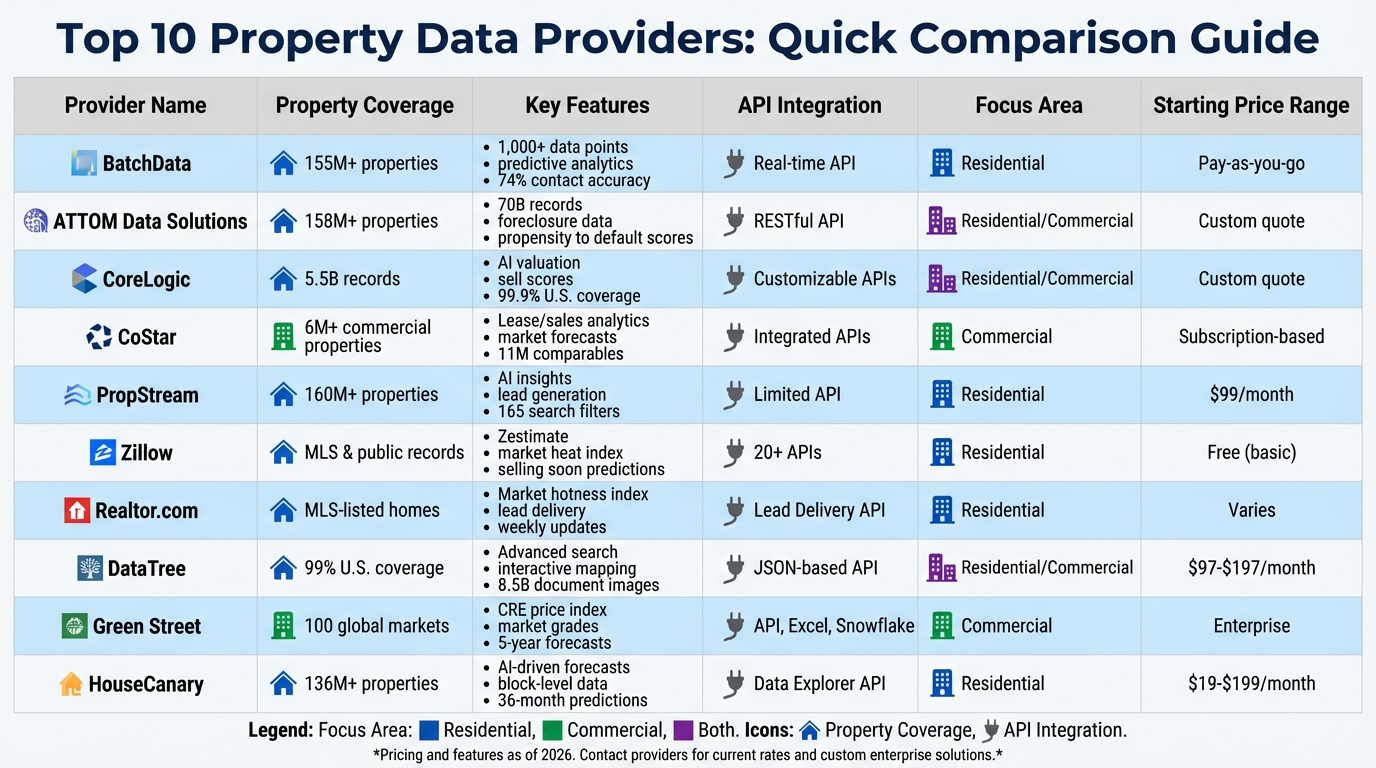
Top 10 Property Data Providers Comparison Chart for Real Estate Investors
1. BatchData
Property Data Coverage and Accuracy
BatchData provides data on over 155 million properties across the U.S., offering more than 1,000 data points per asset. The platform delivers everything from basic property details – like the number of bedrooms, bathrooms, square footage, and zoning – to highly specific features such as HVAC systems and roof types. Ownership records are equally detailed, including owner names, mailing addresses, absentee status, and even identifying individuals behind LLCs and trusts.
Financial insights include automated valuation models (AVM), estimated equity, LTV ratios, and a complete history of mortgages and liens. For those targeting distressed properties, BatchData provides access to pre-foreclosure notices, auction dates, trustee details, and detailed legal descriptions.
When it comes to contact data, the platform enriches property records with up to five phone numbers and three email addresses per property, complete with reachability scores and tools to flag potential TCPA compliance risks. This extensive dataset forms the backbone of BatchData’s powerful analytics.
Analytics and Predictive Tools
BatchData goes beyond just providing raw data – it equips investors with advanced analytics to zero in on specific opportunities. With over 700 data points available for filtering, users can identify properties that match precise criteria, such as long-term absentee ownership or unique equity situations. Features like price confidence scores and propensity scoring help prioritize leads more effectively.
“What used to take 30 minutes now takes 30 seconds. BatchData makes our platform superhuman.” – Chris Finck, Director of Product Management
BatchData’s tools are designed for seamless efficiency, integrating with real-time APIs to deliver insights instantly.
API and Integration Capabilities
BatchData’s real-time API is engineered for efficiency, allowing users to pull multiple datasets – like property details, ownership history, and contact information – in a single query. This reduces both latency and costs. The platform guarantees 100% uptime for its Property Search API and integrates with leading CRMs such as Salesforce, HubSpot, and Podio, making lead enrichment and contact validation a breeze. For larger-scale operations, bulk data delivery options are available via AWS S3, Snowflake, or flat files.
A standout feature is the Model Context Protocol (MCP) server, which connects directly to AI tools like Claude. This integration enables investors to go from research to actionable strategies in minutes. Whether users prefer a “Push” or “Pull” architecture, the API offers flexibility to fit seamlessly into existing workflows.
Specialized Features for Real Estate Investors
BatchData offers specialized tools tailored to real estate professionals. Its skip tracing and phone verification APIs ensure that contact details are accurate before launching marketing campaigns, reducing wasted outreach and lowering legal risks. For fix-and-flip investors, permit data identifies properties with older roofs or those without solar installations, helping create highly targeted lead lists.
Additionally, CRM enrichment tools automatically update lead records with the latest property values and distress indicators, ensuring sales teams always have the most current and actionable data.
These features allow investors to implement precise, data-driven strategies with speed and confidence.
Real Estate Data Masterclass 2025: AI + Automation
2. ATTOM Data Solutions
ATTOM Data Solutions provides a powerful platform for detailed real estate analysis, offering one of the most expansive property data collections available.
Property Data Coverage and Accuracy
ATTOM’s database includes information on 158 million U.S. properties, covering 99% of the population. Data is sourced from over 3,000 counties, creating a massive repository with 70 billion rows and 9,000 attributes, amounting to approximately 30TB of data.
The platform delivers a wide range of property-related data, including tax records, deeds, mortgages, foreclosures, property features, sales history, and Automated Valuation Models (AVMs). It also offers specialized datasets like building permits, HOA fees, “Propensity to Default” models, and property flipping reports. For example, the building permit database tracks over 200 million permits from more than 2,000 building departments, covering 94% of the largest U.S. cities.
Data quality is maintained through a rigorous 20-step Enterprise Data Management Program (EDMP), which standardizes and validates information before assigning each property a unique “ATTOM ID”. This identifier allows users to connect various datasets – such as tax records and foreclosure filings – seamlessly for any given property.
Analytics and Predictive Tools
ATTOM’s Market Analytics suite provides tools for analyzing market trends, including flipping reports, foreclosure activity, sales trends, and vacancy rates. It also includes affordability metrics, iBuyer analysis, and predictive features like “Propensity to Default” scoring, which helps identify distressed properties early.
“ATTOM’s Q1 2026 Home Affordability Report shows homes still remain unaffordable as 97% of counties are less affordable despite wage growth.” – ATTOM
The platform supports both AVMs and Rental AVMs, helping users evaluate property values and potential rental returns. Tools like “Neighborhood Navigator” and “Property Navigator” enable comparisons of local trends, including crime rates, school performance, and environmental risks. ATTOM’s data is also optimized for machine learning, making it easy to integrate into risk models and trend forecasting.
API and Integration Capabilities
ATTOM’s RESTful API architecture ensures fast, scalable access to its data, making it ideal for modern PropTech applications. With a persistent ATTOM ID assigned to every property, developers can easily combine datasets and access endpoints for property details, mortgage history, AVMs, foreclosure data, and more.
The platform offers flexible delivery options, including Snowflake cloud integration, bulk licensing, and “Match & Append” services to enhance existing databases. Developers can explore the platform with a 30-day trial and a free API key before committing to a subscription. The ATTOM Nexus tool provides a centralized interface for assessing data quality and coverage before deeper API integration.
Specialized Features for Real Estate Investors
ATTOM equips investors with tools to make informed decisions by offering climate risk data, including scores for floods, wildfires, heat, and drought. Additional natural hazard indices cover tornadoes, hail, and radon exposure.
The building permit database highlights properties undergoing significant renovations, while foreclosure data and default propensity scores help investors identify distressed assets early. Neighborhood data, such as crime rates, school test scores, demographics, and unemployment rates, provides a well-rounded view of market conditions. ATTOM’s data structure is tailored for automated underwriting and machine learning, making it particularly effective for large-scale operations.
3. CoreLogic

CoreLogic runs an extensive property database in the U.S., managing a staggering 5.5 billion property records collected over 50 years. It claims to cover 99.9% of U.S. properties, with 99.5% of the data sourced directly. This resource serves over 1.2 million real estate professionals, offering detailed insights into property characteristics, ownership data, mortgage records, and home equity trends dating back to 2009. Below, we explore CoreLogic’s data coverage, analytical tools, integration options, and features tailored for real estate investors.
Property Data Coverage and Accuracy
CoreLogic delivers detailed property intelligence via its proprietary CLIP® solution, which connects various data points to form unified property records. The platform boasts 94% MLS coverage across the U.S., along with granular data on building specs, lot details, and construction features. It also tracks 95% of all voluntary liens nationwide with real-time ownership and mortgage data. Additionally, the database includes 25 years of home price trends, natural hazard risk models, and energy efficiency metrics.
Analytics and Predictive Tools
CoreLogic leverages AI and machine learning to power tools like Total Home ValueX (THVx), which provides automated property valuations using a single-model approach. Propensity scores predict five major real estate events within six months, giving investors a competitive edge. Another standout tool, Realist, evaluates “sell scores” to identify homeowners likely to list their properties.
For instance, in January 2026, broker Rick Martinez used Realist to focus his marketing efforts on homeowners with sell scores over 500, helping him streamline his outreach:
“It helps me identify homeowners in specific subdivisions who have a ‘sell score’ of 500+ so that I can send them a postcard and place an advertising hanger on their door.” – Rick Martinez, Broker, Golden Crescent Realty LLC
The Araya™ platform acts as a comprehensive SaaS solution for market, portfolio, and property insights. Through The Exchange, investors can access specialized datasets – such as involuntary liens, pre-foreclosure statuses, and building permits – to uncover distressed property opportunities. Meanwhile, market risk indicators and home price forecasts provide tools to gauge volatility and assess potential risks.
API and Integration Capabilities
CoreLogic offers customizable APIs that seamlessly integrate its property data into existing investor tools and CRMs, providing real-time updates with minimal latency. It also supports integration with cloud platforms like Databricks, Google Cloud, and Snowflake, eliminating the need for manual data imports. The Discovery Platform further enables secure, fast evaluation and integration of property data, while AI-driven automation simplifies complex data analysis in minutes.
Specialized Features for Real Estate Investors
For investors, CoreLogic provides Growth Intelligence tools to pinpoint emerging real estate markets. The platform also delivers hyper-local insights, including natural hazard risk assessments, crime rates, school ratings, demographics, and employment trends. It tracks distressed property indicators like involuntary liens, judgments, and bankruptcy filings. Flexible pricing options are available, including pay-as-you-go RESTful JSON APIs and custom quotes for bulk data licensing.
4. CoStar

Let’s take a closer look at CoStar and its offerings for the commercial real estate sector. CoStar manages an extensive database of commercial real estate in the United States, covering 6 million properties and 11 million lease and sale comparables across various sectors like office, retail, industrial, multifamily, hospitality, and mixed-use properties. Over the past 38 years, the company has poured more than $5 billion into building this proprietary database. Backed by a team of over 1,500 researchers conducting thousands of daily updates, CoStar ensures data accuracy and reliability. This robust infrastructure empowers investors to make informed decisions in commercial real estate markets.
Property Data Coverage and Accuracy
CoStar provides market and submarket insights for over 3,000 markets across the country. The platform offers detailed property data, including characteristics, verified lease comparables, historical rent trends, and ownership records across all major commercial property types. Its unified backend system, which integrates CoStar and LoopNet, reduces research delays and improves data quality. With 8.3 million tenant profiles available, users can track occupancy patterns and identify potential vacancies before they hit the market. This rich dataset forms the backbone of CoStar’s analytics tools.
Analytics and Predictive Tools
CoStar’s analytics tools are designed to forecast market trends across 17,000 locations. Its COMPASS model uses 18 years of historical data to evaluate credit risks and predict defaults for commercial properties. Investors can also access tools to project Net Operating Income (NOI) and property values. CoStar Risk Analytics offers portfolio and debt analysis, helping investors identify vulnerabilities in their real estate holdings.
John Grotto, Senior Director of Real Estate at The Hertz Corporation, shared how CoStar’s tools helped negotiate a better lease deal:
“If I save $1000 a month on a 5-year lease, then I’ve saved the Hertz Corporation $60,000 for just one transaction. That’s where we add value in the real estate department with CoStar.”
API and Integration Capabilities
CoStar simplifies data access by integrating with platforms like CoStar Real Estate Manager and Visual Lease, which combine lease management and accounting into existing workflows. The platform also leverages Matterport’s 3D digital twin technology, allowing users to interact virtually with property data. Specialized tools like CoStar for Lenders and Benchmark enhance risk assessment and market comparisons. With 78 offices in 14 countries and a team of 8,400 employees, CoStar centralizes data across sectors, including office, industrial, retail, hospitality, and residential. These integrations enable investors to act quickly and with confidence.
Specialized Features for Real Estate Investors
CoStar offers tools like Saved Search and Automatic Notifications to monitor expiring leases and uncover off-market opportunities. The Peer Property Comparison feature allows investors to benchmark a property’s performance against similar assets in the same submarket. For CMBS investors, the platform provides data on 191,000 CMBS properties, along with tools for cash flow forecasting, expected loss analysis, and price-yield evaluations. With a 90% contract renewal rate for subscriptions lasting 12 months or more, CoStar generates about 95% of its revenue from subscriptions.
5. PropStream
PropStream provides access to data on more than 160 million U.S. properties, pulling from public records, MLS listings, and private sources. This includes 70 million MLS records, 308 million deed and sales records, 185 million mortgage records, and 150 million involuntary liens. With this level of detail, investors can explore ownership histories, mortgage balances, tax records, and MLS data. However, some users have noted delays in data updates – sometimes exceeding 30 days in certain counties.
Property Data Coverage and Accuracy
The platform features 165 search filters and 20 pre-built “Quick Lists” aimed at lead types like pre-foreclosures, tax liens, and vacancies. Its database includes 41 million pre-foreclosure records and over 7 billion document images. While the data is generally reliable across the country, occasional delays in updating ownership changes can occur due to reliance on national aggregators. Investors can also use the “flip comps” tool to pinpoint properties bought and sold within a 24-month window, offering insights into local investor activity and after-repair value (ARV).
Analytics and Predictive Tools
PropStream recently launched “PropStream Intelligence”, an AI-powered data suite designed to enhance lead generation with predictive insights. This tool allows investors to combine multiple targeting factors – like absentee owners, out-of-state owners, or downsizing homeowners – with specific property attributes to create focused audience lists. Additionally, the platform includes Rehab and ADU (Accessory Dwelling Unit) calculators to provide detailed cost analyses and ROI projections for potential projects.
“The ability to combine targeting factors – like absentee and out-of-state owners or downsizing homeowners – with specific property characteristics has transformed lead generation” – Josh Schoenly, Team Leader at eXp Realty
Specialized Features for Real Estate Investors
PropStream’s “Lead Automator” add-on, starting at $27 per month, keeps marketing lists updated automatically as new properties meet specific criteria. The mobile app supports “driving for dollars”, allowing users to check property details and send mailers directly from their phones. Following its July 2025 acquisition of BatchDialer, PropStream now integrates calling capabilities within the platform. Subscriptions start at $99 per month, with skip tracing priced at about $0.12 per lead for Essentials users. These tools are specifically designed to enhance investor efficiency and streamline workflows.
6. Zillow
Zillow pulls together data from MLS listings, public records, tax assessments, and historical sales data across the United States. It provides detailed property information, including the number of bedrooms, bathrooms, square footage, and neighborhood-level insights like market trends and real estate metrics. Investors can narrow their search using filters such as “3D Tour”, “Fenced yard”, or “New Construction” to focus on properties that meet their specific needs. This extensive data fuels Zillow’s tools for property valuation and market analysis.
Property Data Coverage and Accuracy
Zillow’s Zestimate tool offers quick property value estimates by leveraging an automated valuation model that covers millions of homes. Another standout feature is the “Selling Soon” tool, which predicts homes likely to sell within the next 30 days based on listing dates, pricing, and property details. These tools provide investors with actionable insights to make informed decisions.
Analytics and Predictive Tools
Zillow’s Market Heat Index assigns scores ranging from 1 to 100 to reflect market conditions. A score above 55 indicates a seller-friendly market, while below 45 signals a buyer-friendly environment. These scores are calculated using data like user engagement, price reductions, and listing activity. Zillow also tracks the Zillow Home Value Index (ZHVI), which represents typical home values, and offers a Rental & New Construction Dynamics dashboard for insights into rental concessions and permit activity.
API and Integration Capabilities
To enhance data accessibility, Zillow provides nearly 20 APIs, including those for Public Data, Zestimate, Mortgage, LOS Plug-In, and Transaction Management. These APIs allow seamless integration with investment analysis tools, making it easier for investors to incorporate Zillow’s data into their workflows.
Specialized Features for Real Estate Investors
The “BuyAbility” tool helps estimate affordability and loan qualification by factoring in real-time mortgage rates and personal financial details. Zillow’s rental network simplifies the process of managing rental properties, from finding tenants to collecting rent. Additionally, the Affordability Dashboard tracks how changes in mortgage rates impact local buying power, offering insights into shifts in market demand.
7. Realtor.com
Realtor.com is a key player among property data providers, offering an extensive Residential Real Estate Data Library. This library includes MLS-listed for-sale homes across the United States, covering single-family homes, condos, and townhomes. With data sourced from hundreds of channels and updated monthly, Realtor.com provides real-time access to property listings, including foreclosures, new builds, and recently sold homes. The platform supports multiple geographic levels, from national trends down to ZIP codes.
Property Data Coverage and Accuracy
Realtor.com updates its U.S. housing inventory data every Thursday, ensuring timely insights into market changes. Monthly housing data is typically refreshed by the 5th of each month, and the “Market Hotness” rankings are updated monthly, with the latest being on March 13, 2026. However, in areas with unique definitions of active inventory or limited sales coverage, data can show volatility. Investors analyzing smaller markets or regions with fewer listings should approach the data with caution.
“Data in this Real Estate Data Library is based on the most comprehensive and accurate database of MLS-listed for-sale homes in the industry.” – Realtor.com
This commitment to accuracy, combined with regular updates, makes Realtor.com a reliable resource for real estate insights.
Analytics and Predictive Tools
Realtor.com equips investors with powerful analytics tools, including the Market Hotness Index, which combines Demand and Supply Scores to pinpoint areas with high buyer interest. The Demand Score reflects the number of unique listing page views per property, while the Supply Score measures how quickly homes are selling by tracking median days on the market. Together, these metrics create the Hotness Score, offering a comprehensive view of market dynamics. Additional data points, like Pending Ratio and Price Decrease Count, provide even deeper insights into market conditions.
API and Integration Capabilities
Realtor.com also excels in API functionality, allowing seamless integration with CRM systems. The Lead Delivery API (eLead) connects its lead delivery system to CRMs like Follow Up Boss, LionDesk, and Top Producer. This API delivers detailed lead data, including listing URLs, coordinates, MLS IDs, and search/view history. All API calls are encrypted with HTTPS, and an optional digital signature ensures data integrity. While email leads can serve as a backup, implementing deduplication is recommended to avoid processing the same lead multiple times.
Specialized Features for Real Estate Investors
Realtor.com goes beyond data by offering tools tailored to landlords and investors. These include tenant screening, lease creation, and online rent collection. The platform also releases annual “Hottest Zip Codes” lists and forward-looking housing market predictions, such as the 2026 forecast published earlier this year. Historical data is frequently updated to improve accuracy, so investors should refresh their datasets monthly. Additionally, the Residential Real Estate Data Library provides downloadable public datasets for research, which must be attributed to “Realtor.com Economic Research”.
These features, combined with its advanced tools and analytics, make Realtor.com a valuable resource for data-driven real estate strategies. Its offerings simplify operations and enhance decision-making, giving investors a competitive edge in the housing market.
8. DataTree

DataTree stands out as a versatile property research and prospecting platform, designed with real estate investors in mind. Backed by First American Data & Analytics, this web-based tool provides access to one of the largest property data collections available. Users can search properties using various methods, including address, Assessor’s Parcel Number (APN), owner name, or even through an interactive map interface.
Property Data Coverage and Accuracy
DataTree’s database offers extensive coverage across key property data categories. It boasts 99% coverage for deeds, mortgages, foreclosures, and map/parcel boundary data. Assignments and lien releases are covered at 96%, while active real estate listings span 85% of the market. With over 8.5 billion land record images and daily updates reflecting new transactions and recorded documents, the platform ensures users have access to the most up-to-date information. Additionally, investors can retrieve critical documents, such as conveyance deeds, judgments, and assessor maps, directly from their original sources. This level of accuracy and timeliness is crucial for making well-informed investment decisions.
Specialized Features for Real Estate Investors
DataTree goes beyond data access by offering tools tailored to investors’ needs. With over 125 advanced search fields, users can generate targeted lead lists based on criteria like equity, open liens, or foreclosure status. The platform’s Map Selection Tool allows users to draw freehand, polygon, or radius shapes to zero in on specific areas. Property Event Flags highlight properties that are for sale, recently sold, or in foreclosure/auction.
Interactive overlays provide further insights, displaying details like flood zones, Opportunity Zones, school boundaries, and HOA information. Reports such as TotalView and Enhanced Transaction History give a detailed picture of a property’s financial and ownership history, helping investors make confident decisions.
API and Integration Capabilities
For those looking to integrate property data directly into their workflows, DataTree offers a JSON-based real estate API. This API allows seamless integration with existing business systems, automating data feeds to eliminate manual processes and reduce platform switching. It delivers a range of information, including property details, tax data, foreclosure activity, and recorded document images, all in real time.
The API also incorporates the Procision Automated Valuation Model (AVM), enabling rapid property or portfolio valuations. Additionally, it provides Homeowner Association contact information, lien data (including PACE liens for clean energy financing), and direct access to recorded real estate document images using document IDs.
Pricing Options
DataTree offers flexible, pay-as-you-go pricing through its Online Store. Plans start at $97/month for Basic, $147/month for Plus, and $197/month for Premium, with higher-tier plans offering greater savings on reports and lead generation.
9. Green Street
Green Street brings over four decades of experience in commercial real estate (CRE), offering data-driven tools and insights for investors managing high-value commercial properties. Their platform focuses on institutional-grade analytics, catering to large-scale assets like office buildings, industrial warehouses, retail centers, and apartment complexes.
Property Data Coverage and Accuracy
Green Street’s database spans 100 global markets and 20 property sectors, including the top 50 U.S. markets and 334 tertiary markets across four key sectors. Every transaction is meticulously verified by trained associates to ensure accuracy, making it a trusted resource for CRE professionals. Their reach extends across North America, Europe, and, as of October 2025, the Australian REIT market.
The platform specializes in transactions valued at $5 million or more, with its Sales Comps database standing out due to its rigorous manual verification process. Additionally, Green Street’s advisory branch has supported over $40 billion in transactions, further solidifying its reputation for reliable market intelligence.
Analytics and Predictive Tools
Green Street offers five-year forecasts for operating fundamentals and asset values across regions like the U.S., Canada, and Europe. Their Automated Valuation Model (AVM) allows investors to quickly evaluate market positions and risks for entire portfolios. The Commercial Property Price Index (CPPI®) provides real-time tracking of asset values, serving as a key benchmark for performance measurement.
In March 2026, Green Street integrated Placer.ai foot traffic data into its U.S. platform. This addition offers deeper insights into retail activity and tenant performance at specific locations. Investors can also use the platform’s proprietary Market Grades – ranging from A- to C+ – to evaluate submarket quality during due diligence.
For those investing in public markets, Green Street analyzes over 160 REITs worldwide, delivering Net Asset Value (NAV) estimates, balance sheet reviews, and Buy/Hold/Sell recommendations.
“Hands down, Green Street has the best data & analytics of any CRE research firm. Their credibility is second to none.” – Bruce Choate, Director & Board Member at Watson Land Company
These tools are designed to seamlessly integrate into the decision-making processes of CRE investors.
API and Integration Capabilities
Green Street ensures its insights fit smoothly into existing workflows with three integration options: Excel Add-in, Snowflake, and direct API access. These methods eliminate the need for manual data entry, providing real-time updates. The Snowflake integration is particularly useful for managing large datasets and automating CRE intelligence within internal systems.
The platform’s API supports every stage of the investment lifecycle, from sourcing opportunities to refining exit strategies and managing risks. Investors can directly feed real-time comps and valuation models into their tools to better estimate potential returns.
“I’ve followed Green Street for 25 years. Their research is always timely, objective, and invaluable for public and private investing. Simply the best real estate research firm.” – Youguo Liang, Head of Global Research at Abu Dhabi Investment Authority
10. HouseCanary
HouseCanary stands out among property data providers by delivering AI-driven insights across 136 million properties in all 50 U.S. states. This platform is designed to help residential investors make swift, informed decisions. Impressively, it supports 6 of the top 10 Single-Family Rental REIT operators and 4 out of 5 top buyers of residential whole loans on Wall Street, showcasing its strong reputation among institutional investors.
Property Data Coverage and Accuracy
HouseCanary takes property intelligence to the next level with block-level Home Price Index (HPI) values and advanced image recognition to assess home conditions. This level of detail is particularly valuable for analyzing high-loan-value properties.
“I was sold on HouseCanary by the granularity of their data. Most other providers only offer HPI values at the MSA level. HouseCanary’s block-level data, especially at higher loan values, was a big selling point.” – California-Based Regional Bank
Their data undergoes rigorous quality control, both AI-driven and manual, and is compiled from thousands of sources. Beyond basic property details like bedrooms, bathrooms, and square footage, HouseCanary includes additional insights such as crime scores, school proximity, frontage orientation, privacy ratings, and even environmental risks.
Analytics and Predictive Tools
At the heart of HouseCanary’s analytics is CanaryAI, which powers its valuation and forecasting tools. By processing vast datasets, it provides instant property valuations and market predictions. The Acquisition Explorer tool helps investors tailor “buybox” searches across all 50 states, applying specific investment criteria. For those managing portfolios, the Teams plan ($199/month or $1,990/year) includes features like monitoring up to 50 properties, tracking value trends, and identifying potential risks.
The platform also offers price and rental forecasts for up to 36 months, enabling investors to anticipate market changes with confidence. W. Luke Newcomb, VP of Capital Markets, highlighted the platform’s efficiency:
“HouseCanary’s user-friendly platform has allowed us to accurately assess property risk and generate precise valuations for thousands of properties.”
These tools integrate seamlessly with existing systems through HouseCanary’s API, ensuring smooth workflows for users.
API and Integration Capabilities
HouseCanary’s Data Explorer API provides 75+ granular data points per property, which can be integrated directly into CRMs, underwriting models, and valuation engines. This API supports high-volume requests, making it easy to pull bulk data and automate portfolio management.
“The clean and accessible crime score data is excellent, and having a single source of data through a well-documented API is a huge benefit.” – Chad Collishaw, Partner
Pricing options are flexible, starting at $19/month for the Basic plan (2 custom valuation reports and CanaryAI access). The Pro plan, priced at $79/month, offers 15 valuation reports, 15 AVM PDFs, and Core API access. The Teams plan, at $199/month, supports 10 users, 40 valuation reports, and portfolio tracking. Enterprise plans provide tailored limits and advanced API features with dedicated support. API usage costs range from $0.30 to $6.00 per call, depending on the endpoint.
Pricing and Features Comparison
For real estate investors relying on data-driven insights, understanding the pricing structures and features of property data providers is essential. The choice often comes down to traditional, long-term license models versus modern real estate APIs that offer flexible, pay-as-you-go options. Here’s a closer look at how various providers compare in terms of pricing and features.
BatchData stands out with its Pay-As-You-Go API model, granting access to over 150 million property records and more than 700 data points per request. Key features include Smart Property Search, Contact Enrichment with a 74% Right Party Contact Rate, and custom bulk solutions available via S3, Snowflake, or flat files.
In contrast, traditional providers like ATTOM and CoreLogic require direct sales consultations to determine pricing. Platforms such as PropStream and PropertyShark offer monthly plans typically ranging from $95 to $200, though some demand a 12-month commitment or have pay-per-use models with escalating costs. For example:
- ATTOM boasts a database of 155 million parcels and 35 billion historical records.
- PropStream caters to individual investors with a $99 monthly plan, including over 120 filters and lead list-building tools.
- DataTree and RealQuest Pro pricing falls between $150 and $275 per month.
- ListSource operates on a pay-per-use basis, requiring a minimum $50 transaction and charging between $0.30 and $0.45 per record.
While credit-based systems can be convenient, exceeding monthly allowances often leads to higher costs, making budgeting more challenging.
“What used to take 30 minutes now takes 30 seconds. BatchData makes our platform superhuman.” – Chris Finck, Director of Product Management
The growing demand for real-time data and seamless integration has made API-first models increasingly appealing. With no long-term commitments, pay-as-you-go pricing ensures transparency and flexibility. BatchData’s API-first approach, for instance, reportedly improves efficiency by up to 900%. This highlights the competitive edge of adopting modern, API-driven solutions in a fast-paced, data-centric market.
Conclusion
The real estate market is evolving at an incredible pace. In Q2 2025 alone, investors purchased over 345,000 homes – marking a recent high point in activity. In this competitive environment, having access to reliable and detailed property data can be the difference between securing a lucrative deal or missing out entirely.
The platforms covered here each bring unique strengths to the table, tailored to varying investment strategies. Whether you’re looking for in-depth property insights with thousands of data points for thorough due diligence, real-time APIs that seamlessly integrate with your CRM, or bulk datasets for analyzing market trends on a larger scale, the best choice depends on your specific goals and technical setup. This focus on data accessibility reflects the growing demand for faster, more informed decision-making across the industry.
Real-time data tools are especially game-changing, cutting research time and boosting the accuracy of predictive investment models by 60%. With home flip returns dropping to a 17-year low of 25.1% ROI in Q2 2025, precision in underwriting has become more important than ever. Even smaller investors – who own 81.5% of single-family rental properties – now rely on data tools that were once exclusive to large institutions.
Before selecting a provider, it’s essential to evaluate key factors: how frequently data is updated (ideally verified through primary sources like county records), compatibility with your current tools, and compliance with regulations like GDPR and CCPA.
As the PropTech sector continues its rapid growth – expected to hit $40 billion by 2025 – the shift from static reports to real-time data signals is reshaping the way investors operate. Choosing a data provider that aligns with your immediate needs while offering room for future growth will position your portfolio to thrive in this fast-changing market.
FAQs
How do I choose the right property data provider for my investing strategy?
To find the right property data provider, prioritize accuracy, comprehensive coverage, and integration capabilities. Make sure the provider sources data directly from reliable, original sources and updates it regularly. The data should include key elements like property details, ownership records, valuations, and market trends relevant to your target areas. Additionally, look for integration options like APIs that can easily connect with your current systems, ensuring smooth workflows and effective, data-backed decision-making.
How often is property data updated, and how can I verify it’s accurate?
The frequency of property data updates depends on the provider, but platforms like BatchData offer daily updates. This means users get access to the most current property listings, ownership changes, and market trends – critical for making well-informed decisions.
To ensure you’re working with accurate data, take a look at the provider’s sources and methods. For example, BatchData pulls information directly from original sources, which helps minimize errors and boosts reliability. Many providers also disclose details about how often they update their data and the steps they take to validate it.
What should I look for in an API if I want to automate my deal analysis?
When searching for an API to access property data, prioritize one that delivers accurate and current information. This should include details like property characteristics, ownership records, valuations, and market trends. Look for key features such as:
- Flexible data requests to tailor queries to your needs.
- Real-time updates to ensure information is always up-to-date.
- Tools like property search, data enrichment, and skip tracing to streamline your workflows.
Additionally, make sure the API is reliable, scalable, and integrates seamlessly with your systems. It should provide detailed and customizable responses, empowering you to make informed, data-driven decisions in real estate investments.