



































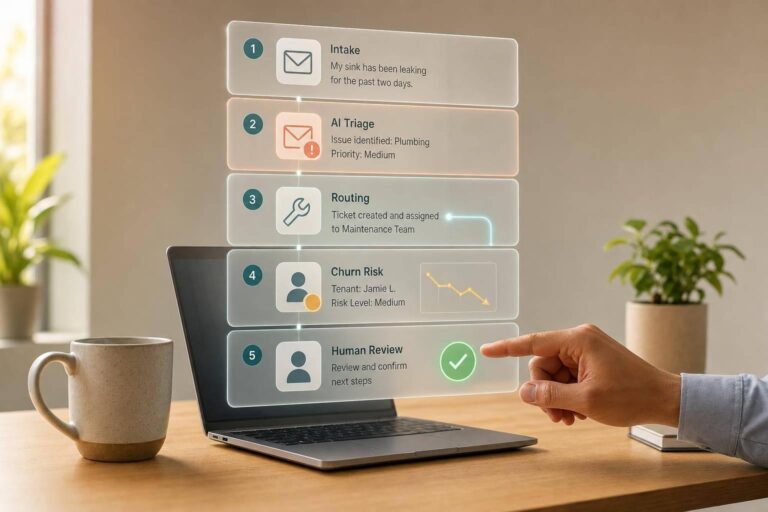
AI helps property teams sort tenant feedback faster, flag risk earlier, and reply in less time – but it still needs people in the loop.
If I boil the article down, the main point is simple: AI is most useful when it reads tenant messages, tags the issue, spots repeat problems, and sends urgent cases to the right person. That matters because resident turnover costs about $4,000 per unit, renewal rates can improve by about 7% with AI-led renewal workflows, and slow replies can hurt both ratings and retention.
Here’s the short version:
- AI reads feedback at scale from emails, texts, tickets, portal messages, and reviews
- Sentiment analysis works best at the topic level, not as one overall score
- Pattern detection can spot repeat issues across units or properties
- Predictive scoring can flag churn risk using payment timing, service history, and tone changes
- Routing and auto-replies can cut delays, with some systems replying in under 60 seconds
- Data quality matters because bad CRM records, bad timing, or weak integrations can skew results
- Human review still matters for sarcasm, mixed sentiment, legal tone, and urgent cases
A few numbers stand out:
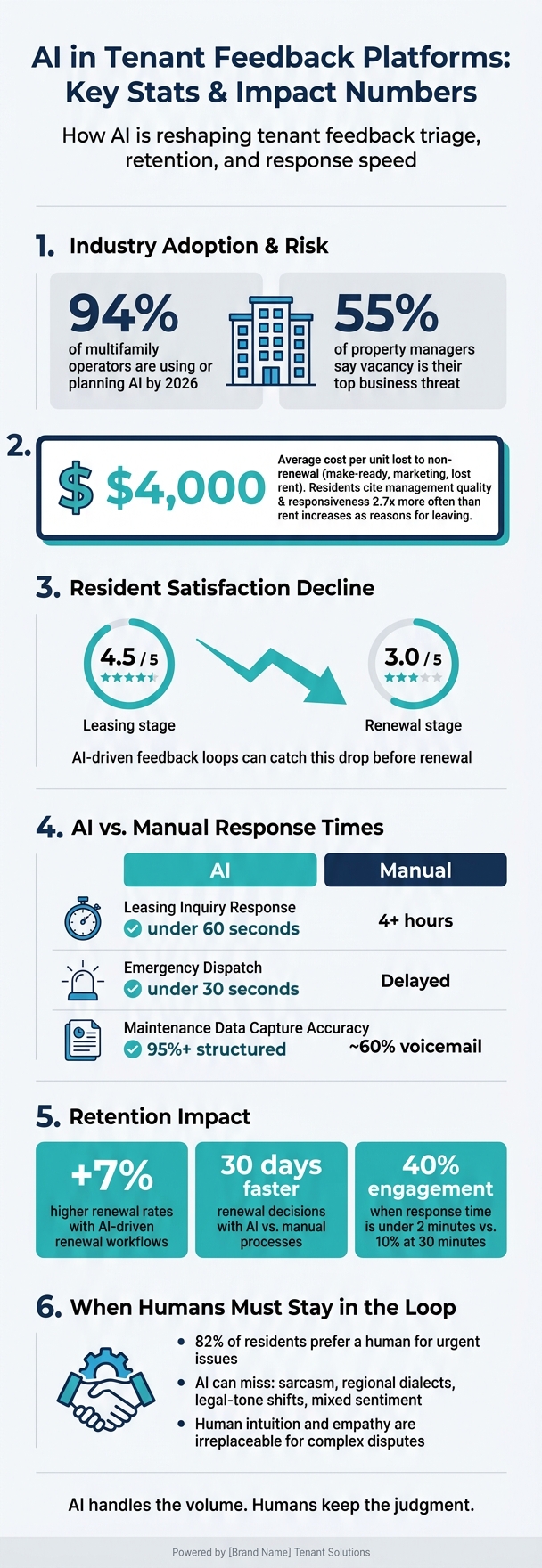
- 55% of property managers say vacancy is the top threat
- 94% of multifamily operators are using or planning AI in 2026
- Resident satisfaction can drop from 4.5/5 at leasing to 3.0/5 at renewal
- Residents mention management quality and responsiveness 2.7x more often than rent increases when explaining why they leave
- 82% of residents still prefer a human for urgent issues
| Area | What AI Does | What to watch |
|---|---|---|
| Feedback triage | Sorts and routes messages | Wrong tags if data is messy |
| Sentiment | Finds frustration by topic | Can miss sarcasm or dialect |
| Risk alerts | Flags likely non-renewals | False positives can happen |
| Follow-up | Sends replies and assigns tasks | Urgent cases still need staff |
So if you’re asking whether AI helps in tenant feedback platforms, my answer is: yes, mostly in triage, routing, and early warning – not in replacing human judgment.
AI in Tenant Feedback Platforms: Key Stats & Impact Numbers
How AI Is Used in Tenant Feedback Workflows: Recent Research
Sentiment Analysis and Issue Classification
Modern AI reads context, not just negative keywords. That means it can split mixed feedback like "Maintenance is quick, but communication is terrible" into two separate signals. A property team can go after the communication issue without assuming the maintenance process is failing too.
AI also sorts raw text into day-to-day operating categories like maintenance, safety, cleanliness, and communication, which cuts out a lot of manual coding. Instead of digging through comments one by one, teams get weekly trend reports, location-level views, and fast summaries while the feedback is still fresh.
One point stands out here: topic-level sentiment is more useful than one big overall score. It gives teams a direct target. If communication scores badly but cleanliness looks fine, the next move is a lot clearer.
Once feedback is sorted, the next job is to find repeat patterns across properties.
Pattern Recognition and Predictive Alerts
AI can spot repeat complaints across units and surface property-wide issues before they blow up. But the bigger change is prediction. AI pulls together portal activity, maintenance frequency, and payment timing into an engagement score that signals renewal risk.
Some platforms also watch for tone shifts. If a resident moves from casual messages to formal, legal-sounding email, that can signal churn risk. In plain English, teams are no longer stuck reacting after the fact. They get a chance to see trouble coming.
Those signals matter most when they lead to faster routing and follow-up.
Personalized Follow-Up and Communication Routing
AI can route urgent safety or habitability issues right away, while routine requests move into standard workflows. Speed matters here: responses within 1–2 minutes generate 40% engagement, while waiting 30 minutes drops engagement to 10%.
Systems can also change the wording of automated replies based on a resident’s detected emotional state. So a frustrated tenant gets a more empathetic response than someone sending in a routine request. That cuts manual workload and leaves staff more time for cases that need human judgment.
| AI Function | Data Sources | Action Signal |
|---|---|---|
| Sentiment Analysis | Emails, SMS, reviews | Positive / Neutral / Negative / Frustrated |
| Triage & Routing | Maintenance notes, chat | Emergency vs. Routine |
| Pattern Recognition | Multi-unit service requests | Recurring theme clusters |
| Predictive Analytics | Payment timing, tone shifts | Renewal likelihood / Churn risk |
All of this only works if the property and contact data is clean and the workflow is connected well enough to act on what the system finds.
sbb-itb-8058745
What Research Shows About Operational Impact
Faster Triage, Prioritization, and Response Management
The clearest day-to-day win from AI is faster triage with fewer manual handoffs. When an urgent issue comes in, the system can route it to the right staff member and create the work order on the spot. That keeps the path from feedback to action short, which is where teams feel the difference first.
The payoff shows up in three places: response speed, cleaner data, and leaner staffing.
AI systems answer leasing inquiries in under 60 seconds, compared with more than 4 hours in manual workflows. For emergency dispatch, AI cuts response time to under 30 seconds. On the maintenance side, AI intake captures 95%+ structured data, while manual voicemail lands at about 60%. That gap matters. If the intake is messy, the whole process gets messy too.
There’s also a labor angle. Equity Residential reported $14 million in annual payroll savings after automating front-office workflows.
Effects on Tenant Engagement and Retention
Fast follow-up also shapes renewals. Resident satisfaction starts high at leasing, around 4.5/5, then can slide to as low as 3.0/5 by the renewal window. That drop is where AI-driven feedback loops can help most. If a negative issue gets flagged and fixed before renewal time, the resident is more likely to stay.
AI-driven renewal programs report renewal rates that are roughly 7% higher than manual workflows, and decisions happen about 30 days faster. That speed matters because every lost renewal is expensive. Non-renewal costs operators around $4,000 per unit in make-ready costs, marketing, and lost rent. So even a small bump in retention can offset move-out costs in a meaningful way.
There’s another point here that’s hard to ignore: residents cite management quality and responsiveness 2.7 times more often than rent increases as reasons for leaving. In plain English, the feedback loop isn’t just an admin process. It’s part of retention.
These gains depend on clean data, clear routing rules, and human review for edge cases.
Research Findings Table
The studies below show where the operational gains are strongest.
| Source Type | Key Finding | Property Management Implication |
|---|---|---|
| Benchmark Report | Emergency dispatch under 30 seconds via AI | Cuts damage risk and improves safety response |
| Lifecycle Analysis | Resident sentiment drops from 4.5 to 3.0 stars by renewal | Intervene before negative sentiment reaches renewal |
| Operational Study | AI-driven renewal programs are about 30 days faster | Cuts vacancy time and admin load |
| Resident Research | 82% prefer human interaction for urgent issues | AI handles routine triage; humans must stay available for emergencies |
| Reputation Study | Replying within 1 hour improves the chance of rating recovery | Fast response to negative feedback is the most effective reputation recovery tactic |
| Financial Benchmark | Non-renewal costs average about $4,000 per unit | Small retention gains materially offset move-out costs |
Implementation Requirements, Risks, and Data Dependencies
Clean Feedback Data and System Integration
The gains above depend on three things: clean data, connected systems, and human review.
AI feedback tools work best when they can pull both structured and unstructured feedback into one pipeline. That usually means data from resident portals, CRM records, maintenance work orders, SMS threads, email, and web chat all flowing into the same place. In practice, that’s often harder than it sounds.
Most property management systems don’t come with built-in AI feedback plugins. So teams usually connect tools with webhooks to trigger surveys at key moments, like when a work order is marked closed.
That sounds simple. But there’s a catch.
A closed ticket doesn’t always mean the resident thinks the issue is fixed. If a survey goes out too soon, the feedback data can skew from the start.
AI systems also need two separate data streams:
- Transactional data tied to specific events, such as move-ins, maintenance completions, and lease renewals
- Relationship data from recurring surveys, like quarterly NPS checks
BatchData can support real estate data enrichment and integration workflows that help keep resident records accurate for decision support.
Even when the inputs are clean, the output still needs a person to review it.
Bias, Transparency, and Over-Reliance on Automation
Even well-set-up AI systems have blind spots.
Sentiment models can miss context. They may trip over regional dialects or property-management terms that don’t show up often in general training data. Early-generation models also produced plausible-sounding outputs based more on word counts than context.
The bigger risk, though, is operational. Staff can start treating AI output like the final answer instead of what it should be: a first pass that still needs human judgment.
That’s where taxonomy governance comes in. Tags should stay stable, versioned, and easy to explain so staff know what they’re looking at and why.
Human spot-checks are still needed for things AI often gets wrong, including sarcasm, mixed sentiment, and legalistic tone shifts.
Benefits vs. Limitations Table
The trade-off here is simple: speed versus control.
| Capability | Implementation Requirements | Benefits | Limitations |
|---|---|---|---|
| Sentiment Analysis | Clean text from emails, chat, and open-ended surveys. | Detects frustration and recurring complaints. | May misclassify sarcasm, negation, or regional dialects. |
| Predictive Analytics | Service history, payment timing, and engagement data. | Identifies non-renewal risks before formal notice is given. | Requires high data volume for reliable baselines; false positives are possible. |
| Personalization | Synced CRM records with tenant details and history. | Supports tailored follow-ups. | Outdated CRM data can make responses feel off or impersonal. |
| Urgency Alerting | Keyword triggers and an urgency taxonomy. | Escalates safety or critical maintenance issues instantly. | Requires careful threshold calibration to stay useful. |
I Tested an AI Property Manager That Handles Tenants 24/7
Conclusion: Where AI Delivers Value in Tenant Feedback Platforms
The research lands on one clear use case: faster triage with human oversight. Put simply, AI compresses feedback triage from days to hours, but humans keep judgment. That time savings is where the practical payoff shows up most clearly, and the evidence keeps circling back to the same two themes: speed and workflow control.
AI works best when message volume is high and quick response matters. It helps improve response quality by cutting down the sorting work, not by taking staff out of the loop. That’s why automation should stop at routing and summarizing.
High-stakes decisions should stay human-led. The setup that works best uses AI as a triage layer: it handles the volume, pulls out what matters, and passes anything tied to compliance, fairness, or escalation review to people. In day-to-day use, that means AI can take on routine cases while humans spend their time on edge cases and sensitive situations.
The money side makes this hard to ignore. Resident turnover costs about $3,872 per unit once you include marketing, make-ready work, concessions, and lost rent.
The edge goes to operators who use AI to explain why residents are frustrated, not just what they said.
FAQs
How accurate is AI at reading tenant sentiment?
AI can do a strong job of spotting tenant sentiment because it picks up on small language cues, mood changes, and context clashes that standard metrics often miss.
It can flag tone, urgency, and intent across messages and maintenance requests. But it is not a stand-in for human judgment. Its accuracy depends on proper model setup, clear context, and precise prompts.
What data do AI feedback tools need to work well?
AI feedback tools work best when they pull from both structured and unstructured data.
That means things like maintenance request frequency, resolution times, work order histories, and sentiment from emails, text messages, and portal interactions.
They can also look at payment patterns, amenity usage, and leasing notes. Put those signals together, and property managers can turn scattered records into one clear view of the tenant experience, which leads to better insights and sharper decisions.
When should staff review AI-routed tenant issues?
Staff should step in when the AI hits its confidence limit or trips a set escalation trigger. That includes cases like:
- legal threats or eviction
- urgent maintenance emergencies, like gas leaks or flooding
- negative sentiment
People should also review sensitive rent negotiations, hardship accommodations, unanswered inquiries, and any request that still isn’t resolved after four hours.