
If your tax data is wrong, your property decisions can be wrong too. I’d treat validation as the first step because assessor data covers 155+ million U.S. properties across 3,200+ local sources, and each source updates on its own schedule.
Here’s the short version:
- Validation checks the basics first: APNs, FIPS codes, owner names, mailing addresses, assessed values, tax amounts, and jurisdiction fields.
- The main problems are easy to spot but costly to miss: stale ownership, old values, missing property details, and mismatched parcel IDs.
- Why errors happen: county, recorder, GIS, and tax collector records often don’t match, and local formatting rules vary from place to place.
- What’s at risk: bad outreach, weak underwriting, extra manual review, audit issues, and tax overpayment that can slip through.
- How I’d handle it: clean the record, compare it across datasets, confirm the right taxing authority, then send odd cases to human QA.
- Why it matters day to day: better lead lists, finding property owners more efficiently, cleaner portfolio analysis, more reliable reporting, and fewer data problems moving into CRMs and BI tools.
Bottom line: tax data validation helps stop small record errors before they turn into costly workflow and reporting problems. If you use assessor data for real estate investing, lending, portfolio review, or compliance, this check should happen before the data enters your system.
Common Tax Data Errors and Why They Happen
The Most Frequent Errors in Property Tax Records
The most common problems in property tax records are stale ownership, lagging values, missing property details, and mismatched property IDs.
Here’s what that looks like in practice: assessor ownership fields often trail recent sales, so outreach can go to the wrong person. That’s not just awkward. It can also create compliance risk and insurance underwriting challenges. Assessed values can also fall behind market shifts because reassessment cycles tend to move slowly. And then there are the basic record issues that throw everything off – missing square footage, incorrect lot size, mismatched APNs, and inconsistent owner names.
These issues usually show up in four places:
- Property IDs
- Values and taxes
- Physical characteristics
- Ownership fields
That’s why validation needs to catch them before tax data gets pushed into a workflow. Once bad data gets into outreach, reporting, or deal review, the mess tends to spread fast.
Why County and Municipal Data Often Conflicts
The situation gets tougher when local sources don’t match.
County, recorder, and GIS systems often track different parts of the same property, and they don’t all update on the same timeline. One system may push daily feeds, while another updates monthly, quarterly, or only during annual certification cycles. So a transfer might show up in one place and still be missing somewhere else.
There’s also a formatting problem. Counties use their own field structures, APN formats, and exemption codes. That makes cross-jurisdiction standardization a hard engineering job. If you merge county files without reconciling those differences, the result is still inconsistent data.
Validation is the checkpoint that catches those mismatches before they flow into underwriting, reporting, or outreach workflows.
The Cost of Unvalidated Tax Data
Once bad records get into the workflow, the damage shows up fast – in decisions, day-to-day work, and reporting.
Financial and Workflow Risks
Bad tax data doesn’t just add extra work. It creates direct cost.
Lagging assessed values can skew collateral analysis, AVM outputs, and loan decisions. stale ownership records can burn outreach budget, slow title work, and hide liabilities during due diligence. And when teams rely on monthly or quarterly feeds, they often end up doing more manual reconciliation, which adds labor cost across a large operation.
Then the problem spreads. The same errors that start in source data can move straight into compliance and reporting.
Compliance and Reporting Exposure
Across multi-state portfolios, counties use different APN formats, exemption codes, and update schedules. That mix can lead to mismatches in audits and investor reporting. Assessor tax data is current only through the last certified update.
There’s another issue here: assessments tend to go up more easily than they come down, so overpayment risk can slip by without active monitoring. That’s why validation is the first check before data moves into underwriting or reporting.
How Tax Data Validation Works
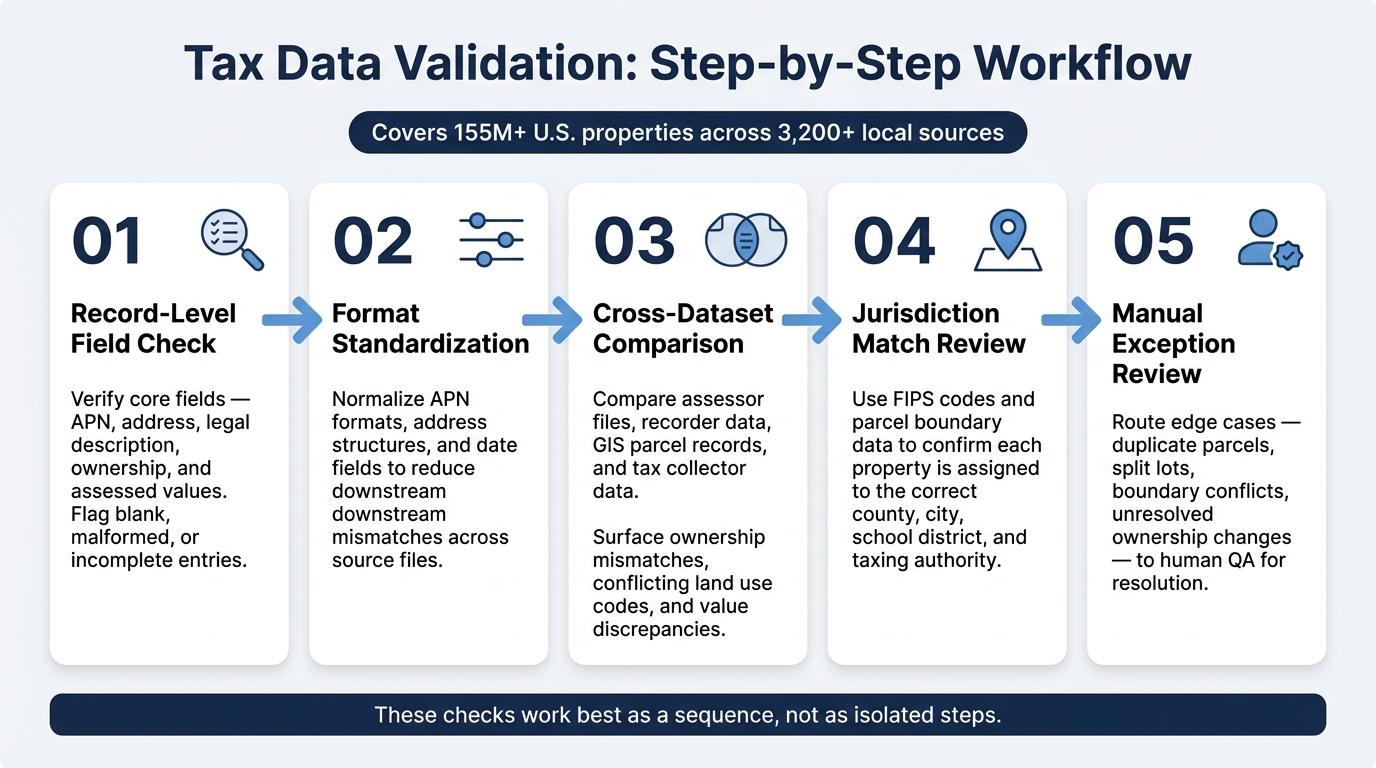
Tax Data Validation Process: 5 Steps to Clean Property Records
Validation usually starts at the record level. Then it moves into source comparison and jurisdiction matching. That order matters. If the base record is messy, everything that comes after gets harder.
Record-Level Checks That Catch Errors Early
Start by checking the core fields: APN, address, legal description, ownership, and current values. From there, flag anything missing, incomplete, or malformed. A blank owner name, a broken date field, or a partial APN can throw off the whole process.
It also helps to standardize APNs as early as possible. That step cuts down on mismatches later, especially when the same parcel shows up in more than one file with slightly different formatting.
Cross-Dataset Comparison and Manual Review
Once the record is clean, compare it across source files. Assessor files, recorder data, GIS parcel records, and tax collector data often tell slightly different stories about the same property. That’s where the common conflicts tend to show up: ownership mismatches, conflicting land use codes, and different assessment values.
Most of this can be handled with automation. But some records still need a human to step in. Split lots, boundary conflicts, duplicate parcels, and unresolved ownership changes are the kinds of issues that don’t always fit neatly into a rule set.
Cross-Jurisdictional Mapping and Reconciliation
This is usually the toughest part. Counties and municipalities often use different APN formats, naming rules, boundary definitions, and update schedules. So even when two records point to the same property, they may not line up cleanly.
FIPS codes help here by giving counties a standard federal identifier. That cuts down on confusion when city or district names look alike across states. Paired with parcel boundary data and legal descriptions like Section-Township-Range, those identifiers help confirm that a property belongs to the right taxing authority. That’s what keeps county and municipal records in sync before the data moves into underwriting or reporting.
These checks work best as a sequence, not as isolated steps.
| Validation method | Purpose | Data source | Typical error caught |
|---|---|---|---|
| Field completeness check | Find missing required values | Tax roll or assessor file | Blank owner name, missing APN, missing assessed value |
| Format and standardization check | Normalize records for matching and reporting | Source tax records and imported files | Inconsistent APN format, address formatting issues, invalid date format |
| Cross-dataset comparison | Detect conflicts across public sources | Assessor, recorder, GIS, and tax collector data | Ownership mismatch, conflicting land use code, different assessment values |
| Jurisdiction match review | Confirm property sits in the correct taxing authority | Parcel boundary and jurisdiction reference data | Wrong city, county, school district, or tax district assignment |
| Manual exception review | Resolve edge cases automation cannot confirm | Flagged records from all source systems | Duplicate parcels, split lots, boundary conflicts, unresolved owner changes |
Building Better Real Estate Workflows With Validated Tax Data
Where Validated Tax Data Creates Immediate Value
Once tax data is validated, it starts doing useful work in everyday operations. It matters most in fast-moving workflows where property records need to be right the first time.
For off-market lead sourcing, validated tax data cuts down on false positives caused by old ownership records or stale exemption data. For portfolio analysis, clean records make it possible to calculate metrics like tax-to-rent ratio and year-over-year tax growth across a portfolio. That gives asset managers a clearer view of rising tax pressure before it turns into a bigger problem.
Verified owner and mailing data also improves contact deliverability and reduces skip-trace waste. On top of that, validated records support audit-ready reporting by linking each tax figure to a parcel ID, jurisdiction code, and refresh date. That makes audits and covenant tracking far easier to manage. The main edge, though, comes from keeping those records up to date.
What a Reliable Ongoing Validation Process Looks Like
Those gains last only if validation happens on a set schedule. A good starting point is to match refreshes to county update cycles – monthly, quarterly, or more often in places where midyear corrections and supplemental bills show up often. Counties and municipalities change APN formats, exemption codes, and jurisdiction boundaries over time, and scheduled refreshes help catch and reconcile those shifts before they spill into underwriting or reporting workflows.
A solid process also needs exception handling, clear resolution paths, and audit trails that log every change: source, timestamp, validation checks applied, and who or what made the edit. That trail makes tax data easier to defend and easier for teams to trust across systems.
BatchData supports this kind of integration through property search APIs, bulk data delivery via FTP/SFTP, and professional services that help teams map cross-jurisdictional fields into a unified internal schema. That way, validated tax updates can flow straight into CRMs, underwriting tools, and BI platforms without manual work.
FAQs
How often should tax data be validated?
Tax data needs regular validation through routine maintenance, not the occasional spot check. Property values and ownership details can shift fast, so daily updates help keep records current.
For most investment analysis work, refreshing the data every 24 hours is enough to keep the information reliable.
What tax data errors are hardest to catch automatically?
The toughest errors to spot with automation are the subtle, context-driven ones. A good example is bedroom counts in odd layouts or homes with finished basements, where local building code can change how a room should be classified.
Another problem area is mapping errors and data that looks fine on the surface but is still wrong in practice. That includes things like incorrect square footage, valuation numbers, or property type labels. In many cases, the only way to catch these issues is to check several sources or do a manual audit.
When should validated tax data enter your workflow?
Validated tax data should enter your workflow before property records are imported into your system. When you check core fields like ownership and property details at the point of entry, you cut down on incomplete or inaccurate records before they create problems downstream.
Data cleaning and enrichment shouldn’t be a one-time task either. They need to stay part of your day-to-day process. And when the stakes are high, real-time API integrations can verify tax data straight from county sources before you lock in an investment or close a property deal.