






































Data-driven lead nurturing leverages AI, data analytics, and automation to streamline how leads are managed, segmented, and converted. This approach uses detailed insights – like ownership history, property value, and behavioral patterns – to create highly personalized and efficient campaigns. For real estate agents, this means less time spent on admin tasks and more time closing deals.
Key Takeaways:
- AI tools analyze 500+ data points to deliver 50%+ reply rates and 99.9% contact accuracy.
- Behavioral data, like property views and email engagement, helps identify high-intent leads.
- Automated campaigns triggered by lead actions increase response rates and conversions.
- Lead scoring systems rank prospects, ensuring agents prioritize the most likely buyers or sellers.
- Tools like BatchData enrich contact profiles with property insights and verified details, saving time and improving accuracy.
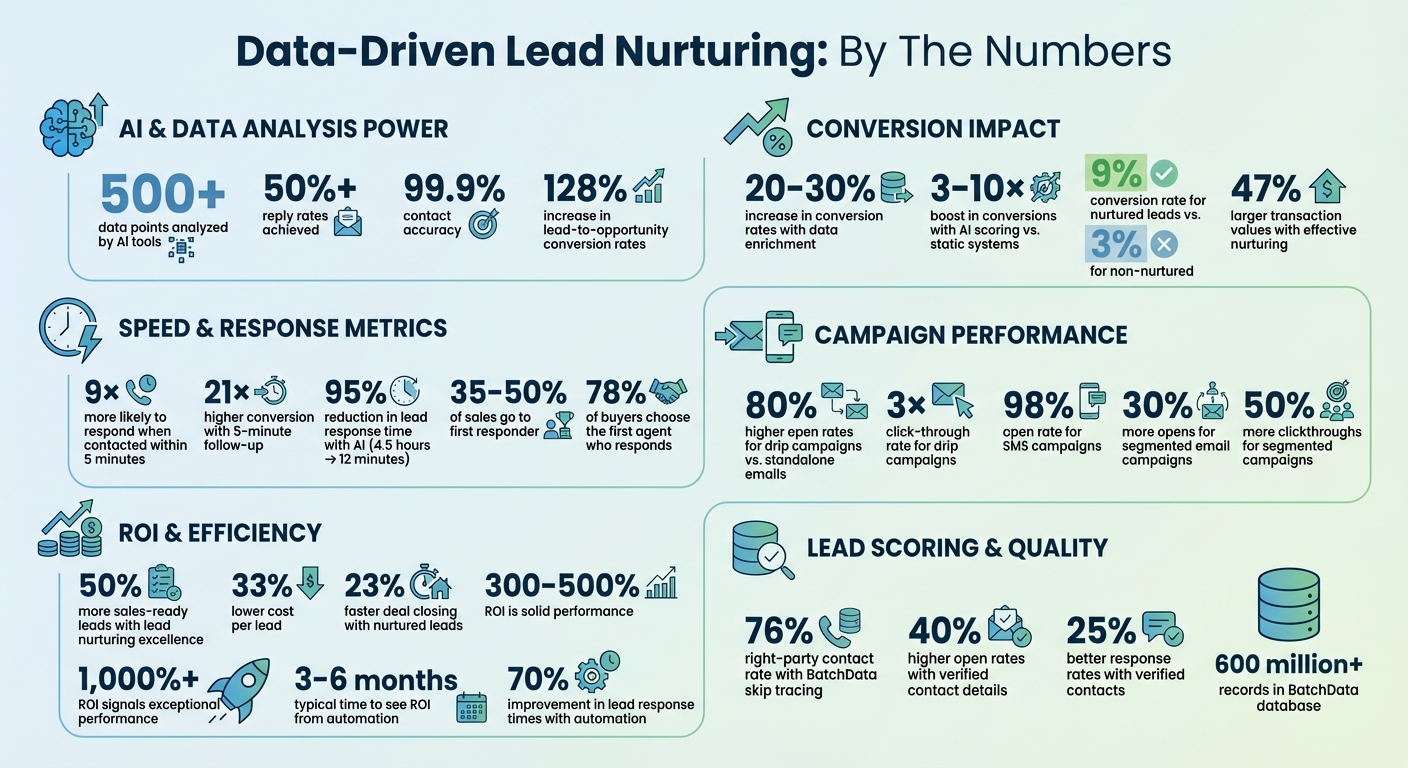
Data-Driven Lead Nurturing Statistics and ROI Metrics for Real Estate Agents
How to Collect and Enrich Lead Data
What Data Enrichment Is and Why You Need It
Data enrichment takes basic lead information – like a name and email – and turns it into detailed profiles that include ownership history, verified contact details, property values, and even behavioral insights. For instance, a lead from an open house might initially provide just their name and email, but with data enrichment, you can uncover details like the square footage of their property, how long they’ve owned it, recent comparable sales in their area, and even mortgage specifics. These added layers of information allow for precise segmentation and personalized outreach, which can increase conversion rates by 20-30%, according to industry benchmarks for targeted campaigns.
This process fills in the blanks, such as whether the lead owns or rents, the estimated value of their property (for reference, the median U.S. home price is $450,000), and their transaction history. It also identifies life-stage indicators and recent property searches, helping you focus on high-intent prospects. Instead of sending generic follow-ups, enriched data enables you to craft targeted, automated nurturing strategies that resonate with your audience.
Best Practices for Collecting Real Estate Data
To capture leads effectively, use website forms to gather basic details like name, email, phone number, and property preferences. Social media campaigns, IDX searches, and open houses are also excellent sources for lead generation. Once a lead is captured, log their details into your CRM and aim to respond within 5 minutes – quick follow-ups significantly boost conversion rates. To ensure high-quality contacts, use double opt-in email verification and include clear consent checkboxes (e.g., "I agree to receive property updates via email and SMS") to comply with TCPA regulations.
After collecting leads, organize and enrich them immediately. Tools like BatchData can help aggregate property information and verify contact details using multi-source validation, achieving up to 99.9% accuracy. For example, if you collect leads from an open house, BatchData can identify which attendees are homeowners versus renters. This segmentation allows you to tailor your follow-up efforts, such as sending renters information about first-time buyer programs or offering homeowners insights on their property’s market value.
To build a well-rounded database, diversify your data sources. Combine MLS feeds, county records, and CRM behavioral data for a more complete picture. Provide value to your leads by sharing market updates, home valuation reports, or renovation tips – this builds trust while keeping them engaged without overwhelming them. Start small by testing your strategies in batches, and conduct quarterly audits to ensure compliance. With enriched and verified data, you’ll be able to segment your leads more effectively and create campaigns that truly connect.
How to Segment Leads for Better Targeting
Using Behavioral Data to Identify Lead Intent
Behavioral data paints a clearer picture of what your leads are actually doing – not just what they claim to want. For instance, if someone views the same property detail page three times in a week, schedules a showing, or requests a Comparative Market Analysis (CMA), they’re signaling a strong intent to take action. These behaviors often speak louder than what someone fills out on a form because actions reveal true priorities.
To make sense of these behaviors, you need a lead scoring framework. This system assigns points based on specific actions, helping you rank leads by their likelihood to convert. For example:
- Viewing more than 10 properties in a week? That could be worth +20 points (indicating high buyer interest).
- Opening three emails in a month? Maybe just +5 points (showing mild interest).
- Requesting a CMA? Add +15 points for seller intent.
- Scheduling a showing? That’s another +10 points for immediate readiness.
This scoring system allows you to identify the leads that are ready to act versus those who are just casually browsing.
"The difference between a 20% conversion rate and a 5% conversion rate often comes down to one thing: speed and focus." – Lead Scoring for Real Estate
Timing is everything. Intent can fade quickly, which is why your scoring system should include score decay – subtracting points for inactivity (e.g., -5 points for every week without engagement). This ensures your "hot leads" list stays up to date with only the most active prospects. For example, if a lead suddenly revisits a property after weeks of inactivity, an automated reactivation email can nudge them back into the pipeline. You can also set up CRM alerts for high-priority actions, like a lead viewing the same property multiple times, so you can follow up immediately while their interest is at its peak.
By layering behavioral insights with demographic and property data, you can fine-tune your targeting for even better results.
Segmenting by Demographics and Property Data
Demographic data helps you understand who your leads are and what they can afford. By grouping leads based on age, income, family size, or life stage, you can tailor your approach. For example, a young couple with a baby has very different needs than empty nesters looking to downsize. Financial readiness is another critical factor – segmenting by mortgage pre-approval status, down payment availability, or a seller’s equity position can help you prioritize leads more effectively.
Property preferences add another layer of precision. You can categorize leads by:
- Geographic location (neighborhoods or zip codes)
- Property type (single-family homes, condos, investment properties)
- Price range
- Desired features like pools, modern kitchens, or proximity to top schools
When you combine this demographic and property data with behavioral signals, you can create hyper-specific segments. For instance, a lead browsing homes with pools in a particular neighborhood could be targeted with listings that match those exact criteria.
The real magic happens when you merge demographic capacity with behavioral intent. Let’s say you have a high-income lead who hasn’t opened an email in 90 days. They shouldn’t get the same attention as a pre-approved buyer who’s viewed 15 properties this week. This dual approach ensures you’re not wasting time on leads who can afford a home but have no intent to move, while giving priority to those ready to act.
Here’s why this works: segmented email campaigns see 30% more opens and 50% more clickthroughs compared to generic ones. That means your efforts directly translate into better conversion rates.
| Segment Category | Key Data Points | Content |
|---|---|---|
| First-Time Buyers | Age, starter home preference, low down payment | Mortgage advice, buying process guides |
| Investors | Income, multi-family interest, appreciation trends | Market analysis, ROI calculations, cap rates |
| Sellers | Equity position, property condition, life events | Staging tips, CMA reports, market forecasts |
| Retirees | Downsizing preference, specific amenities | Low-maintenance living guides, neighborhood safety |
How to Automate Lead Nurturing Campaigns
Setting Up Data-Triggered Drip Campaigns
After segmenting and enriching your leads, automation takes over to ensure timely and relevant communication. The process starts with capturing lead data and integrating it seamlessly into your CRM. Tools like website forms, AI chatbots, and social media ads should feed directly into your system, eliminating the need for manual data entry. This setup ensures every new lead is automatically added to your nurturing pipeline.
Next, map out the typical lead journey. Identify key points where leads tend to drop off and pinpoint where automated touchpoints can make the most difference. Behavioral triggers are crucial here – actions like viewing a property multiple times or downloading a resource, such as a Home Value Guide, can automatically initiate targeted follow-ups. These triggers help your messages land when leads are most engaged.
Establishing a consistent sending cadence is equally important. For example, you might send one email daily for the first three days, then switch to weekly emails for two months, followed by bi-weekly check-ins. Drip campaigns tend to perform better than standalone emails, boasting an 80% higher open rate and generating three times the click-through rate. A simple but effective tactic is the "9-Word Email" strategy – sending a quick message like "Are you still looking to buy a home?" every 90 days to re-engage colder leads.
In May 2024, Laura Gillott of Keller Williams demonstrated the power of automation with a Mother’s Day giveaway campaign. The effort drove impressive engagement, resulting in multiple appointments, showings, and even a closed sale within just three months.
For even greater impact, coordinate your communications across multiple channels. Pair email campaigns with SMS (which boasts a 98% open rate) and employ AI chatbots to handle inquiries around the clock. Many real estate teams report seeing returns on investment within three to six months, with automation improving lead response times by up to 70%. These systems not only streamline processes but also set the stage for deeply personalized interactions.
Personalizing Messages with Data Insights
Tailored messages are far more effective, driving six times higher transaction rates compared to generic ones. To achieve this, leverage the data you’ve collected – property preferences, search habits, and engagement patterns – to craft messages that feel personal and relevant.
Dynamic fields can be a game-changer here. Use them to insert specific details like the neighborhood a lead has searched, the type of property they’ve favorited, or the square footage they’ve consistently viewed. For instance, if a lead has been browsing waterfront condos in a specific zip code, your email could showcase new waterfront listings in that area along with a market update. This level of detail makes automated messages feel thoughtfully tailored rather than impersonal.
Behavioral data should also guide your content strategy. If a lead frequently opens your "Market Trends" emails, it could signal high intent – set up a CRM alert to follow up with a call. Similarly, for leads searching within a particular price range, configure your system to send instant alerts when matching properties become available. Reaching out within five minutes of a lead’s interaction can increase conversion rates by 21 times.
Will Sawyer, an agent with Keller Williams Greenville Upstate, offers a great example of using data to personalize outreach. In 2024, he tapped into YouTube engagement data, embedding calls-to-action within the first 45 seconds of his relocation videos. This approach brought in over 50 new leads in January alone, contributing to $612,000 in gross commission income for the year.
"The goal isn’t to replace your personal touch. It’s to scale it." – iHomefinder
Segmenting your automated messages by lead type and timeline can further enhance their effectiveness. For example:
- First-time buyers: Offer educational content like mortgage pre-approval guides or home inspection tips triggered by a contact form submission.
- Sellers: Provide market valuations and staging advice after they download a home value guide.
- Investors: Share detailed market reports and rental yield insights when they search for multi-family properties.
Using AI and Analytics for Lead Scoring
How AI Improves Lead Scoring Accuracy
AI takes lead scoring to a whole new level by analyzing hundreds of variables at once – things like website activity, email engagement, and property search trends. This allows it to pick up on subtle signals of intent that manual methods often overlook. The best part? Machine learning keeps improving over time. By studying past closed deals, AI identifies patterns that lead to conversions and applies those insights to score new leads in real time. For instance, if a prospect views the same waterfront condo multiple times over three days, AI adjusts their score instantly. This dynamic scoring can boost conversion rates by 3–10× compared to static systems.
Here’s a stat to consider: implementing AI-driven lead scoring can lead to a 128% increase in lead-to-opportunity conversion rates.
"AI lead scoring transforms lead nurturing from a spray-and-pray approach to a targeted strategy." – Hannah Recker, Head of Growth Marketing, Coefficient
AI also simplifies lead management by automatically sorting prospects into "Hot", "Warm", and "Cold" categories. This helps sales teams focus on the leads most likely to convert. Speed is another game-changer – AI can cut lead response times by 95%, shrinking the average response window from 4.5 hours to just 12 minutes. That’s a big deal, especially since 78% of buyers go with the first agent who responds to their inquiry. Faster responses mean more conversions.
This smarter scoring sets the foundation for tracking the metrics that truly matter.
Key Metrics for Evaluating Lead Quality
AI’s dynamic scoring doesn’t just stop at assigning scores – it’s built on clear, weighted metrics that make lead evaluation more precise. These metrics fall into four main categories:
- Behavioral signals (40%): Actions like viewing 10+ properties in a week or refining search criteria.
- Demographic indicators (25%): Factors such as mortgage pre-approval status or readiness for a down payment.
- Engagement metrics (20%): High email open rates (40% or more) and quick SMS replies.
- Market context (15%): Budget alignment and how well a lead matches available inventory.
Certain behaviors stand out as strong indicators of intent. For example, requesting a Comparative Market Analysis (CMA), downloading spec sheets, or repeatedly visiting pricing pages signals serious buying or selling interest. Real estate-specific data like equity growth, mortgage balances, tax delinquency, and even code violations add more depth to the analysis. Advanced AI models can even predict selling likelihood based on life events like relocation, downsizing, or "landlord exhaustion".
To keep scores relevant, AI adjusts them based on recent activity. Leads that go quiet for too long see their scores drop – 5 points per week of inactivity after 30 days, for example. It also deducts points for disqualifiers like negative equity or delayed purchase timelines.
Sales teams using predictive scoring can build pipelines about 30% faster by avoiding wasted effort on leads that aren’t a good fit. Clear thresholds help streamline efforts: Hot leads (80–100 points) need immediate personal outreach within five minutes, Warm leads (40–79 points) are best suited for automated nurture campaigns, and Cold leads (below 40 points) receive minimal automation. Companies that excel in lead nurturing see 50% more sales-ready leads at a 33% lower cost.
sbb-itb-8058745
Leveraging AI for Enhanced Productivity and Lead Nurturing in Real Estate
Using BatchData for Advanced Lead Nurturing

BatchData takes lead nurturing to the next level by combining AI scoring with tools like property data enrichment and contact accuracy checks. These features turn basic contact information into rich, actionable profiles using property insights, skip tracing, and real-time APIs.
Using BatchData for Property Data Enrichment
Property data enrichment transforms a simple address into a goldmine of information. It adds details like ownership history, tax records, mortgage data, and equity positions to your leads. For instance, identifying homeowners with over 30% equity – those more likely to sell – becomes effortless. This allows you to create personalized campaigns with messages like, "Your home’s value has increased 15% – ready to cash out?" instead of relying on generic outreach.
BatchData’s massive database, boasting over 600 million records spanning addresses, properties, and phone numbers, powers these insights. The Smart Search API streamlines the process by delivering qualified leads in real-time. For example, it can instantly flag properties that meet specific criteria, such as absentee owners with high equity or pre-foreclosure status, eliminating the need to manually sift through outdated lists.
"What used to take 30 minutes now takes 30 seconds."
- Chris Finck, Director of Product Management at BatchData.
Here’s a real-world example: An investor enriched 10,000 leads and identified 500 off-market properties. This led to 20 mail campaigns, resulting in 15 showings and 5 closed deals, achieving a 300% ROI. Agents using enriched property data report 25–40% higher engagement rates when they tailor messages with property-specific insights.
Of course, even the best property data needs accurate contact information to ensure your outreach hits the mark.
Improving Contact Accuracy with BatchData Skip Tracing
Reaching the right decision-makers starts with accurate contact details. BatchData’s skip tracing service finds verified phone numbers, emails, and mailing addresses by cross-referencing public records, utilities, and proprietary databases. With a 76% right-party contact (RPC) rate, it outpaces the industry average by nearly three times. This ensures your messages land where they’re supposed to, not in dead ends.
BatchData goes further by identifying individuals behind LLCs and trusts. It also scrubs phone numbers against the DNC registry and flags TCPA litigators, helping you stay compliant. With daily data updates and real-time verification, you won’t waste time chasing disconnected numbers.
Using BatchData is simple. Upload your lead list via CSV or API, select the enrichment fields you need – such as property value or liens – and receive enriched data within hours. This data seamlessly integrates into your CRM, enabling automated, multi-channel campaigns. For example:
- Day 1: Send an SMS like, "Hi [Name], saw your property at [Address] – quick question on selling?"
- Day 3: Follow up with an email.
- Day 7: Make a phone call.
This strategic, multi-touch approach keeps leads engaged without overwhelming them. Agents using verified contact details in their campaigns report 40% higher open rates and 25% better response rates.
How to Measure ROI and Optimize Your Strategy
Tracking ROI is crucial for fine-tuning your data-driven lead nurturing efforts. Success comes from identifying the right metrics and making adjustments based on real insights. Without clear data, you’re left guessing which campaigns are effective. To strike the right balance, focus on both quick wins (like immediate conversions) and long-term value (customer relationships that span the typical seven-year homeowner cycle).
Tracking Key Performance Indicators (KPIs)
Your KPIs should align with the lead’s journey through the sales funnel. Here’s how to break it down:
- Awareness Stage: Track email open rates (aim for at least 21.5%) and website visits.
- Consideration Stage: Monitor click-through rates and time spent on property pages.
- Decision Stage: Focus on meetings booked and how quickly leads move from Marketing Qualified Leads (MQL) to Sales Qualified Leads (SQL).
- Post-Sale: Measure retention rates and upsell opportunities.
Quick responses are critical. Engaging within 5 minutes makes leads 9 times more likely to respond, and 35-50% of sales go to the first responder. Yet, many agents miss this opportunity – 44% give up after just one attempt, even though 80% of sales require at least five follow-ups.
To calculate ROI, use this formula: (Revenue – Cost) / Cost × 100. For real estate, a 300-500% ROI is solid, while 1,000% signals exceptional performance. For example, if you spend $800 a month on database remarketing for 4,000 contacts, closing just one deal can yield a 1,100% ROI.
"If you don’t know where you’re spending your money, and what the return on that investment is, you’re not really running a business, you’re just guessing."
- Chris Speicher, Co-owner, The Speicher Group
Pay attention to declining metrics. An unsubscribe rate above 1% could mean your content is missing the mark. To maintain accuracy in your lead list, implement score decay – subtract 5 points per week of inactivity after 30 days.
With these metrics in place, regular reviews will help you fine-tune your campaigns for better results.
Improving Your Strategy Based on Data
Once your KPIs are in place, use the data to refine your approach. Here’s how often to review key metrics:
- Weekly: Email opens and click-through rates.
- Monthly: Content performance trends.
- Quarterly: Impact on your sales pipeline.
- Annually: Customer lifetime value.
If your highest-scoring leads (80+ points) convert at less than 35-40%, your scoring system might be too loose and need adjustments.
Set up lead scoring bands to streamline follow-ups:
- 80+ points: Immediate phone calls.
- 60-80 points: Follow-up by an Inside Sales Agent (ISA) within 48 hours.
- 40-60 points: Enter an automated email nurture campaign.
- Below 40 points: Add to a long-term drip campaign.
Companies that excel at this process generate 50% more sales-ready leads while cutting costs by 33%. Compare nurtured leads to non-nurtured ones to measure the impact. Typically, nurtured leads convert at 9% versus 3% for non-nurtured leads, close deals 23% faster, and generate 47% larger transactions.
A/B testing is another powerful tool. Experiment with subject lines, landing pages, and call-to-action buttons to identify what resonates with your audience.
Use attribution tracking to pinpoint which channels perform best. Assign unique phone numbers to offline sources and use UTM parameters for digital campaigns. If certain channels underperform, shift your budget to those delivering better results. Weekly check-ins with your sales team can also provide valuable feedback on lead quality, helping you adjust your content strategy accordingly.
Conclusion
Data-driven lead nurturing transforms real estate from a guessing game into a predictable, results-driven business. The gap between a 5% and a 20% conversion rate often hinges on three factors: speed, focus, and personalization – all fueled by precise data sources. With over 3 million licensed agents vying for clients in the U.S., relying solely on intuition is no longer enough.
The numbers speak for themselves. Effective nurturing strategies not only increase transaction values by an average of 47% but also generate 50% more sales-ready leads while cutting costs by 33%. And timing? It’s everything. Studies reveal that 47–59% of buyers go with the first agent who contacts them. These stats highlight the undeniable value of data-driven systems in staying competitive.
To achieve these results, the right tools are essential. BatchData’s property and contact data enrichment provides a solid starting point. Its skip tracing ensures contact information is accurate, while its APIs integrate seamlessly with your CRM. High-engagement channels like SMS, with an impressive 98% open rate, become even more effective when paired with enriched data. This level of personalization – akin to a Netflix-style tailored experience – replaces outdated mass email strategies.
The shift lies in moving from reactive follow-ups to proactive, automated systems. By incorporating lead scoring, applying score decay for inactive leads, and using behavioral triggers, you can ensure your hottest prospects receive immediate attention. Meanwhile, long-term leads can be nurtured through drip campaigns. AI-powered tools are already delivering reply rates above 50%, and by 2024, 28% of professionals are expected to use AI in their workflows. Together, these strategies create a seamless, automated lead nurturing system that works tirelessly to drive results.
FAQs
How does AI improve lead scoring accuracy in real estate?
AI brings a new level of precision to lead scoring by processing massive datasets to uncover patterns and signals that might escape human analysis. It evaluates key factors such as property specifics, engagement behaviors, and market trends to rank leads by their potential to buy or sell. This helps agents zero in on the most promising opportunities.
What’s more, AI systems get smarter over time. They adapt to new data, continually fine-tuning their accuracy. By automating lead scoring, real estate professionals can act quickly on high-priority leads, cut down response times, and improve conversion rates – all of which contribute to greater efficiency and better ROI.
How does data enrichment improve lead nurturing in real estate?
Data enrichment plays a key role in improving lead nurturing by making contact information more accurate and detailed. It fills in missing pieces like phone numbers, email addresses, demographics, and property details, turning incomplete records into useful insights. This helps real estate professionals connect with the right prospects and create more personalized, targeted outreach, which can lead to higher engagement and better response rates.
On top of that, enriched data simplifies lead qualification by adding context, like whether someone is a homeowner or their income range. This allows professionals to concentrate on high-priority leads. It also cuts down on manual research, automates tasks, and ensures compliance with privacy regulations, making the entire lead nurturing process smoother and more effective.
How do automated campaigns help increase lead conversion rates?
Automated campaigns boost lead conversion rates by delivering timely, personalized, and consistent communication to potential clients. These systems can respond to inquiries almost instantly, engaging leads when their interest is at its peak and increasing the likelihood of turning interest into action.
With automation, follow-ups can be customized to match where a lead is in their buying or selling journey, offering the right information at the right time to help them make confident decisions. It also simplifies workflows, cuts down response times, and ensures communication stays active – even outside standard business hours. For real estate professionals, this means nurturing leads more efficiently, speeding up the sales process, and ultimately achieving better results.