
































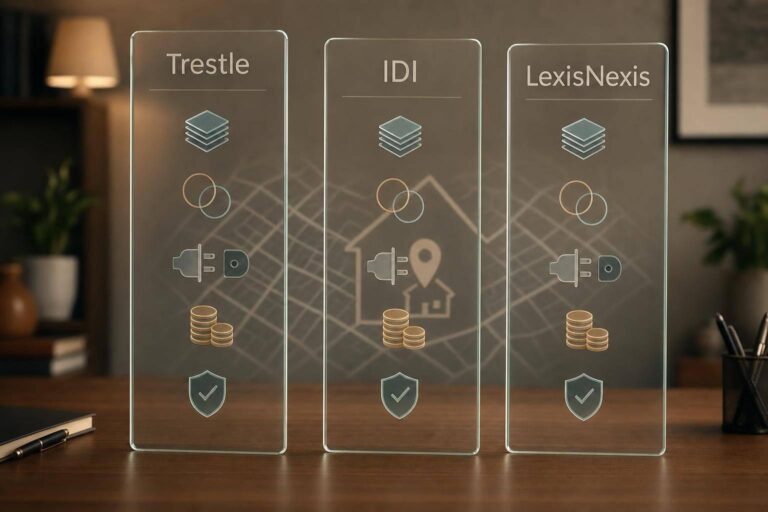
If you need the short answer: Trestle fits API-led lead intake, IDI fits deeper skip-trace work, and LexisNexis fits large teams with strict compliance needs.
I’m comparing these providers on the six points that matter most: data depth, identity resolution, integration, pricing visibility, compliance controls, and best-fit use case. The biggest gap between them is not just data. It’s also how hard they are to access, how they bill, and whether they can support day-to-day real estate work without extra cleanup. This is especially true when evaluating accurate skip tracing data for high-volume outreach.
A few facts shape the whole decision:
- About 35 million U.S. phone numbers are reassigned each year.
- Phone data can decay by about 18% per year.
- Tier 1 data sources can post hit rates above 90%, while Tier 2 public-records sources often land around 60% to 75%.
- A low posted price can still cost more if you pay for misses.
Quick comparison
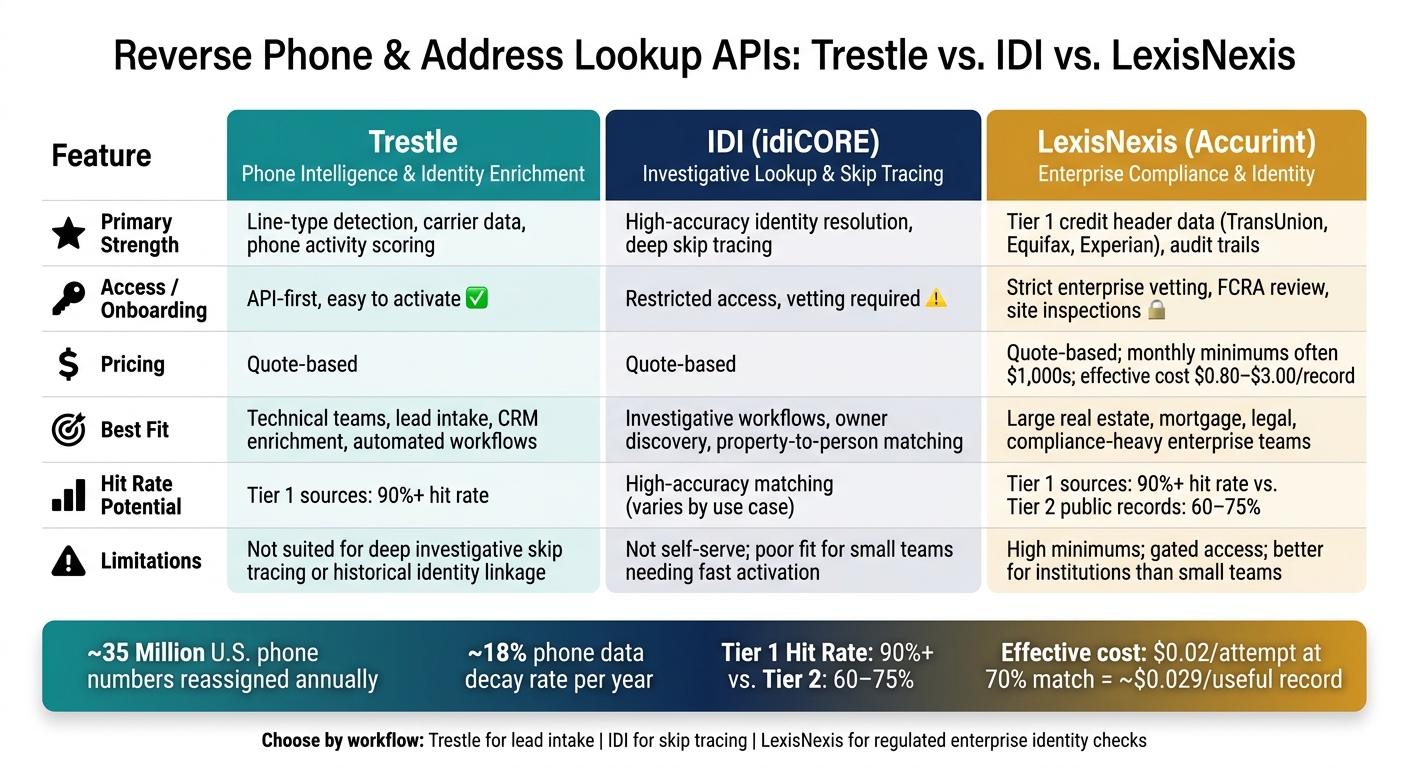
Reverse Phone & Address Lookup APIs Compared: Trestle vs. IDI vs. LexisNexis
| Provider | Main focus | Strong point | Access | Pricing | Best for |
|---|---|---|---|---|---|
| Trestle | Phone lookup and identity enrichment | Line type, carrier data, phone activity scoring | API-first | Quote-based | Lead routing, CRM enrichment, intake flows |
| IDI (idiCORE) | Investigative lookup | Deeper person-address-phone matching | Restricted | Quote-based | Skip tracing, owner research |
| LexisNexis (Accurint) | Compliance-heavy identity checks | Tier 1 credit header data, audit trail, lineage | Strict enterprise vetting | Quote-based, often high minimums | Large real estate, mortgage, legal, risk teams |
Here’s the plain-English takeaway:
- Use Trestle if you want easier API rollout and phone-level scoring.
- Use IDI if you care more about deeper lookup work than self-serve access.
- Use LexisNexis if your team needs stronger controls, auditability, and large-scale identity checks.
I also call out what public comparisons still leave out: output schema, match-confidence signals, latency, waterfall logic, DNC handling, and true cost per useful match. That missing detail is often what decides whether an API works in production or only looks good in a demo.
sbb-itb-8058745
Category comparison: Trestle vs. IDI vs. LexisNexis
Core capability matrix
Using the criteria above, the differences show up pretty fast in day-to-day workflow fit.
These three providers sit in the same broad category, but they solve different jobs. Trestle is built around phone intelligence and identity enrichment through API. It adds risk signals and phone activity scoring so teams can flag VoIP or mobile lines and automate lead routing. IDI (idiCORE) leans more toward investigative depth, with controlled access that fits deeper skip-trace workflows. LexisNexis (Accurint) is the better match for large-scale, compliance-heavy identity checks, using Tier 1 credit header data sourced directly from TransUnion, Equifax, and Experian. It is also the most enterprise-focused option here, with Tier 1 credit header data and stronger lineage controls than API-first tools.
The table below maps the differences that tend to matter most when a team is choosing between them:
| Dimension | Trestle | IDI (idiCORE) | LexisNexis (Accurint) |
|---|---|---|---|
| Primary emphasis | Phone intelligence and identity enrichment | Investigative lookup with controlled access | Best for large-scale, compliance-heavy identity checks |
| Distinctive strength | Line-type detection and phone activity scoring | Deeper skip-trace workflows | Tier 1 credit header data and strong lineage |
| Access / onboarding | API-first and easier to activate | Restricted access | Strict enterprise vetting; access can require FCRA review and site inspections |
| Pricing | Quote-based | Quote-based | Quote-based |
| Best fit | Technical teams and lead intake | Investigative workflows | Larger real estate, mortgage, and compliance-heavy teams |
LexisNexis, in particular, comes with monthly minimums that often run into the thousands of dollars. Once those minimums are baked in, effective per-record costs usually land between $0.80 and $3.00.
Best-fit use cases by team type
Those capability gaps matter most when the API has to slot into an actual team workflow.
Technical architects who care most about API integration and latency will often see Trestle as the easiest starting point. It is API-first and tends to be simpler to plug in than more gated enterprise options. For synchronous skip-trace calls, the target ceiling is under 1,500 ms, so latency testing during evaluation is not just nice to have. It matters.
Operations teams focused on right-party contact and ROI should test against live lists, not polished demo files. That’s where weak data shows itself. Trestle’s phone activity scoring can help screen lower-quality numbers before they hit a dialer, while LexisNexis brings stronger lineage for compliance-heavy workflows.
Investor and acquisitions teams doing owner discovery and off-market research usually care most about identity depth and skip-trace quality. IDI’s controlled-access model makes sense for deeper investigative work. LexisNexis can handle similar use cases, but its enterprise setup is usually a better fit for larger real estate, mortgage, and compliance-heavy teams.
Provider breakdowns: strengths and limits of each API
The matrix above shows where each provider fits. These breakdowns make that easier to picture in day-to-day work.
Trestle: phone intelligence and identity enrichment via API
Trestle’s clearest edge is speed to launch. Its REST API is built for real-time, one-off lookups, so it works well for teams that want to plug phone validation straight into a CRM or a lead intake flow.
Where Trestle shines most is phone data. It gives you line-type detection, carrier data, and answer-likelihood scoring, which helps teams sort leads before sending them into a dialer. In plain terms, it helps answer a simple question: Is this number worth calling first? That extra scoring layer can save time when reps need to focus on the best records first.
The tradeoff is depth. Trestle is not the right pick for deep skip tracing or for linking identity data across older records over time. It works best when the job is phone-level enrichment and lead verification, not deeper identity research.
| Dimension | Detail |
|---|---|
| Strengths | Line-type detection, carrier data, answer-likelihood scoring, developer-friendly REST API |
| Limits | Not suited for deep investigative skip tracing or historical identity linkage |
IDI (idiCORE): investigative lookup and controlled access
IDI is a better match for skip-trace work where deeper identity matching matters. Its idiCORE platform is built around high-accuracy identity resolution and single-record skip-trace lookups. That’s the kind of work you see in owner discovery, property-to-person matching, and research settings where a loose match just won’t cut it.
Its access model lines up with that use case. IDI is not self-serve, and onboarding includes vetting. For a small team that wants to get started fast, that can feel like a speed bump. For a larger group running a steady skip-trace process, it makes more sense. The platform is geared toward higher-stakes research, not quick and light lookups.
Once the need shifts from lookup depth to heavy compliance and scale, LexisNexis starts to look like the bigger enterprise choice.
| Dimension | Detail |
|---|---|
| Strengths | High-accuracy identity resolution, investigative skip tracing, owner discovery |
| Limits | Not self-serve; restricted access; poor fit for smaller teams that need fast activation |
LexisNexis: risk, compliance, and large-scale identity linkage
LexisNexis (Accurint) is the most enterprise-focused option in this group. It includes Tier 1 credit header data, lineage, and audit trails. That’s why it tends to sit inside risk, fraud, legal, and enterprise identity workflows where contract terms and process controls matter a lot.
Tier 1 providers can post hit rates above 90%, versus the 60% to 75% range that’s common with Tier 2 public-records sources. That gap matters when teams need fewer misses and tighter matching. The catch is access. Setup usually involves strict FCRA vetting, and monthly minimums often run into the thousands of dollars. In practice, that makes LexisNexis a stronger fit for institutional teams than for smaller groups.
| Dimension | Detail |
|---|---|
| Strengths | Tier 1 credit header data, extensive data lineage, audit trails, enterprise identity linkage |
| Limits | Gated enterprise access; strict vetting may be required |
| Pricing visibility | Quote-based; monthly minimums typically run into the thousands of dollars |
What is missing from the market and from public comparisons
The table above shows who fits which workflow. This section looks at what buyers still can’t confirm from public materials. Most public comparisons stop where vendor disclosure stops. Before you run a test, you usually can’t see output, pricing logic, or control settings in any concrete way.
Transparency gaps buyers still have to work around
The main issue is disclosure, not capability. Buyers still struggle to get clear answers on output schema, match confidence, latency, and compliance controls. Public comparisons also blur match rate with right-party contact (RPC), even though those are not the same thing. A high match rate doesn’t mean you reached the right person.
And homepage match rates? They’re more like a best-case ceiling than a day-to-day expectation.
That ceiling is often based on clean test lists. Real estate lists – LLC-owned parcels, out-of-state owners, and aged leads – tend to come in below those posted numbers. Phone data also goes stale fast. Numbers decay at about 18% per year, and the FCC says roughly 35 million U.S. numbers are reassigned each year. So in practice, a high match rate on old data can be a lot less useful than a middle-of-the-road rate on newer records.
The table below sums up what buyers still have a hard time checking from public materials.
| Detail | Why it matters |
|---|---|
| Output schema | Determines whether owner names behind LLCs or trusts are actually returned. |
| Match confidence signals | Helps you decide when to automate outreach versus send a record to manual review. |
| Address history depth | Critical for skip tracing owners who have moved multiple times. |
| Latency expectations | Synchronous "click-to-reveal" CRM flows need fast responses. |
| Effective cost per record | Needs to account for stranded credits, pay-for-miss billing, and effective cost per useful match. |
| Waterfall logic | Shows whether low-cost sources are checked first before higher-cost escalation. |
| DNC responsibility | Clarifies who handles Do-Not-Call and litigator scrubbing, and whether it happens inline or separately. |
Waterfall logic is one of those things vendors seldom spell out. Buyers have to ask if lower-cost records are checked first before a lookup moves to a higher-cost source. DNC scrubbing is often just as murky. Some APIs do it inline, while others push it to a separate endpoint call.
Pricing adds another wrinkle. A headline price of $0.02 per attempt with a 70% match rate works out to an effective cost of about $0.029 per useful record. That means a $0.05 per-match model can end up cheaper if it doesn’t bill for misses. At scale, that math isn’t small potatoes, yet public docs rarely walk buyers through it in plain English.
What a modern real estate lookup stack still needs
Disclosure is only part of the problem. The bigger issue is that the market still splits identity, property, and compliance data across different tools. If you need owner contact discovery and address-based intelligence, you usually need one tool for property data and another for contact data. That leads to more integrations, more contracts, and more cleanup work.
The market still doesn’t offer a single API that combines owner contacts, property data, and identity resolution. CRM lookups still need low-latency responses, and a split workflow makes that harder to hit on a steady basis.
For investor workflows, LLC piercing is still a major blind spot. Legacy services often fail to pierce LLC structures to identify beneficial owners.
The market also still lacks real estate-specific buying guidance around effective cost per useful match, contact recency, RPC, and compliance responsibility. So buyers are left to test with their own lists and do the math themselves. Those missing details are what separate a demo-ready API from one that can handle production.
Conclusion: Matching provider type to team needs
These providers all handle the same basic lookup job. But in practice, they serve very different teams. The main gaps come down to access friction, developer experience, pricing, and how cleanly the API fits into your day-to-day workflow.
LexisNexis makes sense for enterprise compliance teams that need Tier 1 credit header data, audit trails, and contract-level controls. The tradeoff is pretty clear: vetting and minimum commitments can make it a bad fit for smaller teams. IDI is also controlled-access and compliance-first, but its focus is investigative depth and regulated workflows, not fast self-serve setup. Trestle is a stronger match for developers who want structured JSON responses and low-latency calls that slot into automated systems with less hassle.
For proptech and home-services teams, the main issue is simple: can the API support an automated lead flow without a bunch of extra integration work? When you’re handling leads at scale, integration speed and pricing visibility matter almost as much as coverage.
Key takeaways from the comparison
- Data freshness matters more than headline match rates. A high match rate on stale records does not guarantee a reachable contact.
- Access requirements often decide the shortlist; enterprise providers add vetting that slows onboarding.
- Verify DNC scrubbing and waterfall logic before purchase.
Choose by workflow: Trestle for lead intake, IDI for investigative skip tracing, and LexisNexis for regulated enterprise identity checks.
FAQs
How should I test a lookup API with my own data?
Don’t lean on vendor match rates alone. Instead, run a side-by-side test with two providers from different tiers using the same sample of 1,000 records from your actual database.
Track:
- Match rate
- Cost per useful match
- Downstream conversion, such as connected calls
Then go one step further. Check a sample for actual connectivity, not just reported matches. As you review results, log edge cases like no-match outcomes, conflicting signals, suspicious line types, timestamps, provider statuses, and internal rule outcomes.
What does cost per useful match really mean?
Cost per useful match is the real cost of getting a verified, reachable contact, not just the posted price for each API request.
What you actually pay depends a lot on the quality of your list. That includes things like lead age, LLC ownership, and where those records are located.
To figure it out, divide your total batch cost by the number of accurate, reachable contacts returned.
That’s the part many teams miss: a higher per-record fee can still lead to a lower cost per useful match if the data is fresher and more precise.
Can one API handle owner, property, and compliance data together?
Yes. Some platforms, such as BatchData, are built to return verified address, property, owner, and contact data in a single API call.
That means one request can bring back:
- Ownership details
- Property values
- Mortgage status
- Phone numbers
- Email addresses
- Compliance checks like DNC status
So instead of jumping between tools, teams can verify data, add more detail, and review risk in one workflow.