




































Real estate CRMs manage sensitive client data like budgets, Social Security numbers, and health details, often sourced from comprehensive real estate datasets. With 97% of home buyers using the internet, data collection has skyrocketed, increasing risks tied to privacy breaches and regulatory fines. Violations can cost $500–$1,500 per message under TCPA, $51,744 per email under CAN-SPAM, and up to €20 million under GDPR.
The solution? Data minimization – collect only what’s necessary, retain it only as long as needed, and control access strictly. This article breaks down four strategies to achieve this:
- Access Control (RBAC): Limits data access based on roles, reducing risks of misuse.
- Automated Deletion: Clears outdated records, ensuring compliance with retention laws.
- De-Identification & Masking: Protects sensitive data in testing or external systems. This is especially critical when using property enrichment services to update records.
- Consent Management: Ensures data is processed only with clear, documented permissions.
Each strategy balances privacy, compliance, and workflow integration. Whether it’s setting role-based permissions, automating deletion, or managing consent, these practices help real estate teams mitigate risks while staying efficient.
1. Access Control and Role-Based Permissions
Privacy Protection
Role-Based Access Control (RBAC) ensures that access within your CRM is determined by specific job functions rather than seniority or convenience. In real estate CRMs, this means agents can view property details and client interactions, managers can access performance reports, and executives see sensitive financial data.
By preventing "access accumulation" as roles evolve, RBAC helps minimize exposure risks. For example, in brokerages dealing with mortgage documents, credit histories, and pre-approval letters, unrestricted access could lead to significant liabilities.
"RBAC reduces the amount of data that employees are exposed to, which also helps mitigate the risk of misuse." – Archiz Solutions
Setup Complexity
To implement RBAC effectively, start by defining clear roles (e.g., Agent, Manager, Executive), assigning precise data permissions, and managing access throughout the employee lifecycle – granting access at hiring, reviewing it annually, and revoking it upon departure.
For situations where standard roles aren’t detailed enough, field-level controls can limit access to highly sensitive information, such as income details or legal deeds.
Compliance Value
RBAC isn’t just a smart security measure – it’s often a regulatory requirement. Here’s how it aligns with key compliance frameworks in real estate:
| Regulation | RBAC Requirement | Key CRM Implication |
|---|---|---|
| GDPR | Required | Ensures data minimization by granting access deliberately, not by default |
| HIPAA | Required | Restricts access to client health-related information to authorized personnel |
| CCPA/CPRA | Recommended | Tracks data access for California residents to support the "Right to Know" |
| SOX | Required | Prevents unauthorized changes to deal records and revenue data |
| FINRA | Required | Controls access to broker-dealer communications |
The financial penalties for non-compliance are steep. Under GDPR, fines can reach €20 million or 4% of global annual revenue – whichever is higher. The largest GDPR fine to date, as of 2023, was €1.2 billion. Similarly, HIPAA violations can cost up to $1.9 million per category, per year.
By meeting these regulatory requirements, RBAC also strengthens the CRM’s overall security posture.
Fit for Real Estate CRM Workflows
Incorporating RBAC into real estate CRM workflows naturally enhances data security. The typical hierarchy of agent, manager, and executive aligns with the data access needs of most brokerages, ensuring users only see the information relevant to their role.
Modern CRM platforms are also adopting AI-driven monitoring to track access patterns and flag unusual activity automatically, reducing the need for manual audits. Combining RBAC with Multi-Factor Authentication (MFA) adds another layer of protection by ensuring users are both authorized and verified. Together, these measures address the most common vulnerabilities tied to access control in real estate CRM systems.
sbb-itb-8058745
How Do Real Estate Agents Protect Client Information? – Real Estate Closers Guide
2. Data Retention and Automated Deletion
Managing data retention and automating deletion processes are key steps in minimizing CRM data while ensuring compliance and reducing risk.
Privacy Protection
Holding onto outdated client data increases your exposure to potential breaches. Automated deletion helps by clearing out records that no longer serve a business purpose.
"A well-maintained CRM is a business asset. One filled with records that have outlived their legitimate purpose is a liability." – Zlatko Delev, Country Manager & Head of Commercial, GDPRLocal
A good initial approach is to remove leads who haven’t interacted with your communications in 18 to 24 months. For instance, you can configure fields like "Last engagement date" to trigger deletion after 365 days. This approach complements strict access controls by keeping your data inventory lean and manageable.
Setup Complexity
The real challenge with automated deletion lies in deciding what data to delete and when. Start by categorizing all CRM data types—often integrated via a real estate API— – contact details, transaction records, communication logs, lender documents – and assign specific triggers for retention periods.
| Data Category | Trigger Event | Typical Retention Period |
|---|---|---|
| Closed Transaction File | Closing Date | 3–5 Years |
| Unsuccessful Lead | Last Interaction | 1 Year |
| Tax-Related Financials | Tax Filing Date | 7 Years |
| AML Records | Transaction Date | 5 Years |
Real estate data often spans multiple platforms – email systems, call recordings, marketing tools, and calendar apps – all of which need to be included in your deletion workflows. Additionally, ensure any third-party vendors align with your retention policies through contractual obligations.
Two safeguards are critical: a "soft delete" period (e.g., 30 days before permanent deletion) to catch errors, and a legal hold mechanism to pause deletion for records tied to ongoing or anticipated litigation.
Compliance Value
Both GDPR’s Article 5(e) Storage Limitation principle and the CPRA’s standards require businesses to retain personal data only as long as necessary. The CPRA also mandates scheduled deletions, even without consumer requests.
Failing to comply can be costly. Under the CPRA, each affected record can count as a separate violation, with fines of $2,500 for unintentional breaches and $7,500 for intentional ones.
"Disclosure without enforcement is the liability. The CPPA has made clear that retention notices must reflect real practice." – Aatish Mandelecha, Founder, Strac
These strategies not only meet legal requirements but also align with the operational realities of real estate data management.
Fit for Real Estate CRM Workflows
With the majority of home buyers relying on online platforms, agents generate vast amounts of digital records, much of which quickly becomes irrelevant. However, not all data can be deleted immediately – state licensing boards and RESPA regulations require closed transaction files to be retained for three to five years.
A tiered retention policy works well here. Inactive leads can follow automated deletion processes, while closed transaction files are retained for compliance. This distinction is especially important for brokerages using AI tools. As Ben Laube, AI Implementation Strategist, explains: "The point is not to slow work down. The point is to stop old data from quietly becoming new AI input."
To mitigate risks, restrict AI tools from accessing sensitive data like full lender packets, identity documents, and raw call recordings.
3. De-Identification and Data Masking in Non-Production Use
When it comes to non-production environments, de-identification and data masking play a key role in securing sensitive information. These measures go hand-in-hand with strong data retention protocols to minimize risks.
Privacy Protection
Real estate CRM systems often handle highly sensitive information – details like buyer budgets, health-related accommodations, and even personal situations such as divorces or financial struggles. If this data were to fall into the wrong hands, the consequences could be serious. De-identification and masking act as safeguards, especially when CRM data is shared with AI tools, marketing platforms, or testing environments.
The National Association of REALTORS (NAR) 2025 Technology Survey highlights that 46% of REALTORS now use AI-generated content. This increase in AI adoption means client data is being transferred between systems more frequently than ever before.
"Block free-text notes by default. Notes are where agents write the context that never belongs in a marketing model: family stress, divorce timing, medical issues, financial fear, personality judgments, negotiation weaknesses, or side conversations." – Ben Laube, AI Implementation Strategist
One effective strategy includes using a "deny list" to block free-text notes, document links (like IDs or bank statements), and inferred tags such as "distressed" or "high net worth" by default. AI can also lend a hand by identifying sensitive fields and flagging questionable export requests before data leaves the CRM system.
Setup Complexity
The real challenge isn’t the masking process itself – it’s deciding what data to mask. Much of the information in real estate CRMs is unstructured, often buried in free-text notes or metadata from attachments. Automatically generated traits, like "high net worth" or "distressed seller", add another layer of complexity. Even exporting these traits in a masked form can lead to issues with data provenance.
A practical solution involves three main components:
- A default deny list for all data exports.
- A structured handoff queue with clear stages (e.g., Requested → Needs Narrowing → Approved → Exported → Expired).
- Pre-approved workflow templates that define exactly which fields are permissible for common tasks.
| Workflow Template | Allowed Fields | Blocked by Default |
|---|---|---|
| Past-Client Market Update | Name, Email, City, Last Transaction Date | Private Notes, Financial Details, Document Links |
| Showing Follow-Up | Name, Phone, Preferred Area, Tour Date | Estimated Equity, Credit Concerns, Family Context |
| Transaction Coordination | Contact Details, Property Address, Milestone Status | Marketing Tags, Inferred Traits, Personal Judgments |
"A data export handoff… should be able to approve, reject, or narrow the export in less than five minutes because the evidence is structured." – Ben Laube, AI Implementation Strategist
By implementing these protocols, organizations can reduce data exposure while staying aligned with compliance requirements.
Compliance Value
De-identification also plays a role in regulatory compliance. For example, under CCPA and CPRA, only the minimal dataset necessary for a specific purpose should be moved. This approach also mitigates risks under Fair Housing laws; unmasked notes filled with personal judgments can lead to biased AI outputs, potentially resulting in disparate-impact liability.
"Reducing personal data collected under CCPA also limits the risk of biased outcomes in algorithmic systems governed by Fair Housing requirements." – NewAgeSysIT
These practices align with the NIST Privacy Framework, emphasizing data governance across its entire lifecycle. For instance, keeping an audit log that tracks who approved a data transfer, what was excluded, and when the data must be destroyed demonstrates accountability and effective governance.
Fit for Real Estate CRM Workflows
De-identification complements access controls and retention policies, ensuring sensitive data remains secure when transferred to non-production systems. For example, an agent’s note about a client’s financial concerns or family situation has no place in a marketing model. Without a deny list, however, such details could unintentionally be included.
"AI should not move CRM records just because it can. It should move the smallest useful dataset for a specific purpose, into a known destination, under a named owner." – Ben Laube, AI Implementation Strategist
After any masked data export, it’s essential to review audit records and field counts to confirm that no sensitive information slipped through during the process.
4. Consent, Disclosure, and Vendor Data-Sharing Limits
After implementing data masking measures, the next step in protecting CRM data is ensuring robust consent practices. Collecting data responsibly is only part of the equation; managing how that data is used through clear and documented consent is equally important. Consent and disclosure mechanisms bridge this gap by ensuring personal data is processed only when there’s a valid and transparent reason.
Privacy Protection
Consent mechanisms act as a safeguard against unauthorized data use, requiring explicit permission before processing sensitive information like property search histories, financial details, or precise geolocation. However, the real challenge lies not just in obtaining consent but in managing it properly. When consent records are stored in unstructured formats, it becomes difficult to query or update permissions promptly when they change.
"AI can generate polished personalization from messy context, but it cannot responsibly infer consent that the business failed to record." – Ben Laube, AI Implementation Strategist
To address this, many modern real estate platforms are adopting consent ledgers – centralized systems that log consent details for each individual, including the channel, source, status, and timestamp. This approach ensures consent isn’t just documented in a policy but is enforceable in real time.
Setup Complexity
Real estate workflows often involve multiple communication channels like email, SMS, and phone calls, each governed by distinct legal frameworks such as GDPR, CCPA, and RESPA. For example, a client who agrees to buyer representation outreach hasn’t necessarily consented to receiving marketing messages.
"A single audit layer can support RESPA, the Fair Housing Act, and CCPA simultaneously. Similarly, consent and disclosure workflows can be centralized." – Giovanni Livia, AI & Software Solutions Consultant, NewAgeSysIT
Centralizing disclosures at well-defined interaction points simplifies these complexities. However, the process requires rigorous compliance measures to ensure all legal and regulatory requirements are met.
Compliance Value
Failing to comply with regulations can be costly. Under CCPA/CPRA, fines can reach up to $7,500 per violation, with additional penalties under laws like the California Delete Act and GDPR.
Just as role-based access control (RBAC) and data retention policies protect internal data, strict vendor agreements are essential for safeguarding data shared externally. Every third-party integration – whether it’s an e-signature platform or mortgage tool – requires a Data Processing Agreement (DPA) to ensure vendors meet the same privacy standards as the primary CRM. Without a documented DPA, brokerages risk being held liable for how vendors handle client data.
Fit for Real Estate CRM Workflows
Real estate brokers occupy a distinct legal role. Under California’s Delete Act, they are classified as "data stewards", not data brokers, because they collect information directly from clients to provide services. This classification imposes heightened transparency and disclosure requirements, even though certain exemptions may apply specifically to brokers.
There’s also a need to balance compliance with CCPA deletion rights and state retention mandates for transaction records. CRM systems must support workflows that can delete marketing data while retaining legally required transaction records. Additionally, opt-out requests need to be handled immediately. For instance, a "STOP" reply to an SMS should trigger suppression across all communication channels, including email, dialers, and AI agents – not just the channel where the request originated.
"Consumer trust increasingly depends on clarity, control, and follow-through. Brokerages, MLSs, and agents who keep their digital policies current, understandable, and easy to act on will be better positioned." – Victor Lund, Founder/CEO, WAV Group
Pros and Cons of Each Strategy
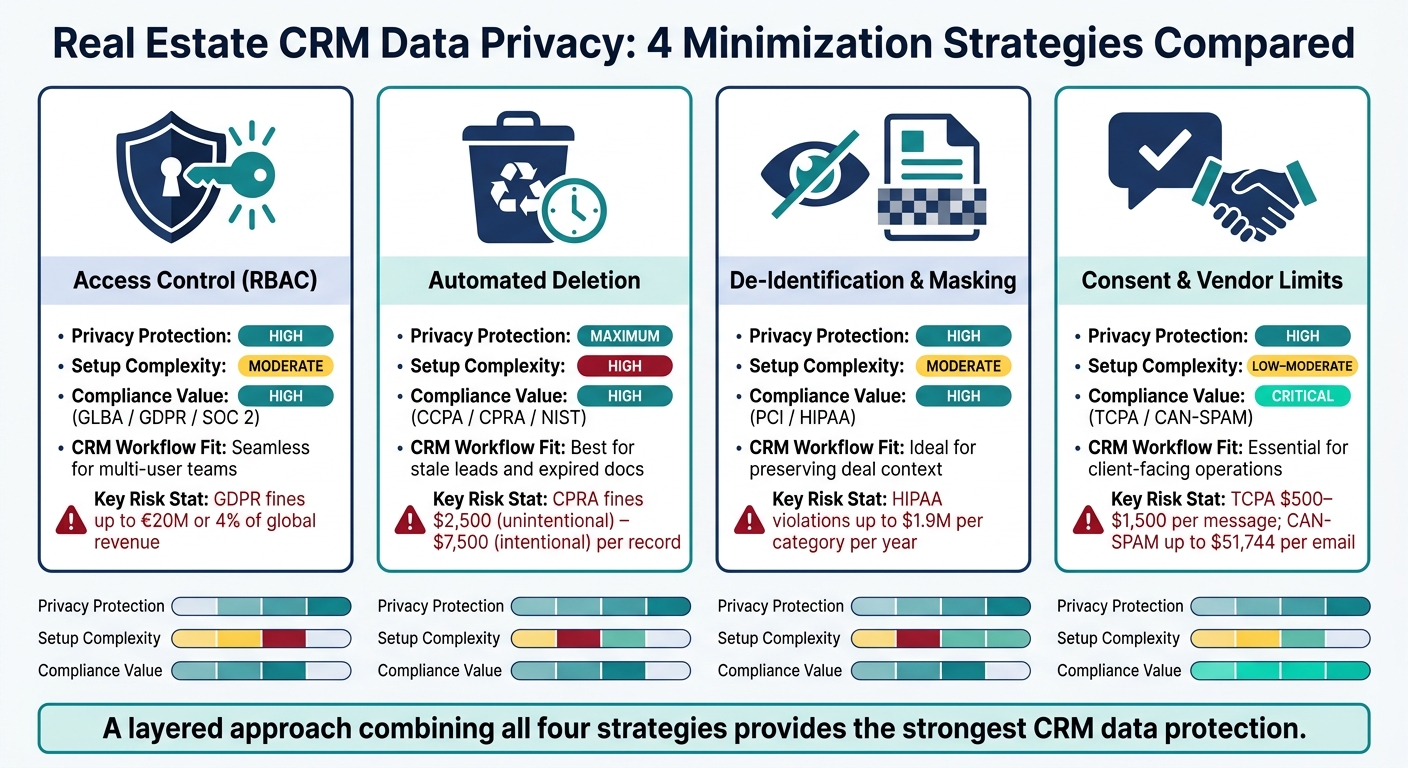
Real Estate CRM Data Privacy: 4 Minimization Strategies Compared
Balancing privacy, operational efficiency, and compliance in real estate CRMs means carefully weighing the trade-offs of each approach. Every strategy has its own strengths and challenges, helping real estate teams align their privacy compliance goals with their operational needs.
| Strategy | Privacy Protection | Setup Complexity | Compliance Value | CRM Workflow Fit |
|---|---|---|---|---|
| Access Control (RBAC) | High | Moderate | High (GLBA/GDPR/SOC 2) | Seamless for multi-user teams |
| Automated Deletion | Maximum | High | High (CCPA/CPRA/NIST) | Best for stale leads and expired docs |
| Redaction/Masking | High | Moderate | High (PCI/HIPAA) | Ideal for preserving deal context |
| Consent & Vendor Limits | High | Low–Moderate | Critical (TCPA/CAN-SPAM) | Essential for client-facing operations |
Here’s a closer look at the practical benefits and challenges of each strategy:
Access Control (RBAC)
Access control ensures that only authorized users can view or modify specific data, making it a strong choice for brokerages with diverse roles. It integrates smoothly into daily workflows, especially for multi-user teams. However, the need for ongoing audits to maintain correct role assignments can be time-consuming.
Automated Deletion
Automated deletion takes privacy to the next level by removing data after it’s no longer needed. This approach is particularly effective for handling stale leads and expired documents. However, balancing deletion rights under laws like CCPA and CPRA with state licensing board requirements for record retention can be tricky. As Aatish Mandelecha, Founder of Strac, explains:
"Data minimization is an enforcement problem, not a policy decision – most companies know they shouldn’t retain SSNs in old support tickets. The hard part is finding and removing PI across 50+ SaaS apps."
Redaction and Masking
Redaction and masking strike a balance between privacy and business needs. These techniques remove sensitive information while keeping the context of CRM records – like deal history and property notes – intact. However, masking alone might not fully address "right to delete" requests, as the underlying data often remains accessible.
Consent and Vendor Limits
This strategy focuses on managing client permissions and limiting data sharing with third parties, which is critical for compliance with laws like TCPA and CAN-SPAM. While the initial setup is relatively simple, maintaining opt-out preferences across multiple communication channels can be challenging. Non-compliance risks are steep, with potential fines ranging from $500–$1,500 per TCPA violation and up to $51,744 for CAN-SPAM breaches. To streamline implementation, using pre-approved export templates and default blocks on free-text notes can help avoid workflow bottlenecks.
Conclusion
There’s no one-size-fits-all approach to data minimization in real estate. The best strategy depends on factors like your team’s size, the amount of client data you manage, and the specific regulations governing your market. Each method targets different aspects of data minimization, working together to strengthen your CRM’s data security.
Techniques like redaction and automated deletion strike a balance between protecting privacy and maintaining efficiency. Redaction ensures key business details – such as deal notes, interaction history, and property specifics – remain intact while removing sensitive identifiers. On the other hand, automated deletion eliminates outdated records entirely, lowering the risks tied to retaining unnecessary information.
However, while tools like RBAC (Role-Based Access Control) and consent management are crucial for managing access and permissions, they don’t directly reduce the volume of data stored.
Alex Margau, Compliance Content Manager at Clym, sums it up well:
"Data minimization is not about collecting as little data as possible. It is about limiting personal information collection, use, and retention to what is justified by specific business purposes." – Alex Margau
A layered approach is key to effective data minimization. Real estate teams can start by implementing RBAC to manage access, automating the deletion of inactive records, and using redaction during data entry to avoid storing unnecessary sensitive details. For teams managing large datasets, advanced real estate data solutions like BatchData offer compliance controls at the API level, easing the workload and ensuring adherence to regulations.
FAQs
What CRM fields should we stop collecting first?
When cleaning up your CRM, start by getting rid of fields that no longer serve a clear business purpose or were added due to outdated requests. Focus on removing sensitive data first – like Social Security numbers, credit card details, or health information – if it doesn’t belong in your system. Also, clear out unused enrichment fields and rethink mandatory fields that may not be necessary. For instance, if your service is digital-only, mailing addresses might not be relevant. Similarly, if email authentication is enough, collecting phone numbers could be unnecessary.
How can we delete data without violating record-retention rules?
To meet record-retention requirements, it’s essential to connect each CRM record to a lawful basis and a defined retention period. Once the processing purpose is complete, sensitive data should either be deleted or pseudonymized. Here’s how to approach it effectively:
- Automate retention schedules: Set up systems to flag or delete records once they expire.
- Redact sensitive data: Remove personal details while keeping the necessary business context intact.
- Document exceptions: Maintain clear records of any legal or regulatory reasons for keeping data beyond its standard retention period.
- Conduct regular audits: Review processes periodically to ensure compliance and reduce unnecessary data storage.
By following these steps, you can align with regulations while managing data responsibly.
How can we block sensitive notes from AI and vendors?
To protect sensitive notes, make free-text or private fields “blocked” by default. This ensures that access requires explicit, field-level approval. Use techniques like redaction or tokenization to replace raw data with placeholders (e.g., "[SSN REDACTED]"). Strengthen security by enforcing role-based access controls, encrypting data both during storage and transit, and deny-listing sensitive fields in exports.
Additionally, set up a review board to classify which data can be accessed by AI systems. For cases where permissions are unclear, require a human review to ensure compliance and safeguard privacy.