
Looking for the best tools to handle massive property datasets? Here’s a quick guide to seven real estate APIs designed for high-volume data needs. These APIs streamline access to property records, market trends, property valuations, and other real estate data, helping professionals process millions of records efficiently. Whether you’re building machine learning models, analyzing portfolios, or generating leads, these tools deliver the data you need.
Key Highlights:
- BatchData: Over 155M properties with 700+ attributes, real-time queries, and bulk data delivery.
- ATTOM Data: Nationwide property insights, tax records, and market trends with custom bulk data options.
- CoreLogic: Covers 99.9% of the U.S. housing market, advanced analytics, and scalable cloud integrations.
- HouseCanary: Offers AVMs, rental estimates, and machine learning-powered predictions.
- RentCast: Rental estimates, market trends, and Zapier integration for non-developers.
- Datafiniti: Residential and commercial property data with robust filtering and bulk ingestion.
- Mashvisor: Focused on MLS listings, rental analytics, and investment metrics.
Quick Comparison:
| API Provider | Coverage | Best For | Pricing |
|---|---|---|---|
| BatchData | 155M+ properties | Bulk data, compliance tools | Subscription or pay-as-you-go |
| ATTOM Data | 155M–158M properties | Market trends, tax records | Subscription or enterprise |
| CoreLogic | 99.9% U.S. housing | Advanced analytics, institutional users | Custom enterprise pricing |
| HouseCanary | AVMs, rental data | Predictions, valuations | Tiered plans |
| RentCast | 140M+ properties | Rental platforms, small teams | Usage-based pricing |
| Datafiniti | Residential/commercial properties | Bulk data, filtering | Subscription-based |
| Mashvisor | MLS, STR, LTR data | Rental analytics, investment tools | Credit-based plans |
These APIs cater to developers, investors, and enterprises, offering scalable solutions for property data management. Choose based on your specific needs, such as detailed property attributes, bulk data handling, or rental market insights.
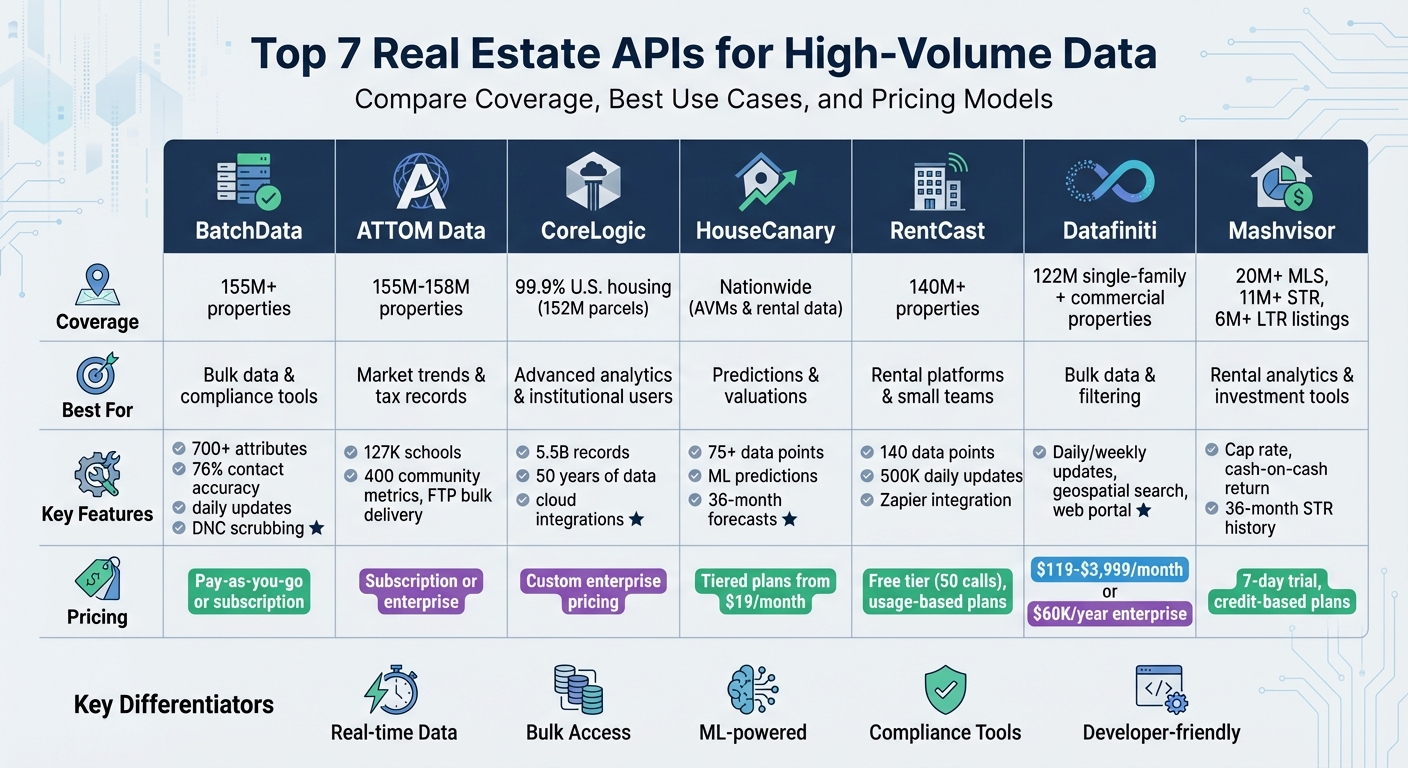
Real Estate API Comparison: Coverage, Features, and Pricing Guide
1. BatchData API
BatchData addresses the challenges of managing massive real estate data through a dual-delivery system that separates real-time transactional queries from large-scale analytics. Its REST API is designed for quick, real-time lookups in user-facing applications, while the Direct Cloud Access feature delivers standardized datasets directly to platforms like Snowflake, BigQuery, or Databricks. This setup eliminates the need for cumbersome ETL processes, enabling teams to jump straight into analysis without delays.
The platform’s database spans over 155 million properties across the U.S., with more than 700 attributes per record. These include construction details, tax assessments, sales histories, and indicators of financial distress. Its contact enrichment feature boasts a 76% right-party accuracy rate – three times better than the industry standard – by using advanced entity resolution to uncover the real owners behind corporate entities. Daily updates keep property profiles up-to-date, while automated checks against Federal Do Not Call lists and known litigators minimize compliance risks during outreach efforts.
For bulk operations, BatchData provides data in Parquet files, which can be delivered to Amazon S3 or Google Drive. This supports a variety of workflows, from training machine learning models to performing large-scale risk assessments across property portfolios. Enterprise plans offer higher rate limits and dedicated infrastructure, while standard plans come with generous limits suitable for most production needs. Integration is made easier with developer-friendly API documentation and standard RESTful JSON endpoints.
Additional features include phone and address verification APIs to clean up databases before marketing campaigns, validated geocodes for mapping purposes, and professional services for building custom data pipelines. By combining real-time APIs with cloud-native bulk delivery, BatchData is an ideal solution for both instant property lookups and large-scale data processing – whether it’s analyzing market trends in major cities or identifying motivated sellers through distress indicators.
2. ATTOM Data API
The ATTOM Data API provides nationwide property data, offering detailed insights into property features like square footage, zoning, mortgage and transaction histories, foreclosure activity, and neighborhood metrics such as crime rates, school performance, and climate-related risks.
Data Coverage
With a database spanning 155 million to 158 million property records, the ATTOM Data API grants immediate access to assessments, tax data, valuations, and market trends. Beyond the basics, it includes specialized datasets, such as information on 127,000 schools with attendance zones, nearly 400 community metrics (e.g., income levels, weather risks), and transit details across 3,400 cities. This broad scope makes it ideal for applications that require both detailed property and transaction data and wider market analytics.
Scalability
ATTOM supports bulk data operations for large-scale use cases. Users can access bulk data delivery via FTP in .csv format, enabling long-term local storage and analysis. Data can be purchased by state or for the entire country, with delivery options ranging from weekly to annual updates. The API itself works on a monthly quota system, where only successful “200 OK” responses count toward usage limits. Additionally, ATTOM offers custom “match and append” services to integrate specific data points for tailored business needs.
Integration Features
The API is RESTful and provides data in JSON and XML formats. Developers can start accessing endpoints immediately after retrieving an API key, aided by interactive documentation and a detailed data dictionary for testing calls and previewing data fields. A 30-day trial is available, allowing teams to evaluate the API’s capabilities before committing to a plan.
“After you have an API key, you can begin making calls to our endpoint URLs and start getting back data in a JSON or XML format for integration into your product.” – ATTOM Developer Platform
Pricing Models
ATTOM offers three pricing tiers: a free trial with a 30-day API key for testing, a start-up plan for smaller projects, and custom enterprise solutions for larger-scale requirements. Bulk data pricing varies depending on geographic coverage and delivery frequency, with quotes available upon request.
3. CoreLogic API
The CoreLogic API offers a massive dataset that spans 99.9% of the U.S. housing market, with 5.5 billion records collected over 50 years. It covers detailed information on 152 million parcels nationwide, including property details, building permits, mortgage data, and financial liens. The platform also tracks 95% of all U.S. voluntary liens and provides data ranging from AI-powered valuations (THVx) to neighborhood demographics, school information, and risk modeling for insurance. Let’s break down CoreLogic’s data coverage, scalability, integration options, and pricing.
Data Coverage
CoreLogic APIs are built for environments that require bulk data and offer more than just basic property details. They include advanced analytics like propensity scores, which predict upcoming real estate events. The API also grants access to a 25-year history of home price index (HPI) data, real-time listings, rental trends, and market risk indicators. Additional features include ParcelPoint geometry data and building polygons for GIS mapping. On the international front, the datasets extend to 1 million Australian properties and 2.2 billion U.K. energy records.
“CoreLogic collects, maintains and integrates more than 50 years of property and related financial data, representing 99.9% of the U.S. housing market.” – CoreLogic
Scalability
CoreLogic offers three main delivery methods: custom APIs, bulk data exports, and integrations through cloud platforms like Databricks, Google Cloud, and Snowflake. These options are ideal for large-scale analytics and machine learning applications. The platform’s cloud-to-cloud sharing feature eliminates traditional rate limits, making it easier to handle significant data loads. Additionally, the Spatial Web Services (SWS) platform uses a RESTful API to deliver data on natural hazard risks, tax jurisdictions, and parcel geocoding. It supports programming environments like Java, .Net, and PHP.
Integration Features
The Trestle API stands out for being RESO 2.0 certified and using Data Dictionary 2.0, which ensures consistent schemas across multiple MLS sources. Developers can track properties across different datasets using tools like the CLIP machine-learning identifier and the Universal Parcel Identifier (UPI). The WebAPI supports advanced OData-compliant error messages and nested OData string functions for filtering. Developer resources include a documentation portal, email support, and a Slack community channel. CoreLogic is also transitioning the Trestle API to a new host URL (api.cotality.com), with the migration set to finish by the end of 2025.
Pricing Models
CoreLogic doesn’t provide publicly available pricing. Instead, it offers custom quotes based on specific data needs and usage volumes. For users requiring a permanent increase in data consumption rates, Premium Quotas are available. Enterprise customers can contact the sales team at 774-3282 or use the online support portal to discuss tailored pricing options.
4. HouseCanary API
HouseCanary provides extensive coverage across the United States, offering data at various levels, including property, census block, block group, ZIP code, MSA, and state levels [16, 17]. With over 75 data points per property, the platform includes AVMs (Automated Valuation Models), essential property details like the number of bedrooms and bathrooms, square footage, and comprehensive sales and mortgage histories [16, 18]. Using machine learning, HouseCanary predicts monthly property values and rental performance for up to 36 months [16, 18]. The API also delivers unique insights like privacy scores, lot frontage, property orientation, and backyard views.
Scalability
HouseCanary’s API is designed for high-volume data requests, enabling POST batch processing of up to 100 item identifiers in a single JSON request. The property/component_mget endpoint allows developers to pull multiple data types for several addresses in one go, minimizing the number of HTTP calls required. For standard users, the Analytics API has a rate limit of 250 components per minute, while Value and Rental Reports are capped at 10 requests per minute. For larger datasets, pre-cleaned property data is accessible via AWS and Snowflake, bypassing API rate limits entirely. Enterprise clients can negotiate custom throughput limits tailored to their needs [16, 17].
Integration Features
The RESTful API is built on standard principles, utilizing a structured URL format ({VERSION}/{LEVEL}/{TARGET}) and supporting standard HTTP methods. Developers can take advantage of a Python client and code samples in languages like Java, C#, Ruby, PHP, R, and Node.js to simplify integration. For those without coding expertise, the “Match and Append” tool offers a no-code alternative, allowing data uploads via spreadsheets. Authentication is handled securely through HTTP Basic Authentication using an API Key and API Secret over HTTPS. Responses are delivered as JSON arrays, maintaining the order of the requested items. Additionally, the platform provides test credentials and a whitelist of test addresses for staging purposes, ensuring smooth verification before production deployment.
These features make integration straightforward, while offering flexibility for a variety of use cases.
Pricing Models
The Basic Plan starts at $19 per month, making it accessible for smaller operations. Premium Data Points, such as Land Value and LTV Details, are available for an extra fee. For enterprise clients, custom pricing options are available, which include higher rate limits and dedicated infrastructure to handle large-scale usage. HouseCanary also offers a price match guarantee for identical services, provided proof of competitive pricing is submitted.
5. RentCast API
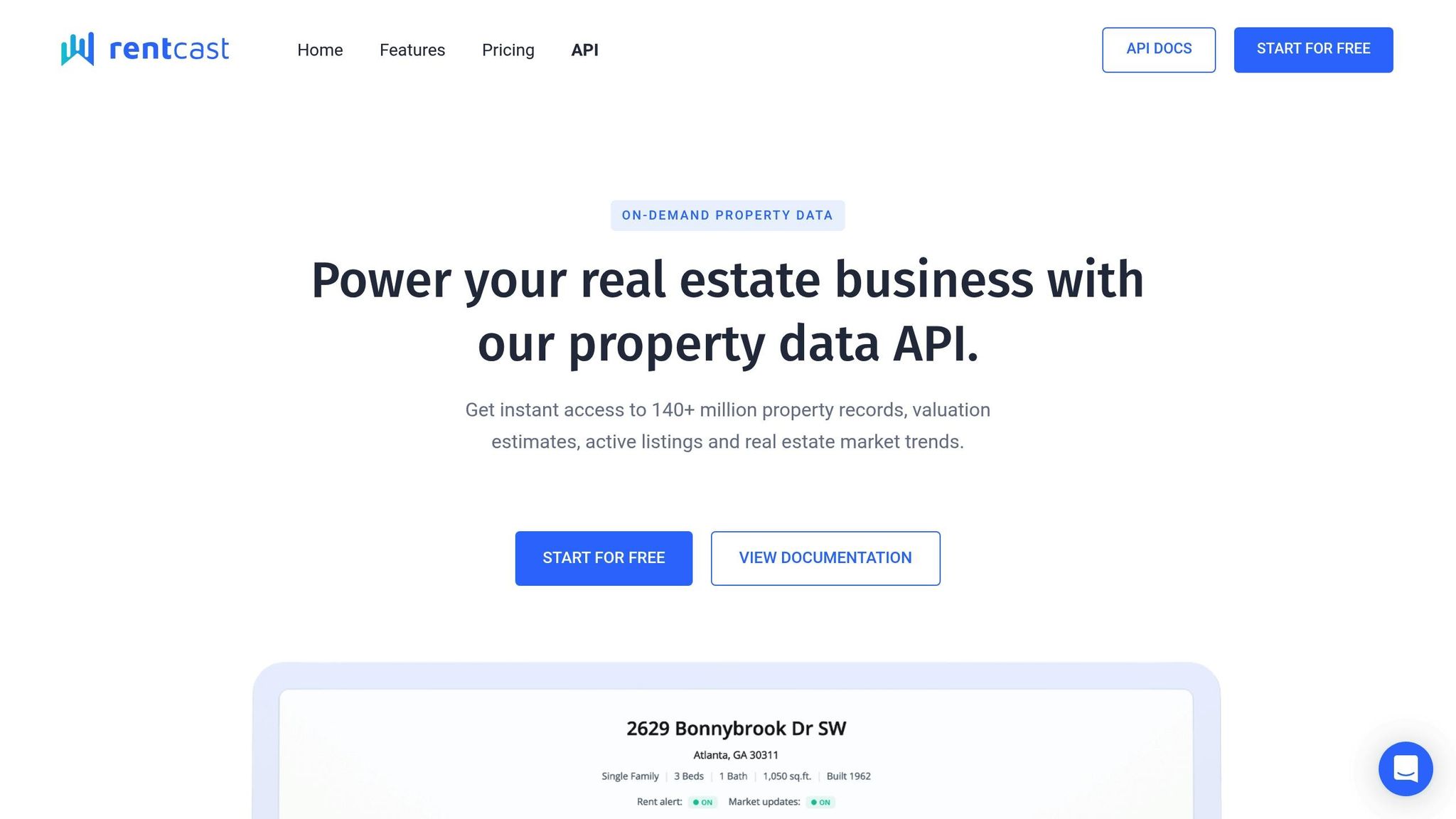
RentCast is a go-to solution for integrating real estate API data at scale, offering nationwide coverage across the U.S. with access to a massive database of 140 million property records. Each record includes over 140 distinct data points, covering everything from property features and ownership details to valuation models, comparable listings, active market trends, and historical data. Launched in June 2023, RentCast API provides instant access to this extensive dataset. As Anton Ivanov, Founder and CEO, puts it:
“Our new RentCast API gives you instant access to 140+ million property records, owner details, value and rent estimates, comps, active listings, and real estate market trends.”
Scalability
RentCast’s API is designed to handle heavy data demands effortlessly. Its REST API adapts to high request volumes, ensuring reliable performance. With over 500,000 daily updates, the platform guarantees up-to-date information on residential and commercial properties. A real-time dashboard tracks key metrics like request volumes, errors, and latency, giving users full visibility. For non-developers, RentCast offers Zapier integration, enabling connections with over 6,000 tools, including Salesforce, HubSpot, and Google Sheets. Plus, all pricing plans include an overage fee system, so users can continue accessing data even if they exceed their monthly limits.
Integration Features
Developers will appreciate RentCast’s robust integration tools. The platform offers a dedicated portal with a complete endpoint reference, an interactive sandbox for testing, and pre-built code samples in various programming languages. The interactive playground allows users to preview API responses before diving into integration. A centralized dashboard lets users manage API keys, monitor request metrics, and oversee billing. For added convenience, support is available via live chat every day of the week or through email. Flexible licensing terms mean there’s no requirement for data attribution or RentCast branding in the final application, making it easy to integrate RentCast into any project.
Pricing Models
RentCast offers a free tier with 50 API calls per month, perfect for development and testing purposes. Paid plans are based on monthly request volumes, with no long-term contracts or commitments required. To handle unexpected spikes in usage, all plans feature overage fees, ensuring uninterrupted access to data. Users can also switch between billing plans directly through the API dashboard, making it simple to adjust as needs change.
6. Datafiniti API
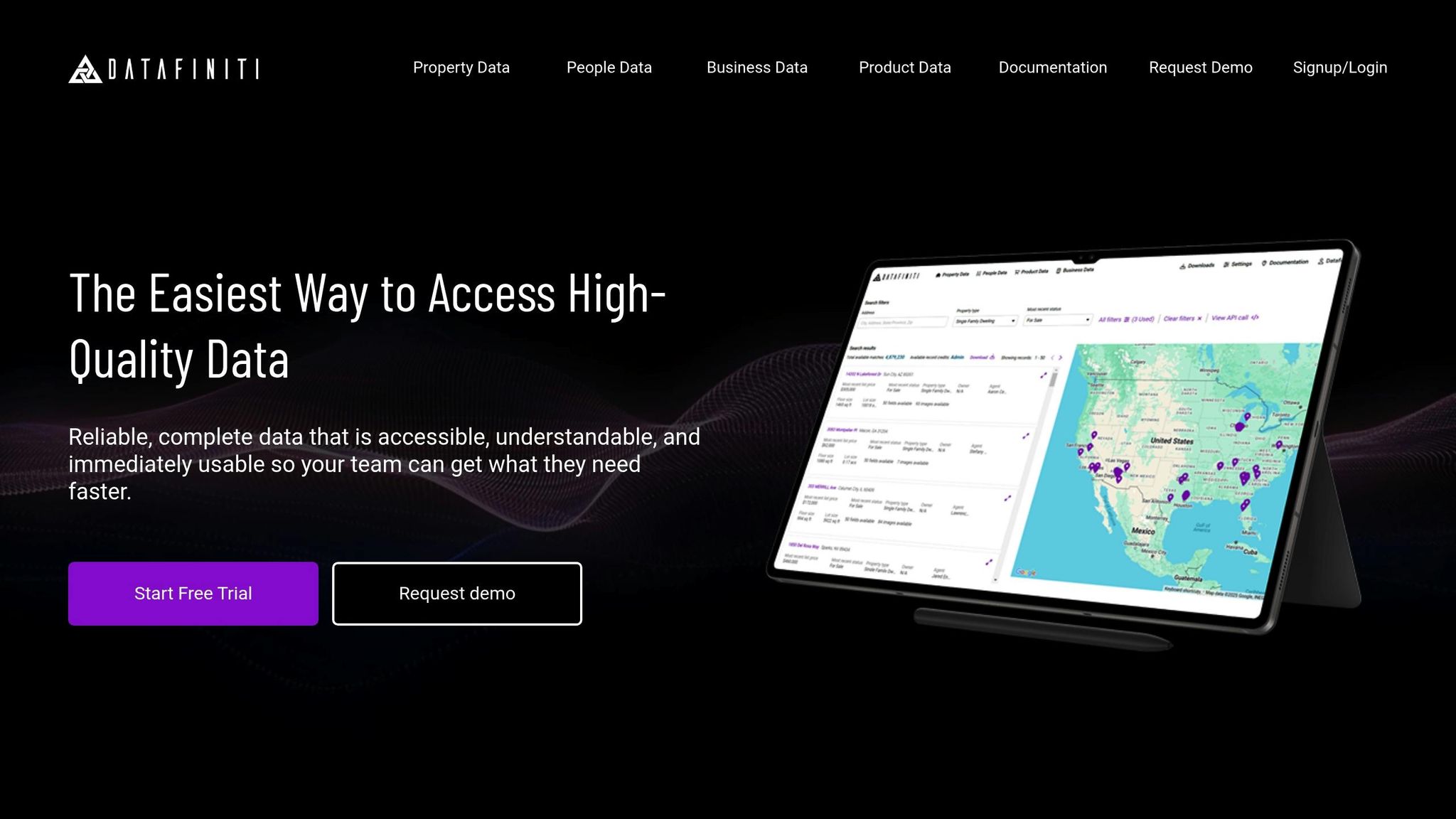
Datafiniti provides an extensive dataset covering a wide range of property types across the U.S., including 122 million single-family homes, 27.8 million apartments, 27.2 million townhomes/condos, 17.9 million land parcels, 10.6 million mobile/manufactured homes, 6.2 million commercial/industrial/retail properties, and 5.5 million multi-family units. This comprehensive database includes active listings, historical records, off-market properties, and inventory without current listing activity. Its scope makes it ideal for both nationwide analysis and more focused market studies, supporting bulk integrations for high-volume property analytics.
Data Coverage
The Datafiniti API delivers a wealth of information, including location data, property characteristics, tax and assessment details, transaction history, and listing activity. The records are updated on a rolling daily and weekly basis to include new listings, sales, and tax changes. Users can apply granular filters – such as location, property type, and market activity – making it possible to extract highly targeted datasets. Additionally, a user-friendly web portal simplifies data exports, eliminating the need for engineering support. This structure provides a reliable foundation for bulk data integration.
Scalability
Built to handle high-volume requests, the API uses tools like pagination and a “Count” feature, which shows the total number of matching records before initiating a full transfer. This helps users plan resources effectively. It also supports scheduled exports via the API, allowing nightly or weekly bulk ingestion into internal systems. For more localized insights, geospatial searches using coordinates and radius filters enable neighborhood-level analysis. These features make scaling data operations seamless.
Integration Features
With a stable RESTful interface, the API ensures consistent search patterns and a standardized schema, reducing the need for heavy preprocessing. Developers can find detailed documentation at docs.datafiniti.co. The platform includes tools like Autotrace for advanced data discovery and Geolocation for property searches based on coordinates. Flexible filters allow users to query data by geographic location, address, or property status, enabling highly specific searches tailored to unique needs.
Pricing Models
Datafiniti offers a free trial, allowing access to 1,000 records over two weeks. Paid plans start at $119 per month for 1,000 records and scale to $349 per month for 10,000 records, $899 per month for 100,000 records, and $3,999 per month for 1,000,000 records. For businesses with larger or more specific data needs, an Enterprise plan is available for $60,000 per year, with a 10% discount for annual payments.
7. Mashvisor API
Mashvisor brings together property details, short-term rental (STR) metrics, long-term rental (LTR) estimates, and investment analytics like cap rate and cash-on-cash return. Covering all 50 U.S. states, it offers access to over 20 million MLS listings, 11 million active STR listings, and 6 million LTR listings. This makes it especially useful for rental arbitrage analysis and for PropTech developers creating investment underwriting tools. Its endpoints align perfectly with the need for scalable, high-volume data solutions.
Data Coverage
The API is structured to provide specific data through distinct endpoints. For example:
- The
/client/propertiesendpoint delivers basic property details like the number of bedrooms, bathrooms, square footage, and pricing. - The
/client/get-propertyendpoint offers more comprehensive profiles, including tax history, transaction records, and three automated valuation models (AVMs).
For rental performance, the /client/airbnb/listings endpoint provides STR data such as occupancy rates, average daily rates (ADR), and revenue projections. Meanwhile, the /client/rental-rates endpoint delivers LTR estimates for properties ranging from one to five bedrooms. Historical STR data spans 36 months, making it ideal for time-series analysis and understanding seasonal trends. MLS listings are updated multiple times a day, and STR data refreshes daily.
Scalability
Mashvisor operates on a credit-based system, with each API call consuming credits based on the endpoint and data volume. Higher-tier plans include larger credit allowances, making them suitable for enterprise-level applications requiring frequent queries. For users needing massive datasets, Mashvisor provides dedicated bulk access and custom endpoints. For example, the /client/marketplace-listings-search endpoint allows for bulk retrieval of MLS data, enabling market-wide analysis at scale.
Integration Features
The API is built on a RESTful, JSON-based architecture, making it compatible with programming languages such as Python, Node.js, Java, C#, R, Go, and PHP. Users authenticate through API keys generated in their dashboard. The Mashvisor developer portal offers detailed documentation, along with sample code for Python and cURL to assist with quick integration.
“Honestly from a developers perspective, I really like working with you guys and there has been a number of times where we have reached out and you guys had preemptively identified the issues we wanted raise and were already considering solutions for them” – Kyle Horton, Owner and Co-Founder at Kelix
Pricing Models
Mashvisor offers a 7-day free trial, providing 30 credits to test its endpoints and data structure. Paid plans are tiered, with higher levels granting more credits and access to advanced features like bulk data retrieval. For large-scale users, such as professional investors and PropTech developers, custom pricing options are available to support dedicated infrastructure needs.
“Mashvisor has been an essential data partner for PropInsight from day one. Their API has enabled us to deliver real-time investment insights to our users, saving countless hours of manual research and accelerating our product development” – Seyi Odusami, Founder at PropInsight
API Comparison Table
Choosing the right API for accessing high-volume property data depends on what you’re looking for – whether it’s detailed property attributes, rental market insights, or bulk data handling. Below is a side-by-side comparison of seven APIs based on their data coverage, scalability, integration options, and pricing structures.
| API Provider | Data Coverage | Scalability & Performance | Integration Features | Pricing Model |
|---|---|---|---|---|
| BatchData | Covers 155M+ properties with 700+ attributes, ownership records, MLS (active/sold), liens, pre-foreclosures, and skip tracing with 76% right-party contact accuracy | Offers low latency, high-concurrency pipelines, daily updates, 99.8% US coverage, and enterprise-grade infrastructure | RESTful JSON APIs with built-in compliance tools like Federal DNC and litigator scrubbing | Pay-as-you-go or subscription; enterprise solutions available |
| ATTOM Data | Includes property details, mortgages, school zones, crime data, climate risks, environmental hazards, and neighborhood boundaries | Features the Enterprise Data Management Program (EDMP) for standardization and supports large-scale data requests | RESTful JSON/XML APIs with community and POI insights | Enterprise or subscription-based pricing |
| CoreLogic | Provides tax assessor records, deed transfers, foreclosures, property characteristics, and market trends | Built for institutional clients, handles massive datasets for industries like lending and insurance | XML and JSON endpoints with dedicated account management for enterprise users | Custom enterprise pricing |
| HouseCanary | Offers AVMs, rental estimates, block-level analytics, and property condition scores | Uses machine learning models for speed and supports frequent valuation requests | RESTful JSON APIs with Python and JavaScript SDKs and detailed documentation | Subscription plans based on API call volume |
| RentCast | Focuses on rental estimates, property details, market comparables, and neighborhood data | Designed for developers scaling rental platforms, with a user-friendly dashboard and no long-term contracts | RESTful JSON APIs with straightforward authentication and sample code in multiple languages | Usage-based pricing with tiered plans |
| Datafiniti | Covers residential and commercial properties, sold prices, rental listings, short-term rentals, and geolocation data | Supports bulk data downloads and enrichment of existing datasets through a robust search portal | RESTful JSON APIs with custom filtering and bulk ingestion capabilities | Subscription-based pricing with volume discounts |
| Mashvisor | Features 20M+ MLS listings, 11M+ short-term rental (STR) listings, 6M+ long-term rental (LTR) listings, and investment analytics like cap rate and cash-on-cash return | Offers a credit-based system, bulk access, and custom endpoints for market-wide analysis | RESTful JSON APIs compatible with Python, Node.js, Java, C#, R, Go, and PHP, with a detailed developer portal | 7-day free trial (30 credits), tiered plans, and custom enterprise pricing |
This table provides a quick overview to help you evaluate which API aligns with your project’s requirements, whether you’re a developer, investor, or enterprise user.
Conclusion
Choosing the right real estate API for managing high-volume data requires a careful match between your specific needs and the API’s capabilities in areas like scalability, data depth, and pricing. For example, if you’re creating a nationwide platform for investors that demands detailed property attributes, ownership records, and reliable skip tracing, BatchData offers impressive coverage with over 155 million properties, 700+ attributes, and a 76% right-party contact accuracy rate. This level of detailed and up-to-date data can provide a strong backbone for scalable, high-performance systems.
Scalability is a must-have feature. The API should be able to handle millions of requests per month without delays. BatchData’s infrastructure, with its high-concurrency pipelines and daily updates, showcases the kind of enterprise-grade performance you should look for.
When it comes to data, both breadth and depth matter. Consider whether your use case requires just basic property details or more specialized insights, like liens or pre-foreclosure information, and pick the API that aligns best with those needs.
Finally, pricing is a critical factor for long-term success. Flexible pay-as-you-go models, like BatchData’s, are useful for fluctuating data demands, while subscription plans can help maintain predictable costs for consistently high usage. Be sure to check for any hidden fees tied to premium features, higher usage limits, or access to specialized data. For businesses processing thousands or even millions of API requests each month, volume discounts and custom enterprise plans can make a big difference in managing costs effectively.
FAQs
How do I choose between real-time APIs and bulk data delivery?
When deciding between the two, consider what fits your workflow best. Real-time APIs are perfect if you need immediate, up-to-date information – think live property searches or generating leads on the spot. On the other hand, bulk data delivery works well for deeper analysis or historical research, giving you large datasets that can be processed offline. If staying current is your priority, go for real-time APIs. If managing and analyzing large volumes of data efficiently is key, bulk delivery is the way to go.
How can I ensure property data stays accurate and up to date at scale?
To keep property data accurate and current on a large scale, rely on APIs that offer frequent updates, access to extensive datasets containing millions of properties, and bulk data processing capabilities. These tools make it easier to handle large volumes of data efficiently while ensuring the information remains dependable for making informed decisions.
What’s the best way to estimate API costs for millions of monthly requests?
When estimating API costs for handling millions of monthly requests, you’ll need to weigh several factors, including data volume, how often the API is accessed, and the chosen pricing model – whether it’s a pay-as-you-go structure or a tiered subscription plan.
To keep costs under control without sacrificing performance, consider strategies like caching frequently accessed data and processing data in bulk where possible. These methods can significantly reduce the number of API calls required, helping you strike the right balance between cost efficiency and maintaining high performance for large-scale API usage.