





































The U.S. real estate market is under constant regulatory pressure, and PropTech companies are stepping up to meet these challenges. From stricter data privacy laws like California’s CCPA to new federal anti-money laundering rules, staying compliant is no small feat. Non-compliance costs can average $14.8 million, nearly triple the cost of maintaining compliance.
Here’s how PropTech is tackling these issues:
- Data Privacy: Laws like CCPA and CPRA demand tighter controls, while states like Colorado are setting AI oversight requirements for housing and lending decisions.
- Energy Standards: Over 50 cities now enforce building performance rules, with penalties as high as $268 per ton of carbon emissions.
- Federal Reporting: New FinCEN rules require detailed ownership disclosures for cash transactions, with severe fines for violations.
Legacy systems struggle to handle these demands due to fragmented data, manual processes, and poor audit capabilities. PropTech solutions offer centralized data, real-time monitoring, and automated ESG tracking to turn compliance into an operational advantage.
This article explores the challenges, why older systems fall short, and how modern PropTech tools are reshaping compliance and creating market opportunities.
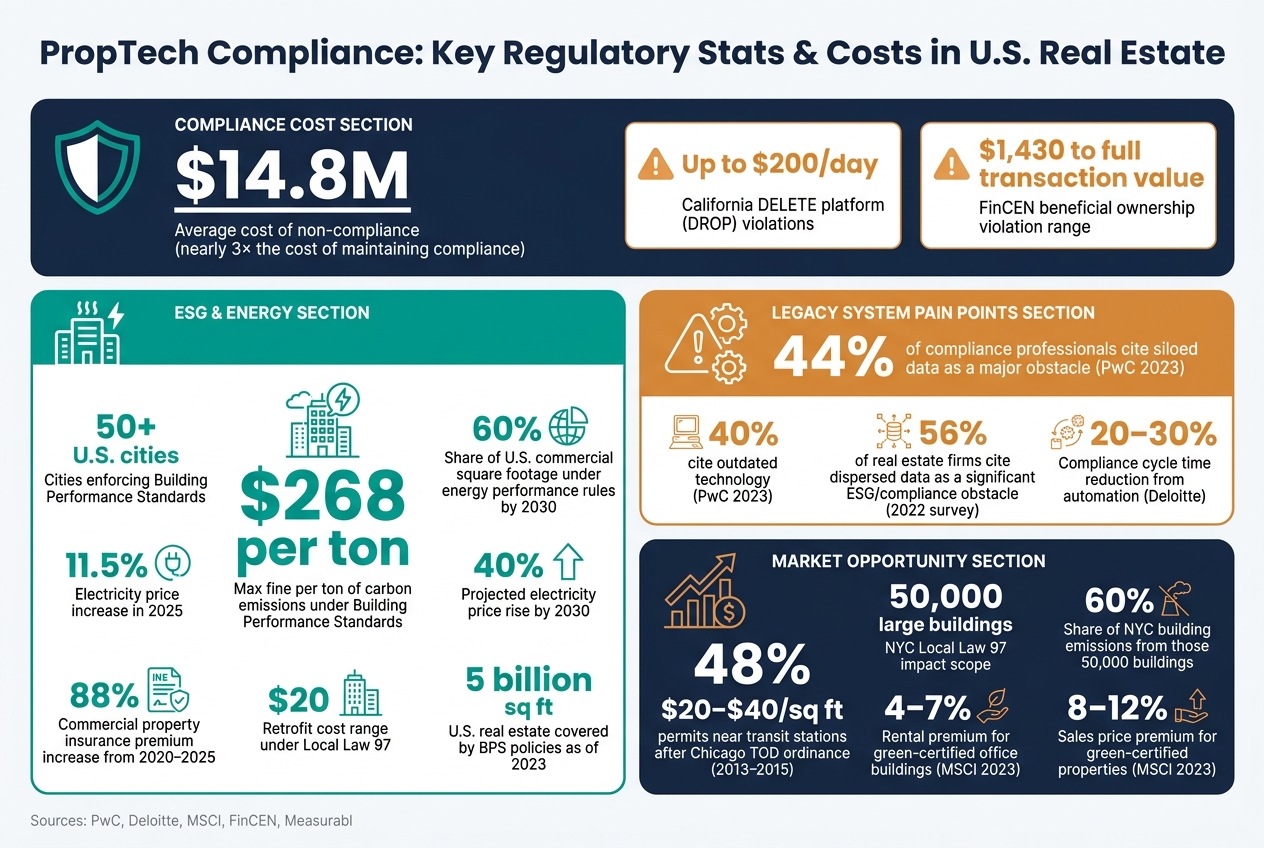
PropTech Compliance: Key Regulatory Stats & Costs in U.S. Real Estate
Proptech Panel – Proptechs Making AML Compliance Easy
sbb-itb-8058745
Major Regulatory Challenges in U.S. Real Estate
The U.S. real estate market is navigating a maze of shifting regulations, shaped by stricter data privacy laws, environmental rules, and federal reporting requirements. These changes are redefining how property transactions are managed and monitored. Let’s take a closer look at the major challenges transforming the industry.
Data Privacy and Security
State-level privacy laws are forcing real estate and PropTech platforms to rethink how they handle property and contact data. This often requires advanced contact enrichment to maintain accuracy while ensuring compliance. Laws like the California Consumer Privacy Act (CCPA) and California Privacy Rights Act (CPRA) demand tighter controls on data retention and deletion. However, this creates a tug-of-war between consumer rights and the need for long-term transaction records. Take California’s DELETE platform (DROP) as an example: a single consumer deletion request can trigger widespread obligations for data brokers, with penalties of up to $200 per day for violations.
"Privacy by design is a schema discipline. The schema decisions made in sprint one determine whether a platform can satisfy a regulatory audit three years later." – Monika Stando, Marketing Campaigns Team Leader, Hicron Software
Colorado has also stepped into the spotlight with SB 26-189, which will require human oversight for AI-driven housing and lending decisions starting in January 2027. According to Loren Furman, CEO of the Colorado Chamber of Commerce, this law could set a precedent for other states. Meanwhile, environmental regulations are adding another layer of complexity to compliance.
ESG Mandates and Building Performance Standards
Energy and emissions regulations are no longer optional. Over 50 U.S. cities now enforce Building Performance Standards, and by 2030, roughly 60% of U.S. commercial square footage will fall under energy performance regulations. Non-compliance comes with steep fines, reaching up to $268 per ton of carbon emissions.
The financial strain doesn’t stop there. Electricity prices jumped 11.5% in 2025 and could rise by as much as 40% by 2030. On top of that, insurance premiums for commercial properties skyrocketed by 88% between 2020 and 2025. For instance, in a 2026 South Florida multifamily deal, updated insurance quotes increased projected costs by 22%, tightening loan terms and reducing the Debt Service Coverage Ratio (DSCR) from 1.32x to 1.25x.
"Some are putting limits on energy use, others on emissions. This makes it rather complicated to track all of this manually." – Mike Zatz, Senior Vice President of Global Ecosystem Data and Partnerships, Measurabl
Local Housing Regulations
Federal rules are also reshaping the landscape. The FinCEN Residential Real Estate Reporting Rule, effective March 1, 2026, requires disclosure of beneficial ownership in all-cash residential transactions involving legal entities or trusts. Penalties for non-compliance range from $1,430 for negligent violations to the full transaction value for willful breaches.
For PropTech platforms, this means creating efficient reporting protocols through automated workflows, often referred to as a "reporting cascade", to meet these new requirements. These evolving rules highlight the growing need for data-driven solutions to ensure compliance in an increasingly regulated market.
Why Legacy Systems Struggle With Regulatory Demands
The regulatory challenges facing businesses today – from privacy laws to ESG requirements and beneficial ownership rules – all hinge on one critical need: data that is accurate, interconnected, and easy to audit. Unfortunately, legacy systems, which were primarily built for basic recordkeeping, fall short in meeting these demands. Their limitations become apparent in three key areas: fragmented data, reliance on manual processes, and inadequate audit capabilities.
Siloed and Incomplete Data
In many real estate organizations, key information like property details, ownership structures, and tenant records are scattered across separate systems. When new regulations arise, teams often face a daunting task: answering even simple questions like "Which properties are impacted?" requires manually pulling data from multiple sources.
This lack of integration creates serious compliance risks. Fragmented data can lead to missed filings or incorrect asset classifications, undermining the reliability of compliance efforts. A 2023 PwC survey highlights this issue, with 44% of compliance professionals identifying siloed data as a major obstacle, while 40% cite outdated technology as a significant challenge.
Manual Tracking of Regulatory Changes
Real estate portfolios in the U.S. often span a patchwork of states, cities, and districts, each with its own rules on zoning, rent control, building standards, and data privacy. Keeping up with these regulations manually – through newsletters, agency websites, or email threads – is not only slow but also prone to inconsistencies. Different interpretations of the same rule can lead to compliance gaps.
Research from the Deloitte Center for Financial Services shows that automating compliance tracking can cut cycle times by 20–30%. This speed is crucial, especially when new housing or privacy regulations can take effect with minimal notice. The sheer scale of new rules compounds the challenge: over 100 U.S. cities and states have already introduced or proposed building performance standards, making manual tracking nearly impossible for operators managing properties across multiple markets. Legacy systems, reliant on manual processes, only magnify these inefficiencies.
Limited Auditability and Reporting
Older platforms often lack detailed, unchangeable audit logs. In spreadsheets or outdated software, data edits frequently overwrite previous entries, leaving no clear record of changes. When regulators, lenders, or investors ask for details – such as how a number was calculated or which policy applied at a specific time – teams are left scrambling to piece together answers.
Reporting in legacy systems typically involves extracting data from various sources and reconciling discrepancies, a process that is both time-consuming and error-prone. By contrast, modern compliance tools streamline this process, enabling organizations to respond to regulatory demands with greater efficiency and accuracy. These limitations highlight the pressing need for technology that not only tracks regulatory updates but also integrates seamlessly with compliance workflows, reducing operational headaches and improving confidence in the data.
PropTech Solutions That Turn Regulatory Challenges Into Opportunities
Navigating complex regulations can feel like a burden, but with the right tools, it can actually become a strategic advantage. Modern PropTech solutions not only help firms stay compliant but also offer a clearer view of the market, unlocking opportunities along the way.
Enriched and Centralized Real Estate Data
Fragmented data is a common challenge, but the solution lies in creating a single, comprehensive dataset. This dataset should include property details like ownership structures, zoning rules, rent control statuses, tax assessments, and relevant federal, state, and local regulations. By normalizing this information with consistent identifiers – like Assessor’s Parcel Numbers (APNs) or standardized addresses – firms can build a strong foundation for their compliance strategies.
With unified datasets, compliance teams can quickly pinpoint properties affected by regulatory changes. Meanwhile, investment teams can identify trends, such as areas with aging or energy-inefficient buildings that might require future upgrades. This centralized approach also ensures financial modeling in USD remains consistent, allowing underwriting and compliance teams to operate from the same playbook.
Real-Time Compliance Monitoring and Impact Analysis
Traditional periodic updates just don’t cut it when regulations are changing at a rapid pace. Real-time monitoring tools bridge this gap by continuously scanning federal, state, and municipal codes for new or amended rules. These tools then cross-reference the updates with your portfolio, flagging properties that need attention.
One standout feature of these systems is their financial impact analysis. For instance, if a new emissions rule is introduced, the system can estimate retrofit costs using building attributes and cost curves (in USD per square foot). It can also model how compliance – or non-compliance – might affect metrics like net operating income (NOI) or internal rate of return (IRR). This kind of analysis is especially useful during acquisitions, helping to determine whether a discounted purchase price justifies anticipated compliance costs.
In addition to monitoring, automation ensures performance tracking stays on point, so compliance is maintained over time.
Automated ESG and Building Performance Tracking
Regulations related to energy and sustainability are increasingly stringent, making automated tracking a must. These systems integrate operational data – like sub-meter readings, IoT sensor outputs, and building management system (BMS) logs – with relevant benchmarks in the U.S., such as ENERGY STAR, GRESB, and city-specific energy ordinances. Metrics are calculated in U.S. standard units (e.g., kBtu per square foot, gallons, °F) and are continuously updated against compliance deadlines.
Automated workflows can trigger actions like energy audits when energy use intensity (EUI) thresholds are exceeded or schedule HVAC maintenance before a breach occurs. Every activity is timestamped and ready for audits, which is particularly helpful for regulatory inspections and for securing green loans or sustainability-linked financing.
Ownership and Contact Data Enrichment
When regulations change, quick communication with property owners or managers becomes essential. However, public records in the U.S. are often incomplete, and ownership structures can be complex, involving LLCs or layered entities that obscure the actual decision-makers.
This is where services like BatchData come in. They provide tools for property and contact data enrichment, skip tracing, and verifying phone numbers and addresses. BatchData simplifies outreach by linking compliance teams to verified contact details and ownership structures. As they explain:
"Rely on up-to-date, multi-sourced data to ensure accuracy and compliance across your platform."
For investors, having access to enriched ownership data is a game-changer. It opens up opportunities for off-market acquisitions, especially in cities with strict climate laws where owners of older, inefficient buildings might be motivated to sell. Continuous data enrichment also ensures compliance notices reach the right people, reducing the risk of missed deadlines and penalties.
Using Market Analytics to Find Opportunities in Regulatory Change
Regulatory changes often act as signals for investors and operators, highlighting undervalued assets and untapped markets. Those who can interpret these shifts early have a chance to act before the broader market adjusts, capitalizing on opportunities others might overlook.
Finding High-Potential Markets
PropTech analytics platforms are powerful tools for identifying promising markets by layering regulatory data over property-level insights. For instance, in Los Angeles, you can analyze census tracts where recent upzoning has increased residential density limits. Combine this with data showing areas where floor-area ratio utilization is below 0.6 and rents have risen by more than 5% year-over-year. The result? A ranked list of neighborhoods with strong development potential.
The impact of zoning reforms is well-documented. Take Chicago’s 2013–2015 transit-oriented development (TOD) ordinance as an example: housing-unit permits within 0.5 miles of transit stations increased by 48% compared to areas without such reforms. By using analytics tools to track permit activity alongside zoning changes, investors can identify similar trends in other cities – often before prices rise.
Adaptive reuse is another area gaining traction. Cities like Los Angeles, Denver, and Washington, DC are adopting ordinances that allow older office buildings to be converted into residential units. PropTech platforms can pinpoint commercial or industrial properties in these newly eligible zones and rank them based on factors like building age, floor plate configuration, vacancy rates, and proximity to transit. This kind of data helps identify properties with strong conversion potential, complete with projected development margins expressed in dollars per buildable square foot. With this level of precision, acquisition strategies can be designed with confidence.
Targeted Acquisition Strategies
Once market opportunities are identified, enriched ownership data can help investors turn regulatory insights into actionable acquisition strategies. Instead of pursuing every property in an upzoned area, investors can focus on parcels that underutilize the new zoning potential – like a single-story retail property now eligible for six-story development. Add in distress signals, such as tax delinquencies or long-term static ownership, and you’ve got a highly targeted approach.
Consider New York City’s Local Law 97 as an example. This regulation impacts approximately 50,000 large buildings (over 25,000 square feet), which collectively account for about 60% of the city’s building emissions. With retrofit costs ranging from $20 to $40 per square foot, some owners may prefer to sell rather than invest in upgrades. Investors who factor these retrofit costs into their acquisition models – and calculate the repositioned asset’s internal rate of return (IRR) post-upgrade – can craft compelling offers. While sellers see a way out of a regulatory challenge, buyers see an opportunity.
Platforms like BatchData make this process even more efficient. Their tools for contact enrichment, skip tracing, and phone verification help investors connect directly with decision-makers behind complex LLC ownership structures. This ensures that outreach efforts are targeted and timely, reaching the right person with the right proposal.
Portfolio Optimization Based on Regulatory Risk
It’s not just about finding opportunities – it’s also about managing risks within existing holdings. PropTech platforms can score markets based on regulatory pressures, such as rent control or stricter mandates, and identify favorable trends like upzoning or density bonuses. These scores help quantify potential impacts on net operating income (NOI), capital expenditures (capex), or property valuations over the next five years.
As of 2023, building performance standards (BPS) policies cover over 5 billion square feet of U.S. real estate across cities like New York, Washington, DC, Boston, St. Louis, and Denver. Portfolios heavily exposed to BPS-regulated cities without clear compliance plans face increasing risks. Scenario modeling tools allow asset managers to simulate various outcomes – stricter emissions limits, tighter rent caps, or accessory dwelling unit (ADU) legalization – and measure their effects on NOI and debt service coverage ratios (DSCR). This kind of forward-looking analysis enables proactive decision-making, turning potential challenges into opportunities for strategic capital allocation.
A Step-by-Step Plan for Regulatory Adaptation Using Data
To address modern compliance challenges and fill existing gaps, a structured, data-driven approach can guide effective regulatory adaptation.
Assess Regulatory Exposure and Data Readiness
Start by creating a detailed regulatory inventory for each asset. Include specifics like use type, ZIP code, square footage, year built, ownership structure, and active leases. Map these details against relevant regulations such as performance standards, rent control laws, CCPA/CPRA requirements, and local zoning rules.
Next, conduct a data readiness audit. This involves cataloging every system that houses compliance-related data – think property management platforms, CRMs, energy management systems, and accounting software. Evaluate each data domain for completeness, accuracy, timeliness, and accessibility. Tackling fragmented systems is crucial, as this issue often stems from older technology. In fact, a 2022 survey found that 56% of real estate firms identified dispersed data across multiple systems as a significant obstacle to effective ESG and regulatory compliance.
Centralize and Enrich Core Data Assets
Once gaps are identified, consolidate your property, ownership, tenant, utility, and building data into a single, centralized hub. Use standardized identifiers, such as APNs and USPS addresses, to maintain consistency. Begin integrating operational systems in phases, starting with read-only feeds to test and validate pipelines without disrupting daily operations.
External data enrichment can significantly improve accuracy. Services like BatchData – Ivo Draginov provide tools for property and contact data enrichment, ownership resolution, skip tracing, phone verification, and bulk data delivery. These capabilities address common gaps left by internal systems. For example, enriched ownership hierarchies help meet transparency requirements, while verified contact details ensure that legally mandated notices reach the correct recipients. Chris Finck, Director of Product Management at BatchData, highlights the efficiency this brings:
"We want to supplement your work and make you superhuman so you can do things in seconds not hours. That’s where BatchData comes in. What used to take 30 minutes now takes 30 seconds."
Plan for quarterly data enrichment to keep records current and avoid outdated information undermining audits.
Embed Regulatory Logic Into Analytics and Workflows
Regulations should be translated into machine-readable logic to streamline compliance. For instance:
- Flag buildings exceeding energy intensity thresholds under Local Law 97.
- Block rent increases that surpass a city’s annual cap.
- Enforce a 45-day response window for CCPA data subject requests.
These rules should be embedded across three key areas: analytics models (to calculate risk scores and estimate penalty exposure), workflow tools (to trigger tasks for approaching deadlines or breached thresholds), and building automation systems (to ensure energy use stays within limits).
Keep a clear record of every rule evaluation through logging and version control. This creates a transparent paper trail for regulators, lenders, and auditors, showing how decisions were made and the data that supported them. This step also sets the stage for continuous compliance monitoring.
Set Up Compliance Monitoring and Reporting Processes
Shift from periodic reviews to continuous monitoring using dashboards tailored to specific roles. For example:
- Executives can view portfolio-level compliance scores and fine exposure by jurisdiction.
- Asset managers can track energy use intensity (EUI), emissions progress, and unresolved code violations at the property level.
- Legal teams can review privacy logs and monitor data subject request timelines.
Dashboards should use red/amber/green indicators to highlight issues immediately, rather than waiting for quarterly reports. Automated alerts should focus on exceptions, triggering only when a rule is at risk of being violated. These alerts should also create assigned tasks in your workflow system to ensure proper resolution.
For ESG reporting, standardized outputs should align with regulatory expectations. Examples include annual emissions disclosures, ENERGY STAR score submissions, and fair housing reports. Generating these reports using frozen data snapshots not only preserves auditability but also eliminates the last-minute rush often caused by manual reporting processes.
Conclusion: Why Data Intelligence Is the Foundation of Regulatory Success
Real estate regulations are evolving rapidly, tightening building performance standards, expanding data privacy requirements, and refining local housing rules. Firms relying on manual tracking or scattered spreadsheets risk falling behind in compliance and making real estate investing decisions based on outdated information.
In this challenging landscape, strong data intelligence becomes the cornerstone of success. Instead of relying on a patchwork of tools, firms need centralized records, enriched ownership data, real-time monitoring, and automated ESG tracking – all working together as part of a unified compliance strategy. When this foundation is in place, regulatory changes shift from being reactive emergencies to strategic opportunities. For instance, a 2023 MSCI analysis revealed that green-certified office buildings achieved rental premiums of 4–7% and sales price premiums of up to 8–12% compared to non-certified properties. This highlights the financial advantage of treating compliance data as a strategic asset rather than just a reporting requirement. Beyond managing risks, this approach uncovers opportunities to gain a competitive edge in the market.
Accurate ownership and contact data are equally critical. When regulations require disclosures or retrofitting notices, having access to reliable owner information is key. Tools like BatchData streamline property and contact data enrichment, ensuring teams can respond quickly while integrating seamlessly into compliance workflows and portfolio analytics.
With a solid data infrastructure in place, firms can take small, manageable steps to leverage these insights. Start with one city, a specific asset type, or a single regulatory focus. Build a clean data pipeline, demonstrate its value, and then scale up. Firms that embrace these incremental improvements and collaborate with experts like BatchData will be better equipped to adapt to shifting regulations. Agile, data-driven systems not only keep pace with regulatory demands but also position firms to capitalize on emerging market opportunities.
Modern compliance isn’t about adding more staff – it’s about creating efficient, adaptable systems to navigate an ever-changing market.
FAQs
What’s the fastest way to see which of my properties are affected by a new regulation?
The fastest way to pinpoint properties affected by new regulations is by leveraging a centralized property data API, such as those offered by BatchData. By integrating an API into your workflow or CRM, you can streamline your analysis by filtering properties based on specific traits, financial details, or distress indicators. Additionally, you can configure automated alerts to keep track of compliance updates or shifts in property values as they happen.
How can we stay compliant with privacy laws and still keep required real estate records?
To navigate privacy laws effectively in managing real estate records, it’s essential to align regulatory requirements with your internal processes. Start by mapping relevant regulations to your operational procedures and thoroughly vet vendors for certifications like SOC 2 or ISO 27001, which demonstrate strong data protection standards.
Leverage tools such as BatchData to simplify compliance tasks. These tools offer features like automated TCPA list scrubbing and DNC (Do Not Call) checks, helping you stay compliant without manual effort.
It’s also critical to distinguish between publicly accessible property records and sensitive personal data. Ensure your systems are equipped to handle consumer data requests efficiently, meeting legal deadlines to avoid penalties.
What data is needed to comply with the 2026 FinCEN ownership reporting rule?
The FinCEN Residential Real Estate Reporting Rule, though vacated by a federal court, initially mandated collecting detailed information for non-financed residential property transfers involving entities or trusts. This included legal names, dates of birth, addresses, citizenship, taxpayer identification numbers (or foreign equivalents) for both signing individuals and beneficial owners, along with payment details and transaction terms. It’s important for professionals to remain aware of any future regulatory changes.