

































Address verification is critical in real estate to prevent fraud, ensure compliance, and maintain accurate records. Here’s why it matters and how to do it right:
- Fraud Prevention: In 2023, address-related fraud caused $1.9 billion in losses. Verifying addresses ensures properties exist and are tied to legitimate owners, stopping scams like wire fraud.
- Regulatory Compliance: Laws like the USA PATRIOT Act and FHA guidelines require accurate address validation. Violations can lead to fines of up to $1 million per case.
- Data Accuracy: Address data decays at 2% per month. Regular updates prevent errors that could disrupt transactions or lead to legal issues.
Key Steps for Address Verification:
- Collect Documents: Use utility bills, deeds, or tax statements to verify addresses. Ensure high-quality scans for digital submissions.
- Standardize Data: Follow USPS formatting rules to fix errors and normalize entries.
- Cross-Check Databases: Validate addresses using USPS, tax records, and geolocation tools.
- Use APIs: Real-time tools catch errors instantly, saving time and ensuring accuracy.
- Maintain Records: Keep audit trails for at least five years to meet compliance requirements.
Tools to Simplify the Process:
- APIs: Automate real-time address validation with USPS-certified systems.
- Bulk Verification: Process large datasets efficiently for audits and compliance checks.
Accurate address verification protects businesses from financial losses, legal risks, and operational challenges. It’s a necessary step for secure, compliant transactions in real estate.
Address Lookup and Verification | Searchbug Tutorials
sbb-itb-8058745
Why Address Verification Matters in Real Estate
Address verification shields real estate professionals from two major threats: fraud and regulatory violations. Inaccurate address data costs U.S. businesses over $20 billion each year, and up to 23% of customer and prospect data contains errors that make it undeliverable. Compounding this issue, around 8% to 10% of the U.S. population relocates annually, with address data degrading at a rate of over 2% per month. This highlights the importance of distinguishing between physical and mailing addresses, not just for operations but also for compliance.
The distinction between a physical address and a mailing address carries significant legal weight. Physical addresses are critical for determining tax jurisdictions, validating legal services, and assessing risks for mortgages and insurance. Mailing addresses, on the other hand, are primarily for correspondence and are generally unsuitable for legal documents. For example, sending legal notices to a P.O. Box or recording deeds in the wrong county can invalidate legal actions.
Preventing Fraud and Verifying Identities
Address verification plays a pivotal role in preventing fraud by ensuring that properties physically exist and confirming that individuals are genuinely tied to those locations. It also flags Commercial Mail Receiving Agencies (CMRAs) and private mail drops, which are common tools used in synthetic identity fraud to obscure actual locations.
This verification process supports Know Your Customer (KYC) protocols by cross-referencing provided addresses with official records to authenticate identities. Many data quality issues – 80%, in fact – stem from typos and invalid entries. Real-time integration of address verification into CRMs or web forms helps catch these errors immediately. Systems certified by the USPS Coding Accuracy Support System (CASS) further enhance accuracy by standardizing addresses and confirming their physical validity. Additionally, Delivery Point Validation (DPV) ensures that each address is an active delivery point within the USPS database. These measures not only combat fraud but also help businesses meet strict regulatory requirements.
Meeting Regulatory Requirements
Accurate address verification is mandated by U.S. federal and state laws to uphold fair lending practices and protect sensitive financial data. Laws such as the Fair Credit Reporting Act (FCRA), Gramm-Leach-Bliley Act (GLBA), and Driver’s Privacy Protection Act (DPPA) require verified addresses for making eligibility decisions and safeguarding consumer information. Sending critical documents to incorrect addresses can lead to compliance violations, hefty fines, and legal repercussions.
In the U.S., CASS certification is the gold standard for address compliance. It ensures standardized addresses and appends ZIP+4 codes to meet USPS delivery requirements. Given the rapid decay of address data, regular verification – ideally monthly or quarterly – is crucial for maintaining compliance. Additionally, using Federal Information Processing Standard (FIPS) codes helps distinguish between counties with identical names in different states, reducing jurisdictional confusion.
How to Verify Addresses: Step-by-Step Process
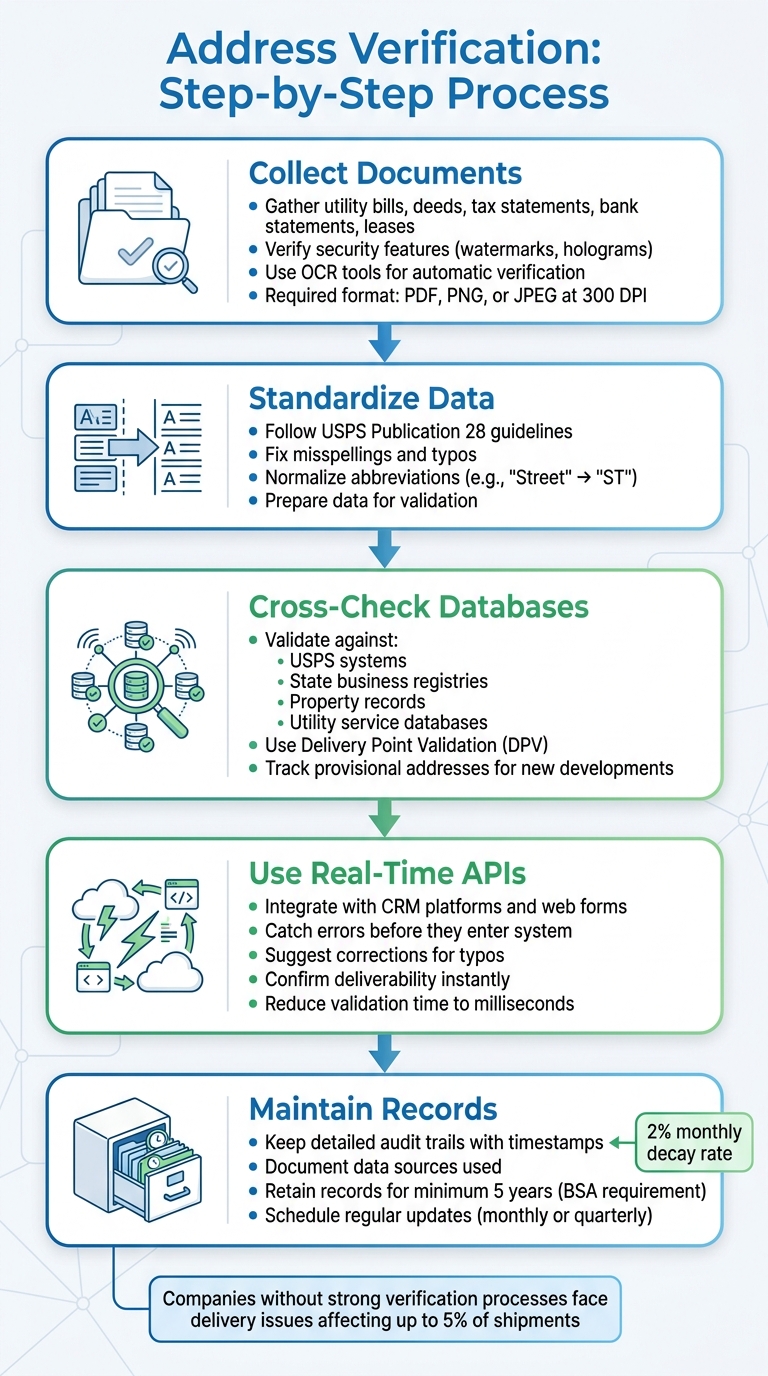
5-Step Address Verification Process for Real Estate Compliance
Address verification in real estate is a structured process aimed at preventing fraud and ensuring compliance with regulations. It involves gathering documents, cross-checking geolocation data, and maintaining proper records.
Collecting and Validating Documents
Start by collecting key proof-of-address documents like recent utility bills, bank statements, leases, deeds, or tax statements. Carefully inspect these for security features such as watermarks or holograms. Optical Character Recognition (OCR) tools can help automatically verify the details. For digital submissions, ensure files are in PDF, PNG, or JPEG format with a resolution of 300 DPI.
Next, normalize the raw address data following USPS Publication 28 guidelines. This step involves fixing misspellings and standardizing abbreviations – like changing "Street" to "ST". Once standardized, the data is ready for further validation through geolocation and cross-referencing.
Using Geolocation and Data Cross-Referencing
After normalizing the address, verify it against trusted databases, including state business registries, USPS systems, property records, and utility service databases. Delivery Point Validation (DPV) is a critical step here, as it confirms whether the address is not just correctly formatted but also an actual physical delivery point. For addresses in new developments that may not yet appear in USPS records, use data providers that track provisional addresses to maintain accuracy in rapidly changing markets.
Real-time API integrations – whether in CRM platforms or on web forms – can help catch errors before they enter your system. These tools suggest corrections for common typos and confirm deliverability, reducing the risk of poor-quality data. This is particularly important since companies without strong address verification processes can face delivery issues affecting up to 5% of their shipments. Once verified, retaining this data ensures compliance and future reference.
Keeping Records for Audits and Compliance
It’s important to maintain detailed audit trails of all verification activities. This includes timestamps and information about the data sources used. Under the Bank Secrecy Act (BSA), businesses must retain these records for at least five years. Such documentation is invaluable during regulatory audits, as it demonstrates compliance efforts.
Since address data can decay at a rate of over 2% per month, scheduling regular updates – monthly or quarterly – helps keep records accurate and legally defensible. This proactive approach ensures your data remains reliable over time.
Address Verification Tools and APIs
Automated tools have taken address verification to the next level, making real estate transactions faster and more reliable. By connecting directly to trusted databases, these tools eliminate manual errors and streamline workflows. They work seamlessly with CRMs, transaction management platforms, and MLS databases, enabling real-time or bulk address validation. Here’s a closer look at how APIs and bulk processing tools enhance precision and efficiency in address verification.
API Integration for Automated Address Verification
Real-time APIs catch address errors the moment they’re entered. When a user types an address into a web form or CRM, the API cross-checks it with USPS databases and instantly provides a standardized, deliverable address. This process eliminates up to 80% of manual data errors and reduces validation time from minutes to mere milliseconds.
Commercial APIs are built for scale, handling 10,000+ requests per minute with 99.9% uptime. For comparison, the free USPS Web Tools API limits users to 60 requests per hour as of January 2026, which doesn’t meet the needs of busy brokerages or title companies. Enterprise-grade APIs go further by offering features like CASS certification (ensuring 98.5% standardization accuracy), Delivery Point Validation (DPV) to confirm physical deliverability, and SuiteLink to add missing apartment or suite numbers.
Some APIs, like BatchData‘s address verification API, combine validation with property data enrichment. This means professionals can verify addresses while accessing ownership records, tax histories, and sales comparables – all in one step. By reducing the number of API calls, this approach simplifies workflows and saves time.
Bulk Address Verification for Large Datasets
For real estate firms managing large datasets, bulk verification tools are indispensable. These services can validate thousands – or even millions – of addresses in a single operation by uploading files in formats like CSV or JSON. They’re perfect for tasks like portfolio audits, pre-listing address cleanups, and compliance checks, where speed and accuracy are critical. Enterprise solutions are capable of processing over 1 million addresses per hour.
The results from bulk verification tools include standardized addresses, status codes, coordinates, and confidence scores. This allows teams to quickly identify entries that need manual review while accepting high-confidence matches automatically. These tools not only save time but also ensure compliance by maintaining accurate data across large property portfolios. For firms managing mailing lists, processing addresses through NCOALink (National Change of Address) every 95 days ensures USPS compliance and unlocks postage discounts.
BatchData’s bulk verification options accommodate flexible file formats and custom datasets, making them adaptable to specific compliance needs. For more complex data pipelines, professional services are available to assist with integration, ensuring a smooth process from start to finish.
Common Address Verification Mistakes and How to Fix Them
Even with advanced tools, address verification can fail when key details are overlooked. These errors not only slow down transactions but also pose compliance risks, costing U.S. businesses over $20 billion annually. Below, we’ll dive into common missteps and practical ways to fix them, ensuring a smoother verification process.
Using Incomplete or Outdated Documents
Address data doesn’t stay accurate forever – it decays at a rate of over 2% per month. That means a lead list can become unreliable in less than a year without regular updates. One common issue is missing secondary unit details, like apartment or suite numbers. For multi-unit buildings, this can result in an address being “partially valid.” While mail might reach the building, it won’t necessarily make it to the intended recipient. This can disrupt everything from legal notices to tax bills and service delivery.
"Address data decays at a blistering rate of over 2% per month, rendering a new lead list unreliable in under a year without constant cleansing and verification."
– Ivo Draginov
The solution? Use CASS-certified software to ensure addresses meet USPS formatting standards and include ZIP+4 codes. For multi-unit properties, always collect secondary unit details (e.g., Apt, Suite). Regular database audits are essential – ideally monthly, but at least quarterly. Without consistent verification, delivery failure rates can climb to 5%, leading to missed deadlines and compliance headaches.
Skipping Document Issuer Verification
Another common mistake is failing to verify the legitimacy of document issuers. For example, Commercial Mail Receiving Agencies (CMRAs), like The UPS Store, provide addresses that look like physical office suites but are essentially mail drops. Basic tools often struggle to distinguish these from valid physical addresses. Similarly, R7 addresses, which require mail pickup at the post office, lack Delivery Point Verification (DPV) barcodes, creating additional challenges.
To address this, use CASS-certified systems to flag P.O. Boxes and CMRAs as “Mailing Only.” Always require a verified physical address for legal documents, tax assessments, and risk-related decisions. This extra layer of scrutiny helps close compliance gaps.
Ignoring Geolocation and Cross-Referencing
Accurate geolocation is critical for meeting regulatory standards, but many teams rely too heavily on ZIP codes to determine county or tax jurisdiction. This is problematic because postal boundaries often cross legal lines. Using ZIP codes alone can lead to errors in flood zone determinations, property valuations, and even legal filings. For instance, filing documents in the wrong jurisdiction could delay closings, result in penalties, or lead to denied insurance claims.
To avoid these problems, use enhanced tools that incorporate non-postal address data for properties not serviced by USPS. Federal Information Processing Standard (FIPS) codes can also help uniquely identify counties and eliminate confusion. Additionally, verify addresses at the point of entry using an API that standardizes data and distinguishes between residential addresses and CMRAs, reducing the risk of compliance failures.
| Address Edge Case | Definition | Best Practice |
|---|---|---|
| P.O. Box | Locked mailbox inside a Post Office. | Flag as mailing-only; require verified physical address. |
| CMRA | Private business (e.g., UPS Store) accepting mail. | Use CASS-certified systems to identify; treat as mailing-only. |
| Multi-Unit | Single building with multiple distinct units. | Include secondary unit details (Apt, Suite). |
| Unincorporated | Areas outside city limits under county jurisdiction. | Use parcel-based coordinates, not mailing city name. |
Conclusion
Address verification plays a crucial role in ensuring secure and legally sound real estate transactions. Without it, companies risk penalties, audit issues, and increased exposure to fraud. By making sure legal documents reach the right recipient and fulfilling KYC and AML requirements, accurate address data protects both your business and your clients.
Thanks to modern tools, the verification process has gone from taking minutes to just seconds. Automated systems cross-check trusted databases, standardize addresses with an impressive 98.5% accuracy rate, reduce costs, and maintain compliance.
To maintain data integrity, it’s essential to implement verification at the point of entry. Regular audits, CASS-certified tools, and thorough documentation are key to staying ahead of potential issues.
Whether you’re handling a single transaction or managing thousands of properties, address verification delivers real advantages: fewer delivery errors, better fraud prevention, and reliable data. In an industry where even one mistake can disrupt a closing or lead to legal trouble, having this level of accuracy and compliance is invaluable. It ensures every transaction builds trust and meets regulatory standards.
FAQs
What documents count as valid proof of address for a real estate transaction?
Valid proof of address can include documents such as utility bills, lease agreements, official letters from government agencies, bank statements, and property tax receipts. To be accepted, these documents must display the applicant’s full name and current address. Additionally, they are usually required to be issued by recognized institutions and dated within the last 3 to 12 months.
How often should we re-verify addresses to stay compliant as data changes?
To stay compliant, it’s important to re-verify addresses on a regular basis. Many regulations mandate keeping records for a minimum of 5 years, and periodic updates ensure any changes in data are accurately captured. Taking a proactive approach to re-verification not only helps minimize risks such as fraud but also ensures you meet legal requirements in real estate transactions.
How can we tell if an address is a real location or just a P.O. Box/CMRA?
To check if an address is a genuine physical location, you can use USPS address validation tools or APIs. These tools cross-reference the address with official postal records to ensure its accuracy and confirm it can receive mail. This process also helps identify P.O. Boxes or CMRA (Commercial Mail Receiving Agency) addresses, which might not correspond to actual physical locations.