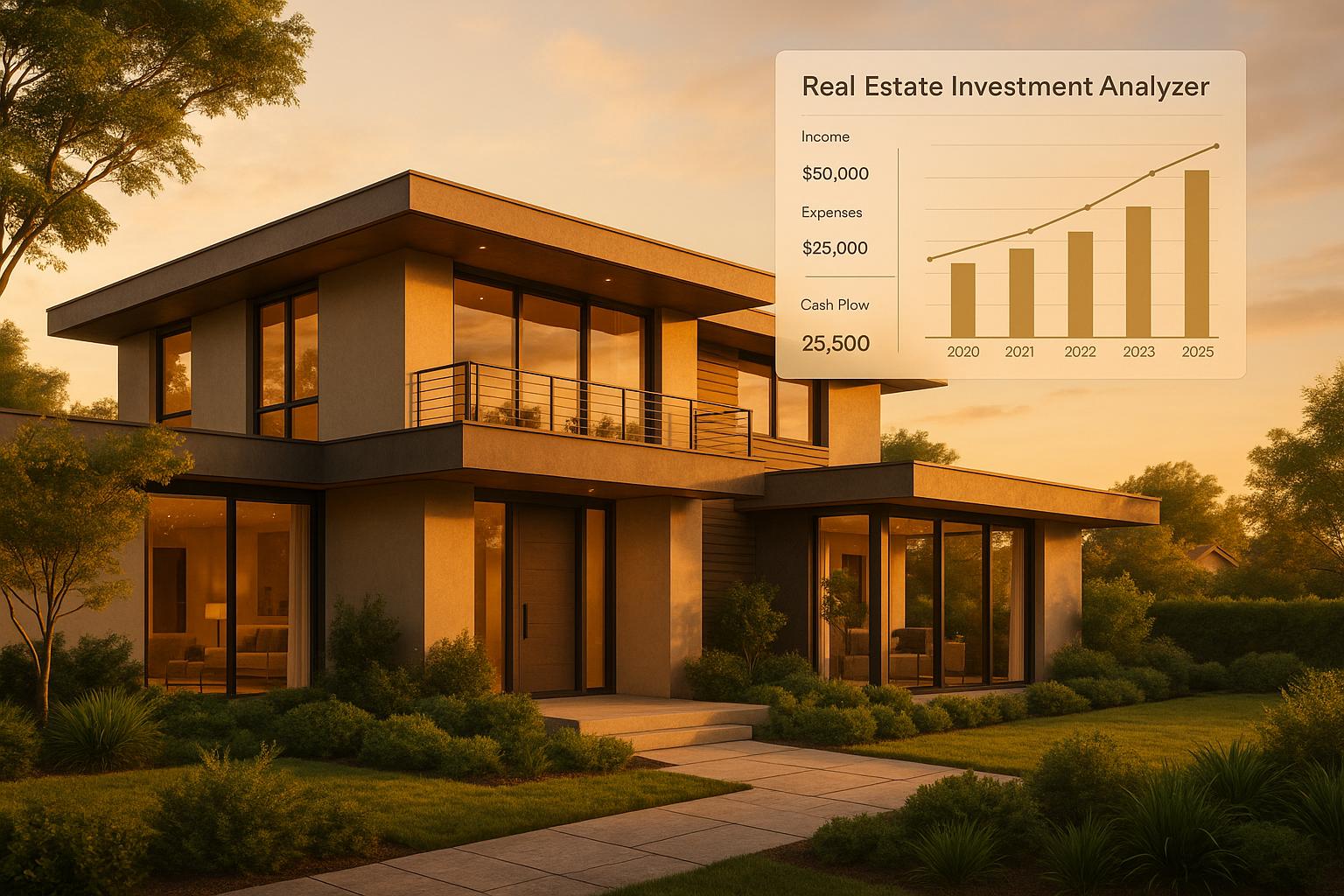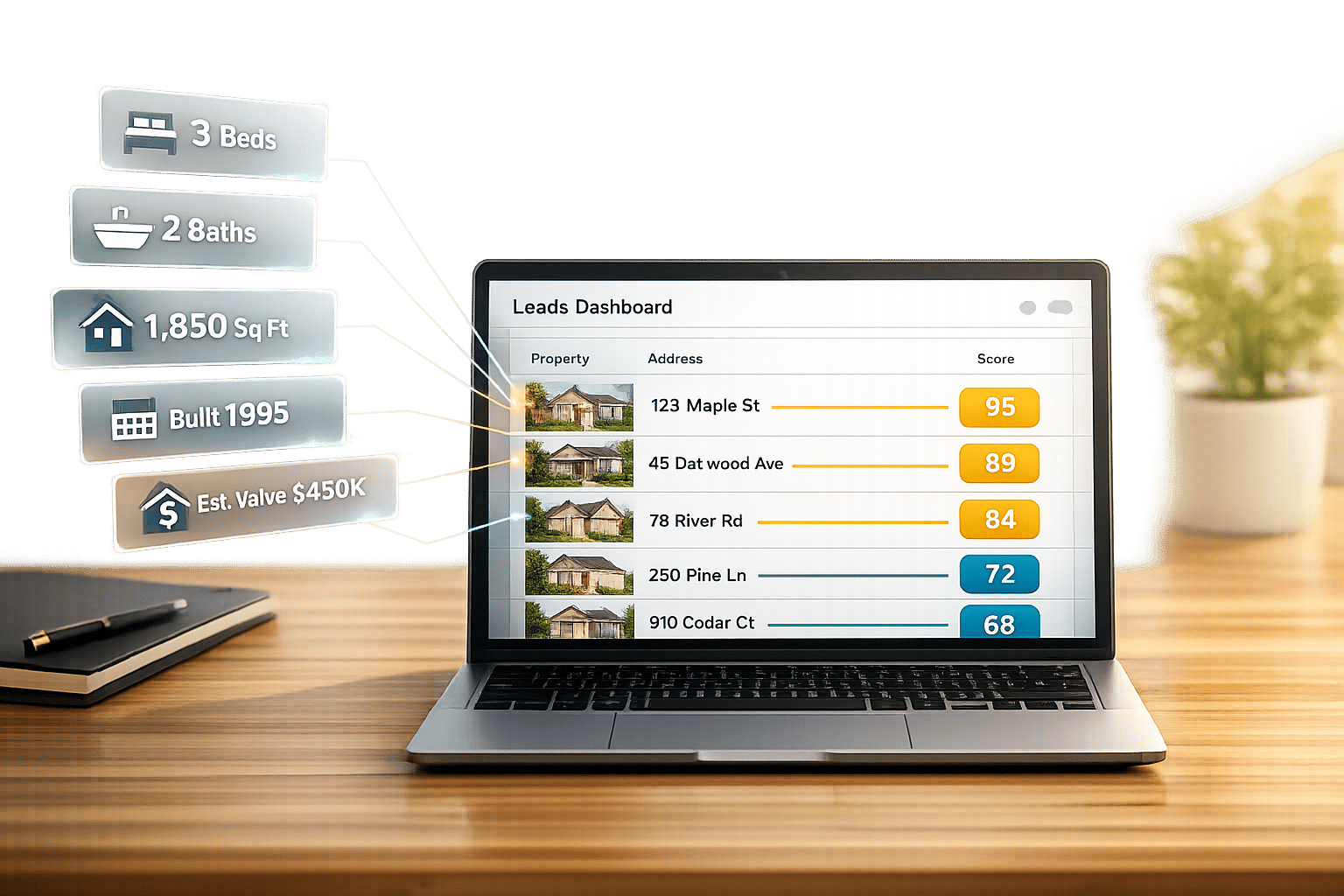
Machine learning is transforming real estate by delivering fast, data-driven property sale predictions and valuations. Platforms now analyze vast datasets – covering 99.8% of U.S. property parcels – and use advanced algorithms like Gradient Boosting and Neural Networks to generate highly accurate insights. Automated Valuation Models (AVMs) estimate property values in milliseconds, incorporating over 1,000 property attributes and real-time market data. These tools also predict sale likelihoods with up to 82% accuracy, helping investors and professionals focus on properties with the highest potential.
Key takeaways:
- AVMs: Cover 99.25% of single-family homes with valuations updated daily.
- Algorithms: From Linear Regression to Neural Networks, each offers unique strengths for property analysis.
- Real-time Data: Over 3,200 sources ensure predictions reflect current market conditions.
- BatchRank Scores: Predict the likelihood of a property selling within 90 days.
Whether you’re a lender, investor, or agent, leveraging these tools can reduce manual work, improve decision-making, and optimize marketing efforts. Platforms like BatchData offer flexible solutions, from real estate APIs to custom datasets, to meet diverse needs in this evolving industry.
AI in Real Estate Systems: Machine Learning for Valuation, Risk, and Smart Assets | Uplatz

Machine Learning Algorithms for Property Sale Predictions
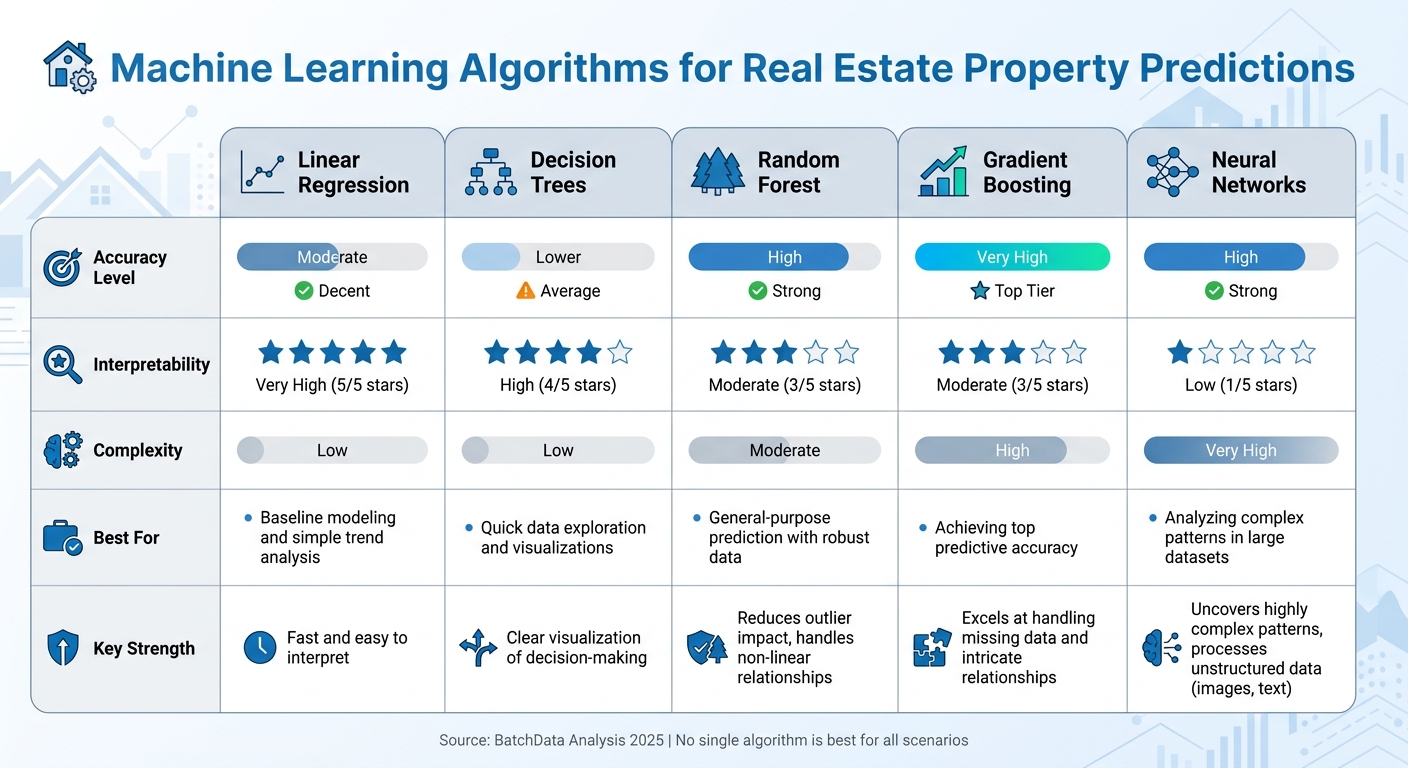
Machine Learning Algorithms for Real Estate: Comparison of Accuracy, Complexity, and Use Cases
Common Algorithms Explained
Predicting property sales in dynamic real estate markets requires algorithms that can handle a wide range of property features. The most commonly used machine learning models in the real estate industry include Linear Regression, Decision Trees, Random Forest, Gradient Boosting Machines (like XGBoost), and Neural Networks. Each of these approaches processes data uniquely, offering different strengths.
Linear Regression is often used as a starting point for property valuation. It establishes straightforward relationships between property features – such as square footage, location, and number of bedrooms – and sale prices. While it’s fast and easy to interpret, it struggles with the complex, non-linear patterns typically found in real estate data.
Decision Trees visualize the decision-making process, splitting data into branches based on features like neighborhood, property size, or age. This makes them easy to understand, even for non-technical audiences. However, they can be overly sensitive to small changes in data, leading to overfitting.
Random Forest, an ensemble method, solves this issue by combining predictions from multiple decision trees. This approach reduces the impact of outliers and handles non-linear relationships effectively, though it requires more computational power and is less interpretable than a single tree.
Gradient Boosting models, especially XGBoost, are known for their accuracy. They excel at handling missing data and capturing intricate relationships between property features. However, they can be challenging to explain due to their “black-box” nature .
Neural Networks are designed to uncover highly complex patterns. They analyze large datasets, often incorporating unstructured inputs like property photos or listing descriptions. This allows them to pick up on subtle factors, such as “curb appeal”, that structured data might miss. However, they demand significant data and computational resources, and their complexity makes them difficult to interpret.
Hybrid models blend traditional algorithms with AI techniques, offering flexibility for valuing both typical and unique properties. These models are particularly useful for properties that don’t fit standard patterns.
Each algorithm has its own trade-offs, making the choice highly dependent on the specific challenges being addressed.
Algorithm Strengths and Limitations
Machine learning tools are vital for navigating the unpredictable real estate market. However, each algorithm has its own strengths and weaknesses. Linear Regression, for example, is highly interpretable, making it easy to explain how specific features – like an extra bathroom – impact property value. But it struggles with market volatility and is sensitive to outliers.
Decision Trees offer clear visualizations, but when used alone, they can be unstable, as even small changes in data can lead to drastically different results.
Random Forest strikes a balance between accuracy and robustness. While it’s more reliable than a single decision tree, it requires more computational power and is harder to interpret. Gradient Boosting models, like XGBoost, often deliver the most accurate predictions but are less transparent, which can be a downside when explaining valuations to clients.
“Accurate price forecast is essential for well-informed decision-making in the dynamic and ever-changing property market.” – Siddhant Jain, National Institute of Technology Raipur
Neural Networks excel in identifying intricate patterns and handling unstructured data, but their complexity and high data requirements can make them impractical for smaller datasets or less technical teams. Additionally, their lack of interpretability can reduce trust in client-facing applications.
The choice of algorithm depends on the specific goal. For competitive markets where precision is key, models like Gradient Boosting or XGBoost are ideal. For simpler, more transparent analyses, Linear Regression remains a go-to option. When unstructured data like images or descriptions plays a significant role, Neural Networks provide a clear advantage. For example, BatchData’s AVM achieves 99.25% coverage for single-family homes by leveraging a combination of these methods.
| Algorithm | Accuracy | Interpretability | Complexity | Best For |
|---|---|---|---|---|
| Linear Regression | Moderate | Very High | Low | Baseline modeling and simple trend analysis |
| Decision Trees | Lower | High | Low | Quick data exploration and visualizations |
| Random Forest | High | Moderate | Moderate | General-purpose prediction with robust data |
| Gradient Boosting | Very High | Moderate | High | Achieving top predictive accuracy |
| Neural Networks | High | Low | Very High | Analyzing complex patterns in large datasets |
No single algorithm is the best across all scenarios. Performance depends on factors like market conditions, data quality, and the specific problem being addressed. There’s also a growing interest in models that offer “feature importance” visualizations, a step toward making AI more explainable .
Automated Valuation Models (AVMs) in Property Sales
How AVMs Work
Automated Valuation Models (AVMs) use machine learning to estimate property values by analyzing extensive datasets in real time. These models take into account factors like location (ZIP codes, neighborhood trends), property size (square footage, lot size), amenities (features such as pools or garages), and local sale trends (recent comparable sales within a specific radius). For example, when assessing a 2,000 sq. ft. home in Miami, FL, an AVM might process MLS data showing a recent sale at $450,000 on January 1, 2026, details like 3 bedrooms and a pool, and market trends indicating a 5% annual appreciation rate. Using this data, the model could estimate the home’s value at $465,000 with a 95% confidence score.
Modern AVMs utilize advanced techniques like gradient boosting (e.g., XGBoost) and neural networks to interpret complex, non-linear relationships among property features. BatchData’s AVM, for instance, processes over 1,000 attributes – including deed history, mortgage records, building permits, and demographic data – to deliver monthly updated valuations for more than 128 million properties. The system draws daily updates from over 3,200 sources, ensuring valuations reflect current market conditions instead of outdated information.
“Our AVM is built on a foundation of dynamic, real-time data, not static, outdated records.” – BatchData
By combining statistical methods with AI-driven logic, hybrid AVMs excel at valuing both standard properties and unique cases where traditional models often struggle. This approach enhances predictive accuracy, achieving a 98% correlation with actual sale prices in data-rich markets. In stable urban areas, median errors fall within 2-5% of the sale price. Coverage rates are also impressive: 99.25% for single-family homes, 99.02% for condos and townhouses, and 96.27% for multi-family properties (1-4 units).
These cutting-edge valuation techniques pave the way for seamless integration options, which are discussed in the next section.
BatchData Solutions for AVM Implementation
BatchData provides flexible integration methods to incorporate AVMs into real estate platforms. Real-time APIs enable sub-second response times for instant underwriting or customer-facing tools, while bulk data delivery options via Amazon S3, FTP, or Snowflake support large-scale portfolio analysis and machine learning model development. Developers can also use BatchData’s MCP (Model Context Protocol) servers to enable large language models like Claude or GPT to access property data tools directly, eliminating the need for custom backend coding.
The platform’s enriched datasets address common gaps that hinder AVM performance, improving model accuracy significantly. For example, BatchData increased AVM precision by 7% in a 2025 study involving 50,000 Florida properties, reducing the average error to $8,000. One hedge fund used BatchData’s APIs to refine their AVMs, achieving a 12% increase in ROI by delivering more precise valuations for properties priced between $400,000 and $2,000,000 in volatile markets. Real-time data ensures that these tools keep pace with the industry’s demand for fast, data-driven decisions.
BatchData also offers pay-as-you-go pricing, allowing users to pay only for the data they use, avoiding long-term commitments. For larger enterprises, custom tailored real estate data solutions and professional services like Investor Pulse reports, which provide localized market insights. Additionally, the platform integrates BatchRank scores, which use AI to predict the likelihood of a property selling within 90 days. This helps investors focus their marketing efforts on the most promising leads.
Data Sources for Accurate Property Sale Predictions
Datasets Required for Machine Learning Models
Predicting property sales with precision relies on a mix of historical data and current economic and local factors. Historical MLS data and public records – like deeds, tax assessments, and ownership histories – provide the groundwork for spotting trends and tracking value changes. These datasets alone can achieve 85–90% accuracy in predictions, but adding more data sources can push accuracy to an impressive 92–95%.
Economic indicators, such as interest rates, play a major role in shaping buyer behavior. For instance, Federal Reserve data on 30-year mortgage rates (hovering around 6.5% as of May 2026) highlights how a 1% increase in rates can reduce demand by 10–15%. Including time-series data in models enhances predictions by 20% during periods of rate fluctuations.
Zooming in further, local factors make predictions more granular. Demographic data – like median household income, population growth, and age distributions from the U.S. Census – reveals demand trends within specific ZIP codes. Crime rates, sourced from the FBI Uniform Crime Reporting or local police APIs, show that high-crime areas may see property values drop by 5–10%, while neighborhoods attracting young professionals often experience value increases of 8–12%. Infrastructure developments, such as new roads or transit systems tracked through government APIs, can signal future value boosts of 3–5%.
BatchData steps in to enhance these foundational datasets with daily updates from over 3,200 sources, enriching property records with more than 800 attributes. This ensures the data reflects current market conditions rather than outdated snapshots, improving the reliability of machine learning models.
BatchData’s Data Enrichment and Custom Solutions
BatchData takes raw datasets to the next level by filling in gaps and adding critical details, resulting in more accurate predictions. Its data enrichment techniques refine property information and improve model performance significantly.
One standout feature is BatchData’s skip tracing service, which achieves a 95% success rate in locating owner contact details, addressing gaps in ownership records. The platform also offers property search APIs that provide real-time parcel queries across more than 3,000 U.S. counties. Additionally, contact enrichment tools append phone numbers and email addresses from a database of over 500 million records. Together, these tools close 30% more data gaps, leading to cleaner inputs and a 15% increase in AVM accuracy.
A prime example of BatchData’s capabilities is its BatchRank scoring system, which analyzes millions of data points – ranging from ownership history to market trends and proprietary signals – to generate sale propensity scores. These scores predict the likelihood of a property selling within 90 days with 82% accuracy, as demonstrated in Q3 2025 testing. For instance, a hedge fund using BatchData’s enriched APIs improved its comps accuracy by 18%, refining its valuation models.
“Data freshness means daily updates and real-time checks for content accuracy. It is what separates productive deal-making from wasted effort.”
– Ivo Draginov, President, BatchData
For businesses needing specialized datasets, BatchData offers custom solutions like tailored data feeds and InvestorPulse reports, which provide localized insights. Its pay-as-you-go pricing model allows users to access enriched data without long-term commitments, offering flexible, credit-based options that scale with usage. This enriched approach empowers machine learning models to deliver exceptional predictive performance across a variety of property types and market dynamics.
Case Studies: Machine Learning in Property Sales
Here’s a closer look at how BatchData’s tools deliver real-world results in property sales and marketing, demonstrating the power of machine learning and data-driven strategies.
Predicting Market Trends with BatchData Tools
From August 1, 2025, to early October 2025, BatchData’s president, Ivo Draginov, put the BatchRank AI algorithm to the test. The goal? To assess its ability to predict which properties would sell within 90 days. The results were impressive: the model achieved 82% accuracy in identifying properties that actually sold during the testing period.
Real estate investors who used BatchRank during this time saw a dramatic boost in their performance, closing 76% more deals than before. By zeroing in on the top 50 properties with the highest sale likelihood in specific markets, these investors significantly increased their deal flow while optimizing their marketing efforts.
“Our goal for BatchRank is more deals and less marketing spend.”
– Ivo Draginov, President, BatchData
The financial results were equally striking. High-volume investors leveraging BatchRank tools reported achieving over a 9x return on investment compared to traditional marketing methods. Moreover, early adopters reduced their prospecting time by up to 80%, allowing them to focus on properties with genuine sales potential rather than wasting time on unmotivated sellers.
These outcomes highlight how predictive analytics can transform marketing strategies, making them more efficient and profitable.
Improving Investment Decisions through Data Insights
Building on its success in property sales, BatchData partnered with a national landscaping company to tackle a familiar challenge: connecting with new homeowners during their moving phase. By using BatchData’s real-time property and homeowner contact information – enhanced with Do Not Call (DNC) and litigation tags – the company pinpointed and reached homeowners during this critical decision-making window.
This approach enabled the landscaping company to be the first to contact homeowners when they were most likely to need property maintenance and improvement services. The enriched data not only ensured compliance but also turned a traditionally hard-to-reach audience into a pool of qualified leads.
“For decades, real estate professionals, investors and service providers have been playing a numbers game… our clients can now focus their efforts on the homeowners who are genuinely likely to make a move.”
– Ivo Draginov, Co-founder, BatchData
These case studies underline how data-driven insights can reshape strategies, allowing businesses to reach the right audience at the right time while maximizing resources and compliance.
Implementing Machine Learning Predictions with BatchData
BatchData offers powerful tools for data enrichment and automated valuation models (AVMs) that can be directly integrated into real estate applications. Here’s how you can make the most of these predictive capabilities.
BatchData’s Pay-As-You-Go vs. Custom Solutions
BatchData provides two flexible options for accessing property sale predictions and machine learning tools.
The Pay-as-you-go or subscription pricing is ideal for individual investors, small teams, or businesses testing predictive models. Pay-as-you-go or subscription pricing- you simply pay for the data and API calls you use. This setup is perfect for those exploring the potential of predictive analytics without committing to long-term contracts.
On the other hand, Custom Solutions cater to enterprise-scale operations and complex use cases. These solutions provide tailored datasets, professional services, and custom delivery methods. Pricing is determined by factors like data volume and operational scale, ensuring that businesses with large portfolios or advanced requirements get exactly what they need.
| Feature | Pay-As-You-Go | Custom Solutions |
|---|---|---|
| Best For | Individual investors, small teams, concept testing | Enterprise operations, bespoke analysis, large-scale model training |
| Pricing Structure | Variable per use; Flexible pricing options | Custom quotes based on volume and scope |
| Data Access | Real-time APIs and on-demand lookups | Bulk delivery via Amazon S3, FTP, or custom pipelines |
| Flexibility | High; integrates easily into existing CRMs and applications | High; includes professional services and InvestorPulse reports |
| Support Level | Standard documentation and SDKs | Dedicated data concierge team for white-glove service |
Both models offer extensive daily-updated data, ensuring seamless integration into your workflows.
Integration Steps for Real Estate Applications
Once you’ve selected a pricing model, the next step is integrating BatchData’s predictive tools into your system. Start by choosing the delivery method that fits your workflow.
- Real-Time APIs: Perfect for customer-facing applications that need instant property valuations or sale propensity scores. These APIs support sub-second response times, making them ideal for live dashboards or underwriting tools. Developers can embed AVM estimates or BatchRank scores directly into CRMs or custom applications using RESTful APIs, backed by SDKs and detailed documentation.
- Bulk Data Delivery: Best suited for large-scale analysis, this method allows you to process thousands or even millions of records at once. Recurring feeds or one-time file transfers via Amazon S3, FTP, or custom pipelines are available, enabling efficient portfolio valuation and regional trend analysis without the need for individual API calls.
BatchData enriches applications with over 1,000 property and homeowner attributes, such as deed history, permits, and demographics. For example, you can automate lead prioritization by using BatchRank’s sale propensity scores (categorized as High, Medium, or Low) to focus marketing efforts on properties most likely to sell within 90 days. This targeted approach helps sales teams maximize their budgets and target motivated sellers.
“Technology should simplify, not complicate.”
– Ivo Draginov, President, BatchData
For businesses requiring custom analysis or localized insights, BatchData’s professional services team can provide InvestorPulse reports and normalized datasets. If you’re still exploring the platform, you can start with a free account to test data quality and experiment with concepts before scaling up.
Conclusion
Machine learning has reshaped how real estate professionals evaluate properties and make investment decisions. Instead of relying on instinct or outdated comparisons, industry leaders now use predictive algorithms that analyze vast amounts of data to forecast trends, spot undervalued properties, and target high-intent leads. The transition from static spreadsheets to real-time analytics isn’t just a tech upgrade – it’s become essential in today’s fast-paced market.
BatchData makes this advanced technology accessible to investors at all levels. With tools like BatchRank AI achieving an impressive 82% accuracy in identifying properties likely to sell during Q3 2025 testing and AVMs covering 99.25% of single-family homes, the platform offers enterprise-level analytics without requiring a costly in-house data science team (which can exceed $500,000 annually). Whether you prefer a pay-as-you-go option for testing or need custom bulk solutions for scaling, BatchData’s tools integrate seamlessly into your workflow without locking you into rigid contracts.
The results speak for themselves. Users report reaching 76% more homeowners compared to traditional methods. Predictive propensity scoring helps teams direct their marketing budgets toward the top 50 properties most likely to sell within 90 days, cutting down on wasted spending. And with real-time API integrations, instant valuations can be embedded directly into CRMs, reducing manual due diligence from weeks to mere seconds.
“We envision transitioning from simply being a data provider to becoming an intelligence partner that can tell you both a property’s history and predict its future.”
– Ivo Draginov, President, BatchData
The real estate market increasingly rewards those who combine data-driven insights with predictive modeling. You can start by testing BatchData’s free account to evaluate its data quality on your portfolio and scale up to tailored solutions as your needs grow. With the global real estate analytics market expected to hit $25.4 billion by 2030, the real question isn’t whether to embrace machine learning – it’s how quickly you can make it a part of your strategy.
FAQs
How accurate are AVM valuations in my local market?
The reliability of AVM (Automated Valuation Model) estimates in your area largely hinges on the quality of available data and the specific trends shaping the local real estate market. Research indicates that AI-driven AVMs frequently estimate property values within 5–10% of their actual sale prices. This represents a notable step forward in terms of predictive accuracy for property valuations.
What data do I need to get reliable sale-likelihood predictions?
To create dependable sale-likelihood predictions using machine learning, you need a broad range of data sources. These include public property records, MLS data, tax assessments, mortgage records, and online behavioral data. Factors such as ownership history, financial status, demographic information, and transaction history play a crucial role in helping models like logistic regression and neural networks uncover meaningful patterns. Access to enriched, real-time data significantly boosts prediction accuracy, making it easier to identify and focus on high-probability leads.
How can I add AVM values and BatchRank scores into my CRM?
You can bring AVM values and BatchRank scores into your CRM by leveraging BatchData’s APIs. By connecting your CRM to BatchData’s AVM and BatchRank APIs, you’ll be able to pull in property valuations and sales likelihood scores seamlessly.
Here’s how it works:
- Use the APIs to fetch property valuations and sales likelihood scores.
- Map these data points directly to property profiles in your CRM.
- Automate data synchronization to ensure your records are always up-to-date.
This setup allows your team to access real-time, AI-powered insights right from your CRM, helping you make smarter and faster decisions.