




































Real estate platforms face two key challenges in 2026: handling massive traffic spikes during peak seasons and managing diverse data through real estate APIs for MLS listings, property images, and IoT inputs. The architecture you choose – monolithic or microservices – directly impacts scalability, reliability, and costs.
- Monolithic systems bundle all components into one codebase. They’re simple to start with but struggle to scale efficiently and are prone to crashes when one feature fails. Scaling requires duplicating the entire system, leading to wasted resources.
- Microservices divide the system into smaller, independent services (e.g., property search, user authentication). This approach allows scaling specific features, isolates faults, and improves deployment flexibility. However, it introduces higher complexity and infrastructure costs.
Key example: Realtor.com reduced data retrieval times by 90% and cut infrastructure costs from $4,000 to $150/month after switching to microservices. In contrast, eXp Realty’s monolithic system crashed every two hours under growth pressure, forcing a transition to microservices.
Quick takeaway: Monolithic systems suit small teams or startups with predictable workloads. Microservices work better for large platforms with uneven traffic and complex operations, despite their higher cost and complexity.
1. Monolithic Architecture
Architecture Structure
A monolithic architecture combines all components of a real estate API – like property listings, agent details, transaction histories, and search functionalities – into one unified codebase. This tightly connected system runs as a single unit, sharing memory space and relying on a centralized database for all operations [8,13,15]. While this setup simplifies the structure, it also means that changes to one component can unintentionally affect others.
“A monolithic architecture is a singular, large computing network with one code base that couples all of the business concerns together.” – Atlassian
This design is often favored during the early stages of development. Startups and small teams lean toward monoliths because they’re easier to build, have lower initial overhead, and allow for faster deployment. However, as the application grows, the tight integration begins to create problems. Updates become more complicated, and the system’s overall performance starts to suffer. These issues become even more pronounced when it comes to scaling.
Scalability
Scaling a monolithic real estate API usually requires duplicating the entire application across multiple servers, even if only one function is experiencing increased demand. For instance, during a busy house-hunting season, a spike in property search queries might require scaling the entire system – including unrelated services like user authentication or image processing – just to handle the load. This approach is inefficient and costly because resources are wasted on components that don’t need additional capacity.
Another major challenge is the centralized database, which often becomes a bottleneck as all components compete for access. As the codebase grows, identifying the specific areas affected by increased traffic becomes harder. These inefficiencies make scaling a monolithic system both expensive and complex.
Resilience
Monolithic systems are also vulnerable when it comes to fault isolation. A single bug or memory leak in a minor feature – like a mortgage calculator – can bring down the entire platform, disrupting critical functions such as property listings or transaction processing.
“A monolithic architecture creates a single point of failure. A memory leak in a non-critical feature can crash the entire application.” – Indexnine
This lack of fault tolerance has caused significant issues for companies. For example, Ginesys, an e-commerce platform with a 16-year-old monolithic system, processed millions of transactions daily but faced frequent crashes due to its tightly coupled design. Similarly, eXp Realty encountered severe challenges when its monolithic system began crashing every two hours during a period of rapid growth, forcing the company to transition to a microservices architecture.
The need to redeploy the entire system for even minor updates adds to the risk and complexity. These limitations highlight the stark differences between monolithic and microservices architectures, which will be explored in the next section.
sbb-itb-8058745
2. Microservices Architecture
Architecture Structure
Microservices divide a real estate API into smaller, independent services, each responsible for a specific function. For instance, Egypt MLS (powered by Arab MLS) organizes its platform into distinct services for tasks like property listings, search and filtering, and transaction management. This setup allows the system to handle large volumes of property data across the Middle East efficiently.
These services communicate using standardized protocols like HTTP/REST or asynchronous messaging tools such as RabbitMQ or Kafka. By employing polyglot persistence, each service can use its own database system, reducing the risk of bottlenecks. This modular approach also makes it easier to scale specific components as needed.
Scalability
One of the biggest advantages of microservices is the ability to scale individual components independently. For example, during peak house-hunting periods, platforms can scale the property search service without having to scale the entire application, a limitation often seen in monolithic systems .
Netflix is a prime example of this scalability in action. The company uses the Zuul API Gateway to route millions of daily requests across its microservices. Similarly, LambdaTest relies on AWS and Kubernetes to handle large-scale operations .
“With Kubernetes, APIs are built on microservices, allowing each service to scale independently.” – Mayank Bhola, Head of Products and Co-Founder at LambdaTest
This selective scalability also strengthens the system’s ability to handle faults, ensuring better overall reliability.
Resilience
Fault isolation is another key benefit of microservices. If one service, like a recommendation engine, experiences an issue, other services – such as search or property playback – can continue functioning without interruption. Trulia provides a real-world example: starting in 2015, the company began breaking apart its monolithic system to tackle growing complexity and rising defect rates.
To improve resilience, Trulia adopted the Circuit Breaker Pattern, which prevents failures in one service (e.g., a third-party geolocation API) from cascading across the platform. They also implemented strategies like Command Query Responsibility Segregation (CQRS) and the Saga Pattern to ensure data consistency across their ecosystem .
Implementation Strategies
Transitioning to microservices requires a thoughtful approach. The Strangler Fig Pattern is a popular method, allowing teams to gradually replace portions of a monolithic system with microservices until the legacy architecture is completely phased out. Many teams begin by extracting edge services, such as user authentication or customer profiles, to build operational expertise before tackling more complex core functionalities.
Domain-Driven Design (DDD) is another essential tool, helping teams define clear boundaries for services based on business capabilities. An API Gateway acts as a central entry point, managing tasks like authentication, rate limiting, and load balancing. For real estate platforms, common service divisions include property data management, authentication, geolocation, and media handling.
To ensure smooth operations, implementing UUIDs for resource identifiers early on helps prevent database conflicts. Using asynchronous message brokers like Kafka further decouples services, improving performance during high-traffic periods. Success in adopting microservices often depends on strong foundations in continuous delivery, container orchestration (e.g., Kubernetes), and monitoring through distributed tracing and centralized logging .
How To Build Scalable and Resilient Microservices | Designing Event-Driven Microservices
Advantages and Disadvantages
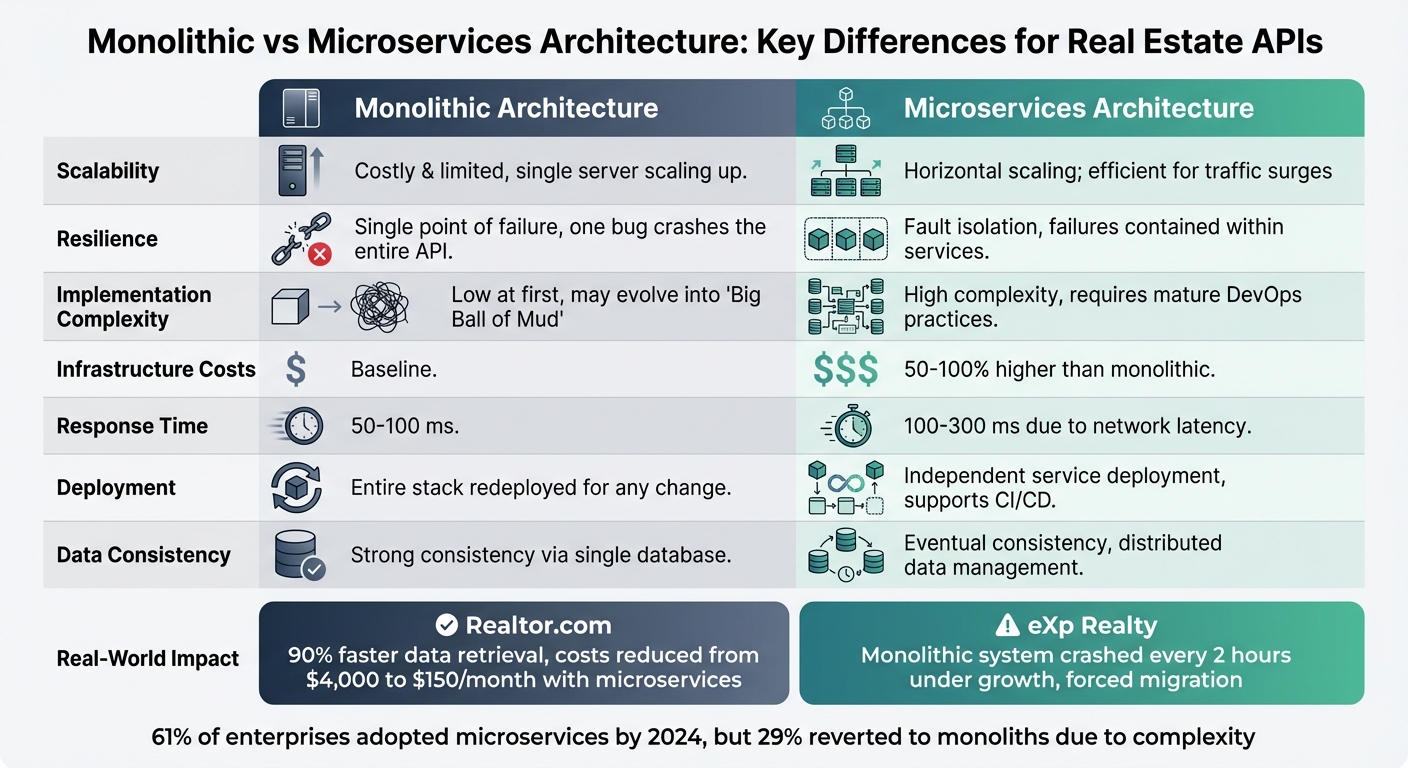
Monolithic vs Microservices Architecture for Real Estate APIs: Key Differences
When weighing the benefits and drawbacks of monolithic versus microservices architectures, it’s essential to consider key factors like scalability, resilience, and complexity. Each approach has its strengths and weaknesses, and the right choice often depends on the organization’s specific needs and capabilities.
Scalability
Monolithic architectures rely on vertical scaling, meaning the entire application must scale together – even when only a specific feature experiences high demand. This can be both costly and inefficient. On the other hand, microservices enable horizontal scaling, allowing individual services to scale independently. For example, real estate platforms can scale high-demand features like property search without affecting the rest of the system. This flexibility makes microservices particularly appealing for applications with uneven usage patterns.
Resilience and Fault Tolerance
Microservices excel in resilience due to their service isolation. By breaking an application into smaller, independent services, failures in one area are less likely to bring down the entire system. Trulia’s migration from a monolithic codebase to microservices is a case in point – they significantly improved fault isolation by making this shift. However, this resilience comes at a cost. Microservices require 50–100% more infrastructure investment and can introduce additional network latency, increasing response times from 50–100 ms to 100–300 ms.
Complexity and Implementation Challenges
While microservices offer clear benefits in scalability and resilience, they also introduce significant complexity. In 2024, 61% of enterprises adopted microservices, but 29% reverted to monoliths due to the challenges of managing such a distributed system. Choosing the wrong architecture can lead to higher development costs (up to 40%) and longer time-to-market (up to 60%). Atlassian’s “Project Vertigo” illustrates these challenges. The company transitioned from 15 monolithic services to over 1,300 microservices, increasing their deployment frequency from once a week to multiple times daily. As Atlassian CTO Sri Viswanath explained:
“A company transformation requires a senior executive sponsor who is accountable for results and is willing to enforce the necessary tradeoffs”.
Comparing Key Features
The table below highlights the key differences between monolithic and microservices architectures:
| Feature | Monolithic Architecture | Microservices Architecture |
|---|---|---|
| Scalability | Vertical scaling; costly and limited | Horizontal scaling; efficient for traffic surges |
| Resilience | Single point of failure; one bug can crash the API | Fault isolation; failures contained within services |
| Implementation Complexity | Low at first; may evolve into a “Big Ball of Mud” | High complexity; requires mature DevOps practices |
| Infrastructure Costs | Baseline | 50–100% higher than monolithic |
| Response Time | 50–100 ms | 100–300 ms due to network latency |
| Deployment | Entire stack redeployed for any change | Independent service deployment; supports CI/CD |
| Data Consistency | Strong consistency via a single database | Eventual consistency; distributed data management |
Choosing the Right Approach
For smaller platforms or startups, a monolithic architecture often makes sense. It provides faster initial development and lower costs, making it easier to get a product to market. Microservices, however, are better suited for larger organizations with complex systems that require independent scaling and have the resources to manage the operational demands of a distributed architecture.
Real-World Applications and Examples
Microservices have transformed how real estate platforms manage core functions like property search, data enrichment, and user authentication. By separating these into distinct services, platforms can handle peak traffic efficiently and improve overall performance.
Property search is one of the most resource-intensive features for real estate platforms. A dedicated property search microservice processes millions of records based on filters like location, equity percentage, and property age. This separation allows the search function to scale independently during traffic surges, ensuring the rest of the platform remains unaffected. A great example of this is Realtor.com’s overhaul between 2019 and 2024. By migrating their RESO-certified web API from JavaScript to Go and restructuring their database to use structured columns instead of JSON blobs, they cut data retrieval times by 90%. Infrastructure costs plummeted from $4,000 to $150 per month, and the system managed up to 300,000 listings per minute across parallel batches of 500. This highlights how isolating critical services can dramatically improve platform responsiveness and efficiency.
Beyond search, data enrichment services play a key role in enhancing real estate APIs. These services operate independently, enriching basic property data with verified owner contact details, financial history, and other relevant information. For instance, BatchData’s enrichment service achieves a 76% accuracy rate in verifying phone and email contacts, tripling the industry average. This system integrates seamlessly through API endpoints like GET /property/search for targeted data retrieval and contact append endpoints for skip tracing solutions. Chris Finck, Director of Product Management, praised this functionality, saying:
“What used to take 30 minutes now takes 30 seconds. BatchData makes our platform superhuman”.
Another critical component is user authentication and management, which operates as an independent service to secure the platform. These services handle user roles, permissions, and access to sensitive data while coordinating with other microservices like property listings and transactions. Trulia adopted this approach by transitioning from a monolithic architecture using a “decompose by subdomain” strategy. They employed the Command Query Responsibility Segregation (CQRS) pattern for their search services, enabling independent scaling of search operations without disrupting the listing acquisition pipeline. Harpreet Kaur Arora, one of the engineers behind the transition, explained:
“Microservice architecture is a way for large organizations to align infrastructure with business objectives while maximizing agility and flexibility”.
These microservices communicate through API gateways that handle request routing, authentication, and rate limiting. Event-driven communication ensures seamless synchronization – for example, when a property status changes, an event triggers the search service to refresh its cache automatically. Each service uses its own specialized database, such as NoSQL for quick search results or relational databases for maintaining transaction consistency, avoiding bottlenecks across the system.
Conclusion
Deciding between monolithic and microservices architecture comes down to your platform’s scale, team size, and growth trajectory. Monolithic systems are great for startups or smaller teams – typically under 50 developers – managing predictable workloads. They offer lower infrastructure costs and excellent single-machine performance. On the other hand, microservices excel when specific components, like property search or data enrichment, face uneven traffic demands. With microservices, you can scale individual parts of your system without overcommitting resources across the entire stack.
As Intellectsoft aptly puts it:
“The real question for CTOs and architects isn’t monolith vs. microservices, but which approach best aligns with their scalability strategy and business needs”.
The numbers back this up: by 2024, 61% of enterprises adopted microservices, yet 29% reverted to monolithic systems due to unexpected complexity. While microservices offer flexibility, they come with higher costs and potential latency issues compared to monoliths.
Microservices also bring unique advantages in high-demand scenarios. They allow independent deployments and let teams choose the best tools for specific tasks – for instance, using NoSQL databases for fast search queries alongside relational databases for maintaining transactional integrity.
For startups or teams with fewer than 50 developers, starting with a monolith often makes sense. As your platform grows and complexity increases, you can transition to microservices when the benefits of modularity outweigh the challenges of distributed systems. Martin Fowler calls this tipping point the “Microservice Premium”. Approaches like the Strangler pattern can help break down monoliths into manageable microservices over time. Companies like BatchData illustrate this balance by providing scalable API solutions for property search and contact enrichment.
The microservices market is poised to grow to $11.8 billion by 2032, with an annual growth rate of 13.75%. However, success in this space requires strong DevOps practices, automated CI/CD pipelines, and comprehensive monitoring tools. If your platform needs to handle unpredictable traffic spikes, support multiple independent development teams, or integrate thousands of third-party data sources, microservices offer the scalability and resilience to meet those demands. Ultimately, the best choice depends on aligning your architecture with your team’s capabilities, market needs, and long-term goals.
FAQs
When should a real estate API switch from a monolith to microservices?
When a real estate API starts facing hurdles with scalability, deployment, or development, it might be time to consider shifting to microservices. Common red flags include slow build times, prolonged deployment processes, and challenges in scaling specific features independently.
Microservices work by breaking down an application into smaller, modular components. This approach makes it easier to roll out updates quickly and scale individual parts – like property search or data enrichment – without impacting the entire system. If your monolithic architecture is causing bottlenecks or piling up technical debt, adopting microservices can offer the flexibility and efficiency needed to handle large sets of property data and support seamless user interactions.
How do microservices keep the API running when one feature fails?
Microservices keep the API running even when a feature fails by relying on fault tolerance mechanisms such as circuit breakers, health checks, and independent deployment. These tools help contain problems, stop them from escalating, and ensure that unaffected services stay operational without disruption.
What’s the simplest way to migrate a monolith to microservices?
When beginning the process of breaking apart a monolithic system, it’s often best to start small. Identify a standalone service that can be separated without too much disruption. From there, focus on gradually pulling out services tied to core business functions – especially those that tend to evolve often. Each step should be deliberate and incremental, aimed at reducing reliance on the monolith while creating services that are both purposeful and self-contained. This approach, commonly referred to as the Strangler pattern, helps keep the process manageable and minimizes the risks associated with migration.