




































In 2026, real estate data licensing has shifted to meet the demands of AI and PropTech applications. Basic property records are no longer enough – modern systems require detailed, standardized data with verified contact information and real-time delivery. Here’s what you need to know:
- Key Features of AI-Ready Data: Over 1,000 data points per property, including construction details, financial distress indicators, and verified homeowner contacts.
- Delivery Methods: Real-time APIs, cloud platforms like Snowflake and BigQuery, and petabyte-scale datasets for AI training.
- Compliance: Adherence to regulations like the California DELETE Act, CCPA, and TCPA, with daily updates and automated scrubbing.
- Why It Matters: Advanced data powers AI-driven tools that boost efficiency, accuracy, and outreach success.
BatchData leads the industry with 99.8% U.S. market coverage, 76% contact accuracy, and cutting-edge delivery options tailored for AI and PropTech needs.
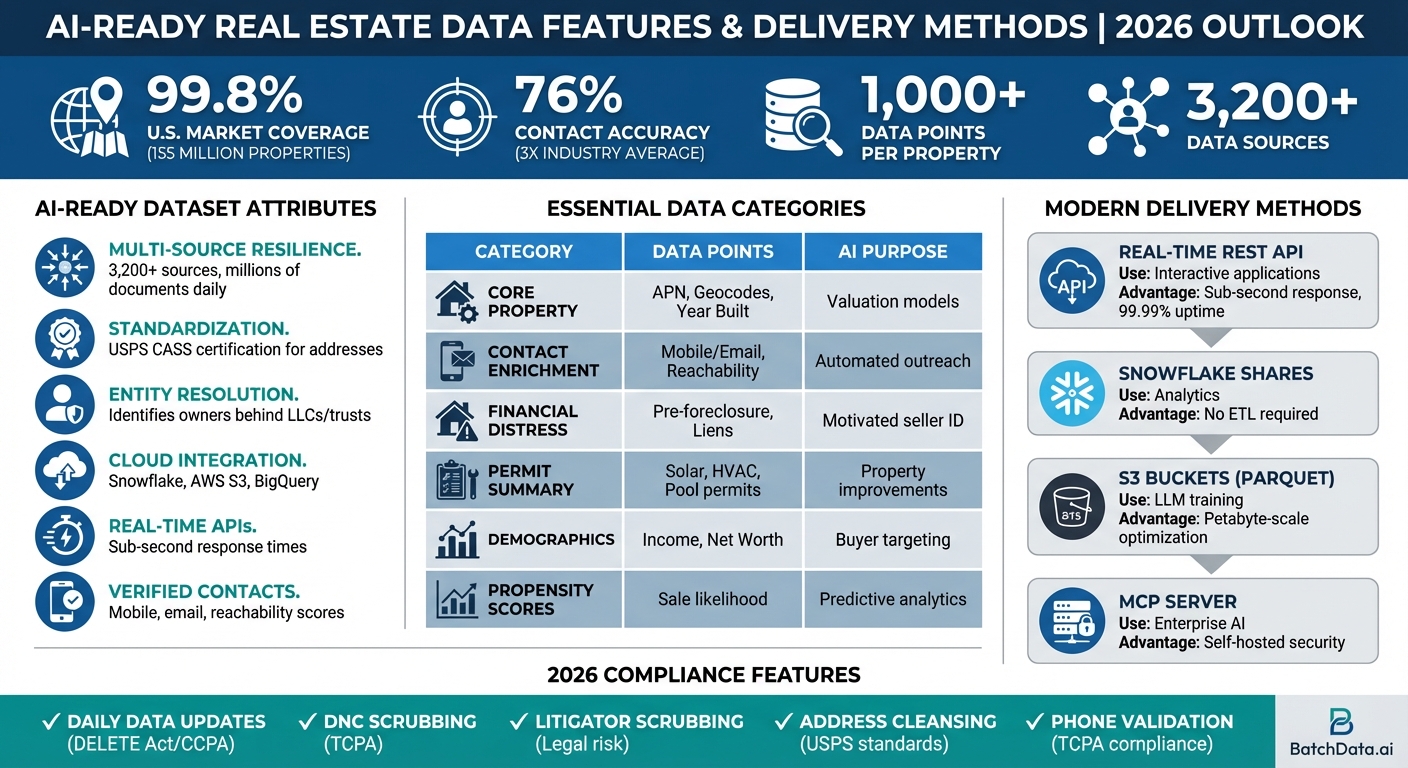
AI-Ready Real Estate Data: Essential Features and Delivery Methods for 2026
What AI-Ready Real Estate Datasets Need to Include
AI-ready real estate datasets are more than just collections of basic property records – they’re designed to be comprehensive, standardized, and ready for machine learning applications. Traditional datasets, like tax assessor records or deed information, often fall short for modern AI use, requiring extensive manual cleaning and validation. In contrast, AI-ready datasets come pre-processed, saving time and reducing errors. Here’s a closer look at the essential features that set these datasets apart.
Core Attributes of AI-Ready Datasets
One key feature of AI-ready datasets is their multi-source resilience. This means they can maintain consistent data flow even when individual county systems experience outages. For example, BatchData collects and processes data from over 3,200 sources, handling millions of documents daily to provide real-time accuracy for 155 million U.S. properties. These datasets include over 1,000 unique data points per property, such as construction details, permit history, and financial distress indicators.
Standardization and normalization are also critical. Addresses should align with USPS standards using CASS certification, ensuring consistent formatting and deliverability across systems. Similarly, property details like square footage, lot size, and year built must follow uniform formats. Without this level of standardization, machine learning models struggle with inconsistent inputs, which can lead to inaccurate predictions.
Another important feature is entity resolution, which helps identify the real owners behind LLCs and trusts – a process often referred to as “piercing the corporate veil”. This capability allows datasets to connect individual property records into broader ownership networks, which is essential for training AI models to understand complex real estate relationships and investor behaviors.
Modern AI workflows also benefit from direct cloud integration. Instead of requiring cumbersome ETL (Extract, Transform, Load) processes, AI-ready datasets can be accessed via platforms like Snowflake Data Sharing, AWS S3 in Parquet format, or BigQuery. This allows data scientists to start training models immediately. For real-time applications, low-latency RESTful APIs with sub-second response times enable quick validation of addresses, geocoding, and property detail retrieval without performance slowdowns.
| AI-Ready Attribute Category | Essential Data Points | Purpose for AI/LLMs |
|---|---|---|
| Core Property | APN, Geocodes, Year Built, Construction Details | Foundational training for valuation models |
| Contact Enrichment | Mobile/Landline, Email, Reachability Scores | Powering automated outreach and CRM agents |
| Financial Distress | Pre-foreclosure status, Default amounts, Liens | Predicting motivated seller identification |
| Permit Summary | Job Values, Permit Types (Solar, HVAC, Pool) | Identifying property improvements and equity growth |
| Demographics | Household Income, Net Worth, Occupation | Enhancing buyer persona and targeting algorithms |
| Propensity Scores | Sale Propensity Score, Category, Status | Prioritizing leads for predictive analytics |
At the heart of these technical capabilities lies verified homeowner contact data, which transforms raw property records into actionable insights.
Why Homeowner Contact Data Matters
While technical attributes like standardization and cloud integration are essential, verified homeowner contact data is what truly elevates a dataset’s value. High-quality contact information – such as mobile numbers, emails, and reachability scores – enables AI-driven tools to directly connect with decision-makers. Without this, even the most advanced datasets remain underutilized.
The difference between traditional and enriched contact data is striking. Legacy sources often achieve right-party contact rates of only 25%. Modern datasets, however, use multi-source validation – combining public records, telecom databases, and secretary of state filings – to verify contact information for over 360 million property owners. This ensures higher accuracy and immediate usability for AI-powered outreach.
Compliance integration is another critical factor. Datasets must be legally viable for automated outreach, which means real-time scrubbing against the National Do Not Call Registry and TCPA litigator lists. These updates, often refreshed every 24 hours, help mitigate legal risks. For example, BatchData includes DNC status, carrier details, and line type (mobile vs. landline) to ensure communication preferences are respected.
Finally, entity resolution within contact data allows AI systems to map individual owners to all their properties nationwide. By linking a single contact to their entire portfolio – across states and corporate entities – AI models can perform advanced relationship analysis and make portfolio-level predictions.
sbb-itb-8058745
How to Deliver Large Real Estate Datasets in 2026
Legacy Methods vs. Modern Delivery Options
The way real estate data is delivered has taken a dramatic turn in recent years. Older methods like FTP transfers, manual extracts, and static CSV files often result in delays and require extensive ETL (Extract, Transform, Load) processes. These outdated approaches can’t keep up with the demands of organizations training large language models or building real-time PropTech applications, where speed and efficiency are critical.
Today, modern delivery methods focus on two main tracks: real-time APIs for transactional needs and direct cloud access for large-scale AI training. Real-time RESTful APIs are ideal for instant tasks like property lookups, address validation, and contact verification, offering sub-second response times with 99.99% uptime. For massive datasets, platforms like Snowflake and S3 Buckets provide direct access to normalized data, cutting out the need for heavy ETL processes and significantly reducing implementation time.
A standout innovation for AI applications is the Model Context Protocol (MCP) server. This self-hosted solution allows custom AI systems to query live real estate data, ensuring accuracy by streaming verified, up-to-date information. This reduces the risk of errors, like hallucinations, by delivering data such as homeowner contacts and property attributes in real time.
| Delivery Method | Best Use Case | Technical Advantage |
|---|---|---|
| Real-Time REST API | Interactive applications | Sub-second response, 99.99% uptime |
| Snowflake Shares | Analytics | No ETL required, always up-to-date |
| S3 Buckets (Parquet) | LLM & ML model training | Optimized for massive datasets |
| MCP Server | Enterprise AI infrastructure | Self-hosted, high-security data control |
This shift in delivery methods paves the way for BatchData advanced solutions.
BatchData Delivery Features

BatchData builds on these modern delivery methods with a dual-track system tailored to both real-time applications and large-scale analytics. For tasks requiring instant responses – like address autocomplete or live property valuations – the platform’s RESTful JSON APIs provide sub-second latency. These APIs query a database of 155 million U.S. properties, ensuring fast and accurate results.
For large-scale analytics and LLM training, BatchData offers datasets through Parquet files on Amazon S3 or via Snowflake integration. This setup is designed for petabyte-scale processing, bypassing the inefficiencies of traditional data transfers. With over 700 unique property attributes per record, including verified contact data with a 76% right-party accuracy rate, the dataset is highly effective for training advanced propensity models.
Enterprise clients can also take advantage of the MCP Server, available for $5,000/month. This option provides localized, secure data access for proprietary AI models, ensuring maximum data control. Standard delivery tiers start at $500/month for 20,000 records, with custom pricing available for larger volumes. To make integration seamless, BatchData offers interactive documentation and SDKs for Python and Node.js, enabling developers to get started in just days rather than weeks.
Legal Rights and Compliance Requirements for Data Licensing
Licensing Rights Needed for AI Applications
When developing generative AI tools or automated decision-making technologies, businesses require more than the typical “internal analytics only” permissions. Derived works rights are a must. These rights allow companies to create derivative datasets, train models, and build new products using licensed data. Standard contracts often restrict usage to internal analysis, but AI applications demand explicit permissions for model training, API integration, and product development.
For instance, organizations training LLMs or creating predictive models benefit significantly from high-quality homeowner contact data. This data supports advanced use cases like automated outreach, predictive modeling, and portfolio analysis. AI-ready licenses should encompass over a dozen critical data sources, such as building specifications, lien histories, and Right Party Contact (RPC) data, to enable complex machine learning workflows.
Essential datasets include AVMs, MLS data, building permits, ownership records, and foreclosure statuses. These licenses should specify coverage metrics – like access to 155+ million U.S. property records across 3,000+ counties – and ensure data freshness standards are met. As regulations continue to evolve, especially heading into 2026, securing these rights becomes increasingly important.
2026 Compliance Requirements
In addition to obtaining broad usage rights, staying compliant with updated regulations is non-negotiable. The California DELETE Act, along with revised CCPA and TCPA rules, has reshaped how organizations manage homeowner contact data. Starting in 2026, compliance requires daily updates, automated deletion processing, and real-time scrubbing to meet these stringent mandates. For businesses operating across multiple states, ongoing compliance efforts now include SOC 2 Type II certification and adherence to GDPR.
Traditional data licensing models, which rely on static flat files or FTP-based delivery, make it difficult to meet these new requirements. These outdated methods lack the flexibility for real-time compliance updates or quick response to deletion requests. Modern API-based licensing, on the other hand, ensures continuous compliance through live data streams that reflect daily changes. This approach supports automated deletion processing and real-time filtering of opted-out contacts, keeping organizations aligned with evolving regulations. To stay protected, licensing agreements must include provisions for continuous compliance updates, automated removal of flagged contacts, and audit trails to demonstrate regulatory adherence.
BatchData Compliance Features
BatchData addresses these challenges with daily updates to property and contact profiles, ensuring compliance with regulations like the CCPA and the California DELETE Act. The platform automatically scrubs data against Federal Do Not Call (DNC) lists and known litigator databases, minimizing legal risks tied to prohibited outreach. It also verifies phone numbers and addresses in real time, ensuring only deliverable contacts are included.
The platform supports multiple data delivery methods, including APIs, bulk exports, and Snowflake integration, all while maintaining strict compliance controls. With direct cloud delivery, organizations can access standardized, always-updated datasets without the need for manual ETL processes. BatchData sources its data from over 3,200 providers, including county recorders and tax assessors, combining automated and human-in-the-loop quality assurance to ensure accuracy and regulatory alignment.
| Compliance Feature | Regulation Addressed | Implementation Method |
|---|---|---|
| Daily Data Updates | California DELETE Act / CCPA | API & Cloud Delivery |
| DNC Scrubbing | TCPA | Contact Enrichment Add-on |
| Litigator Scrubbing | TCPA / Legal Risk | Skip Tracing & API |
| Address Cleansing | USPS / CASS Standards | Address Verification API |
| Phone Validation | TCPA / Outreach Compliance | Real-time API |
For organizations, it’s critical to prioritize licensing agreements that include automated systems for removing opted-out contacts, SOC 2 Type II certification for security and compliance, and clear audit trails. Agreements should also guarantee regular updates to reflect changes in regulations and service level agreements for removing flagged records within specific timeframes. This approach ensures a balance between operational efficiency and regulatory compliance, which is essential for AI-driven real estate solutions in 2026.
Why BatchData Outperforms Traditional Data Providers
Coverage and Accuracy Metrics
BatchData provides an impressive 99.8% coverage of the U.S. market, encompassing 155 million properties and pulling data from over 3,200 sources like county recorders, tax assessors, and MLS providers. This extensive reach ensures that companies working on LLMs or PropTech platforms can rely on almost complete datasets instead of patchy regional data. The platform also delivers a 76% accuracy rate for reaching homeowners through verified mobile numbers and emails – three times the industry average. Such precision transforms static property data into actionable insights, enabling automated outreach, accurate modeling, and more effective portfolio analysis.
With over 1,000 data points per property, BatchData offers a unified dataset that reduces integration headaches and boosts model reliability. This depth of information eliminates the need for juggling multiple data vendors or dealing with gaps in critical fields like foreclosure status or permit history, making it a game-changer for AI systems requiring high-quality training data.
For example, Crexi, a commercial real estate platform, used BatchData property owner data to streamline their entity resolution process, cutting task times down to just 30 seconds.
These metrics provide a solid foundation for building scalable AI systems that rely on BatchData advanced infrastructure.
Building Scalable AI and PropTech Systems
BatchData platform is designed to support scalable AI and PropTech innovations, offering petabyte-scale data delivery through Snowflake Shares, BigQuery, and Databricks. This eliminates the need for manual ETL processes, giving data scientists direct access to standardized, normalized datasets. Such scalability is essential for AI systems that depend on real-time, accurate data streams for forecasting and decision-making.
For predictive analytics – whether it’s demand forecasting, tenant personalization, or risk analysis – BatchData ensures models stay up-to-date with daily data refreshes, avoiding reliance on outdated snapshots. Additionally, its API, backed by a 99.99% uptime SLA and sub-second response times, is perfect for real-time applications like automated property valuations or instant lead scoring.
The platform’s multi-source resilience model ensures continuous data flow by combining inputs from over 3,200 sources, even during county-level outages. It also supports Model Context Protocol (MCP) servers, enabling AI tools and custom LLMs to directly access live real estate intelligence.
Conclusion
Real estate data licensing has become a game-changer for organizations developing AI-powered applications. By 2026, leaders in PropTech and language model development will rely on comprehensive datasets that merge detailed property intelligence with accurate homeowner contact information. These unified datasets transform static information into actionable insights, driving automation and smarter decision-making.
For CTOs, Data Engineers, and AI Researchers, this shift lays the groundwork for scalable and compliant PropTech solutions. BatchData addresses these needs by offering 99.8% U.S. market coverage, 76% right-party contact accuracy (three times the industry standard), and delivery methods tailored for high-speed demands. This modern infrastructure eliminates outdated limitations, enabling faster LLM training, predictive analytics, and real-time applications.
The regulatory landscape in 2026, shaped by measures like the California DELETE Act and updated CCPA/TCPA rules, demands compliance-focused data handling. Features such as built-in compliance scrubbing and daily data updates are no longer optional. Additionally, licensing agreements must explicitly grant “derived works” rights for generative AI applications, not just for internal analytics. BatchData flexible licensing models meet these requirements, offering cost-efficient solutions that maintain compliance while supporting automated outreach and customer engagement.
For technical leaders assessing data providers, the message is clear: data is not just a resource – it’s the backbone of competitive advantage. The platform you choose determines whether your AI operates on outdated snapshots or dynamic, real-time intelligence. With over 1,000 data points per property and resilience built across 3,200+ sources, BatchData sets the standard for building scalable, future-ready PropTech systems.
AI-ready licensing turns raw data into intelligence, enabling advanced modeling, portfolio analysis, and compliance-driven decision-making at scale. Organizations that embrace this evolution and partner with forward-thinking providers will position themselves as leaders in the AI-driven real estate market of 2026.
FAQs
What makes a real estate dataset suitable for AI applications?
An AI-ready real estate dataset needs to have accurate, verified, and current property details, along with reliable homeowner contact information. To work effectively with AI systems, the data must be standardized and normalized, ensuring smooth integration and compatibility for advanced analytics. For real-time applications and efficient processing, it’s crucial to deliver this data through modern, low-latency methods like APIs or cloud platforms. With these elements in place, organizations can confidently create predictive models, automate decisions, and extract actionable insights.
How do modern delivery methods make real estate data more accessible?
Modern delivery methods are changing how we access real estate data, offering faster and more adaptable options for integration. Instead of relying on outdated methods like flat files or FTP dumps, platforms now utilize cloud-based solutions such as Snowflake Shares, S3 buckets, and low-latency APIs. These tools make it easy to integrate massive datasets directly into workflows, enabling real-time applications with minimal delays and greater efficiency.
For AI-driven applications, advanced protocols like the Model Context Protocol (MCP) give large language models (LLMs) access to live, reliable real estate data. This reduces inaccuracies and ensures up-to-date information. With this approach, organizations can perform quick analyses, automate tasks, and make better decisions, turning static real estate data into actionable insights.
What are the key compliance requirements for licensing real estate data in 2026?
In 2026, licensing real estate data demands strict compliance with evolving regulations. Key aspects include obtaining clear rights for derived works, maintaining regularly updated data, and using built-in compliance scrubbing to meet standards like the California DELETE Act and the latest CCPA/TCPA requirements.
To navigate these challenges, it’s crucial to partner with a data provider that prioritizes regulatory safeguards and offers flexible licensing options. This not only minimizes legal risks but also ensures you can confidently develop AI-powered applications.


