


































SEO Title: Lee County FL Real Estate Market Analysis for 2026
Meta Description: Data-driven analysis of Lee County FL real estate in 2026, including pricing, sales volume, hurricane risk, liens, and API-based underwriting.
Meta Keywords: Lee County FL real estate, Lee County housing market 2026, Lee County property data, Lee County investors, Florida hurricane property risk, foreclosure lien analysis, real estate APIs
Lee County is no longer a simple appreciation story. In March 2026, 2,215 homes sold in the county, up from 1,942 a year earlier, even as the median sale price fell to $360,000, down 4.0% year-over-year according to Redfin's Lee County housing market data.
That single contradiction tells you almost everything important about Lee County FL real estate right now. Buyers are active. Sellers are adjusting. Cash remains influential. But price discovery is messy, especially once you factor in hurricane damage, tax assessments, insurance friction, and foreclosure title complexity.
Core takeaways
- Buyer advantage is real: Inventory rebounded to approximately 7 to 9 months of supply in late 2025, a clear buyer-friendly shift according to Coconut Coast Realtors.
- Volume is stronger than pricing: Closed sales increased while prices softened, which points to a rebalanced market rather than a frozen one.
- Risk is no longer optional to underwrite: Post-storm tax assessments, insurance costs, flood exposure, and lien position all affect real value more than headline asking price.
Professionals who treat Lee County like a generic Florida growth market will misprice risk. Professionals who work from parcel-level data can still find misaligned assets, especially where public records, storm impacts, and seller expectations haven't caught up to one another.
Your 2026 Guide to Lee County FL Real Estate
Lee County in 2026 is a buyer-favored but opportunity-rich market where sales activity is rising faster than prices. That creates room for disciplined investors, but only if they underwrite beyond headline comps.
January 2026 opened with unusual force. Closed sales for single-family homes rose 15.4% year-over-year and condo sales jumped 19.1%, while cash buyers accounted for 22.1% more single-family transactions and 25.5% more condo transactions according to Naples Golf Guy's January 2026 Lee County market report. By early spring, broader county-level pricing still looked softer, not stronger.
That combination matters. Rising transaction volume with easing prices usually means buyers are responding to better entry points, not fleeing the market.
What the market is really saying
| Signal | What the data shows | What investors should infer |
|---|---|---|
| Sales activity | Rising closed sales and pending momentum | Buyers are still stepping in |
| Pricing | Values have moderated | Entry points are improving |
| Cash participation | Cash buyer activity remains elevated | Fast, well-capitalized buyers still shape outcomes |
Three conclusions follow.
- This is a negotiation market, not a panic market. Falling prices alone can imply distress. Falling prices with rising sales usually imply repricing and renewed absorption.
- Headline value is less reliable than before. Storm history, insurance friction, and delayed tax logic can distort what a property is really worth.
- Data advantage now compounds faster. When markets move in a straight line, mediocre underwriting still works. In Lee County, it won't.
The practical investor lens
Professional buyers should separate four questions before they bid:
- What is the market doing at county level?
- What is the submarket doing by city and product type?
- What hidden cost layers sit behind this parcel?
- What records can confirm or disprove the asking narrative?
Practical rule: In Lee County, the asking price is only the start of underwriting. Storm exposure, tax lag, and title structure can change the actual deal.
The market still offers liquidity, but it rewards precision instead of speed alone.
What Is the Current State of the Lee County Real Estate Market
2,177 residential closings and more than $1.1 billion in transaction value changed hands in Lee County in March 2026. That level of turnover matters more than the headline price decline because it confirms an active market with functioning liquidity, according to Naples Golf Guy's March 2026 market update.
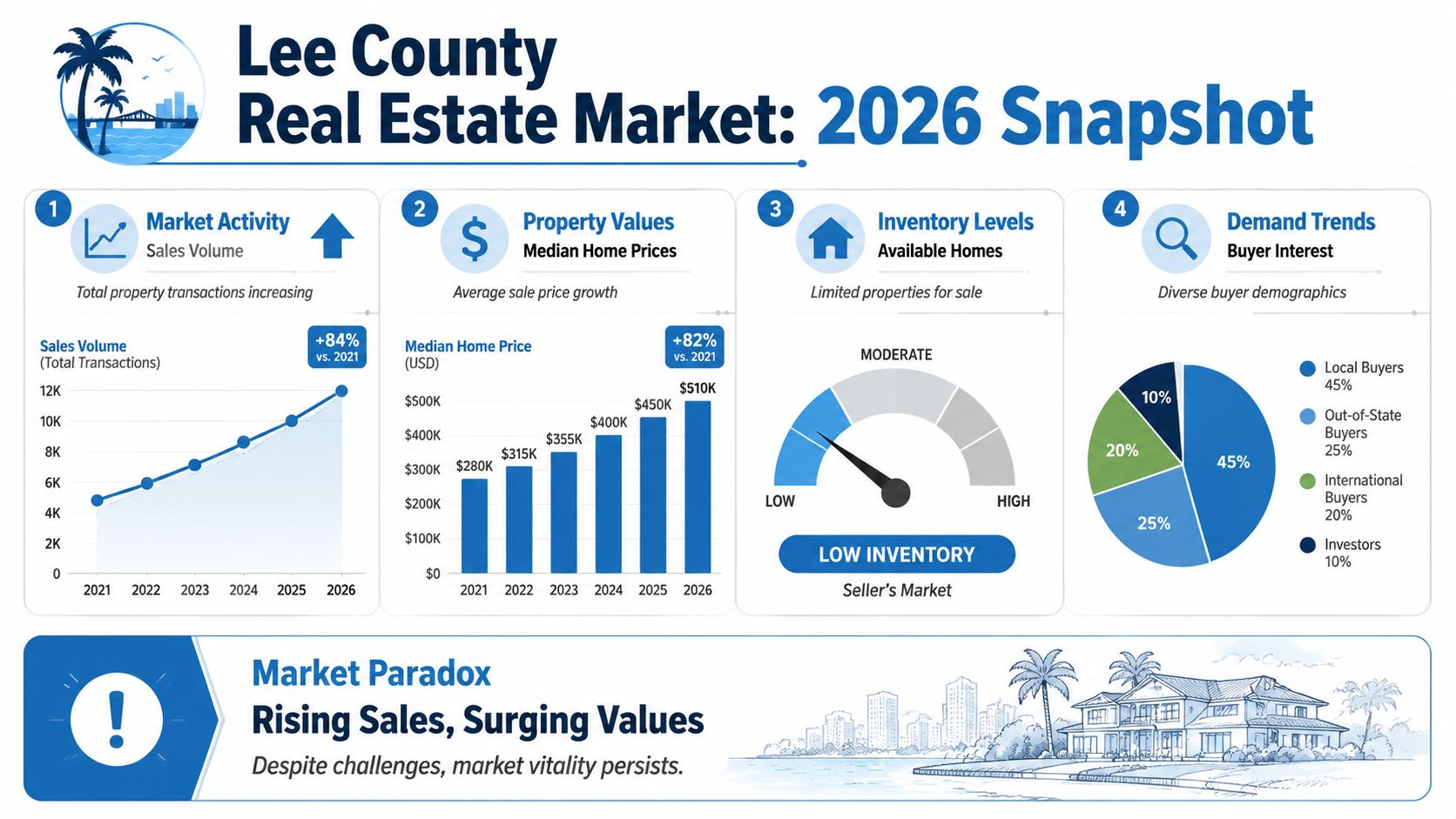
The key shift is price discovery. County-level pricing has reset lower while transaction activity has held up, which usually points to a market clearing process rather than a demand freeze. For investors, that creates a narrower spread between list-price expectations and executable value, but only if underwriting captures storm history, insurance cost drift, and title complexity at the parcel level.
Why volume and pricing diverged
Redfin reported a $360,000 median sale price in March 2026, down 4.0% year over year, with median price per square foot at $218, also down 4.0%. The same Redfin dataset shows 2,215 homes sold in March 2026 versus 1,942 in March 2025 and an average of 79 days on market, up from 72 days a year earlier.
That combination matters. Lower prices brought buyers back, but longer selling times show that buyers are screening harder and punishing weak assumptions on condition, insurance, and post-hurricane repair quality.
A county median is no longer enough.
In Lee County, two homes with similar square footage can trade at materially different effective values once you account for flood exposure, open permits, prior claims, HOA reserves, or unresolved liens. Investors who use property data APIs to verify those variables before offer submission can screen out false discounts and surface listings where seller fatigue is real but the title and physical risk stack is still manageable.
Lee County real estate market snapshot Q1 2026
| Metric | Current read | Investor implication |
|---|---|---|
| Closed sales | Single-family sales increased 9.5% and condo sales increased 29%, as noted earlier | Liquidity exists across product types, especially where pricing has reset |
| Pricing | County median sale price fell 4.0% year over year on the same Redfin dataset | Entry basis improved, but headline discounts still require parcel-level verification |
| Market speed | Average time on market rose to 79 days from 72 days | Buyers gained more time to inspect records, permits, and insurance assumptions |
| Transaction value | More than $1.1 billion in residential value closed in March 2026, as noted earlier | Capital can still enter and exit the market without relying on distressed-only scenarios |
What matters operationally
Professional investors should treat Lee County as a liquid but high-variance market. The opportunity is not merely "prices are down." The opportunity is that repricing has widened the gap between surface-level comps and true risk-adjusted value.
That changes sourcing strategy in three ways:
- Use county data to find direction, then shift to parcel data for conviction.
- Prioritize listings with longer market times only after checking liens, permit history, and storm-related repair records.
- Underwrite insurance and legal friction as part of basis, not as a post-close surprise.
For broader Florida context, the Florida investor pulse report for Q4 2025 helps frame why Lee County's repricing fits a statewide pattern while still carrying county-specific risks tied to hurricane recovery and property records complexity.
Which Lee County Neighborhoods Offer the Best Opportunities
A county median sale price of $360,000, as noted earlier, does not identify the best buy in Lee County. The spread between a clean asset and a problem asset can be wide inside the same ZIP code. For investors, that makes neighborhood selection a data problem first. You need to sort for storm exposure, title friction, insurance cost, and exit liquidity before a discount means anything.
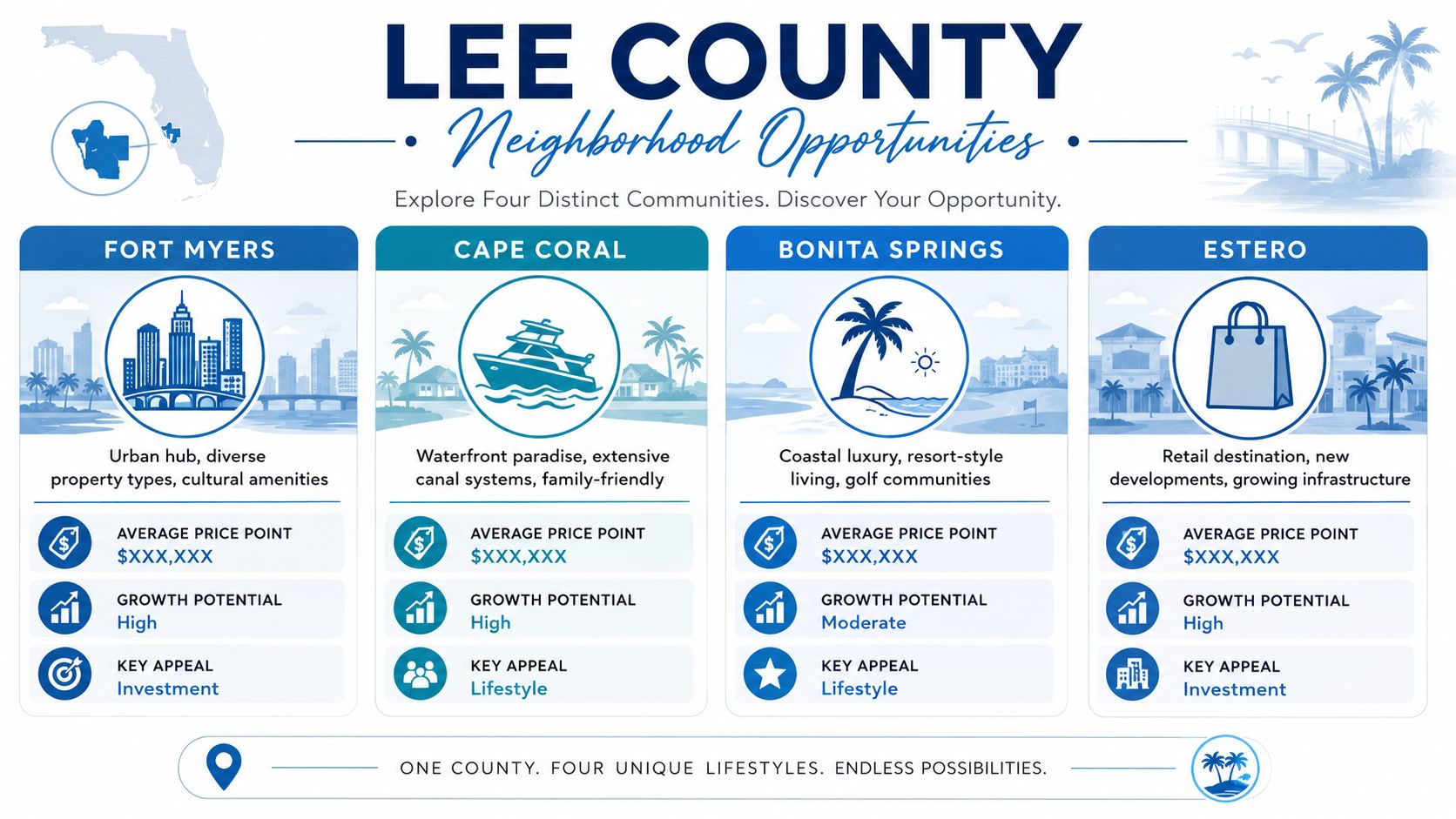
A useful screen is simple. Start with submarkets that still produce enough transaction volume to support resale comps, then narrow by parcel-level risk signals such as open permits, recorded liens, flood zone, year built, and post-hurricane repair history. In Lee County, the best opportunities usually sit where listing prices adjusted faster than property records did.
Submarket comparison for investors
| Area | Best fit | Property profile | Investor read |
|---|---|---|---|
| Fort Myers | Flexible acquisition and exit planning | Older infill, condos, mixed neighborhood quality | Best for investors who can separate cosmetic discount from structural risk |
| Cape Coral | Diligence-heavy sourcing | Canal-heavy single-family inventory with physical site variation | Best pricing gaps often come from seawall, elevation, and insurance differences |
| Bonita Springs | Premium-demand strategies | Coastal, golf, and amenity-oriented housing | Works better for margin protection than for pure yield chasing |
| Estero | Lower-maintenance holds | Newer communities, HOA-driven neighborhoods, retail access | Better fit for investors prioritizing cleaner operations and steadier buyer appeal |
Fort Myers
Fort Myers offers the widest range of deal structures in this group. You can screen older single-family homes, small condo inventory, and infill locations without paying coastal replacement-cost pricing.
That variety matters because Fort Myers creates more than one valid exit. A property may pencil as a rental if resale demand weakens. It may also work as a light renovation if the gap is mostly condition-based rather than legal or insurance-related. For API-driven sourcing, Fort Myers is a strong place to query permit age, ownership duration, and mortgage data together. That combination helps identify sellers facing repair fatigue or balance-sheet pressure instead of testing an aspirational list price.
Focus here when you want:
- Multiple exit paths
- Older stock with fixable deferred maintenance
- Broad buyer demand beyond second-home traffic
Cape Coral
Cape Coral has one of the clearest gaps between headline appeal and actual underwriting quality. Two houses with similar interior finishes can produce very different returns once you price flood exposure, elevation, roof age, seawall condition, and canal obligations.
That is where disciplined investors get paid. Public listing photos rarely capture the full cost stack. Parcel data often does. If you use property data APIs to pull flood zone, lot characteristics, permit history, and ownership records before touring, you can eliminate a large share of false positives. You can also find cases where sellers still anchor to pre-storm valuation logic even though insurance-adjusted value moved lower.
In Cape Coral, pricing errors are often physical-risk errors.
Bonita Springs
Bonita Springs behaves differently because demand is tied more closely to lifestyle and scarcity. Buyers in this submarket usually pay for location precision, community reputation, and amenity access, not just square footage.
That reduces the pool of obvious bargain buys, but it can still produce solid acquisitions. The better setups tend to be properties with strong micro-location and limited capital needs that are temporarily mispriced against nearby active listings. Investors should spend less time searching for deep discounts and more time measuring competitive supply, HOA constraints, and whether the asset stands apart from similar inventory. Small finish upgrades can matter more here than in a purely yield-driven submarket. In some resale cases, targeted presentation work such as installing frameless shower doors in Fort Myers can improve buyer perception without changing the full renovation budget.
Estero
Estero is usually the cleanest operating environment of the four. The housing stock is newer, community standards are more uniform, and near-term repair uncertainty is often lower than in older pockets of the county.
That does not mean Estero is automatically safer. It means the risk shifts. In Estero, investors need to be strict on entry price, HOA review, rental restrictions, and competing new or nearly new inventory. Property data is still useful here, but the highest-value fields are different. Instead of chasing storm-repair ambiguity, you are checking association rules, tax basis, mortgage position, and resale competition.
How to choose the right pocket
Choose the submarket that matches your operating advantage, then confirm the thesis at parcel level.
- Choose Fort Myers if you want variety, optionality, and more ways to create value from aging housing stock.
- Choose Cape Coral if your underwriting process can correctly price water exposure, site risk, and insurance cost.
- Choose Bonita Springs if you care more about preserving margin in premium locations than maximizing gross spread.
- Choose Estero if you want newer product, fewer repair surprises, and a more standardized management profile.
The highest-probability Lee County opportunities are rarely the listings that look cheapest at first glance. They are the properties where public pricing has already softened, but recorded risk is still manageable after you verify title, permits, storm history, and insurance exposure.
What Are Winning Strategies for Buyers Sellers and Investors
Lee County shifted from scarcity to selection. As noted in the Coconut Coast Realtors analysis mentioned earlier, inventory expanded materially by late 2025 and median single-family pricing softened year over year. For investors, that changes the playbook. Margin now comes less from broad market appreciation and more from buying mispriced risk, underwriting repairs correctly, and exiting into the deepest part of local demand.
For buyers
Buyers have more negotiating power, but the best use of that power is disciplined due diligence.
In Lee County, the highest-cost mistakes usually come from incomplete property records rather than from headline pricing. A house can look fairly priced against recent comps and still be a weak acquisition if permit history is inconsistent, a lien issue delays closing, or storm-related repairs were never properly closed out. Before submitting an offer, buyers should verify parcel-level hazard exposure, recorded encumbrances, and improvement history with hazard risk data integration APIs and county records.
Use this screen before you set your walk-away price:
- Rebuild the comp set from recent local sales. Older peak-period pricing is not a valid benchmark.
- Check insurability before the inspection period ends. Roof age, opening protection, flood exposure, and prior claims can change total monthly carrying cost more than a modest price concession.
- Review permits and recorded documents. Unresolved work, open permits, and secondary liens can erase an apparent discount.
- Prioritize improvements that reduce buyer objection at resale. Cosmetic updates only matter if they support rent, shorten days on market, or improve financing appeal. In some properties, interior updates such as installing frameless shower doors in Fort Myers may help position a unit against comparable listings in the same price band.
For sellers
Sellers need a pricing strategy tied to current absorption, not to prior-cycle expectations.
In a market with more choice, buyers compare condition line by line. They also discount uncertainty aggressively. A listing with vague repair history, weak documentation, or visible deferred maintenance often loses more in negotiation than it would have cost to address those issues before going live.
The strongest seller playbook is straightforward:
| Seller move | Why it works | Common failure |
|---|---|---|
| Price at the active comp range | Generates showings before the listing goes stale | Anchoring to 2022 pricing |
| Pre-clear visible repair and maintenance items | Removes easy credits and inspection retrades | Letting buyers estimate worst-case costs |
| Document every major improvement | Supports buyer confidence and lender review | Claiming upgrades without permits, invoices, or dates |
A stale listing is market feedback. Sellers who respond quickly usually preserve more net proceeds than sellers who wait for an old price target to return.
For investors
Investors should treat Lee County as a data-arbitrage market.
The best opportunities often sit in properties that look messy on the surface but become financeable and rentable once you verify the file. That includes homes with incomplete public descriptions, inconsistent condition narratives, older storm-repair histories, or title complexity that discourages less prepared buyers. The edge comes from sorting real impairment from fixable uncertainty.
Focus on three underwriting tests:
- Can you verify true basis? Include acquisition, deferred maintenance, insurance, taxes, and time to stabilization.
- Can you clear legal and record risk early? Liens, probate complications, and permit gaps matter more in Lee County than many out-of-state buyers expect.
- Can you exit into median local demand? A property improved into the middle of the buyer pool is usually safer than one renovated for a narrow premium audience.
Common mistakes that reduce returns
Three errors show up repeatedly in Lee County deals.
- Using county averages to price a single parcel. Street-level flood profile, building age, and repair history can overwhelm broader market trends.
- Treating seller concessions as equivalent to a lower basis. Credits help cash flow, but they do not fix a weak purchase price if the exit market stays soft.
- Assuming every discounted listing is distressed value. Some listings are discounted because the legal, insurance, or repair file is materially worse than the photos suggest.
Professional investors win here by being faster at verification, not by being more optimistic.
How Do Hurricanes and Insurance Impact Property Value
Hurricanes don't just damage structures. They distort valuation, taxes, and buyer confidence. In Lee County, one of the biggest blind spots is the gap between storm-affected market reality and what public assessment systems still show.
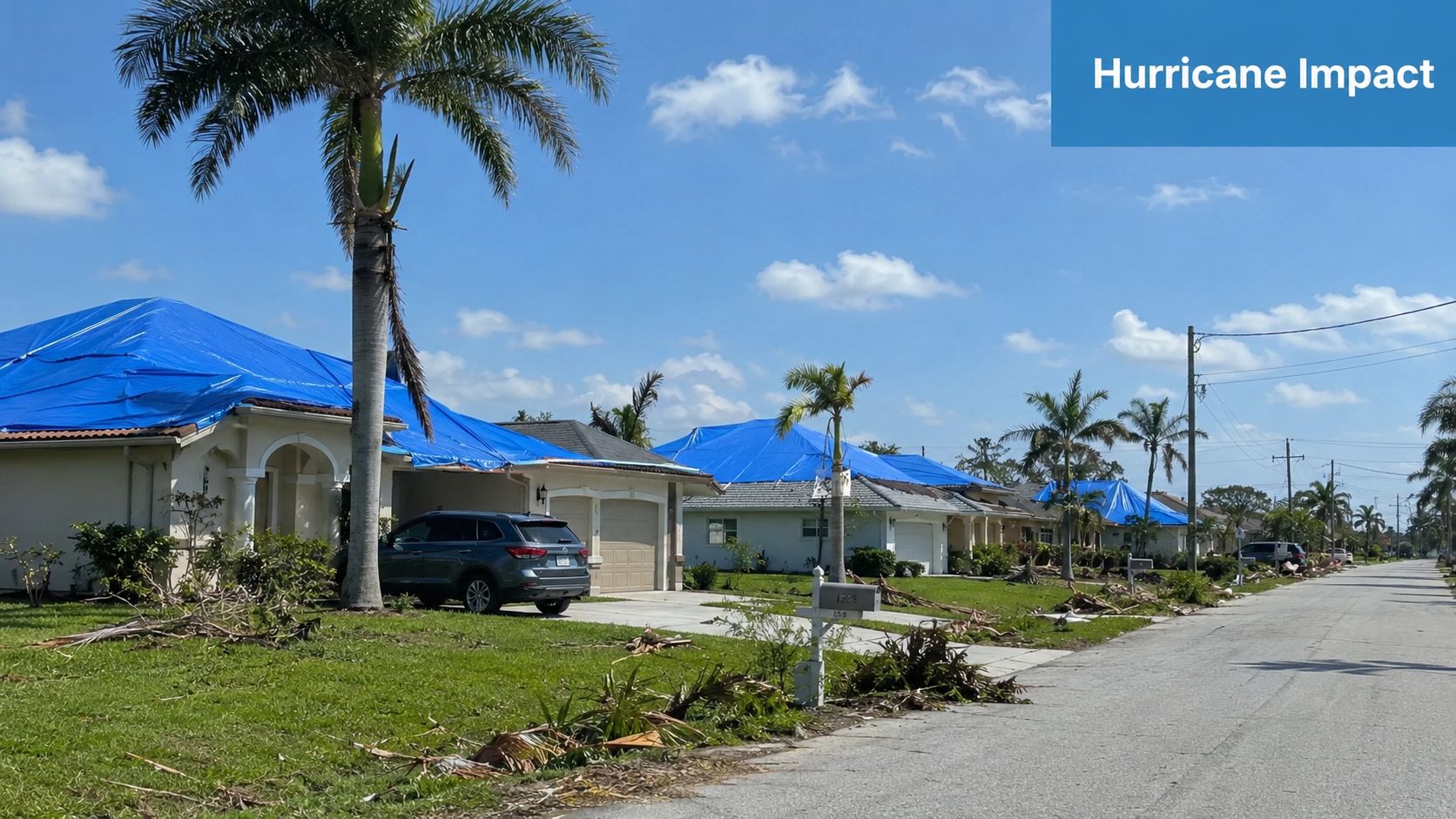
The core issue is documented. The gap between hurricane-adjusted property tax reassessments and actual market valuation post-Helene and Milton remains poorly explained, and recent 2025 to 2026 TRIM notices show rising assessed values despite storm impacts, according to the Lee County Property Appraiser FAQs.
That creates a specific underwriting problem. A property can trade in a softer market while its assessed value does not immediately reflect the same damage, stigma, or impairment.
Assessed value is not market value
Investors regularly overtrust tax records during initial screening. In a normal market, that shortcut is risky. After storm disruption, it's worse.
A parcel may show:
- An assessed value that has risen
- A market value that buyers have mentally discounted
- Repair obligations that neither number fully captures
This is why tax data must be treated as one signal, not the answer.
What to verify before making an offer
Insurance has become part of acquisition economics, not a post-contract administrative step. If you're buying in Lee County, get insurance pricing and documentation reviewed before final commitment.
Focus due diligence on:
Current insurability
Ask for current policy details and get your own quotes early.Flood and elevation position
Flood exposure changes both cost and liquidity.Storm-hardening quality
Construction details now influence both buyer perception and operating cost. For a practical technical overview, Ofir Engineering's guide to storm-resistant construction is a useful reference point.Tax lag risk
Rising assessed values after a storm can leave owners carrying taxes that don't match actual saleability.
Underwriting warning: If storm damage changed market perception but not the assessment trail, your basis can look safer on paper than it is in reality.
Hazard datasets help close that gap. Investors building a more disciplined diligence stack should review approaches to hazard risk data integration through property APIs, especially when flood, wind, and tax signals conflict.
Why this changes exit strategy
A buyer on resale may ask different questions than you did at acquisition. They may care less about interior finishes and more about claim history, roof age, or whether prior damage was fully remediated.
Local video briefings and field context can help frame the risk conversation before you deploy capital.
The larger point is simple. In Lee County, hurricane risk doesn't sit beside valuation. It sits inside it.
Using Property Data to Underwrite Lee County Deals
A distressed deal can look cheap in Lee County and still fail basic recovery math. PropertyOnion's Lee County investing guide reports that in 2025, 22% of county foreclosure auctions involved multi-lien properties, and average recovery for second-lien buyers reached only 38% of expected value because of storm-related title complications.
For an investor underwriting at scale, that is not a legal footnote. It is a pricing input. In Lee County, valuation errors often start in the record stack before they show up in comps.
What should be in a Lee County underwriting dataset
Listings and recent sales are not enough here. A usable underwriting workflow needs title, tax, permit, and hazard context in the same review process so you can separate a true discount from a property with unresolved risk.
Minimum useful fields include:
| Data layer | Why it matters in Lee County | Typical use |
|---|---|---|
| Ownership and equity | Identifies sellers with room to negotiate or refinance pressure | Off-market targeting |
| Mortgage and lien detail | Shows whether the capital stack can impair recovery | Distressed and foreclosure underwriting |
| Assessment and permit history | Helps test whether the physical story matches the public record | Condition validation |
| Hazard and location context | Affects insurance cost, buyer pool, and resale liquidity | Hold and exit modeling |
The investor advantage is not broader data. It is better sequencing. Pull ownership first, then debt position, then permit and tax history, then location risk. That order eliminates weak deals early and keeps analysts from wasting time on assets that were never financeable.
Property data filters that matter in this county
Lee County rewards targeted screens, not generic lead lists. Useful query logic includes:
- Single-family homes in Cape Coral with high equity and no active listing
- Pre-foreclosure properties in Fort Myers with fewer title complications
- Condo units where sales activity has improved but carrying costs still need stress testing
- Parcels with permit or assessment patterns that conflict with the seller's condition claims
Each filter answers a local underwriting question. Is the seller motivated? Is the title stack clean enough to pursue? Do public records support the renovation story? Will the next buyer see the property the same way you do?
A practical workflow
A disciplined Lee County screen usually follows five steps:
Define the geography
Use a city, ZIP code, subdivision, or custom map boundary.Select the asset type
Separate single-family, condo, and small multifamily searches because the risk profile differs.Apply ownership and distress filters
Focus on equity position, absentee status, years owned, and pre-foreclosure signals.Add risk variables
Review lien count, mortgage order, permit gaps, tax changes, and hazard indicators.Send only the short list to manual underwriting
Analysts should review exceptions, not every parcel in the county.
That process matters because Lee County has more ways for a deal to be optically cheap than fundamentally mispriced.
Why historical records matter more than headline pricing
A current snapshot can miss the sequence that created the risk. Reviewing how to use APIs for historical property data helps investors compare prior transfers, tax resets, mortgage recordings, and permit timing before they assign value. That historical chain often shows whether a discount comes from normal distress, unresolved documentation, or post-storm impairment that the listing language minimizes.
Experienced buyers distinguish search from underwriting. A low ask price identifies a candidate. Record history determines whether it belongs in the model.
Lien data should change your bid discipline
Lee County foreclosure buyers cannot treat junior liens as a back-office review item. The PropertyOnion auction data cited above shows why. Multi-lien structures are common enough to affect screening strategy, and second-position recovery has been weak enough to damage returns even when the opening bid looks attractive.
The practical response is simple. Price by lien position and resolution cost, not by headline discount to estimated market value. If the title stack is unclear, widen your margin requirement or pass.
The real edge
Professional investors do not win in Lee County by finding hidden neighborhoods. They win by rejecting bad deals faster than competing buyers.
Property data helps you do that by exposing four common failure points early:
- Tax records that lag actual marketability
- Junior liens that compress recovery
- Ownership profiles that suggest low listing intent but real off-market potential
- Submarket differences that county averages hide
In a cleaner market, comps can carry more of the underwriting burden. In Lee County, record quality and record history carry more.
Conclusion Navigating the Lee County Market in 2026
Lee County in 2026 rewards analysis, not assumptions. Sales activity is strong enough to confirm real buyer demand, but softer pricing, longer selling times, storm-related valuation distortions, and lien complexity mean investors need tighter underwriting than they needed in simpler cycles.
The biggest mistake is reading the market at only one level. County averages show repricing and liquidity. Submarkets show very different opportunity sets. Parcel-level records reveal whether the deal is financeable, insurable, and worth owning through the next weather event or resale cycle.
Lee County is still investable. It's just no longer forgiving.
Professional buyers who win here will do three things better than everyone else. They'll negotiate from current market reality. They'll treat hurricanes and insurance as valuation inputs, not side issues. And they'll use structured property data to verify title, tax, and condition signals before making offers.
That makes this a thinking investor's market. For disciplined operators, that's a feature, not a drawback.
If you're underwriting Lee County opportunities at scale, BatchData gives you a faster way to pull ownership, lien, valuation, permit, and pre-foreclosure signals into one workflow so you can screen risk before you price the deal.