




































Accurate data is the backbone of successful skip tracing, especially when managing thousands or millions of records. Poor data quality leads to wasted time, legal risks, and missed opportunities. Here’s what you need to know:
- Industry Challenges: Only 6% of publicly available contact data is accurate. The average right-party contact (RPC) rate is just 25-35%, meaning most outreach efforts fail.
- Legal Risks: Contacting numbers on the Do Not Call (DNC) registry or TCPA litigators can result in lawsuits.
- Importance of High-Quality Data: Top-tier providers achieve up to 76% RPC rates by using verified, updated, and compliant data.
Key Solutions:
- Choose Reliable Data Providers:
- Look for RPC rates of 65-76%.
- Use providers with daily updates and compliance tools.
- Test data quality
- Leverage Real-Time Updates:
- Use systems that refresh data daily or in real-time.
- Integrate live feedback loops to remove invalid contacts.
- Automate Data Validation:
- Use tools to cross-check phone numbers, addresses, and ownership details.
- Automate scrubbing against DNC and TCPA lists.
- Batch Processing with Accuracy Checks:
- Advanced tools aggregate data from multiple sources.
- Features like confidence scoring and compliance checks ensure better results.
- Regular Data Refreshes and Audits:
- Schedule daily updates to maintain accuracy.
- Run audits to monitor RPC rates and legal compliance.
- Custom Data Enrichment:
- Professional services can resolve ownership behind LLCs and trusts.
- Enrich data with verified contact details for better outreach.
Accurate data reduces wasted effort, minimizes legal risks, and improves contact rates. Investing in verified and compliant data sources is critical for efficient skip tracing.
Has Skip Tracing Gotten More or Less Accurate? | 167
Choose Reliable Data Sources
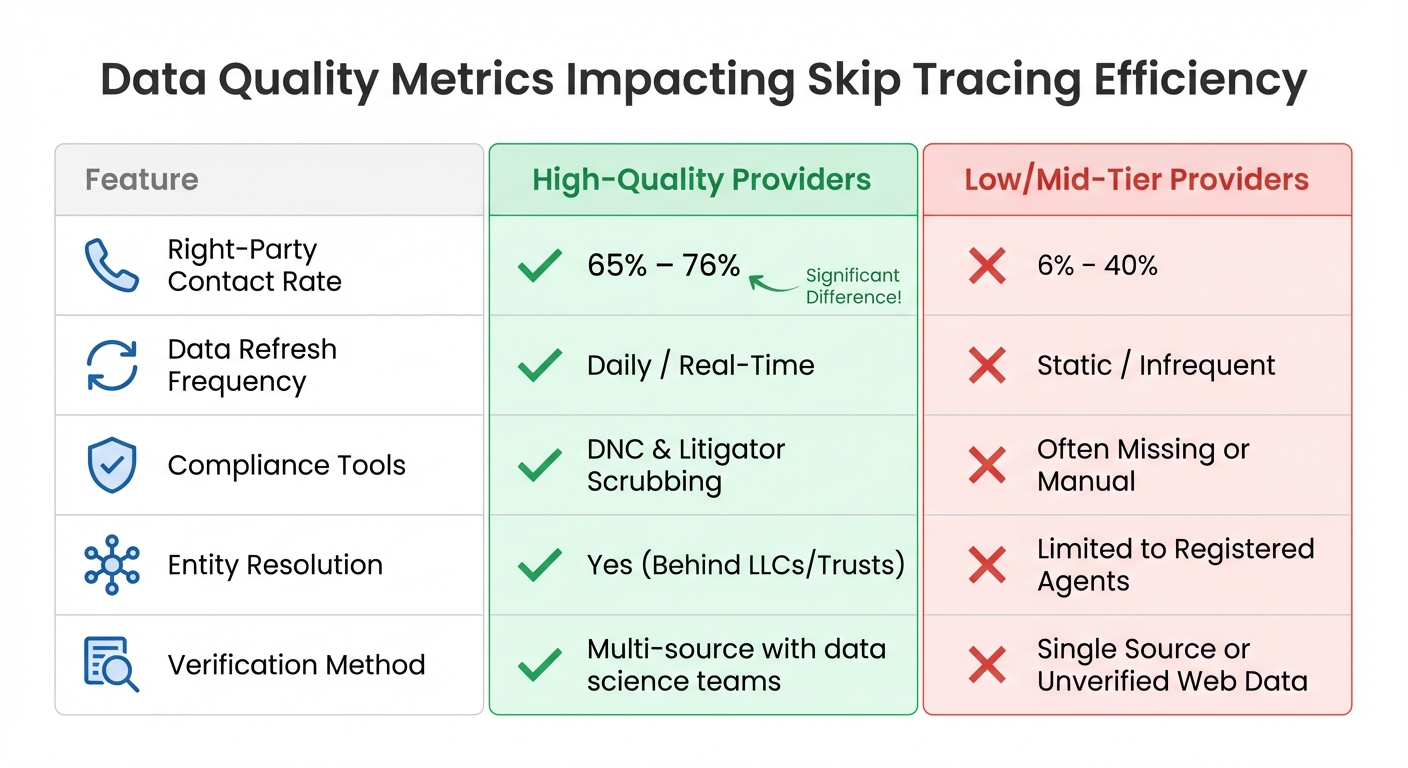
Skip Tracing Data Quality Comparison: High-Quality vs Low-Tier Providers
The quality of your data can make or break your outreach efforts. Reliable, up-to-date information ensures you’re connecting with property owners instead of wasting time and resources on outdated leads.
How to Identify Trusted Data Providers
When evaluating data providers, don’t just take their marketing claims at face value – dig deeper into their performance metrics. One of the best indicators of data quality is the right-party contact (RPC) rate. For context, the industry average RPC rate typically falls between 25% and 35%. However, the most reliable providers boast rates between 65% and 76%.
“Our skip tracing and what we do to ensure accuracy… is typically gonna be anywhere from around sixty five to seventy five percent.”
- Jay, Skip Tracing Expert
Look for providers who update their data daily using automated systems. Static lists, which don’t refresh frequently, become outdated fast. When testing a provider, ask about their update schedules and whether they use real-time feedback loops to remove disconnected numbers.
Another critical factor is compliance. Reliable providers should automatically scrub their data against the National Do Not Call (DNC) registry and the latest TCPA litigator lists.
Before scaling up, consider running a pilot test to evaluate data quality against your own records. Request representative data samples or reports that allow you to assess coverage, accuracy, and usability before expanding your workflow. The format and available data fields can vary by provider and product, so confirm the current capabilities and supported output with the provider before making a purchasing decision.
By following these steps, you’ll be better equipped to choose a provider that aligns with your needs and avoids the pitfalls of outdated or inaccurate data.
Why You Need to Verify Data Sources
Relying on unverified data can lead to a series of costly problems. The most immediate issue? Financial waste. When your team spends hours calling disconnected numbers or reaching the wrong people, you’re essentially paying for unproductive work. Over time, this inefficiency can even lead to higher employee turnover.
There’s also the risk of legal trouble. Calling numbers on the DNC list or contacting TCPA litigators can result in expensive lawsuits. Additionally, repeatedly dialing disconnected numbers may cause carriers to flag your business number as spam, further limiting your ability to connect with prospects.
From a competitive standpoint, outdated data puts you at a severe disadvantage. While you’re struggling with inaccurate leads, competitors using verified data are already engaging with motivated sellers. To put it in perspective, mid-tier providers typically achieve only 40% accuracy, and only 6% of contact information available on the general web is reliable. Building your operations on such shaky ground is a gamble – not a strategy.
Data Quality Metrics Impacting Skip Tracing Efficiency
| Feature | High-Quality Providers | Low/Mid-Tier Providers |
|---|---|---|
| Right-Party Contact Rate | 65% – 76% | 6% – 40% |
| Data Refresh Frequency | Daily / Real-Time | Static / Infrequent |
| Compliance Tools | DNC & Litigator Scrubbing | Often Missing or Manual |
| Entity Resolution | Yes (Behind LLCs/Trusts) | Limited to Registered Agents |
| Verification Method | Multi-source with data science teams | Single Source or Unverified Web Data |
While verified data might come with a higher upfront cost, it pays off in the long run. It reduces wasted effort, minimizes legal risks, and ensures you’re connecting with the right people. Investing in verified data is an essential step toward efficient and compliant skip tracing.
Use Real-Time Data Updates and Verification
Static data has a short shelf life – people move, switch phone numbers, and update their contact details all the time. That’s why relying on real-time data updates is essential for keeping large-scale skip tracing efforts accurate and efficient. With reliable sources and automated verification tools, you can ensure your skip tracing hits the right targets.
Real-time systems tackle this challenge by constantly refreshing datasets and verifying information as it’s accessed. This approach minimizes the risk of dialing disconnected numbers or reaching out to the wrong individuals. The impact can be significant, as BatchData’s verification and contact-data capabilities can help businesses improve the quality and usability of their contact information.
Set Up Real-Time Data Feeds
Real-time data feeds provide up-to-the-moment information in milliseconds, enabling instant enrichment of property records without waiting for batch updates. These feeds pull data from a variety of sources – like financial institutions, carriers, and public records – to create an accurate and comprehensive contact profile.
“Our data is dynamic, not static. We operate a self-enriching engine that constantly verifies and cleanses data in real-time. We refresh our datasets daily, ensuring that when you pull a record, you’re getting the most current and accurate contact information available.” – BatchData
One major advantage of real-time feeds, especially those powered by APIs, is their ability to handle vast amounts of data while maintaining speed and accuracy. Instead of working with static lists that quickly become outdated, you can integrate these high-performance, low-latency APIs directly into your existing workflows.
Another game-changing feature is the live feedback loop. Advanced systems link your outreach tools, like dialers, back to the data source. For instance, if your team encounters a disconnected number, that information is instantly updated in the system to save others from wasting time on the same lead.
Automated Verification Tools
Once you’ve got the most current data, verifying its accuracy automatically is the next step. Automated tools refine and validate records in real-time, ensuring efficiency at scale. When you’re handling thousands of records, manual verification just isn’t practical – automated systems take care of it by cross-checking phone numbers, addresses, and other contact details across multiple databases.
Phone verification stands out as a critical component. These tools track carrier updates and flag inactive lines before your team dials them. They even assign confidence scores to numbers, so you can focus your outreach on the most reliable leads.
Compliance is another area where automated tools shine. They automatically scrub your data against the National Do Not Call (DNC) registry and TCPA litigator lists, ensuring you stay within legal boundaries.
One often-overlooked perk of these tools is their ability to connect the dots behind corporate structures. They can link LLCs and trusts to the actual decision-makers, giving you a clearer path to the right contacts.
Use Batch Processing Tools with Accuracy Checks
Handling thousands – or even millions – of records can feel overwhelming without the right tools. Batch processing systems are essential for managing data at scale, but their real value comes from having built-in accuracy checks. The difference between a basic tool and a powerful one lies in its ability to validate data quickly and reliably.
Advanced batch processing tools don’t just process data – they verify it. By cross-referencing multiple databases, assigning confidence scores, and automatically scrubbing compliance lists, these systems ensure you’re not just speeding up processes but also maintaining data quality. Without these safeguards, you risk working with flawed or outdated information.
Key Features of Batch Processing Tools
Here are some standout features that make batch processing tools indispensable:
- Multi-source aggregation: Instead of relying on a single data source, top systems pull from 50+ providers, including public records, telecom databases, and national land deeds. This creates a more complete and accurate contact profile.
- Entity resolution: High-end tools use proprietary linking logic to connect LLCs and trusts to actual decision-makers, cutting through layers of corporate structures. This is especially valuable for commercial and investment properties where ownership is often masked.
- Confidence scoring: Advanced systems assign scores based on data recency and validity, helping you focus on contacts most likely to respond. This saves time by avoiding outdated or disconnected information.
- Automated compliance scrubbing: These tools run compliance checks automatically during processing, reducing manual effort and lowering legal risks.
Together, these features streamline bulk operations while ensuring the data you rely on is accurate and actionable.
How BatchData Maintains Accuracy
When it comes to skip tracing, accuracy is everything – and BatchData delivers. The platform processes millions of records with a 99.9% accuracy rate, thanks to its rigorous multi-source validation processes. By pulling data from over 50 providers and using proprietary algorithms to link scattered data points, BatchData ensures you’re connecting with the right people.
The results can help businesses improve the quality and usability of contact data, supporting more effective outreach and lead-generation workflows.
“What used to take 30 minutes now takes 30 seconds. BatchData makes our platform superhuman.” – Chris Finck, Director of Product Management
BatchData’s reach is extensive, covering over 155 million properties with more than 700 attributes per record. It also provides contact enrichment for over 360 million property owners. Even at scale, the platform delivers API responses in milliseconds, ensuring seamless performance for large-scale operations.
Pricing varies based on product, usage, and business requirements. For current pricing and available options, contact the BatchData sales team.
sbb-itb-8058745
Cross-Reference and Automate Data Validation
Managing large datasets comes with its challenges, and relying on a single data source often leads to errors. Cross-referencing data across multiple databases ensures accuracy, while automation takes the hassle out of manual validation.
The results speak for themselves. Cross-referencing data can boost your right-party contact rate to 76% – a massive improvement compared to the industry average of 25% to 35%. This method builds on earlier verification steps, tightening the accuracy of your contact lists.
How Cross-Referencing Works
Cross-referencing strengthens data accuracy by comparing information across multiple verified sources. For instance, phone numbers can be checked against public records, telecom databases, and other trusted sources. This process assigns a confidence score based on how consistent the data is across these sources.
It also improves entity resolution by linking business entities, like LLCs or trusts, to the individuals behind them. For example, if a property is listed under “ABC Holdings LLC”, cross-referencing can help identify the actual owners and provide their direct contact details.
Another advantage of cross-referencing is its ability to catch common mistakes. For example, it can identify when a property owner’s mailing address differs from the property address – a detail often missed with lower-quality data. Using key identifiers like names, addresses, and contact information leads to more accurate matches.
“Using multiple sources, investors can verify and cross-reference information about the person they are trying to locate. Verifying information in multiple places can help ensure that the data they have on a person is accurate and up-to-date.” – PropertyRadar
Set Up Automated Validation Workflows
Automation takes data validation to the next level, ensuring accuracy without the need for manual checks. These workflows continuously verify data as it’s processed, saving time and maintaining consistency across even the largest datasets.
One effective method is the live feedback loop. When skip tracing data is connected to tools like dialers, records update automatically based on call outcomes. For example, disconnected or unreachable numbers are flagged and removed from your database, keeping your contact lists clean without manual effort.
“We have a phone verification method. It’s like a live feedback loop where we cross reference the skip tracing with our dialer and that’s done to weed out the invalid and disconnected numbers as best as we can.” – Jay, Skip Tracing Expert, BatchService
Automated workflows can also handle compliance checks by cross-referencing data with DNC and TCPA lists. This reduces legal risks and eliminates the need for separate compliance tools.
For real-time validation, API integration is key. High-performance APIs deliver results in milliseconds, allowing you to verify and enrich data directly within your existing systems. This seamless integration eliminates the need to transfer data between disconnected tools, streamlining the entire process.
To maximize your contact options, always use the full CSV of results. Regular data refreshes and quality audits become much easier when you have automated validation in place, ensuring your records stay accurate over time.
Schedule Regular Data Refreshes and Quality Audits
Even the most advanced automated workflows can falter over time as contact details change daily. Without consistent updates and audits, the accuracy of skip tracing data diminishes, leading to wasted outreach efforts and lower success rates.
The contrast between static and dynamic data is striking. Top-tier providers refresh their datasets daily, achieving much higher accuracy rates, whereas mid-tier providers – updating weekly or monthly – reach only about 40% accuracy. For large-scale operations, daily updates are crucial to maintain high contact rates and ensure your efforts stay effective. Setting a refresh schedule that aligns with the fast pace of data changes is a key step.
Determine Data Refresh Intervals
Your data refresh frequency should match the speed at which your information becomes outdated. For high-performance skip tracing, daily refresh cycles are the gold standard. Changes in property records, phone carriers, and ownership occur every day, so your data must keep up to stay relevant.
| Data Tier | Estimated Accuracy/RPC Rate | Refresh Frequency Recommendation |
|---|---|---|
| Low-Tier (Public Web) | ~6% | Not recommended for professional use |
| Mid-Tier Providers | ~25% – 40% | Weekly or Monthly |
| Premium (BatchData) | ~76% | Daily / Real-Time |
Frequent updates are especially critical when dealing with LLCs and trusts, as ownership changes can happen rapidly.
“We refresh our datasets daily, ensuring that when you pull a record, you’re getting the most current and accurate contact information available.” – BatchData
Run Data Quality Audits
In addition to scheduled updates, running regular audits is essential to maintain data reliability. This involves evaluating datasets against key quality benchmarks: accuracy, completeness, timeliness, consistency, uniqueness, and granularity. Each of these factors highlights potential errors that could negatively impact your contact rates.
Monitor metrics like right-party contact rates and the effectiveness of your outreach methods. A decline in these metrics signals that your data quality may be slipping. Leading providers perform over 1.3 billion updates per month, adding new phone numbers, addresses, and employment records to maintain accuracy at scale.
Your audits should also include compliance checks. Scrub your data against the National Do Not Call registry and TCPA lists to avoid legal risks. This step not only protects you from violations but also ensures your contact lists remain clean and compliant.
Use Professional Services for Custom Data Enrichment
When automated tools and workflows hit their ceiling, professional data services step in to handle the intricate challenges that demand a more precise touch. For scenarios where standard automation just isn’t enough, BatchData’s professional services ensure data accuracy at a level that meets the high expectations of various industries.
Benefits of Professional Data Services
Professional data services excel in tackling complex data problems that go beyond the capabilities of standard tools. For example, they provide advanced entity resolution, uncovering the real decision-makers behind LLCs and trusts instead of stopping at surface-level registered agents.
By combining data from multiple sources – like public records, telecom databases, and secretary of state filings – these services achieve an impressive 99.9% accuracy rate. They also utilize expert analysis and proprietary algorithms to deliver deeper insights into carriers and data trends. Custom match-and-append services further enhance CRM records with verified contact details, such as phone numbers and emails. This multi-source precision forms the backbone of BatchData’s enrichment services, which are designed specifically for large-scale, complex tasks like skip tracing.
BatchData’s Custom Enrichment Services
BatchData takes professional data services to the next level with custom solutions tailored to unique business needs. Their offerings include custom API integrations with lightning-fast response times, bulk delivery in formats like CSV, JSON, or Parquet via FTP/SFTP, and real-time compliance scrubbing.
These services maintain a standout 76% right-party contact (RPC) rate – nearly three times the industry standard. BatchData’s platform also covers over 155 million properties, with each record featuring more than 700 attributes.
Compliance is a top priority, with features like real-time scrubbing against the National Do Not Call Registry and TCPA litigator flagging built directly into the platform. Additionally, contact scoring helps rank leads based on their recency and validity, enabling businesses to focus their outreach for maximum ROI. Pricing depends on usage, product requirements, and business needs. For current pricing and available options, contact the BatchData sales team.
“What used to take 30 minutes now takes 30 seconds. BatchData makes our platform superhuman.” – Chris Finck, Director of Product Management
Conclusion
Accurate skip tracing data is an important foundation for effective outreach. The quality of results depends on how contact data is sourced, verified, and maintained. This highlights the importance of thorough data validation, especially for large-scale operations.
Using multiple data sources is key. For example, BatchData cross-references information from over 50 providers, reaching an impressive 99.9% accuracy rate. On top of that, their data is updated daily to ensure reliability.
Automation plays a huge role in streamlining processes. Features like real-time validation, automated compliance checks against the National DNC Registry, and confidence scoring help you stay legally secure. When automation isn’t enough, professional data enrichment steps in to handle more complex tasks. For instance, uncovering the true decision-makers behind LLCs is something standard tools often can’t manage – but professional services can.
“The payoff is tangible: you spend less time dialing disconnected numbers and more time having conversations with actual property owners.” – BatchData
FAQs
What legal risks are involved in skip tracing, and how can they be avoided?
Skip tracing can come with legal risks if not managed carefully, especially when it comes to privacy and licensing laws. For example, states like California require anyone conducting skip tracing to hold a private investigator’s license. Failing to meet such requirements could lead to fines or even legal action. On a broader level, federal laws like the Telephone Consumer Protection Act (TCPA) and state laws such as the California Consumer Privacy Act (CCPA) govern how personal data, including phone numbers, can be used. Breaking these laws can result in penalties, lawsuits, or regulatory action.
To reduce these risks, it’s crucial to partner with a data provider that emphasizes compliance. Ensure the data you’re using is legally sourced and adheres to privacy laws. Here are some important practices to follow:
- Work with licensed investigators or vendors for manual skip tracing tasks.
- Confirm that all data is collected from legitimate sources and keep thorough documentation.
- Honor do-not-call registries and provide clear opt-out options.
- Stay informed about state-specific privacy and licensing laws.
By pairing a reliable, compliant data provider with strong internal procedures, you can use skip tracing effectively while steering clear of legal issues.
What should I look for in a reliable skip tracing data provider?
When searching for a dependable skip tracing data provider, keep these three essentials in mind: data accuracy, compliance, and flexibility.
Start by ensuring the provider delivers high-quality, regularly updated records pulled from multiple sources. This guarantees you’re working with precise and current information. Equally important is confirming the provider’s commitment to legal compliance. Look for services that offer TCPA-safe and CCPA-compliant data, paired with strong security protocols to safeguard sensitive details.
Why is real-time data verification important for accurate skip tracing?
Real-time data verification keeps skip tracing records current by incorporating the latest updates from property transactions, public records, and contact details. This process minimizes the risk of outdated or incorrect information affecting your outcomes.
Accurate and up-to-date records can greatly enhance match rates, ensuring you connect with the right individuals. This becomes even more crucial in large-scale skip tracing efforts, where even minor inaccuracies can result in unnecessary time and resource expenditure.