


































Home service companies can target homeowners more effectively by predicting which properties are likely to sell soon. Using AI and data-driven models, businesses like roofing, solar, and HVAC services identify high-probability sellers, focusing outreach during the critical pre-sale period. Key benefits include:
- Higher Conversion Rates: Predictive analytics improve response rates (20–30%) and boost conversion rates by 3–5× compared to traditional methods.
- Lower Costs: Customer acquisition costs drop from $500–$1,000 to $200–$400, with a 40% reduction in marketing waste.
- Efficient Targeting: Models use signals like ownership duration, property conditions, and homeowner behavior to score properties likely to sell within 6 months.
For example, BatchData‘s tools, such as BatchRank, achieved 82% accuracy in predicting sales, helping companies focus on homeowners planning pre-sale upgrades. By integrating predictive scores into CRMs and using verified contact data, businesses streamline outreach and maximize ROI. This data-driven approach ensures that resources are spent engaging the right leads at the right time.
AI Predictive Analytics for Real Estate Farming How Smart Agents Find Sellers with Rick Fuller
sbb-itb-8058745
Why Home Service Companies Should Predict Property Sales
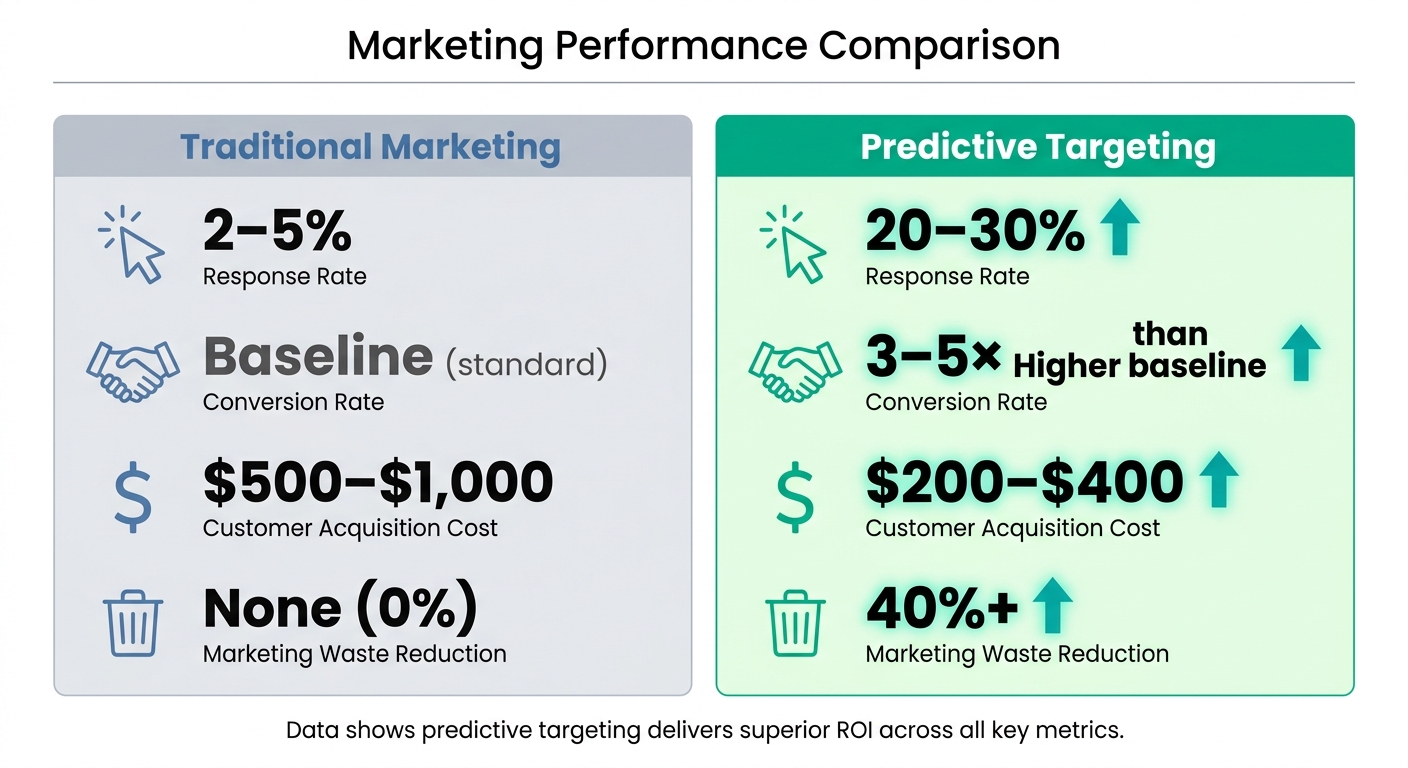
Traditional Marketing vs Predictive Targeting for Home Services: ROI Comparison
Predicting property sales can give home service companies a major competitive edge. On average, homeowners spend about $15,000 on pre-sale improvements to boost their property’s value before selling. Properties identified as “likely to sell” within 6 months see around 40% higher demand for services like cosmetic updates and structural repairs. This creates a golden opportunity for businesses in roofing, solar, HVAC, and similar industries to connect with these homeowners – but only if they act quickly. Early engagement is key to staying ahead of competitors.
Timing plays a massive role here. Take solar sales, for example: reaching out to homeowners 60–90 days before a predicted sale significantly increases the chances of closing deals. This window is when sellers are most focused on making improvements, making it the perfect time to capture their attention.
Predictive models make marketing smarter and more effective. Instead of casting a wide net, businesses can zero in on leads with the highest likelihood of converting using precision property search tools. This targeted approach not only improves engagement but also stretches marketing dollars further. The numbers back this up: companies using predictive lead models see response rates jump to 20–30% (compared to the 2–5% typical of traditional marketing methods) and conversion rates increase by 3–5×.
What’s more, predictive targeting slashes customer acquisition costs. Traditional methods like mass mailers or generic digital ads often cost $500–$1,000 per customer, while predictive models bring that down to $200–$400. Plus, by reducing wasted marketing spend by over 40%, businesses can allocate resources more effectively.
Here’s a quick comparison:
| Metric | Traditional Marketing | Predictive Targeting |
|---|---|---|
| Response Rate | 2–5% | 20–30% |
| Conversion Rate | Baseline | 3–5× Higher |
| Customer Acquisition Cost | $500–$1,000 | $200–$400 |
| Marketing Waste Reduction | – | 40%+ |
Sources:
Next, we’ll dive into the data signals that make these predictions possible.
Data Signals That Predict Property Sales
Figuring out which properties are likely to sell soon boils down to analyzing the right data signals. Predictive models use these signals to calculate a sale propensity score, pinpointing homes that could hit the market within 6 months. The trick lies in combining multiple indicators – a property with high equity, a recent permit, and an out-of-state owner is a much stronger lead than one showing just a single factor. Among these signals, public records stand out as some of the most dependable sources. Many firms access this information through a real estate API to automate their lead generation.
Public Records and Property Information
One of the clearest predictors is ownership duration. Homes owned for 10, 15, or even 30+ years often have built-up equity, putting owners in a strong financial position to sell. Properties with at least 50% equity or over $100,000 in cash value are especially appealing, as sellers can walk away with a significant profit.
Other key indicators include refinancing history, active liens, tax delinquencies, and life events like divorce or death. These events account for 15% and 13% of motivated sales, respectively, and together, life changes drive over 74% of off-market transactions as of 2025. These financial and personal triggers often signal upcoming property transitions.
Municipal code violations and vacancy status also shed light on property conditions. Vacant homes, for instance, can place financial strain on owners due to ongoing costs like taxes, insurance, and maintenance, often prompting a sale. Similarly, properties with unfinished construction permits may point to developers running out of resources, providing another strong clue for identifying motivated sellers.
Online Search Patterns and Homeowner Behavior
Homeowner behavior online can reveal intent to sell before it becomes public. For example, requesting an online home valuation is a strong signal of immediate selling plans. Browsing real estate platforms like Zillow also shows interest, but it needs to be paired with other data to gauge serious intent. Attending open houses is one of the clearest physical indicators of market readiness.
Predictive tools analyze these digital actions to identify which homeowners are nearing a sale. Algorithms prioritize high-intent behaviors like valuation requests over casual browsing. This approach works: predictive analytics tools can forecast more than 70% of new home listings, with some systems identifying 72% of all U.S. home listings in a year. These insights, combined with public records, create a fuller picture of seller intent.
Property Characteristics and Condition
The physical traits of a property also play a role in predicting sales. Factors like home age and roof condition are especially important for home service companies – older roofs, for instance, often signal upcoming repairs or pre-sale upgrades. Recent permits for major systems like roofing, HVAC, or solar installations suggest active investment in the property, a common pre-sale activity.
Absentee ownership and non-owner-occupied status are also telling. Owners who’ve held onto properties for 10+ years often fall into the “tired landlord” category and may be ready to sell, especially if the property has high equity. Additionally, features like square footage, pools, or registered electric vehicles can hint at high energy consumption, helping home service companies identify homeowners with both the need and the means to make upgrades before selling.
When these signals are combined, they allow home service companies to build highly accurate predictive models. For example, BatchData’s BatchRank AI achieved an 82% accuracy rate in predicting property sales during Q3 2025 testing. By focusing on the right mix of data, companies can identify promising leads and connect with homeowners at the perfect moment.
Building Predictive Models with BatchData
After identifying the key data signals, the next step is to transform that knowledge into a functional predictive model. BatchData equips you with the tools to extract property intelligence, automatically score leads, and direct high-potential prospects straight into your sales process. With AI-powered scoring, you can let the system rank leads by their likelihood to convert.
Enrich Property Data with BatchData’s APIs
BatchData’s Property Enrichment API offers access to over 700 data points per property across 155 million U.S. properties. These data points cover a wide range, including structural details (like square footage, year built, and roof type), financial metrics (such as equity levels, mortgage rates, and lien status), and ownership information (like absentee status, deed history, and ownership duration).
For home service businesses, the standout feature is compound queries, which allow you to pull multiple datasets in a single API request. For instance, a roofing company could filter for homes built before 1990, without recent roof permits, owned for over a decade, and located in a specific ZIP code. Similarly, a solar installation company might search for homes with high energy consumption indicators (like pools or electric vehicles) and owners with at least 50% equity. The API pulls enriched, real-time data from over 3,200 sources, updated daily, enabling precise targeting of homeowners who could benefit from pre-sale upgrades. This real-time, enriched data forms the backbone for creating predictive models that are both detailed and actionable.
Build Models to Rank Leads by Sale Probability
BatchData’s proprietary AI model, BatchRank, evaluates 800+ data points to assign a sale propensity score from 0 to 100 to each property. Properties are then classified into High, Medium, or Low categories based on their likelihood of selling within the next 6 months. During testing conducted between August and October 2025, BatchRank demonstrated 82% accuracy, correctly identifying high-potential properties more than 60% of the time.
“BatchRank refines lead generation, precisely identifying and prioritizing high-propensity sellers.” – BatchData
This level of accuracy allows home service companies to focus their marketing efforts on properties most likely to sell, cutting down on prospecting time and boosting ROI. For example, businesses can target homeowners who may need pre-sale upgrades, such as new roofing, HVAC systems, or solar installations, to enhance their property’s value before listing.
Connect Predictive Data to Your CRM
BatchData’s RESTful API integrates seamlessly with existing CRM and sales platforms, enabling you to incorporate predictive scores directly into your workflows. By mapping BatchRank’s sale propensity scores to a custom field in your CRM, you can automatically prioritize high-probability leads at the top of your daily task list. For larger enterprises, data can also be delivered via S3, Snowflake, or SFTP to populate CRM databases.
The integration supports automated skip tracing and phone verification as well. When a property meets specific criteria – such as high equity combined with vacancy – the API can trigger contact enrichment to retrieve verified phone numbers and emails. BatchData provides access to 350 million phone numbers and 260 million email addresses, with a 76% right-party contact rate for owner enrichment. To ensure compliance, you can scrub your lists against DNC (Do Not Call) and litigator registries before outreach.
Companies that integrate predictive data into their CRM report 40% to 60% higher conversion rates and a reduction in marketing waste by up to 50%. Instead of manually pulling lists, high-potential leads are automatically added to your CRM’s daily task list, speeding up sales cycles and significantly improving pipeline efficiency. With predictive data fully integrated, your sales team is better equipped to close deals with high-probability leads efficiently.
Turning Predictions into Profitable Outreach
Once you’ve scored your leads using predictive models, the next step is turning those insights into revenue. Companies that align their outreach with each lead’s likelihood of conversion see impressive results – like a 77% increase in lead generation ROI and a 58% boost in sales productivity. Predictive scores help you prioritize efforts on leads with the highest potential, ensuring your resources are directed where they matter most.
Focus Marketing on High-Probability Leads
Predictive scoring isn’t just about numbers – it’s about action. Start by segmenting your leads into tiers based on their likelihood to convert and tailor your marketing efforts accordingly:
- Tier 1 Leads (85–100% probability): These are your highest-priority prospects. Use multi-channel outreach like personalized direct mail that references specific property details, follow up with immediate phone calls, and offer in-person consultations. For example, a roofing company could send mail highlighting property-specific attributes and recent neighborhood sales trends.
- Tier 2 Leads (70–84% probability): Focus on email campaigns and targeted digital ads to engage these leads effectively.
- Tier 3 Leads (50–69% probability): Use automated email sequences and social media retargeting to nurture these prospects over time.
Here’s a real-world example: In Q2 2024, Storm Guard, a roofing company, used BatchData’s predictive sale scores and skip tracing to target 1,200 high-probability leads. They achieved a 28% contact rate and secured $1.2 million in pre-sale contracts – a 42% increase compared to the previous year [BatchData Case Study, July 2024]. By targeting predicted sellers, they boosted response rates by 4.2× compared to untargeted lists. Home services firms that focused on top-decile predictive leads also reported 25–35% higher close rates on pre-sale projects.
Once you’ve segmented your leads, the next step is ensuring you have accurate contact information to engage them effectively.
Use Skip Tracing and Phone Verification for Direct Contact
Accurate contact information is the backbone of successful outreach. Skip tracing helps connect high-probability leads with decision-makers by locating up-to-date phone numbers, email addresses, and mailing addresses when public records fall short (often outdated by 6–12 months). BatchData offers skip tracing starting at $0.12 per record with a 92% hit rate, while phone verification services cost $0.08 per append, ensuring the numbers are active and accurate [BatchData pricing page, 2025].
Here’s how to make the most of these tools:
- Start with Skip Tracing: Gather multiple contact numbers for each high-probability lead using public records, credit headers, and data brokers.
- Verify the Numbers: Run batch phone verification to confirm which numbers are active and correctly linked to the property owner.
This process can reduce wasted outreach by up to 60% while keeping your efforts compliant. For instance, Sunrun, a solar installer, used BatchData phone verification on 5,000 predicted seller leads between January and March 2025. They cut invalid contacts from 22% to just 3.1%, leading to a 31% increase in install bookings – 179 new contracts worth $4.7 million [Sunrun Annual Report Addendum & BatchData partnership page, 2025].
Verified contact data integrates seamlessly into your CRM workflow. Automated triggers can append verified contact details and add high-probability leads to a daily call list as soon as their sale probability exceeds 85%. This approach capitalizes on a key insight: the first company to contact a lead wins 78% of the sales. By combining predictive insights with verified data, you can streamline your outreach and maximize your chances of closing the deal.
Tracking Results and Improving Your Models
Evaluating and fine-tuning predictive models isn’t just a one-time task – it’s an ongoing process that keeps your business ahead of the curve. By consistently monitoring performance and making adjustments based on actual outcomes, companies can achieve 20-30% higher accuracy within 6-12 months, according to McKinsey analytics reports. Below, we’ll explore key metrics to track and how to refine your models effectively for better results.
Metrics to Track Model Performance
Start by keeping a close eye on lead conversion rates – the percentage of predicted leads that turn into actual sales. For example, if you target 500 high-probability leads and close 150 deals, that’s a 30% conversion rate. In the home services industry, companies should aim for a minimum of 5% conversion on predicted leads, which often outperforms untargeted lists by 2-5 times.
Next, calculate your marketing ROI using this formula:
(Revenue from leads – Marketing cost) / Marketing cost.
For instance, if a solar company spends $10,000 on targeted ads and generates $50,000 in revenue, that’s a 400% ROI. Industry benchmarks suggest aiming for at least 300% ROI in home services campaigns.
Another critical metric is customer acquisition cost (CAC), which you can find by dividing your total marketing spend by the number of new customers acquired. For example, if you spend $20,000 and gain 50 customers, your CAC is $400. Refining your targeting can significantly lower this figure – many companies reduce CAC from $500 to under $300 after improving their models.
Additionally, track prediction accuracy (the percentage of properties that sold within your predicted timeframe) and model lift (how much better your predicted leads perform compared to random leads). These metrics directly impact your ROI and CAC, giving you a clear picture of your model’s effectiveness.
Refining Models with BatchData Services
Improving predictive accuracy hinges on continuous data updates and expert adjustments. BatchData offers data enrichment services that refresh property records quarterly with updated public records, permits, and ownership changes. This ensures your predictions are based on the latest market conditions, not outdated information. BatchData also provides custom model tuning, incorporating your business-specific results – like identifying which property traits led to closed deals in your market.
The refinement process works in cycles:
- Collect 3-6 months of outcome data comparing actual sales to predictions.
- Analyze discrepancies, such as underperforming ZIP codes or missed opportunities.
- Retrain your models with new features and validate them through testing.
- Deploy the updated models.
This cycle can improve accuracy by 10-15% with each iteration. BatchData also offers API consultations for integrating with your CRM and expert-led workshops to help you pinpoint the data signals that matter most for your business. One client, for example, reduced CAC by 40% after BatchData refined their models using conversion feedback.
Conclusion
Home service companies no longer need to rely on guesswork or costly broad marketing strategies. With BatchData’s predictive analytics tools, businesses in roofing, solar, and HVAC can pinpoint properties likely to sell within the next 6 months. This allows them to connect with homeowners right when they’re most likely to need upgrades. The impact is clear: companies using targeted, data-driven approaches report 40–60% higher conversion rates while cutting marketing waste by up to 50%.
BatchRank takes this a step further by helping you prioritize the most promising leads, ensuring your marketing budget is focused where it matters most. Add verified contact data and real-time CRM integration via real estate APIs, and BatchData completely redefines how you locate and engage potential customers. As Ivo Draginov, President of BatchData, aptly states:
“Data freshness means daily updates and real-time checks for content accuracy. It is what separates productive deal-making from wasted effort”.
FAQs
How do sale-propensity scores actually work?
Sale-propensity scores predict how likely it is that a property will sell within a set period, like 6 to 12 months. These scores, which range from 0 to 100, are created using machine learning models. These models analyze various data points, including property records, market trends, and homeowner behavior. By pinpointing leads with a high likelihood of selling, businesses can focus their efforts more effectively, cutting marketing expenses and achieving better outcomes.
What data do I need to start predicting home sales?
To get a good read on home sales predictions, you need access to data that paints a clear picture of property ownership, market conditions, homeowner habits, and significant life events. Some of the most useful sources include public property records, mortgage data, tax assessments, and demographic trends.
AI tools take these data points and dig deeper, analyzing factors like ownership history, financial patterns, issued permits, and neighborhood developments. By crunching these signals, the models can produce scores that help home service companies pinpoint properties that are likely to hit the market in the next 6–12 months.
How do I plug predictive leads into my CRM fast?
Integrate predictive leads into your CRM effortlessly with BatchData’s API and automation tools. With the API, you can access detailed property data, such as ownership details and behavioral signals. From there, create workflows to automatically score leads based on factors like equity levels or how long a property has been owned. Finally, set up your automation platform to send high-priority leads straight to your CRM, ensuring your sales team can follow up immediately and keep the process running smoothly.