



































In today’s real estate industry, data is abundant, but the real challenge lies in turning it into actionable insights. With over 90% of investment decisions now relying on data, outdated tools like spreadsheets and manual processes can no longer keep up. A modern PropTech stack solves this by integrating tools that streamline data into a single source of truth, enabling faster and more accurate decisions.
Key takeaways:
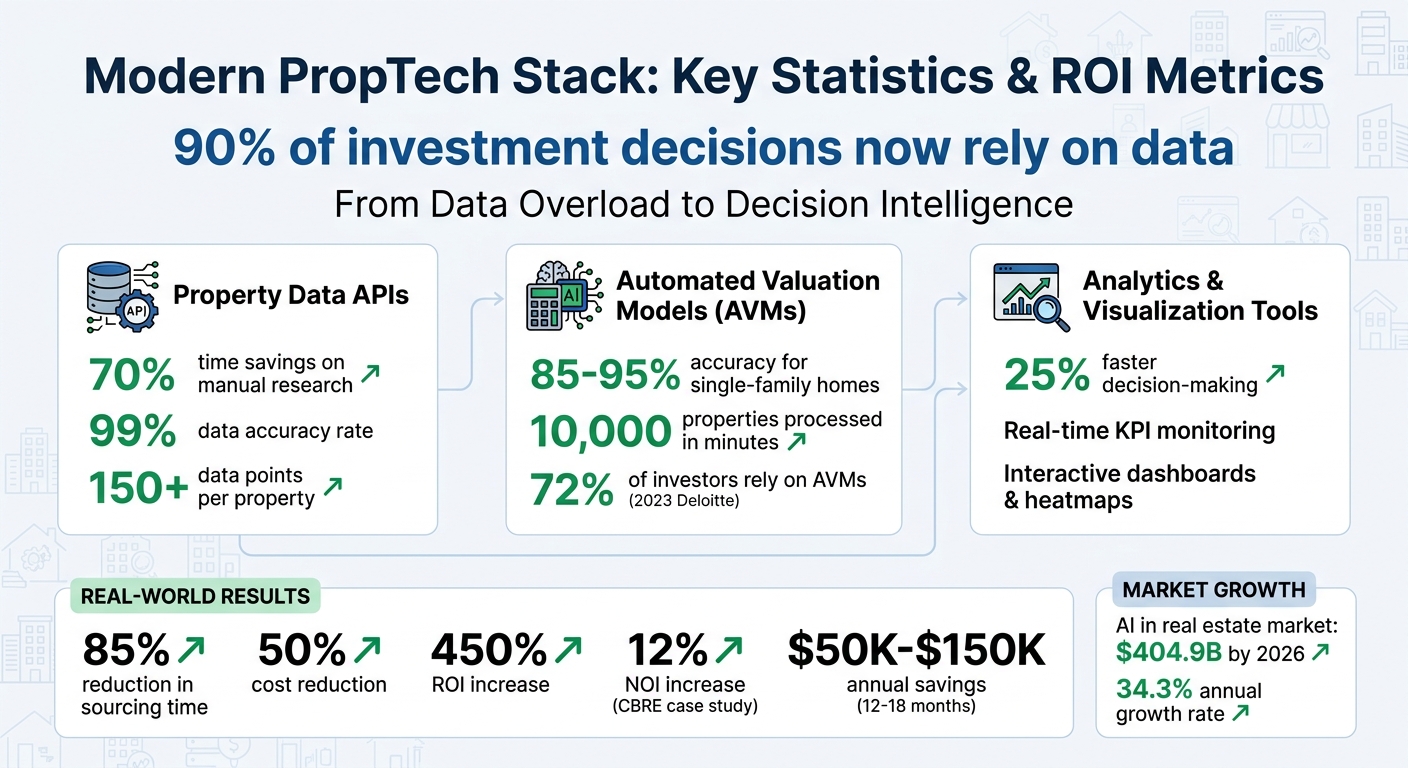
- Real Estate APIs consolidate and clean fragmented data, saving up to 70% of research time.
- Automated Valuation Models (AVMs) use machine learning to estimate property values with 85–95% accuracy in seconds.
- Analytics Tools transform raw data into visual insights, speeding up decision-making by 25%.
Real-world examples show firms cutting sourcing time by 85%, reducing costs by 50%, and increasing ROI by up to 450%. To succeed, focus on tailored data needs, real-time integrations, and strong compliance measures. The right PropTech stack isn’t just about collecting data – it’s about making smarter, faster decisions.
Modern PropTech Stack ROI: Key Statistics and Performance Metrics
The Strategic Tech Stack for Modern Property Managers: Insights from Grant Drzyzga
sbb-itb-8058745
Core Components of a Modern PropTech Stack
A modern PropTech stack functions as an integrated ecosystem where three key components work in harmony to convert scattered property data into actionable insights. These components include Property Data Enrichment APIs for gathering and cleaning data, Automated Valuation Models (AVMs) for estimating property values using machine learning, and Data Analytics and Visualization Tools that transform numbers into visual insights to guide decision-making.
These tools don’t operate in silos. When connected, they create real-time data pipelines, reducing analysis time from weeks to just hours. This streamlined approach enables faster, smarter decisions throughout real estate operations.
Property Data Enrichment and APIs
Property data APIs tackle a major challenge: they aggregate and standardize fragmented data from sources like public records, tax assessments, and MLS listings. Instead of manually searching through multiple sources, real estate professionals can query a single API endpoint to receive clean, structured data in seconds. This speeds up decision-making and eliminates delays caused by outdated information.
For example, BatchData’s property search API provides over 150 data points per property with an impressive 99% accuracy rate, thanks to AI-powered data cleansing. These data points include square footage, tax assessments, liens, ownership history, and transaction records. The API uses RESTful endpoints, allowing users to query by address or parcel ID and retrieve JSON responses that seamlessly integrate into workflows.
In Q1 2024, Roofstock leveraged HouseCanary AVMs alongside BatchData APIs to evaluate 50,000 off-market properties. They identified 200 deals with over 15% IRR, slashing sourcing time by 85% – from four weeks to just three days – and securing $45 million in acquisitions. Mike Merrill, Roofstock’s VP of Investments, led this initiative.
For real estate professionals, this means saving 70% of time on manual research while avoiding risks tied to outdated data, such as ownership changes or new liens. With daily or weekly data refreshes now standard, the industry has moved away from monthly or quarterly updates that often left investors behind the curve.
Automated Valuation Models (AVMs)
AVMs take the enriched data from APIs and use machine learning algorithms to estimate property values in seconds. These models analyze massive datasets – often covering over 100 million U.S. properties – and consider factors like comparable sales, property features, market trends, and hyper-local data, such as school districts and crime rates. For single-family homes, AVMs achieve 85-95% accuracy.
The speed advantage is transformative. AVMs can process 10,000 properties in minutes, with error margins under 5% in stable markets. According to a 2023 Deloitte PropTech Survey, 72% of investors now rely on AVMs for deal screening, reducing analysis time from days to just minutes.
Tools like Zillow’s Zestimate and CoreLogic’s AVMs have reached median accuracy rates of 89-94% for single-family homes, as reported in CoreLogic’s 2024 AVM Report. In competitive bidding scenarios, this instant valuation capability has been shown to improve win rates by 15%, according to NAR data.
In 2023, CBRE combined ATTOM Data APIs with Tableau for portfolio analysis, enriching data on over 1 million properties. This led to a 12% NOI increase, saving $18 million annually through better leasing decisions. Lisa Wong, CBRE’s Data Director, oversaw the project.
Data Analytics and Visualization Tools
The final piece of the PropTech stack turns raw data and valuations into digestible visual insights. Analytics and visualization platforms create interactive dashboards and heatmaps that reveal market trends at a glance. Popular tools include Tableau for custom visualizations, Power BI for integration within Microsoft’s ecosystem, and specialized platforms like Reonomy, which come preloaded with real estate metrics.
These platforms combine data from APIs and AVMs to generate visuals that highlight metrics such as cap rates, NOI forecasts, and predictive yield models. For instance, Tableau can link directly to BatchData APIs to map cash flow projections across U.S. metro areas. This helps investors pinpoint undervalued multifamily properties in high-growth Sunbelt markets with yields ranging from 8-12%.
The benefits are clear: users report 25% faster decision-making when using integrated analytics tools. Instead of laboring over spreadsheets, professionals can automate alerts for value shifts exceeding 10% and monitor KPIs like IRR projections in real time. This shift from reactive analysis to proactive monitoring allows real estate teams to identify opportunities and risks faster than competitors.
Together, these components transform overwhelming amounts of data into actionable intelligence, strengthening investment strategies and driving better outcomes.
Best Practices for Building a Data-Driven PropTech Stack
Having the right tools is only part of the equation. To truly benefit from your PropTech stack, you need to follow practices that align with your business goals. The global AI in real estate market is projected to hit $404.9 billion by 2026, with an annual growth rate of 34.3%. Modern platforms now offer over 1,000 data attributes per property record, making it critical to focus on the data that truly supports your objectives.
Assessing Your Data Needs
Start by identifying the specific data that drives your operations. Data-first strategies are shaping decision-making across the industry. Think about what you need most: ownership and title data for prospecting, tax records for valuation, or foreclosure signals for distressed properties?
"The question has shifted from, ‘Is this a good deal?’ to ‘What does the data say about this deal’s risk, potential, and portfolio fit?’" – BatchData
Next, consider how up-to-date your data needs to be. For high-stakes decisions, daily or weekly updates are becoming the norm. Match your data delivery methods to your existing systems. For example:
- Low-latency APIs are ideal for real-time tools like valuation widgets.
- Bulk data access works better for large-scale research or machine learning projects.
Budgeting is another key factor. Subscription fees can range from a few hundred to several thousand dollars per month, depending on data volume and API usage. If you’re considering an in-house data team, expect costs of $130,000 to $190,000 annually for a single data scientist – and a full team could exceed $500,000 in salaries.
Integrating Real-Time Data Pipelines
Once your data needs are clear, the next step is integrating them into a real-time system. Real-time pipelines are essential for quick decision-making, but 60-70% of integration projects fail due to technical challenges and siloed operations. Avoid custom integrations that can break easily. Instead, use Integration Platform as a Service (iPaaS) tools to connect your ERP, CRM, and analytics systems seamlessly.
Begin with a software audit to identify all tools in use, including unauthorized ones like employee-created spreadsheets ("shadow IT"). This helps you pinpoint integration points. Define a master data architecture to establish a "source of truth" for each data type. For instance, your CRM might manage tenant details, while your property management system handles lease terms.
Roll out changes gradually. Start with one high-impact, low-risk workflow – like automating daily utility readings or vendor onboarding. With over 90% of real estate investment decisions now data-driven, integrating property data APIs can cut underwriting labor costs by more than 50%. Modern systems even offer daily updates on sales, liens, and pre-foreclosure filings.
"The companies scaling most efficiently today are not building every dataset themselves. They are making deliberate decisions about what defines their differentiation and partnering for the rest." – Mashvisor
Ensuring Compliance and Data Security
Data security is not just about avoiding fines – it’s about maintaining trust. PropTech platforms need to comply with regulations like GDPR, CCPA, and Anti-Money Laundering (AML). For example, non-compliance with GDPR can lead to fines of up to €20 million or 4% of annual revenue, whichever is higher.
The real estate sector has become a prime target for ransomware attacks, with 32% of small to medium-sized businesses reporting breaches in 2024. To protect your systems:
- Use Multi-Factor Authentication (MFA) to secure accounts, even if passwords are compromised.
- Encrypt sensitive data with AES-256 encryption, both in transit and at rest.
- Train staff regularly on phishing prevention and secure password practices. Human error caused 55% of cloud data breaches in 2023.
When processing property owner data – especially for outreach – document your business interest and perform assessments to meet GDPR requirements. Work only with vendors who meet security standards like ISO 27001 and SOC2 certifications.
"In an industry where trust is paramount, a reputation for lax security can significantly undermine a company’s competitive edge." – LandTech
Adopt a Secure Software Development Lifecycle (SDLC) to catch vulnerabilities early. Third-party integrations, such as IoT devices or payment platforms, present additional risks. Use Software Composition Analysis (SCA) tools to monitor these dependencies. Automate compliance reporting with tools that generate audit-ready logs, making it easier to prove adherence during audits.
Securing your data pipelines is essential for turning raw information into actionable investment insights.
Case Studies: How Real Estate Professionals Use Decision Intelligence
These examples highlight how modern PropTech tools are helping real estate professionals turn data into actionable insights, leading to measurable business results.
Investor Success with Off-Market Deal Sourcing
In 2025, Zillow, under CEO Jeremy Wacksman, adopted a "Housing Super App" strategy. This included AI-powered tools like BuyAbility scores and SkyTour virtual property tours, which utilized Gaussian Splatting technology. The BuyAbility scores provided daily updates on buyers’ purchasing power by factoring in live mortgage rates and credit profiles. This innovation led to a significant boost in engagement for Showcase listings – page views increased by 79%, saves by 76%, and shares by 91%, compared to traditional listings. As a result, Zillow achieved positive GAAP net income in Q1 2025 and reported a 33% year-over-year revenue increase in its Rentals segment.
The use of generative AI has transformed how potential sales are predicted using automated valuation models, even before properties are listed. In the past, investors often faced a 2% to 5% "ignorance tax" due to incomplete data. Today, better-informed buyers save an average of $20,500 to $25,650 on home purchases, contributing to an estimated $750 billion in savings for American homeowners since 2010.
Enterprise real estate firms are also tapping into advanced data systems to enhance efficiency and profitability.
Improving Efficiency in Enterprise Real Estate
Brixmor Property Group, which manages a portfolio of 63 million square feet, has built a tech ecosystem of around 100 tools, anchored by Salesforce and Oracle‘s JD Edwards. According to CIO Helane Stein:
"We have portfolio reviews where our leasing people can get information about current or prospective tenants faster than the tenants can get the information themselves."
By consolidating tenant sales and lease data into a single platform, Brixmor’s teams can identify trends and anticipate tenant needs in real time. This approach has streamlined marketing and leasing efforts.
Similarly, Vestar, which owns over 30 million square feet of retail space, adopted AirGarage technology at its 325,000-square-foot "The Gateway" district in Salt Lake City in early 2026. Using AI and license plate–reading cameras, the company introduced dynamic pricing and automated payment systems, directly increasing net operating income. Another example is NewMark Merrill Cos., which manages 13 million square feet of shopping centers. They integrated property data with tools like MRI OnLocation smart cameras and Merchant Centric sentiment analysis. CEO Sandy Sigal explained:
"When we put all the data in Datex and then put AI over the top of it, AI starts making connections and drawing conclusions that aren’t immediately apparent from human analysis."
These integrated systems have allowed firms to refine tenant mixes and develop more effective revenue strategies. Between 2023 and 2026, the percentage of commercial real estate companies conducting AI pilot programs skyrocketed from 5% to 92%.
Measuring ROI and Scaling Your PropTech Stack
Moving from overwhelming amounts of data to actionable decision-making requires careful tracking of metrics and the ability to scale with custom solutions. These steps ensure your PropTech stack delivers real results for strategic decisions.
Tracking Key Performance Indicators (KPIs)
To measure the return on investment (ROI) of your PropTech stack, focus on metrics that directly impact revenue. Key indicators include cost per lead (CPL) and deal close time. For example, CPL often drops by 25–40% after PropTech implementation, and deal close time can shrink by 30–50% when real-time data pipelines replace manual processes.
Take the case of a Keller Williams franchise in Texas. By integrating an AVM solution with custom BatchData leads, they reduced acquisition costs from $45,000 to $35,000 per deal across 200 transactions – a 22% savings. Franchise owner Lisa Johnson reported an 18% ROI in the first year, sourcing 150 off-market deals.
Another crucial benchmark is lead conversion rates. Targeted insights can push conversion rates from the industry average of 5–10% to 15% or more. For instance, in Q2 2024, New York City investment firm Greystone, under CIO Mark Rose, analyzed over 500 assets and achieved a 35% increase in deal conversion rates, adding $15 million to their net operating income.
To track these metrics, use integrated dashboards like Tableau or Power BI. Start by establishing a 3–6 month baseline for costs and error rates. For example, pre-implementation valuation inaccuracies often hover around 15%. Set realistic goals, such as achieving 2–3x ROI within 12 months.
Once you’ve validated these results, the next step is scaling your PropTech stack with customized, modular solutions.
Expanding Capabilities with Custom Solutions
When performance metrics confirm your investment, it’s time to evolve your system to meet growing demands. Transitioning from pay-per-call APIs to bulk data delivery and custom integrations is a cost-effective way to handle higher data volumes. Start small – layering tools like BatchData’s off-market property APIs onto your existing AVM systems – and expand with a microservices architecture on platforms like AWS or Azure. This approach allows you to scale from managing 1,000 to 50,000 properties monthly by leveraging tools like Apache Airflow for real-time data enrichment.
Custom solutions also address challenges like data silos (which affect nearly 40% of firms) and compliance risks, such as CCPA violations that could result in fines of up to $7,500 per incident. BatchData’s professional services, for example, offer tailored data enrichment for over 150 million U.S. properties, cutting setup time by 50% with custom API integrations and dedicated support. Enterprise-level implementations include a 4-week onboarding period, 99.9% uptime SLAs, and pricing that ranges from $10,000 to $50,000 depending on project scope.
Consider a mid-sized investor firm that integrated BatchData into its PropTech stack. They saved 35% on costs – roughly $200,000 annually – and increased lead conversion by 28%. Over 18 months, they achieved a 450% ROI and expanded their assets under management from $50 million to $150 million. Using Looker dashboards, they scaled their query volume fivefold without any performance issues.
Conclusion
Building a modern PropTech stack isn’t just about collecting data – it’s about transforming that data into insights that deliver real results. The real estate industry has moved away from instinct-based decisions, with over 90% of institutional investment decisions now relying on data-driven strategies. By incorporating tools like property search APIs, AVMs, and analytics platforms, you can see tangible improvements: 15–25% better deal sourcing efficiency and 20–30% faster transaction cycles.
This shift requires a structured approach. Start by auditing your current data systems, integrating foundational tools like property enrichment APIs, and setting clear KPIs from the outset. Professionals who adopt this strategy can achieve $50,000–$150,000 in annual savings and improve deal quality by 10–15% within 12–18 months, depending on portfolio size.
Three key factors drive success: data quality, integration, and compliance. Even one inaccurate data point can derail analysis, so daily refreshes and verified sources are critical. BatchData provides access to 155 million U.S. property records with over 1,000 attributes per property. Their low-latency REST APIs support real-time applications, while bulk delivery options cater to large-scale analytics. This ensures you’re working from a single, reliable source instead of fragmented datasets.
By following these principles, you can turn raw numbers into a strategic advantage. As BatchData puts it:
"The question has shifted from ‘Is this a good deal?’ to ‘What does the data say about this deal’s risk, potential, and portfolio fit?’"
PropTech isn’t a one-time investment – it’s an ongoing strategy. By adopting intelligence-driven processes, you can move from reactive decisions to proactive strategies that enhance profitability.
Ready to take the next step? Explore BatchData’s solutions at batchdata.io to see how property data enrichment, skip tracing, and flexible API integrations can streamline your real estate operations and deliver measurable ROI.
FAQs
What should I build first in a PropTech stack?
To get started, it’s essential to build a strong base of accurate and detailed property data. Incorporating a dependable real estate data API is key here. This kind of API ensures real-time access to critical information like ownership records, property valuations, and market trends.
Once you have this data infrastructure in place, you might want to take it a step further by integrating an Automated Valuation Model (AVM). An AVM helps produce precise property valuations, which can lead to better investment decisions and more efficient workflows.
How do I know my property data is accurate and current?
To keep your property data accurate and up-to-date, it’s crucial to use reliable, real-time data sources and effective validation methods. Tools like property data APIs and automated valuation models (AVMs) pull information from millions of U.S. properties and update it daily. By combining data from multiple sources – such as public records and brokerage platforms – you can cross-check ownership details, property valuations, and market trends. This approach minimizes errors and ensures your data remains dependable.
Which KPIs show the stack is paying off?
When managing properties, there are a few key performance indicators (KPIs) that really matter: service reliability, asset utilization, operating costs, and tenant response. These metrics are essential for gauging how well a property is performing and where improvements might be needed.
By using property management software, tracking these KPIs becomes much easier. The software helps you monitor operational efficiency and provides the data needed to make more informed decisions. Whether it’s ensuring tenants are satisfied or keeping costs under control, these metrics are your guide to smarter property management.