

































Skip tracing helps real estate professionals locate missing contact information for property owners. There are two main approaches: manual and automated. Manual skip tracing involves detailed research through public records, social media, and interviews, offering precise results but requiring significant time and effort. Automated skip tracing uses contact enrichment APIs and software to quickly process large datasets, delivering fast and cost-effective results for high-volume lead generation.
Key Differences:
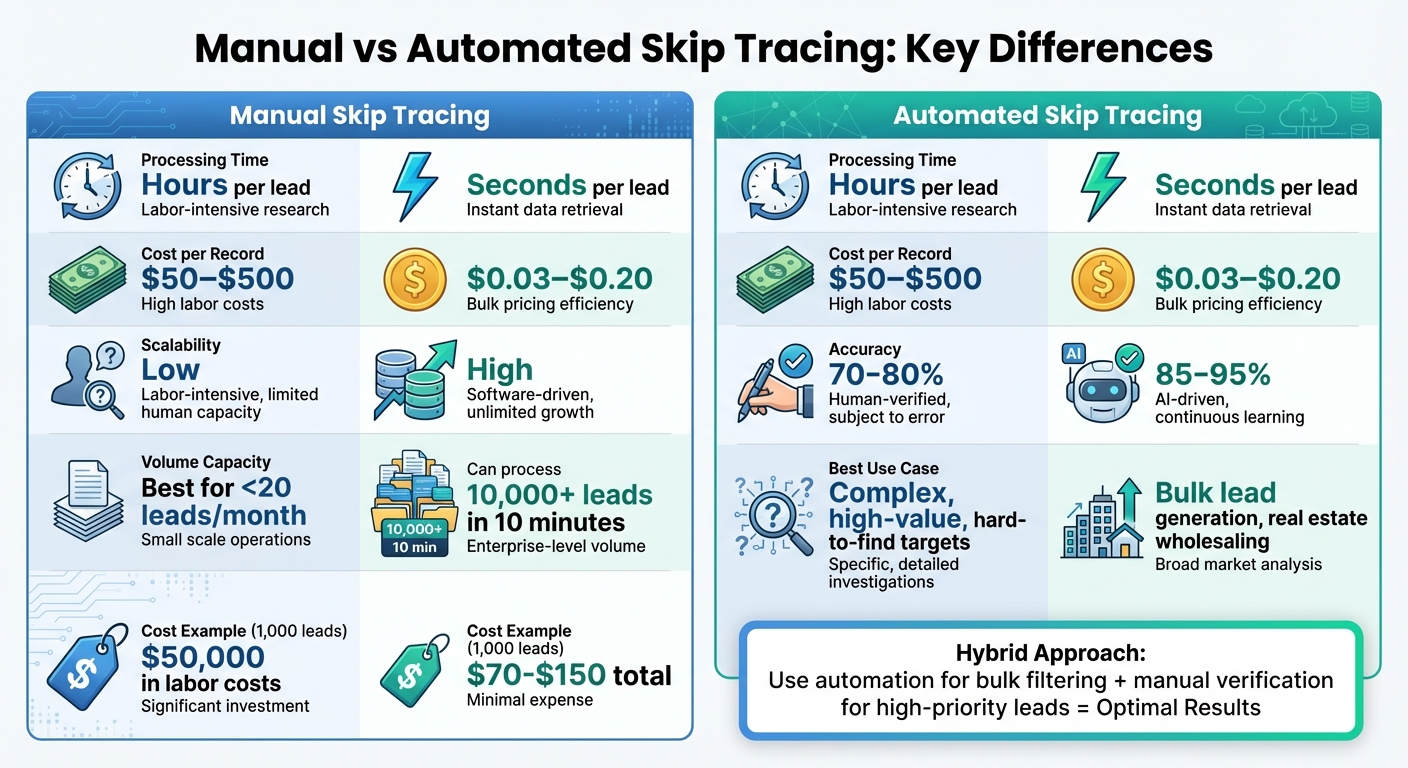
- Manual: Best for small-scale, high-priority cases; takes hours per lead and costs $50–$500 per record.
- Automated: Ideal for bulk leads; processes thousands of records in seconds at $0.03–$0.20 per record.
Quick Comparison:
| Factor | Manual Skip Tracing | Automated Skip Tracing |
|---|---|---|
| Processing Time | Hours per lead | Seconds per lead |
| Cost per Record | $50–$500 | $0.03–$0.20 |
| Scalability | Low | High |
| Accuracy | Human-verified | AI-driven |
| Best Use Case | Complex, high-value leads | Bulk lead generation |
For most, automated skip tracing is the go-to choice for efficiency and scalability. A hybrid approach can combine the strengths of both methods for optimal results.
Manual vs Automated Skip Tracing: Cost, Speed, and Scalability Comparison
6 Real Estate Skip Tracing Techniques
sbb-itb-8058745
What is Manual Skip Tracing?
Manual skip tracing is all about hands-on effort. Unlike automated tools, this method relies entirely on human research and investigation to locate individuals. It involves digging through public records, making phone calls, conducting interviews, and piecing together details from various sources. Every bit of information must be carefully verified, often requiring physical visits to courthouses or conversations with neighbors and relatives. It’s a time-intensive process that prioritizes thoroughness and human judgment.
For instance, a manual skip tracer might scrutinize social media posts for location hints, like a photo tagged at a specific café, or compile a network of the subject’s friends and associates to uncover updated contact details. This method emphasizes qualitative research and relies heavily on intuition and experience.
Steps in Manual Skip Tracing
The process usually starts with gathering basic contact information through batch skip tracing or county records. From there, skip tracers verify and expand on these details by exploring resources like social media, local offices, and personal connections. Key sources of information include:
- Civil and criminal court records
- Tax lien filings
- Property ownership documents
- Utility bills
- Employment applications
Unlike automated systems, these records are accessed one at a time, often requiring in-person visits or formal requests, which can take days or even weeks to complete.
Challenges of Manual Skip Tracing
While manual skip tracing offers a detailed and personalized approach, it comes with some significant hurdles:
- Time-Intensive: Verifying data and conducting interviews can take hours per lead, making it difficult to manage large numbers of cases efficiently.
- Human Error: Mistakes in documents or overlooked details can lead to incomplete or inaccurate results.
- Legal Restrictions: In many states, only licensed private investigators are allowed to perform certain investigative tasks, which adds to the cost and limits who can undertake this work.
- Travel Costs: Physical visits for record verification or interviews can increase both expenses and delays.
For real estate investors or others managing hundreds of leads, manual skip tracing often proves too slow and costly to scale effectively. While it excels in precision, it struggles to keep up with the speed and efficiency of modern, automated methods.
What is Automated Skip Tracing?
Automated skip tracing uses AI-powered software to deliver verified contact details – like phone numbers, emails, and mailing addresses – within milliseconds. This process works by tapping into high-performance APIs and engines that pull data from multiple sources, cross-check it in real time, and provide accurate results instantly.
What makes automation stand out is its ability to handle large-scale operations. For example, BatchData reports a 76% right-party contact (RPC) rate, thanks to dynamic datasets refreshed daily and proprietary algorithms. These algorithms can even uncover connections "behind corporate veils", linking LLCs and trusts to actual decision-makers rather than just registered agents. Next, let’s see how this process fits seamlessly into lead generation workflows.
How Automated Skip Tracing Works
The process is simple. You can either upload a CSV file with property addresses, manually input a single address, or integrate via API for custom platforms. Once your data is submitted, the system aggregates and cross-verifies information from various sources in real time. The result? A detailed contact profile that includes multiple phone numbers (labeled as mobile or landline), valid email addresses, and current mailing addresses.
Advanced systems also include built-in compliance features. For instance, they automatically scrub phone numbers against the National Do Not Call (DNC) registry and flag known TCPA litigators using "Litigator Scrubs." This ensures businesses avoid legal risks while maintaining efficient outreach. For real estate investors targeting off-market opportunities, automation goes a step further by identifying actual property owners behind LLCs and trusts, bypassing intermediaries like registered agents or attorneys.
Benefits of Automation
Automation can process thousands – or even millions – of records at once, offering unmatched speed and scalability. Tasks that might take weeks manually are completed in minutes. Plus, daily data updates ensure information remains current, unlike static lists. Accuracy improves through AI validation, which cross-references multiple sources and uses feedback loops to reduce errors and boost match rates.
BatchData’s system even includes Phone Number Confidence Scores, helping users prioritize high-quality leads and avoid wasting resources on low-value data. These features not only eliminate bottlenecks but also turn lead generation into a competitive edge, addressing the time and scalability challenges that come with manual skip tracing.
Key Differences Between Manual and Automated Skip Tracing
The gap between manual and automated skip tracing is vast, especially when you compare efficiency, cost, and scalability. Manual skip tracing relies on a human investigator combing through databases, social media platforms, and public records. This process typically takes 2–4 hours per lead for a deep investigation. On the other hand, automated skip tracing can process 10,000+ leads in under 10 minutes, using advanced software to cross-reference thousands of data points almost instantly.
The cost difference is equally dramatic. For a list of 1,000 leads, manual skip tracing could rack up $50,000 in labor costs. In contrast, automated skip tracing would cost just $70 to $150. Private investigators performing manual tracing charge between $50 and $150 per hour, or $100 to $500 per successful “hit”, depending on the complexity of the case. Automated platforms, however, operate on a pay-per-hit or subscription basis, with batch processing rates ranging from $0.03 to $0.20 per record. High-volume users often enjoy even lower rates, paying as little as $0.01 to $0.05 per record.
Scalability is another area where automation shines. Manual tracing is constrained by the availability of investigators and the hours they can work. Automated skip tracing, however, is only limited by the software’s processing capacity and your budget. This makes automation the go-to option for bulk lead generation. Meanwhile, manual methods are better suited for locating individuals or businesses in “hard-to-find” cases where automated data may be outdated or insufficient.
Comparison Table
| Factor | Manual Skip Tracing | Automated Skip Tracing |
|---|---|---|
| Processing Time | 1–24+ hours per lead | Seconds per lead (Batchable) |
| Cost per Record | $50–$500 (Labor) | $0.03–$0.20 (Software) |
| Scalability | Low (Labor-intensive) | High (Software-driven) |
| Data Access | Deep, qualitative, localized | Broad, quantitative, nationwide |
| Accuracy | High (Human-verified) | High (Data-driven/AI) |
| Best Use Case | Difficult/High-value targets | Bulk lead generation/Real estate |
| Effort Level | High (Active research) | Low (Upload and click) |
These distinctions set the stage for exploring the strengths of manual skip tracing alongside the efficiency and accuracy of automated solutions like BatchData. Up next, we’ll break down how each approach excels in different scenarios, highlighting the unique advantages they bring to the table.
Advantages of Manual Skip Tracing
Manual skip tracing shines in scenarios where human judgment and contextual analysis are essential, especially in overcoming the limitations of automation. For example, automated tools often struggle with common names that produce countless matches. In contrast, human investigators can cross-reference details like middle names, family ties, employment records, and geographic patterns – nuances that algorithms might overlook.
This approach is especially critical in high-stakes cases, such as serving legal documents or recovering high-value debts, where accuracy is non-negotiable. While manual tracing can be more expensive due to the thorough verification process, it delivers highly reliable results. Investigators often go beyond databases, conducting interviews with neighbors, former landlords, or estranged relatives to gather real-time, actionable insights that automated systems simply can’t provide.
Manual tracing is also highly effective for finding individuals with little or no online presence – often referred to as "ghost" subjects. Investigators rely on local records, physical checks, and social media platforms like Facebook or LinkedIn to uncover clues, such as tagged photos, check-ins, or comments, that might reveal a subject’s location.
For small businesses or solo practitioners handling only a few cases per month, manual skip tracing using free and paid skip tracing tools can be a practical alternative to automated platforms, which often require subscriptions ranging from $49 to $69. Although manual efforts can be time-consuming, this personalized approach is often more cost-effective for low-volume needs.
In many cases, a hybrid strategy works best. Automated skip tracing can efficiently process large lists and identify easily traceable subjects, while manual efforts can focus on elusive or high-priority cases. Combining the precision of manual investigation with the speed of automation ensures both efficiency and accuracy, particularly when accuracy is essential. This tiered approach allows businesses to maximize results while balancing time and cost.
Advantages of Automated Skip Tracing with BatchData
BatchData is tailored for high-volume lead generation, offering a streamlined alternative to traditional methods. Users can upload a CSV file or connect directly through API endpoints to enhance entire datasets. Whether you’re running single searches or processing millions of records simultaneously, BatchData’s platform is built to handle it all. This makes it a powerful tool for real estate investors, debt collectors, or anyone managing real estate wholesale lead generation and other large-scale efforts.
Efficiency and Scalability
BatchData is designed to handle operations at scale. Unlike manual skip tracing, which involves looking up individuals one at a time, BatchData processes thousands – or even millions – of records in a single batch. For example, processing 150,000 records costs approximately $10,500 (about 7 cents per match) and delivers results within minutes – a task that would take a research team weeks to complete. The platform supports various workflows, including single record lookups, bulk uploads, and real-time API integration, ensuring a seamless experience. Additionally, it automatically provides verified phone numbers, emails, and other key metadata from multiple trusted sources, eliminating the need for manual cross-referencing.
Accuracy Through AI and Big Data
With a 76% right-party contact rate, BatchData stands out in terms of accuracy. This is achieved by validating data against over 12 different sources simultaneously and leveraging proprietary algorithms to uncover the actual individuals behind complex entities like LLCs and trusts. The platform’s engine updates datasets daily and incorporates a real-time feedback loop from over 20,000 users, ensuring contact information remains accurate and up-to-date. Unlike static databases that quickly become outdated, BatchData’s multi-source validation keeps your data current and reliable.
Compliance and Reliability
BatchData prioritizes compliance, automatically scrubbing phone numbers against the National Do Not Call (DNC) registry and using a Litigator Scrub feature to flag known TCPA litigators. These built-in safeguards are essential, as contacting someone on the DNC list can result in significant penalties. The platform also offers TCPA-compliant data, CCPA-ready endpoints, and enterprise-grade security measures, making it well-suited for large-scale operations. While manual skip tracing requires painstaking research to verify DNC status and identify potential litigators – leaving room for human error – BatchData automates these processes. This ensures outreach efforts are not only efficient but also legally sound, reducing regulatory risks and giving businesses the confidence to scale their operations securely.
When to Choose Manual vs Automated Skip Tracing
Deciding between manual and automated skip tracing depends on factors like project size, deadlines, and budget. Manual skip tracing works best for smaller projects – typically fewer than 20 leads per month – that require detailed investigative efforts, such as interviewing neighbors or digging through courthouse records that aren’t available online. This method is particularly effective for niche markets where personal connections and highly specific criteria are essential.
On the other hand, automated skip tracing shines when scalability is key. For instance, if you’re handling over 100 leads or targeting entire neighborhoods, automated tools can generate results in minutes. The cost structure also becomes more favorable with larger volumes. Most automated skip tracing software subscriptions range between $50 and $300 per month, making them an economical choice for high-volume needs.
Time is another critical factor. Manual skip tracing can take weeks to deliver results, whereas automation provides real-time updates. If speed is a priority, automation can cut the time spent on skip tracing from around 10 hours per week to just 1–2 hours. Additionally, automated systems typically achieve accuracy rates of 85% to 95%, compared to 70% to 80% for manual methods, which are more prone to human error and outdated data.
For many professionals, a hybrid approach offers the best of both worlds. Automated systems can handle large-scale filtering, while manual efforts focus on verifying high-priority leads. This combination takes advantage of automation’s speed and scalability while retaining the precision of human judgment. To maximize efficiency, it’s essential to define your target criteria – such as property values or equity – before automating.
"While manual scrubbing offers a high degree of control, its limitations in scalability, speed, and cost-effectiveness make it a less viable option for most real estate professionals aiming for consistent growth." – ProbateData
These insights provide a foundation for considering how skip tracing technologies may continue to evolve in the future.
The Future of Skip Tracing Technologies
The skip tracing industry is evolving rapidly, thanks to advancements in artificial intelligence (AI) and machine learning. Real estate wholesalers and investors face annual losses of around $2.5 billion due to outdated and inefficient skip tracing methods. However, new technologies are closing these gaps, offering faster and more effective solutions. For example, parallel API architecture now delivers results in seconds, a massive improvement over traditional batch processes that could take 10 minutes or more. This leap in speed is opening doors to smarter, more predictive capabilities.
AI isn’t just about speed – it’s also about intelligence. With tools like "Predictive Owner Likelihood Modeling", modern systems can now analyze behavioral patterns and neighborhood data to predict which property owners are most likely to sell. These systems assign confidence scores (ranging from 0 to 100) based on factors like data recency, source diversity, and line status. This allows investors to focus on high-quality leads, improving contact accuracy by as much as 40% compared to older methods.
"Every minute you spend waiting for skip tracing results is a minute your competitor is spending on the phone with your seller." – Mike Rodriguez, SkipTrace AI
AI is also making it easier to handle complex data. It can reconcile variations in names and addresses, consolidate LLC ownership records, track out-of-state property owners, and flag loans nearing maturity. Some platforms even generate detailed lead narratives, summarizing essential property information, potential risks, and owner history. Geospatial analysis is another area of growth: Zillow improved its "Zestimate" accuracy by 15% using AI to analyze listing photos, and similar technology is now being used to identify property features like pools and gardens.
The industry is moving closer to full automation, with tools offering real-time data updates and seamless integration into CRMs via platforms like Zapier. Still, investors need to cross-check AI-generated insights with local market knowledge, as AI systems can occasionally produce errors or "hallucinations". As Carter Malloy, CEO of Acres.com, explains:
"AI technology will continue to improve, so it’s important to pay attention and get in the habit of integrating these game-changing tools into your business".
Conclusion
When weighing manual versus automated skip tracing, the decision largely depends on factors like volume, speed, and scalability. Manual skip tracing is ideal for tackling intricate, high-value leads – think probate cases or hard-to-find property owners. However, this approach can be both time-intensive and expensive, costing anywhere from $20 to $100 per lead. On the flip side, automated skip tracing handles thousands of records in mere seconds at a fraction of the cost, typically $0.10–$0.20 per hit.
For the majority of investors and wholesalers, automation forms the backbone of efficient lead generation. Tools like BatchData deliver Tier 1 data, such as credit headers, utility records, and telecommunications data, achieving hit rates of over 80%. With features like automated DNC scrubbing and seamless CRM integration, BatchData simplifies lead processing while ensuring compliance with regulations.
A smart approach might involve a hybrid strategy: using automation for bulk leads while reserving manual methods for unique, high-stakes cases. This combination meets the modern demands of real estate lead generation by balancing speed and precision.
As AI and machine learning continue to evolve, automated platforms are becoming smarter and more predictive. BatchData’s pay-as-you-go model provides flexibility, whether you’re managing 100 leads or scaling up to 10,000. The future of skip tracing is undoubtedly automated, and adopting these tools today ensures you stay ahead in connecting with motivated sellers.
FAQs
Is skip tracing legal for real estate investors?
Yes, skip tracing is legal for real estate investors as long as it is done using lawful methods and complies with privacy laws. It’s important to ensure that all skip tracing activities align with federal and state regulations to steer clear of any legal complications.
When should I use a hybrid skip tracing approach?
A hybrid skip tracing approach blends the efficiency of automated tools with the accuracy of manual methods – a winning combination for real estate professionals. Begin with automated tools to quickly gather and verify basic data. Then, for more complex or high-priority cases, such as confirming LLC ownership or researching distressed properties, rely on manual efforts to dig deeper. This approach strikes a balance, delivering both speed and precision to meet your specific needs.
How can I improve skip tracing accuracy before outreach?
To improve skip tracing accuracy, make sure you’re working with reliable, verified data sources to access the most current contact information. Use real-time data validation tools through APIs to keep your details up-to-date. Automating tasks like cross-checking phone numbers, addresses, and ownership data can help streamline the process while removing duplicates. By integrating multiple sources – like public records and private databases – you can build more detailed and precise profiles.