Cybersecurity now shapes how I build real estate software, not just how I protect it after launch. If a platform handles rent, tenant data, payments, AI workflows, or smart-building feeds, security decisions affect product design from day one.
Here’s the short version:
- Privacy rules now shape data models
- Teams need data labels, consent history, retention rules, and deletion flows built into the product
- GDPR still matters for many firms with EU data ties, and deletion requests may need action within 30 days
- AI use adds new data risk
- Staff may paste private data into public AI tools
- Research cited in the article says 97% of firms that had an AI-related breach lacked proper AI access controls
- Cloud apps, APIs, and vendors expand risk
- Data now moves across many SaaS tools, payment systems, CRMs, eSignature tools, and third-party APIs
- That means more work around logging, access scope, rate limits, and vendor review
- Fraud and ransomware now affect product flows
- A system outage can stop rent collection and slow leasing
- Deepfake voice and video scams are pushing teams to add step-up checks for wire transfers and admin actions
- Smart buildings add device and network risk
- HVAC, sensors, and access systems connect physical systems to cloud software
- That calls for network separation between building devices and core apps
- Identity is now a front-line product issue
- MFA, RBAC, least-privilege access, and zero-trust checks are becoming the default for admins, brokers, agents, and services
A few themes stand out from the article: privacy by design, AI governance, vendor control, and fraud-resistant identity flows. Put simply, if I’m building for U.S. real estate teams in 2026, security is now part of product-market fit.
The rest of the article explains how those shifts are changing architecture, SDLC checks, and day-to-day product choices.
Convention Replay: Cybersecurity & AI Scams Every Realtor Must Know
Current Cyber Risk in Real Estate Technology Stacks
Real estate tech stacks are split across cloud apps, on-prem systems, third-party tools, and IoT devices. That mix makes least-privilege access and clean audit trails much harder to enforce.
Here’s the problem in plain English: one real estate API may expose more data than a user or system needs, while logs sit in different places with different retention rules. The result is messy access scope, uneven logging, and gaps in data retention that product teams need to account for during design. Those weak spots show up most clearly in the systems and workflows below.
The Systems and Workflows Most at Risk
For product teams, each of these risks turns into a product choice around access, logging, retention, or vendor control.
| Real Estate Technology Use | Associated Cyber & Compliance Risks |
|---|---|
| Smart Building Systems (IoT/OT) | Unauthorized access to occupancy and energy data; IT/OT coordination gaps. |
| Transaction & Payment Platforms | PCI-DSS compliance failures; account compromise. |
| CRMs & Tenant Profiles | PII leakage; inability to fulfill data deletion requests; fragmented data lineage. |
| Cloud Document Sharing & eSignature | Data leakage; unauthorized access to sensitive contracts and buyer records; cross-border data residency risk. |
| AI & Predictive Analytics | Exposure of proprietary data to public large language models; AI-assisted phishing; unapproved AI tool use. |
| Property Management Systems | Ransomware; operational downtime; disruption of rent collection. |
AI use gets risky fast when employees paste sensitive data into public models or rely on tools the company never approved. That’s not a fringe issue anymore. It’s one of the clearest signs that security can’t sit off to the side and wait for release day.
Where Research Shows Recurring Weaknesses
The same weak points keep showing up: poor endpoint protection, cloud settings that are set up wrong, limited visibility across spread-out teams, sites, and devices, and weak vendor oversight. Third-party integrations add another layer of exposure, especially when internal teams can’t fully see how data moves across broken-up workflows.
The data side has its own headache. Many PropTech platforms still don’t have automated ways to process regulatory erasure requests. Under GDPR, organizations have only one month to respond to a data erasure request, and that’s tough to meet without automation across all data stores, including caches and search indexes.
The EU Data Act, in force as of 2025, adds more pressure. It requires technical safeguards for data generated by connected products such as smart meters and HVAC sensors. Put all of that together, and the pattern is pretty clear: security controls need to be built into the SDLC, not patched on later.
4 Cybersecurity Trends Driving Product Decisions
Those weak spots are now shaping four product calls. They’re changing roadmaps, shifting build priorities, and tightening the rules around how data gets handled.
Privacy-by-Design Is Becoming a Product Requirement
The first shift is privacy architecture. Privacy is no longer something teams bolt on later. It has to be part of the product from the start: schema-level classification, consent history, and automated erasure all need to be built in.
"Privacy by design is a schema discipline. The schema decisions made in sprint one determine whether a platform can satisfy a regulatory audit three years later." – Monika Stando, Marketing Campaigns Team Leader, Hicron Software
On the ground, this changes how teams build. Data classification metadata needs to live at the schema level. TTL fields should handle retention automatically. Consent needs version history, and withdrawal events should be treated as their own service. Erasure also has to reach across every data store, not just the main one. For real estate platforms, that’s a big architectural lift if it wasn’t mapped out in sprint one.
Data and AI Systems Need Stronger Protection
Real estate data pipelines like property enrichment APIs, skip tracing, and bulk delivery are now part of security reviews.
The requirements here are pretty specific:
- OAuth 2.0 authentication
- Rate limiting
- Secure API gateways
- Clear logs showing who accessed what and when
Sensitive records like phone numbers and contact details need the same level of care as any other PII in a production system.
AI adds a separate risk, but it’s tied to the same problem: data control. Teams need anonymization and masking before model training, clear blocks on unapproved AI tools, and firm rules about what data can be sent to public LLMs.
Cloud, Ransomware, and Transaction Fraud Are Reshaping Architecture
Real estate product teams are moving past simple prevention and focusing more on cyber resilience. The goal is to keep financial transactions, property operations, and tenant services running even during a disruption.
That affects architecture in direct ways. VPC isolation and network segmentation should separate production, staging, and development. At the same time, fraud threats are getting harder to brush off. Deepfake audio and video can now mimic a CEO or CFO well enough to push an urgent wire transfer request, which changes how companies think about verification.
"We have encountered situations in which individuals receive voicemails or messages that closely mimic the voices of the CEO or chief financial officer, requesting urgent wire transfers… Those fakes force companies to rethink their procedures and verification processes." – Sharat Kumar, Principal, RSM US
For product teams, that usually means multi-step verification flows for financial transactions and MFA for high-privilege accounts, including agents, brokers, and system administrators.
Identity Controls Are Moving Toward Zero-Trust Access
Zero trust makes more sense for real estate stacks than simple network trust. When a stack is spread across cloud apps and third-party integrations, every access request needs to be verified and logged, no matter where it comes from.
In product terms, that means tightly scoped role-based access control, based on what each microservice or user role actually needs. For real estate platforms, tighter admin controls and detailed logging are starting to look like the baseline.
And this can’t stop at production. These controls need to show up in development and vendor review too.
What Research Shows About Secure Development Practices in Real Estate
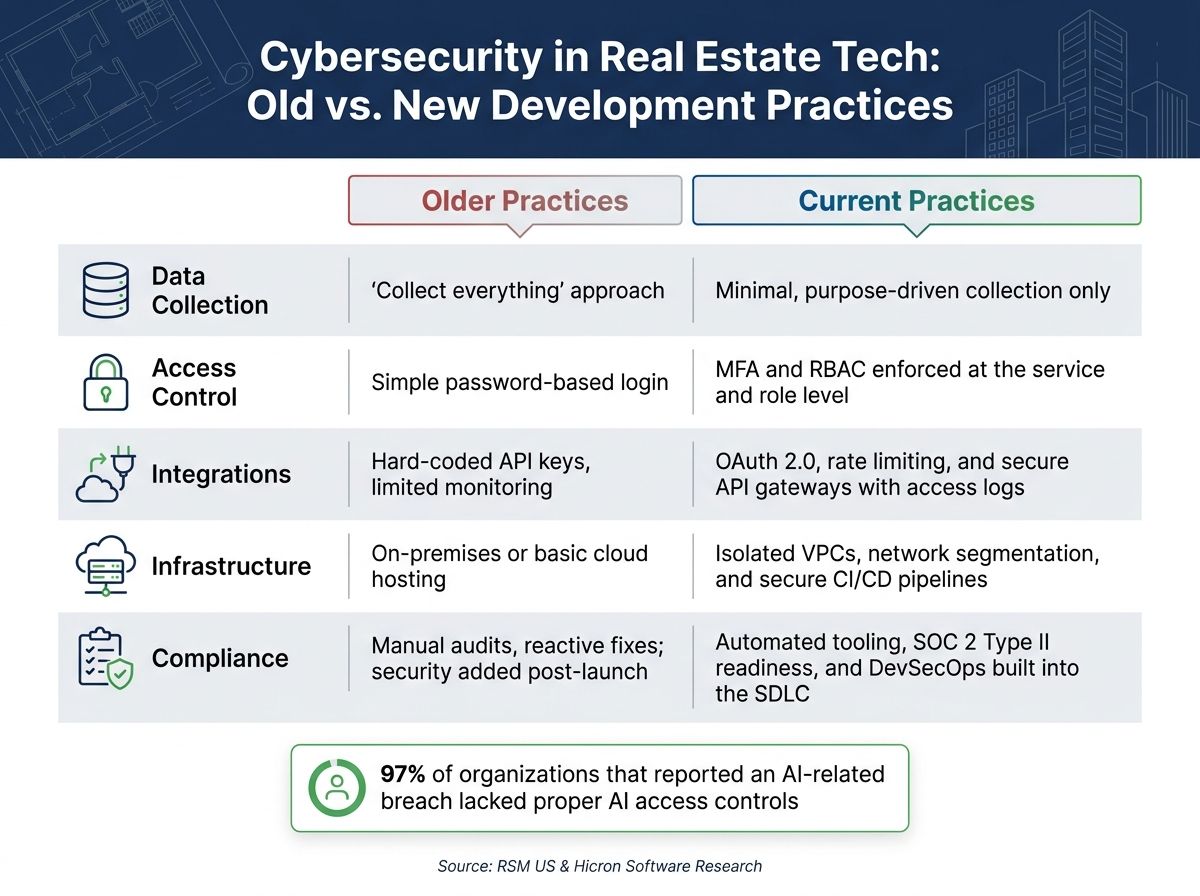
Cybersecurity in Real Estate Tech: Old vs. New Development Practices
Those risks are changing how teams build and ship real estate software. You can see it most clearly in secure development practices. More teams now start with capability assessments, then add security checkpoints across requirements, architecture, code scanning, testing, and release approvals. The point is simple: cover PII handling, API exposure, ransomware resilience, and OT separation from day one.
The table below shows how these practices have shifted:
| Area | Older Practices | Current Practices |
|---|---|---|
| Data Collection | "Collect everything" approach | Minimal, purpose-driven collection only |
| Access Control | Simple password-based login | MFA and RBAC enforced at the service and role level |
| Integrations | Hard-coded API keys, limited monitoring | OAuth 2.0, rate limiting, and secure API gateways with access logs |
| Infrastructure | On-premises or basic cloud hosting | Isolated VPCs, network segmentation, and secure CI/CD pipelines |
| Compliance | Manual audits, reactive fixes; security added post-launch | Automated tooling, SOC 2 Type II readiness, and DevSecOps built into the SDLC |
Security Checkpoints Inside the SDLC
Clear patterns are showing up across real estate product teams. Threat modeling is starting earlier, especially for workflows tied to identity, financial transactions, or high-value property data. Secrets management is moving into cloud-native key management systems with automated rotation. At the same time, vulnerability scanning is being built straight into CI/CD pipelines, so releases don’t slip in regressions.
"Organizations do not always know which tools to invest in, the cost or time associated with implementation, or the overall first step to take. The focus needs to be on building a framework that makes sense for their organization." – Matt Riccio, National Real Estate Consulting Leader, RSM US LLP
That same mindset now applies to vendors and data suppliers too.
Vendor and Data-Governance Controls Are Getting Stricter
Third-party APIs and data suppliers are now treated as part of the attack surface, not something separate from it. In practice, that means security maturity reviews, contractual data processing terms, and least-privilege integration patterns are becoming standard requirements before an external provider gets access to production data.
Data providers such as BatchData now require scoped credentials, logging, and ongoing access monitoring. For platforms handling PII at scale, these controls are starting to look like the floor, not the ceiling.
Smart-Building Integrations Require IT and OT Coordination
The same least-privilege approach applies to connected building systems. HVAC controls, access panels, and other OT devices are feeding cloud dashboards and analytics tools more often now. That overlap between OT and IT creates a different kind of risk, and standard application security controls alone don’t cover it.
When product teams connect building systems to user-facing software, network segmentation isn’t optional. OT environments need to stay isolated from the main application network, so a compromised sensor or access panel can’t turn into a path toward tenant or financial data. Zero-trust access and OT-aware monitoring are now the baseline for platforms that connect physical building infrastructure with cloud software.
Conclusion: What These Trends Mean for the Next Generation of Real Estate Products
Cybersecurity is no longer just an IT issue. In real estate, it’s a product decision.
Today’s platforms handle PII, payments, AI workflows, and connected systems. That means a breach can hit more than systems and support tickets. It can disrupt operations, hurt trust, affect occupancy, reduce NOI, and drag down renewals.
"A breach doesn’t just cost money – it damages trust… One breach can impact occupancy, net operating income (NOI), and renewal rates." – Jason Pullo, Founder, ESP
The Main Signals from the Research
Put it all together, and the research points to four product decisions that now shape secure real estate software. The trends covered here – privacy by design, stronger AI governance, tighter vendor oversight, and fraud-resistant identity controls – are changing both what teams build and how they manage access. In plain terms, real estate product development is moving toward cyber resilience as a baseline requirement.
Why This Matters for U.S. Real Estate Teams Now
These product choices now influence buying decisions and implementation timelines. Many enterprise property managers and REITs now expect SOC 2 Type II readiness. AI controls are also turning into a gating issue: 97% of organizations that reported an AI-related breach said they lacked proper AI access controls. Teams that connect security to a 3- to 5-year product roadmap are more likely to scale with fewer incidents.
Security is now part of product-market fit.
FAQs
How can real estate teams apply privacy by design early?
Real estate teams should apply privacy by design from day one. In plain English, that means building privacy safeguards into the system at the start instead of trying to bolt them on later.
The core idea is simple:
- Collect only the data you need
- Use it only for the purpose you said you would
- Set secure defaults to cut down data exposure
Teams should also build in consent management and user controls. That includes explicit opt-ins, clear data visibility, and options for users to delete or transfer their data.
Done well, this lowers regulatory risk and gives people more clarity about how their information is handled. It also helps teams build trust and stay ready for compliance checks.
What AI security controls matter most for property platforms?
The most important AI security controls for property platforms include strict authentication and access controls. That means using tools like OAuth 2.0 and role-based permissions to limit who can get in and what they can do once they’re there.
You’ll also want TLS encryption, rate limiting, and continuous monitoring in place. Together, these controls help block unauthorized access and reduce the risk of data breaches.
Just as important, property platforms need structured AI governance policies and a solid incident response plan. Threats change fast, and without clear rules and a plan for what happens when something goes wrong, teams can get caught flat-footed.
Why is zero-trust access important in real estate software?
Zero-trust access matters in real estate software because it checks every request for data, not just the first login.
That means each request is authenticated, authorized, and logged. In plain English: the system verifies who the user is, confirms they should have access, and keeps a record of what happened.
This cuts the risk of unauthorized access and data breaches, which is a big deal when your platform handles sensitive property records, financial details, and contact data.