


































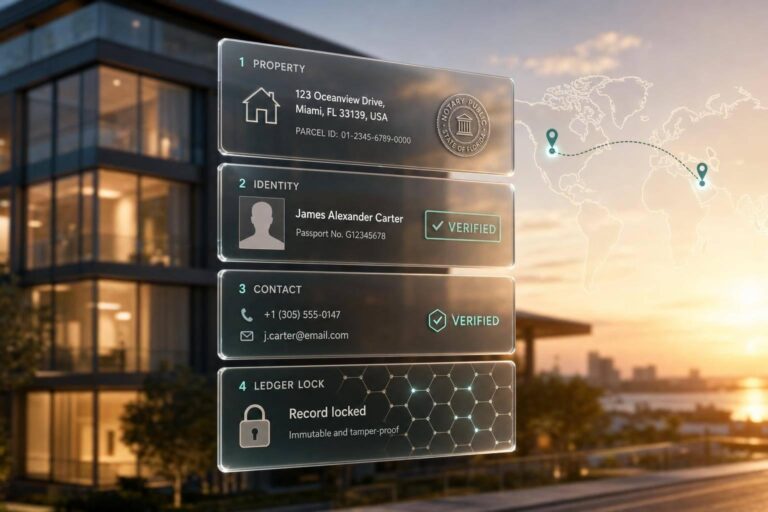
Cross-border property fraud happens when identity checks, title records, and payment steps sit in separate systems. That gap leads to fake sellers, bad title data, duplicate sales, and wire fraud. In the U.S. alone, reported real estate wire fraud losses reached about $446 million, and the FBI logged 13,846 complaints in 2023.
Here’s the short answer: blockchain can help cut fraud, but only if the data going in is checked first. On-chain records can lock ownership history, control escrow with code, and make seller impersonation harder. But if a forged deed or wrong parcel record goes in, the chain keeps that bad record in place.
If I had to boil the article down, it comes to this:
- Fraud usually hits three points: identity, title, and payment
- Email-based wire changes are a major risk, especially near closing
- Shared on-chain records can cut record conflicts and stop last-minute payment swaps
- Smart-contract escrow can hold funds until set checks are done
- Tokenized title plus verified digital identity can block fake sellers
- Off-chain checks still matter, because blockchain tracks record order, not whether the source facts are right
- verified property and contact data should come first before any token transfer, registry update, or fund release
The main takeaway: if you want safer cross-border closings, you need blockchain for control and verified property/contact data for accuracy. One without the other leaves room for fraud.
Using Crypto to Buy/Sell U.S. Real Estate | Attorney’s Compliance Guide
sbb-itb-8058745
The Main Fraud and Process Gaps in Cross-Border Real Estate
Cross-border real estate fraud tends to follow the same patterns again and again. The weak spots usually sit in three areas: identity, title, and payment.
Fake Sellers, Forged Documents, and Ownership Impersonation
The worst schemes often start with identity fraud. A scammer pretends to be the property owner, or the owner’s legal representative, and uses forged deeds, altered IDs, or fake powers of attorney to push a sale forward.
Vacant land and absentee-owned properties face extra risk. There’s often less day-to-day oversight and fewer outside parties checking the title. Some of the most common warning signs are below-market pricing, rushed closings, refusal to speak by phone or video, and wire instructions sent to foreign accounts.
AI-generated fake documents are making this problem harder to catch. Fabricated titles, IDs, and contracts can look very convincing, which makes standard document review less dependable.
Title Defects, Duplicate Transfers, and Registry Mismatches
Even when no scammer is involved, cross-border closings often hit title problems. These issues usually fall into two buckets: ownership defects and registry mismatches.
Title defects are legal ownership issues. That can mean an incomplete chain of title, prior unrecorded interests, overlapping claims, or liens that never made it into the official record.
Registry mismatches are data conflicts. One office shows one owner, the tax office shows another, and the lender’s file says something else. That kind of gap can open the door to duplicate sales when one registry update lags and two buyers end up claiming the same property.
Once the record goes stale, the next weak spot is payment.
Wire Fraud, Escrow Delays, and Payment Diversion
This is where the biggest dollar losses tend to happen. Fraud shows up when attackers use closing-day pressure through business email compromise. Criminals break into or spoof email accounts used by attorneys, title agents, or escrow officers, then send fake wire instructions right before closing.
By 2022, real estate-related BEC losses in the United States alone had passed $446 million – and that figure includes only reported cases.
In practice, these breakdowns show up as ownership impersonation, forged title records, duplicate transfers, wire diversion, escrow delays, and registry mismatches. They keep happening because many cross-border workflows still separate identity, title, and payment into different systems.
Why Standard Cross-Border Transaction Workflows Fall Short
A lawyer, escrow agent, and registry office can each do everything right and the deal can still end up exposed. Why? Because they’re often working in separate systems, on different timelines, without one shared view of the transaction. That’s where fraud slips in.
Paper Records and Centralized Registries Do Not Work Well Across Borders
Most property records are still kept locally. County recorders, registries of deeds, and provincial land offices each maintain their own version of ownership history, and those systems rarely connect across borders.
In many markets, title work still depends on manual registry retrieval and side-by-side review. For a foreign buyer or lender, that means a slow process that leans heavily on local contacts. And when a registry extract finally arrives, it may already be days or even weeks old. That lag gives forged ownership claims and duplicate transfers more time to sit there without being challenged.
The problem gets worse when legal rules don’t line up. Countries apply different standards for notarization, digital signatures, beneficial ownership disclosure, and closing procedures. So a document that checks every box in one jurisdiction may carry little or no evidentiary weight in another. That mismatch slows verification and opens the door to manipulation. When title data falls behind, KYC and closing payments usually fall behind with it.
Manual KYC, Email-Based Approvals, and Off-Chain Wires Add Risk
Identity checks, approvals, and wire transfers that happen outside the record still move through disconnected channels, which means there is no shared record of who approved what and when. A spoofed email can change payment instructions without ever touching the title record.
That’s the crack wire fraud uses. One analysis found that 85% of real estate wire fraud incidents involve spoofed email instructions that alter wiring details. The FBI’s IC3 received 13,846 complaints specifically related to real estate wire fraud in 2023, a 10% increase over the prior year, with total losses reaching approximately $446 million.
The Result: Slow Closings, Stale Data, and Avoidable Disputes
The pattern is pretty clear: slow reconciliation, stale records, and more room for fraud. Every delay adds risk. More time for data to change. More chances for someone to slip in forged documents or swap bank details in the middle of the transaction.
Fraud works when the people involved are not checking the same verified record at the same time. Blockchain tackles that problem by creating one synchronized record for ownership, identity, and settlement.
How Blockchain Closes Fraud Gaps in Property Records and Payments
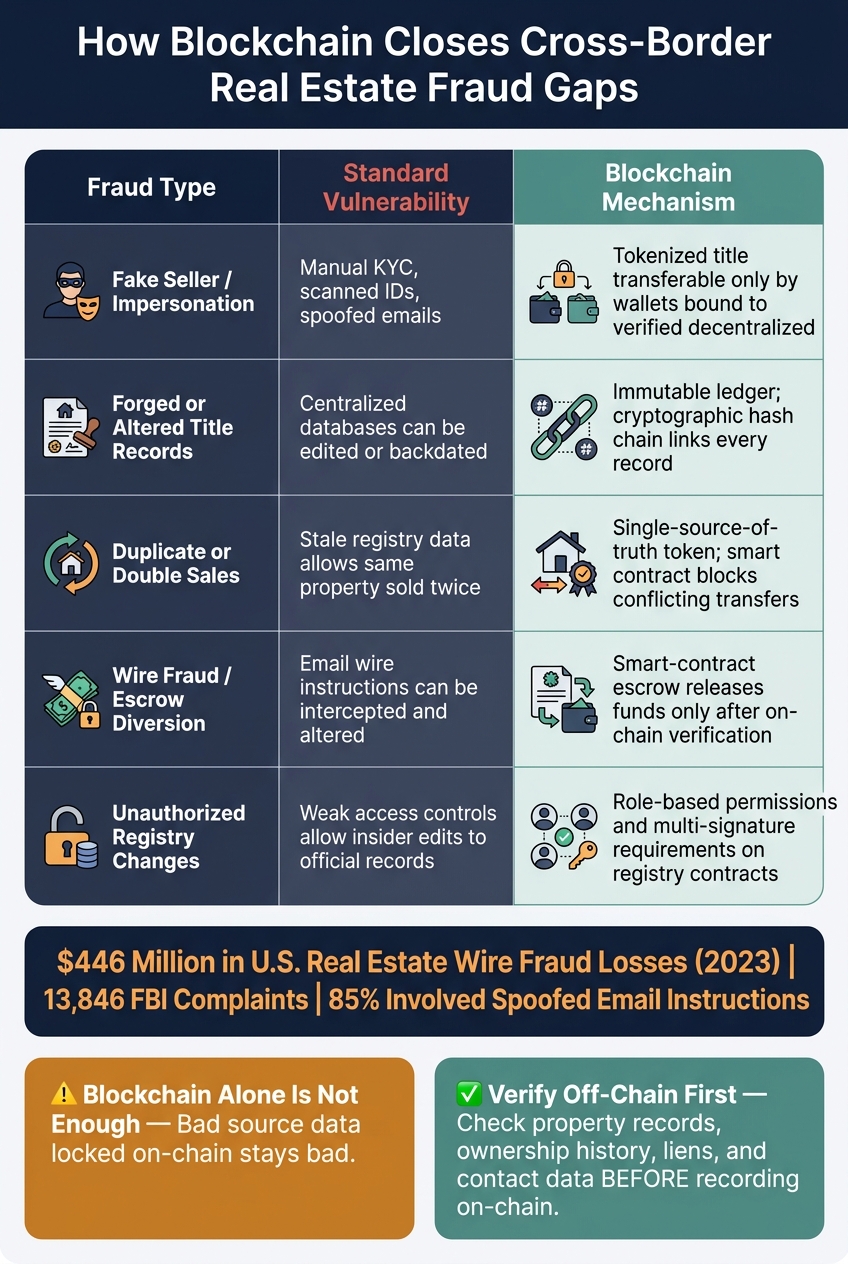
Cross-Border Real Estate Fraud: Blockchain vs. Standard Workflows
Blockchain closes these gaps by putting ownership, settlement, and identity into one tamper-evident workflow. Each control lines up with a specific weak spot. Immutable history helps stop title tampering, smart-contract escrow helps stop payment diversion, and verified decentralized identity makes impersonation much harder. The same idea carries over to settlement: one verified record leaves less room for forged transfers and stolen payments.
Immutable Ownership History Reduces Title Tampering and Duplicate Sales
Every ownership transfer recorded on a blockchain is cryptographically linked to the one before it. If someone changes an older entry, the hash chain breaks, and everyone in the system can see it. That’s very different from a centralized registry, where an insider or attacker may change a record quietly and leave no plain sign of what happened.
Georgia and Sweden have both tested blockchain-backed land registries to make title changes traceable and harder to alter. The practical upside is pretty simple: a shared ledger gives each authorized party – buyer, seller, lender, regulator – access to the same ownership history, no matter where they are.
Smart Contracts Automate Escrow and Release Funds Only When Conditions Are Met
A smart contract can hold funds in an on-chain escrow wallet and release them only after a set checklist is complete – verified title status, confirmed identity credentials, and digital approvals from lenders or notaries. That cuts out editable wire instructions and means payout changes need authenticated on-chain approval.
In cross-border deals, this matters even more. Smart contracts can include currency conversion rules, time-locked deadlines, and compliance steps tied to each jurisdiction. That makes it harder for fraudsters to take advantage of gaps between banking systems and legal rules in different countries.
Decentralized Identity and Tokenized Title Records Limit Impersonation
Tokenized title records ownership as a one-of-a-kind digital asset, and transfers require wallets tied to verified decentralized identities. So a forged paper document can’t move the token without the owner’s verified keys and credentials.
Platforms like Propy already use this setup in practice, wrapping property rights into NFTs and tying transfers to KYC/AML whitelisting. Georgia is also looking at moving its national land registry onto Hedera, with each property represented as a tokenized asset and matched with government-verified checks before any transfer settles.
Blockchain does its best work when verified property and contact data confirm the actual asset, owner, and point of contact behind the on-chain record. Here’s how the main fraud risks map to the blockchain controls meant to stop them:
| Fraud Type | Standard Vulnerability | Blockchain Mechanism |
|---|---|---|
| Fake seller / impersonation | Manual KYC, scanned IDs, spoofed emails | Tokenized title transferable only by wallets bound to verified DIDs |
| Forged or altered title records | Centralized databases can be edited or backdated | Immutable ledger; cryptographic hash chain links every record |
| Duplicate or double sales | Stale registry data allows the same property to be sold twice | Single-source-of-truth token; smart contract blocks conflicting transfers |
| Wire fraud / escrow diversion | Email wire instructions can be intercepted and altered | Smart-contract escrow releases funds only after on-chain verification |
| Unauthorized registry changes | Weak access controls allow insider edits to official records | Role-based permissions and multi-signature requirements on registry contracts |
Each mechanism addresses a specific failure point instead of offering one blanket fix. That’s why the mix of immutable records, smart-contract settlement, and verified identity works better than any single control on its own. Even then, blockchain closes the gap only when the property and contact data going into the system are verified.
Why Blockchain Still Needs Verified Property and Contact Data
Blockchain preserves record order, not record truth. A forged deed, an incorrect parcel ID, or a missing lien can still end up locked into the ledger. If the input is wrong, blockchain keeps that error in place.
A ledger entry can show when a transaction was recorded and who signed it. But it can’t prove that the facts behind that transaction are correct. Even in highly digitized registries, teams still deal with resubmissions caused by document mistakes. The safer move is simple: verify off-chain first, then anchor the checked record on-chain.
Verified Property Data Bridges the Gap Between On-Chain Records and Physical Assets
Before any property interest is recorded or transferred on a blockchain, teams should check several data points off-chain:
- Ownership history
- Parcel and physical details
- Liens, mortgages, and other encumbrances
- Legal description, zoning, easements, and restrictions
- Recent transaction and price history
In cross-border deals, that information may be spread across local registries, tax offices, and commercial data sources. It needs to be pulled, normalized, and reconciled before anything is written on-chain. Skip that step, and blockchain simply preserves the mistake. That can lead to forged ownership claims, duplicate transfers, and title mismatches making their way into the ledger.
Property data proves what is being sold. Contact data proves who is selling it.
Verified Contact Data Helps Confirm the Real Parties Behind a Transaction
Fraudsters take advantage of distance and jurisdiction gaps by posing as owners, heirs, or trustees. Verified contact data gives teams a way to confirm, on their own, that the person acting as the seller is in fact the seller.
That includes phone verification to confirm that a number is active and tied to the claimed person, email verification to check deliverability and cut business email compromise risk, and address validation to cross-check mailing and residence addresses against postal or utility records. Enrichment and skip tracing can also surface alternate phone numbers, past addresses, and related contacts, which helps teams figure out who is actually behind the sale.
This gets even more important when a property is held in a trust, LLC, or offshore entity, or when the owner has died. Enrichment can help identify beneficial owners, authorized signers, or heirs before a transfer is approved.
The goal is straightforward: match names, addresses, and verified contact channels before accepting a signature or recording a transfer.
Where BatchData Fits in the Workflow
That verification step is where BatchData fits. BatchData – Ivo Draginov sits upstream of blockchain, normalizing and verifying property and contact data before tokenization, settlement, or registry updates. It pulls together ownership history, parcel details, mortgage and lien data, and transaction history from multiple sources into a complete property profile.
On the contact side, BatchData provides:
- Phone verification
- Address validation
- Skip tracing
- Contact enrichment
These tools help confirm the real parties behind a transaction.
BatchData’s property search APIs and bulk data delivery let blockchain platforms and proptech applications query and verify property and contact attributes before minting tokens or updating on-chain records. In plain English, it helps keep on-chain records aligned with off-chain facts by checking the property, the parties, and the transfer data before anything is written permanently.
BatchData makes blockchain safer by improving the accuracy of the data recorded on it.
Conclusion: Safer Cross-Border Transactions Require Blockchain and Verified Data Together
Cross-border fraud sticks around for a simple reason: skip tracing and identity checks, title review, payments, and registry checks still live in separate systems. When those systems don’t line up, bad actors get room to move. That’s how fake sellers, duplicate transfers, and wire diversion happen.
Blockchain helps close that coordination gap. It creates tamper-evident ownership records, automated escrow, and a shared audit trail. That matters. But it doesn’t fix bad source data. If a forged deed gets recorded on-chain, it’s still a forged deed.
So the fix starts before anything goes on-chain. Operators should use verified property and contact data from BatchData – Ivo Draginov during onboarding and closing as a pre-on-chain check. Developers should require verified property and identity data before escrow release or title transfer. Investors should look at the data pipeline and the blockchain setup as one system, not two separate pieces.
Cross-border real estate needs blockchain plus verified data.
FAQs
Can blockchain stop real estate fraud by itself?
No. Blockchain can create a secure, transparent record of property transactions, but on its own, it can’t stop real estate fraud.
Problems like fake sellers, record mismatches, and identity-related fraud still slip through if the underlying data is wrong. That’s the catch: blockchain can lock in a record, but it can’t prove the record was correct in the first place.
That’s where BatchData comes in. It adds property enrichment, address verification, and skip tracing so property and contact data are checked upfront. The result is cleaner records and a better shot at stopping fraud before it starts.
What needs to be verified before a property goes on-chain?
Before a property goes on-chain, verify the data first. That step helps stop fraud and avoids record mismatches later.
Confirm that the seller has the legal right to sell. Review the title for any breaks, liens, unpaid property taxes, or boundary disputes. Check that all structures have valid permits and no code violations.
You’ll also want to standardize and validate the address. And if the property is owned by an entity, identify the true owner and confirm that the signatory is authorized.
How do smart contracts reduce wire fraud at closing?
Smart contracts cut wire fraud by using an immutable, decentralized ledger that makes property transactions and registry entries transparent, time-stamped, and unchangeable.
They also automate registry record maintenance, which helps stop forgery during registration. The result is a secure, verifiable system that reduces trust gaps and blocks unauthorized record changes tied to wire fraud at closing.


