
































Bulk skip tracing is a fast way for real estate professionals to find contact information for property owners. But doing it legally means following strict rules to avoid fines or lawsuits. Key laws like the Fair Credit Reporting Act (FCRA), Telephone Consumer Protection Act (TCPA), and California Consumer Privacy Act (CCPA) regulate how personal data is collected, stored, and used. Violations, like contacting numbers on the Do Not Call (DNC) list or using data without proper consent, can lead to penalties ranging from $500 to $1,500 per incident.
Here’s how to stay compliant:
- Follow FCRA rules: Only use consumer data for approved purposes and keep detailed records.
- Obtain consent under TCPA: Get written consent before using automated calls or texts.
- Adhere to the CCPA: Respond to opt-out requests and ensure sensitive data is handled properly.
- Check the DNC list: Scrub your contact lists every 31 days to avoid contacting registered numbers.
Using verified data sources and keeping thorough records can help ensure compliance. Tools like BatchData streamline skip tracing while adhering to these legal standards, making it easier to operate within the law while reaching property owners effectively.
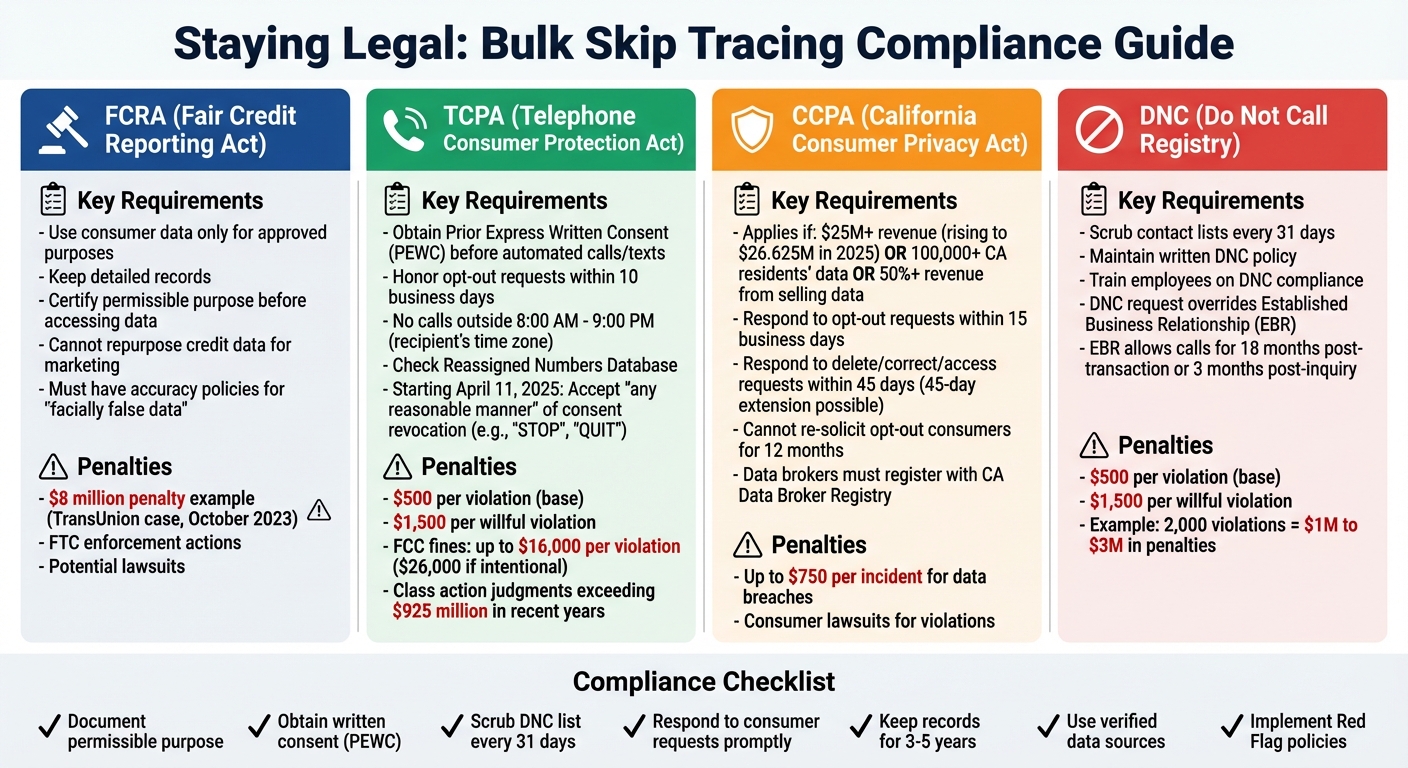
Legal Requirements and Penalties for Bulk Skip Tracing Compliance
Skip Tracing Quiz – Test Your Knowledge on Rules, Ethics, and Compliance
sbb-itb-8058745
Legal Risks in Large-Scale Skip Tracing
Handling thousands of property records comes with its challenges, especially when it comes to compliance. A single mistake in collecting, storing, or using contact information can snowball into widespread violations. Let’s break down where real estate businesses often stumble.
FCRA Violations from Improper Credit Data Use
The Fair Credit Reporting Act (FCRA) mandates that anyone accessing consumer reports – like credit histories, rental screenings, or criminal background checks – must have a permissible purpose. Violating this rule can lead to serious consequences. For example, before accessing such data, you must certify to the consumer reporting agency that the information will only be used for specific purposes, like evaluating tenant applications or creditworthiness. Repurposing it for marketing is strictly off-limits.
The rules now extend to credit header data, which includes names, Social Security numbers, phone numbers, and addresses. If this data is treated as a consumer report, it cannot be sold or used without a permissible purpose. This has significant implications for skip tracing providers.
In September 2023, the FTC took action against TruthFinder and Instant Checkmate for allegedly operating as consumer reporting agencies. They were accused of offering consumer reports without adhering to FCRA compliance, despite using marketing terms like "best background check for landlords". Similarly, in October 2023, the FTC and CFPB filed a complaint against TransUnion Rental Screening Solutions, Inc. (TURSS) for failing to ensure the accuracy of eviction records. TransUnion faced penalties totaling $8 million for multiple FCRA violations, including issues with security freezes and prescreening lists.
These cases highlight the strict oversight on how consumer data is used, especially in high-volume environments.
TCPA Restrictions on Automated Outreach
The Telephone Consumer Protection Act (TCPA) governs how businesses reach out to individuals via phone. If you’re using automated technologies like autodialers, prerecorded messages, or AI-generated voices, you must first obtain Prior Express Written Consent (PEWC) before contacting cell phones for telemarketing purposes. This includes ringless voicemails.
"Proving valid consent is the caller’s requirement and there is no exception for a good faith, but ultimately mistaken, belief that the caller had received consent." – Josh Stevens, Partner, M&S Law Group
Starting April 11, 2025, consumers can revoke consent in "any reasonable manner", including simple texts like "STOP" or "QUIT." Businesses must honor these requests within 10 business days and ensure all campaigns and team members comply globally. Additionally, telemarketing calls or texts are banned outside the hours of 8:00 a.m. and 9:00 p.m. in the recipient’s local time zone.
The financial penalties for non-compliance are steep. Individuals can seek damages of $500 per violation, which jumps to $1,500 for willful violations. On top of that, the FCC can impose fines of up to $16,000 per violation, or $26,000 if intentional. TCPA class action lawsuits have resulted in judgments exceeding $925 million in recent years. Some states, like Florida and Oklahoma, have introduced even stricter versions of the TCPA, with broader definitions of autodialers and potential criminal penalties.
CCPA and Data Privacy Violations in Bulk Operations
The California Consumer Privacy Act (CCPA) applies to businesses that meet specific criteria, such as generating over $25 million in annual revenue (rising to $26.625 million in 2025), handling personal information for 100,000 or more California residents, or earning at least 50% of revenue from selling personal data. Under the CCPA, California residents have rights that include limiting the use of sensitive information, opting out of data sales, correcting inaccuracies, and requesting data deletion.
Skip tracing providers classified as data brokers must register with the California Data Broker Registry and provide clear options for consumers to exercise their rights. Businesses must respond to opt-out requests within 15 business days and address requests to delete, correct, or access data within 45 calendar days (with an optional 45-day extension). Additionally, once a consumer opts out, businesses cannot ask them to opt back in for at least 12 months.
While the CCPA excludes publicly available information – such as real estate records – from its scope, this exemption doesn’t cover non-public data like phone numbers or email addresses obtained through skip tracing. A failure to secure this data can result in lawsuits, with statutory damages of up to $750 per incident in the event of a breach.
DNC Registry Non-Compliance
The National Do Not Call (DNC) Registry is a federal database of phone numbers that have opted out of telemarketing calls. Businesses must scrub their contact lists against this registry every 31 days. Even if you have an Established Business Relationship (EBR) with a property owner, you cannot ignore a specific DNC request. EBR rules allow calls for up to 18 months after a transaction or three months after an inquiry, but the DNC request always takes precedence.
To comply, businesses must maintain a written DNC policy and train employees on its use. The FCC’s Reassigned Numbers Database is another tool to ensure that consent remains valid for the current phone number owner, as numbers often change hands.
"The per-violation penalty can be as high as $500. That amount can increase to as much as $1,500 per violation if the caller’s violation was willful." – Consumer Action
Errors in DNC compliance can be costly. For instance, contacting 2,000 numbers on the DNC list could result in penalties of $1 million at the base rate, or $3 million if deemed willful. In high-volume operations, even minor lapses can have massive financial consequences.
Strict adherence to these regulations is non-negotiable for businesses engaged in large-scale skip tracing.
How to Keep Bulk Skip Tracing Legal
Staying compliant involves following established rules, sourcing property data APIs responsibly, and keeping detailed records. Here’s a guide to ensure your bulk skip tracing efforts remain lawful.
Following FCRA, TCPA, CCPA, and DNC Rules
Start by confirming your permissible purpose and documenting that consumer data is used strictly for authorized purposes, such as tenant screening. If adverse actions are required, provide the necessary notices.
"Written notices allow you to provide proof of FCRA compliance." – Federal Trade Commission
For TCPA compliance, always obtain prior express written consent (PEWC) before using autodialers or prerecorded messages on mobile phones. Honor opt-out requests immediately and regularly update your contact lists using the National Do Not Call Registry.
Under CCPA, respond promptly to consumer requests, whether they involve opting out, deleting, correcting, or accessing their personal data.
When confirming a consumer’s location through third-party contacts, identify yourself and explain your purpose clearly. Avoid mentioning debt and limit your contact with each source to a single interaction unless clarification is necessary.
Using Verified Data Sources
Once regulatory compliance is addressed, focus on using data from verified sources. To ensure data quality and legality, create and follow written accuracy policies. These should include procedures for identifying and correcting "facially false data" – information that is clearly inaccurate or inconsistent. Having such policies in place can protect you from liability in some cases.
"No person shall be held liable for any violation of this section if he shows by a preponderance of the evidence that at the time of the alleged violation he maintained reasonable procedures to assure compliance with the provisions of this section." – 15 USC 1681m
Adopt Red Flag policies to detect patterns or practices that could indicate identity theft in your data. When sourcing contact details, rely on authorized public records and legally obtained, updated databases. Avoid using credit header data or consumer reports for purposes beyond their original certification.
Keeping Records for Audits
Thorough documentation is key to staying prepared for audits. Keep records of consumer selection criteria, permissible purpose certifications, and adverse action notices for at least three to five years. These records can serve as evidence of compliance during audits.
Maintain logs of your data disposal practices, detailing methods like shredding, burning, or secure electronic deletion. If your skip tracing includes personal interviews about character or lifestyle, provide written disclosures informing individuals of their right to request a summary of the report’s scope.
| Record Type | Minimum Retention Period | Purpose |
|---|---|---|
| Consumer Selection Criteria | 3 Years | Proving legal targeting in solicitations |
| Adverse Action Notices | 3–5 Years (Best Practice) | Proof of consumer notification |
| Permissible Purpose Certifications | Duration of Data Use | Demonstrating legal access rights |
| Disposal Logs | Ongoing | Proving secure data destruction |
Using BatchData for Compliant Bulk Skip Tracing
Once your compliance framework is in place, the next step is to use tools that can scale while adhering to strict legal standards. BatchData offers a platform tailored for real estate businesses, enabling them to process massive datasets while staying within the bounds of the law.
BatchData’s Data Enrichment and Skip Tracing Features
BatchData takes compliance seriously, automatically cross-checking phone numbers against the National Do Not Call (DNC) Registry before delivering results. Its Litigator Scrub feature identifies known TCPA litigators, helping you avoid high-risk contacts that could lead to potential lawsuits. This ensures the data you receive is both actionable and legally compliant.
The platform enhances property records by adding mobile and landline numbers, deliverable email addresses, and verified mailing addresses. It covers data for 155 million+ properties with over 700 attributes. To further improve accuracy, BatchData validates phone numbers in real time, removing disconnected or invalid numbers before contact attempts are made, reducing the chance of errors or unintended outreach.
For properties owned by LLCs or trusts, BatchData’s entity resolution feature connects corporate records to individual owners, bypassing generic registered agents. With a 76% right-party contact (RPC) rate, the platform outperforms the industry average by nearly three times.
"What used to take 30 minutes now takes 30 seconds. BatchData makes our platform superhuman." – Chris Finck, Director of Product Management
Professional Services for Compliance Support
Beyond data enrichment, BatchData offers tools and services aimed at ensuring compliance. It supports CCPA-ready endpoints, allowing individuals in states like California, Colorado, Connecticut, Oregon, Utah, Texas, and Virginia to request, amend, or delete their personal information from the database. The platform’s automated system updates datasets daily, validating information against more than a dozen sources.
For companies handling large-scale operations, BatchData provides Enterprise SLA options with detailed API documentation and guaranteed uptime. Additional services include secure data integration, workflow optimization, and custom data pipeline development, all tailored to meet specific compliance needs.
Handling High-Volume Operations
BatchData is built for speed and scale, processing bulk skip tracing requests in milliseconds via its low-latency API. It can handle anything from a few hundred records to millions at a time. Users can upload CSV files through BatchLeads or integrate the API for real-time data enrichment.
The platform uses a pay-per-match pricing model, eliminating minimums or monthly fees. For instance, processing 150,000 records costs about $0.07 per match. Results include confidence scores for phone numbers, carrier details, and address verification, all delivered using TCPA-compliant protocols. This combination of speed, scalability, and compliance ensures BatchData meets the demands of high-volume skip tracing operations effectively.
Why Compliance Matters in Bulk Skip Tracing
When it comes to bulk skip tracing, compliance is more than just a legal obligation – it’s a smart business move. Following legal guidelines not only helps you avoid fines but also improves your data quality and boosts your ability to scale operations effectively. For real estate professionals, prioritizing compliance means better accuracy, smoother workflows, and a stronger foundation for growth. Let’s dive into the key reasons why staying compliant is so important.
Reducing Legal and Financial Risks
Federal agencies keep a close eye on compliance, especially when it comes to consumer reports and adverse action notices. Violating these regulations can lead to serious consequences unless you can prove that reasonable safeguards were in place. As the law puts it:
"No person shall be held liable for any violation of this section if he shows by a preponderance of the evidence that at the time of the alleged violation he maintained reasonable procedures to assure compliance".
Using data obtained illegally can backfire in a big way – it might be dismissed in court or weaken your position in business negotiations. That’s why professional skip tracing companies emphasize compliance. They ensure that data is gathered legally, protecting both themselves and their clients:
"Professional skip tracing companies protect both themselves and their clients by ensuring data is gathered legally and preventing compliance issues that could harm a case or discredit what’s been found".
Getting Better Data Quality and Match Rates
One of the biggest advantages of compliant skip tracing services is access to high-quality property and contact data. These services focus on tier-1 tracing data and reliable public records, which helps cut down on dead leads and improves match rates.
For example, legal skip tracing pulls data from sources like property deeds, court records, and professional licenses. In states such as California, manual traces often require a private investigator’s license. By using a compliant service, businesses can access professional-grade data without taking on the legal risks of doing it themselves. Plus, compliance with telecommunications laws ensures better interactions with potential leads, increasing the chances of successful outreach.
Scaling Operations Confidently
Compliance also makes it easier to scale your skip tracing efforts. AI-powered tools can quickly search through massive datasets, improving both speed and accuracy. However, as technology evolves, so do the regulations. Staying up-to-date with laws like the FCRA, GLBA, and DPPA is critical to maintaining compliance.
When your operations are built on legally obtained, verified data, scaling becomes a lot less risky. You can process large volumes of records without worrying about lawsuits, fines, or reputational damage. For real estate investors, this means the freedom to grow their skip tracing activities without the constant fear of regulatory backlash. It’s about building a business that’s both efficient and secure from the ground up.
Conclusion
Compliance is the backbone of any bulk skip tracing operation, ensuring both growth and legal security. As On-Call Legal emphasizes, "Skip tracing is legal, but only when done the right way". Cutting corners can lead to serious repercussions, such as lawsuits, fines of up to $1,500 per TCPA violation, and even criminal charges for practices like pretexting or unauthorized data access. Real estate professionals and investigators face additional risks, including losing their state licenses if found guilty of illegal skip tracing. A commitment to compliance not only reduces these risks but also paves the way for long-term success.
Operating within legal boundaries builds trust and credibility, especially when your data collection methods can withstand scrutiny in court or negotiations.
As highlighted earlier, compliance with key regulations like FCRA, TCPA, and CCPA is enforced by agencies such as the FTC and CFPB, which impose penalties for violations. For example, California’s Debt Collection Licensing Act mandates that anyone conducting skip tracing as part of debt collection must be licensed by the Department of Financial Protection and Innovation. Staying updated on these rules and implementing documented compliance procedures shields your business from regulatory fallout.
In a fast-paced real estate market, bulk skip tracing can give you a competitive edge – but only if your foundation is legally sound. Prioritizing compliance from the outset allows you to scale confidently, engage leads ethically, and grow your business without the looming threat of lawsuits or license issues. As Data Skip 2.0 puts it:
"Professional skip tracing companies make sure that their information is gathered legally, protecting both the client and themselves from any compliance issues that may harm a case or discredit what’s been found".
FAQs
What counts as a “permissible purpose” under the FCRA for skip tracing?
Under the FCRA, a "permissible purpose" for skip tracing applies to certain legal situations. This includes responding to court orders, subpoenas, or written instructions directly from the consumer. These purposes are strictly confined to instances authorized by law, such as legal actions or specific investigations.
When do I need prior express written consent to call or text leads?
Before reaching out to leads via calls or texts using an automatic telephone dialing system or prerecorded messages – particularly for telemarketing or promotional purposes – you must first obtain prior express written consent. This step is crucial to ensure compliance with the Telephone Consumer Protection Act (TCPA), a law aimed at safeguarding consumer privacy.
What records should I keep to prove compliance in an audit or lawsuit?
To show compliance during an audit or legal case, maintain detailed records of your data sources, how the data was collected, and documentation proving your adherence to privacy laws and ethical standards. This should include evidence that you avoided misleading practices and operated within the boundaries of legal regulations.