

AI is transforming real estate forecasting into a fast, data-driven process. By analyzing millions of data points – like satellite images, social media trends, and building permits – AI generates accurate short-term predictions, helping investors and professionals make better decisions. Key takeaways include:
- Speed: AI completes tasks in hours that used to take weeks, such as analyzing properties or predicting market trends.
- Accuracy: AI-powered tools predict property values within 5–10% of actual prices and improve forecasting precision by 15–20%.
- Efficiency: Homes priced with AI sell 12% faster, and investors using AI cut prospecting time by 80%.
- Growth: The AI market in real estate surged from $222.65 billion in 2024 to $303.06 billion in 2025, with a 36.1% CAGR.
AI tools like Automated Valuation Models (AVMs), machine learning algorithms, and APIs are shaping how risks, opportunities, and market movements are assessed. From identifying climate-driven migration patterns to fraud detection and rental yield projections, AI is reshaping the industry, saving time, reducing errors, and improving decision-making.
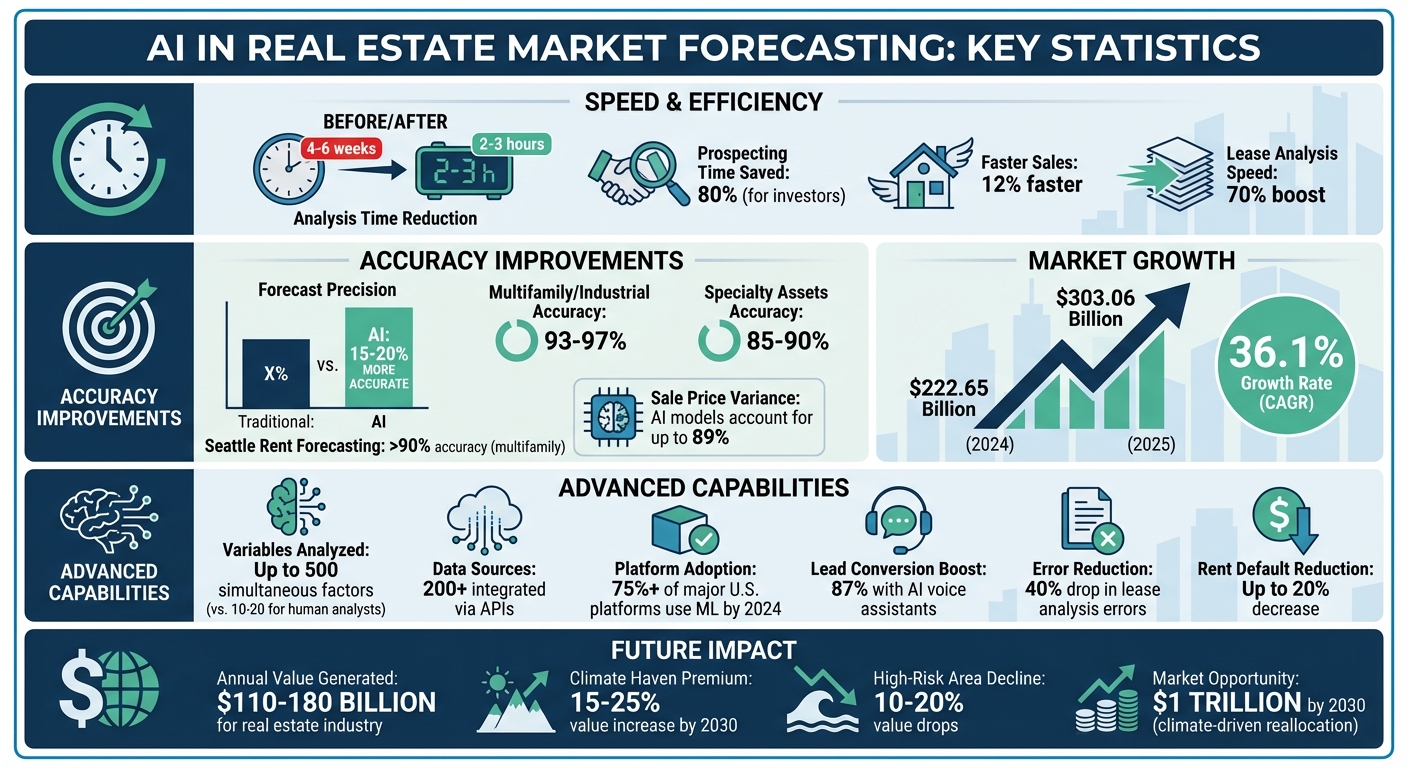
AI in Real Estate: Key Performance Metrics and Market Impact Statistics
How AI Is Changing Real Estate and Mortgages | The Future of Home Buying
sbb-itb-8058745
AI Techniques for Real Estate Forecasting
AI-driven forecasting in real estate relies on three key components: automated valuation models (AVMs), machine learning algorithms that identify market trends, and Real Estate APIs for seamless data integration. Together, these tools transform raw property data into actionable insights.
Predictive Analytics and Automated Valuation Models
Automated Valuation Models (AVMs) are no longer just basic price estimators. They now analyze up to 500 variables simultaneously, including employment trends, interest rates, demographic changes, and zoning activities. This level of complexity is far beyond what human analysts can manage. As McKinsey & Company explains:
"The number of variables influencing property values has expanded dramatically over the past two decades… today’s predictive models analyze hundreds of interconnected data points – from mobility patterns and energy usage to sentiment analysis and zoning activity".
The results speak for themselves. By 2026, AI-powered property valuation models achieve a median accuracy of 5% to 10% of actual transaction prices for standard commercial properties. Multifamily and industrial properties perform especially well, with accuracy rates of 93% to 97%, while specialty assets like medical offices range from 85% to 90%.
Advanced algorithms drive these improvements. Support Vector Machines (SVMs) excel at handling complex relationships in property data, achieving accuracy ranges (R²) between 0.66 and 0.94. Random Forest (RF) models, known for their ability to process large datasets, perform similarly with R² values of 0.70 to 0.93. These models significantly outperform traditional regression methods, which typically achieve R² values of 0.49 to 0.74. For example, McKinsey highlighted a machine-learning model that predicted three-year rent per square foot for multifamily buildings in Seattle with over 90% accuracy, far surpassing older methods.
A major shift in AVMs is their focus on leading indicators, such as building permits, job postings, and mortgage applications, rather than relying solely on past sales data. This forward-looking approach proved essential in Austin, Texas, in May 2022. While traditional metrics suggested a strong market, predictive analytics identified a peak at $667,050 by analyzing new construction permits and declining buyer affordability due to rising interest rates – months before traditional investors caught on. These advancements set the stage for machine learning to uncover even more nuanced trends.
Machine Learning for Market Trend Analysis
Machine learning brings a unique ability to detect nonlinear patterns in complex datasets, turning diverse information into actionable forecasts. These systems analyze alternative data sources like satellite imagery, social media sentiment, foot traffic, and energy usage to identify emerging trends at a local level.
Technologies like Computer Vision and Natural Language Processing (NLP) add another layer of sophistication. Computer Vision evaluates property images to assess condition and curb appeal, while NLP analyzes news articles and social media posts to gauge market sentiment. For instance, models developed by MIT’s Real Estate Innovation Lab can account for up to 89% of sale price variance by incorporating visual and aesthetic factors.
AI-powered forecasting also slashes analysis timelines. What used to take 4 to 6 weeks with traditional methods can now be done in hours. A compelling example is climate-driven migration patterns. AI models predict population shifts from high-risk areas prone to flooding or wildfires to "climate haven" regions like the Great Lakes. These areas are expected to see property value premiums of 15% to 25% by 2030. Such insights are made possible by integrating diverse data streams into machine learning models.
Real Estate APIs and Data Integration
APIs play a crucial role in connecting various data sources with forecasting models, turning fragmented information into cohesive market insights. They aggregate data from over 200 sources, cutting forecasting timelines from weeks to mere hours. This ensures that forecasts include leading indicators – such as search interest, inventory changes, and permit activity – rather than relying solely on closed sales data.
APIs support real-time valuations for platforms like iBuying and bulk data delivery for training machine learning models. By 2024, more than 75% of major U.S. real estate platforms adopted machine learning for price estimates and market trend analysis, with APIs serving as the backbone of their data infrastructure. As Mark Zandi from Moody’s Analytics puts it:
"Housing markets now react to data in near real time. That speed changes how risk shows up".
However, integrating data is not just about connectivity. APIs must standardize information from varied sources – public records, MLS listings, permit databases, and demographic data – into formats that machine learning models can process. This normalization creates a unified data foundation, enabling the comprehensive analysis that defines modern forecasting systems.
Benefits of AI in Real Estate Forecasting
AI has revolutionized real estate forecasting, turning what was once a slow, intuition-heavy process into a fast and efficient system driven by data. This transformation brings three major benefits: greater accuracy, faster analysis, and smarter decision-making for investors and marketers.
Improved Forecast Accuracy and Lower Risk
AI-based property valuations are 15% to 20% more precise than traditional manual methods. This accuracy comes from AI’s ability to process over 500 dynamic factors at once, such as climate risks, the rise of remote work, and social sentiment. In contrast, human analysts typically work with only 10 to 20 variables.
AI also incorporates unconventional data, like visual aesthetics, to explain up to 89% of sale price variations. For instance, in Seattle, AI rent forecasting models achieved over 90% accuracy for multifamily buildings. These models also help reduce common cognitive biases, like recency or anchoring.
Unlike traditional forecasting, which often relies heavily on historical sales trends, AI evaluates leading indicators like building permits, job postings, mortgage applications, and online search trends. This forward-looking approach allows investors to anticipate market changes months in advance. While older models focus on long-term trends that might miss sudden shifts, AI excels in creating 3-to-12-month forecasts that capture rapid market developments. Beyond accuracy, AI significantly speeds up the forecasting process.
Faster Analysis and Scalability
AI drastically reduces the time required for real estate analysis. Tasks that once took 4 to 6 weeks can now be completed in just 2 to 3 hours. By automating tedious processes like property valuation, document handling, and lead sorting, AI frees up teams to focus on more strategic initiatives. It also enables quick decisions by filtering out unsuitable properties, allowing teams to evaluate a much larger number of opportunities in the same amount of time. For example, AI-driven lease intelligence platforms have shown a 70% boost in analysis speed and a 40% drop in errors.
Scalability is another key advantage. AI can monitor hundreds of regions simultaneously, identifying emerging hotspots or declining areas before they become obvious. A notable example is Cavender’s, a retailer that tripled its new store openings – from 9 in 2024 to 27 in 2025 – by leveraging an AI-powered site selection tool. Similarly, Zillow uses machine learning models to deliver real-time home valuations across 30 regions in seconds, replacing hours of manual work.
Better Investment and Marketing Decisions
AI’s enhanced accuracy and speed empower investors to make smarter, data-driven decisions. It replaces intuition with objective strategies, supported by statistical models that quantify risk. For example, predictive models can assign "risk scores" to properties based on factors like market volatility, economic stability, and natural disaster risks. Investors can also run "what-if" scenarios – such as interest rate increases or local economic downturns – to stress-test their portfolios and prepare contingency plans.
AI also identifies off-market opportunities by analyzing unconventional data sources, including zoning applications, public records, and social media sentiment. Automated underwriting processes vast datasets, like rent rolls and tax records, to calculate real-time, risk-adjusted returns while minimizing manual errors. By examining broader tenant data, AI can reduce rent defaults and evictions by up to 20%.
In marketing, AI proves equally impactful. Homes priced using data-driven tools sell about 12% faster than those priced manually. One example involves an AI voice assistant that handled over 14,600 inbound calls for a real estate agent in just three months, boosting lead conversions by 87%. Moreover, AI forecasting models that use advanced feature engineering have shown a 20% improvement in accuracy compared to traditional methods, aiding in more precise targeting of potential buyers.
BatchData Solutions for AI-Driven Forecasting

AI thrives on data, but the quality of that data can make or break a forecasting model’s performance. That’s where BatchData, led by Ivo Draginov, steps in. By offering enriched and verified datasets, the platform helps improve the accuracy of AI-driven forecasts. Specializing in property and contact data enrichment, skip tracing, and APIs, BatchData equips businesses with the tools they need for smarter predictions.
Property Data Enrichment and Skip Tracing
BatchData takes raw property records and transforms them into detailed, actionable datasets. By adding key details like ownership history, equity positions, transaction records, and market comparables, the platform fills in critical gaps. Missing sales records, incomplete neighborhood trends, or outdated economic data? BatchData addresses these issues, enabling predictive models to better identify potential sellers or market shifts. For example, models can analyze equity positions and ownership duration to forecast who might sell next.
The skip tracing service goes a step further, using proprietary algorithms to locate elusive property owners. It provides verified contact details – like phone numbers and email addresses – allowing AI models to incorporate behavioral patterns and transaction histories into their risk assessments. This reduces errors such as overpricing or missed fraud detection. Think of it as akin to how predictive analytics flag unusual credit activity by analyzing histories and market signals.
APIs for Property Search and Data Integration
BatchData’s APIs simplify how businesses access and integrate property data. With features like real-time property search, phone verification, and bulk data delivery, these APIs cut down integration time significantly. Real estate firms can pull in hyperlocal data – recent sales, demographics, property features – directly into their machine learning models. This helps with tasks like forecasting rental demand or predicting price appreciation trends.
The APIs also support automated valuation models (AVMs) by providing frequent updates, which are critical for dynamic pricing strategies. This means real estate portfolios can be optimized across multiple regions without missing a beat.
Custom Solutions for AI Model Training
BatchData doesn’t stop at off-the-shelf solutions. The platform offers custom services to fine-tune data integration and AI model training. By cleaning and curating non-traditional data sources – like geolocation patterns or transactional records – BatchData creates high-quality, labeled datasets that improve model accuracy by 30%–50%.
For firms focusing on hyperlocal forecasting, BatchData helps integrate alternative data sources to train models for identifying up-and-coming neighborhoods or areas on the decline. This approach supports smarter decisions, such as predicting vacancies or identifying investment opportunities. Plus, the flexible pay-as-you-go pricing eliminates the need for long-term commitments, making these solutions accessible and scalable.
With BatchData’s advanced data tools, businesses are better equipped to push the boundaries of AI-driven forecasting and stay ahead in their markets.
Future Trends in AI and Real Estate Forecasting
AI continues to transform real estate forecasting, and emerging trends are set to expand its impact even further. These advancements are reshaping how markets are analyzed and investments are made.
Geographic Risk Analysis and Smart City Integration
AI is now being used to identify "Climate Havens" – areas that are expected to see property values rise by 15–25% between 2028 and 2030 as people move away from high-risk zones prone to flooding, wildfires, or other climate-related issues. Cities like Buffalo, Rochester, and Minneapolis are becoming more attractive due to their climate resilience. On the flip side, areas like Miami, Phoenix, and parts of California may experience property value drops of 10–20% as rising insurance costs make them less desirable. McKinsey estimates this shift could create a $1 trillion market opportunity by 2030.
"The combined physical and transitional risks of climate change will drive a historic, multi-trillion-dollar reallocation of capital across the economy." – McKinsey & Company
AI is also introducing tools like "Neighborhood Momentum", which combines data on permit activity, business licenses and contact enrichment, and transit usage to identify up-and-coming markets. With smart city integration, real-time data from mobile devices, such as foot traffic and mobility trends, helps investors evaluate locations before they fully develop. AI-powered satellite imagery analysis can detect construction months ahead of public permit records, offering a significant edge in market forecasting. For instance, tools like Smartzip were able to predict 72% of real estate listings in 2024 using these advanced methods.
These developments are not only refining market predictions but also enhancing revenue models and fraud prevention systems.
Rental Yield Projections and Fraud Detection
AI has also revolutionized rental yield projections. Systems like LiquidRent and YieldStar provide daily pricing recommendations by analyzing a wide range of market data and demand trends. Using computer vision, AI can identify over 200 property features from photos, leading to highly accurate rental yield adjustments. These models have achieved 94% accuracy, with estimates falling within 5% of final sale prices for listed homes.
Fraud detection is another area where AI is making strides. By 2025, 75% of property management companies reported an increase in fraudulent applications, with about 10% of rental applicants submitting fake documents. AI-powered screening tools can quickly identify fraudulent paystubs and bank statements using anomaly detection algorithms. Meanwhile, automated rent comparison tools match human appraiser selections 90% of the time, cutting manual research efforts by over 80%.
By streamlining rental yield management and improving fraud detection, AI is helping property managers and investors operate more efficiently while reducing risks.
AI for Sustainable Real Estate Investments
AI is also driving investments in sustainable real estate. Smart building technologies, powered by AI, can lower operational costs by 15–30% through real-time energy optimization and predictive maintenance. For example, in June 2025, Royal London Asset Management reported a 708% return on investment and 59% energy savings in a 125,000-square-foot office building by utilizing AI for energy management and occupancy monitoring.
Machine learning models are now integrating ESG (Environmental, Social, and Governance) data to track energy use, highlight sustainability gaps, and ensure compliance with carbon regulations. Predictive analytics can even estimate property value premiums for eco-friendly homes by analyzing growing buyer interest in features like EV charging stations. Additionally, computer vision technology can assess proximity to green spaces and evaluate sustainability features from satellite imagery, helping investors identify undervalued properties in resilient areas.
"The sustainability revolution is also powered by AI, with buildings optimizing energy use in real-time." – Clyde Christian Anderson, CEO, GrowthFactor.ai
Conclusion
AI has shifted forecasting in real estate from a reactive approach to a science rooted in prediction. By analyzing hundreds of variables – like climate risks, mobility trends, and sentiment data – AI now generates between $110 billion and $180 billion annually for the real estate industry.
The benefits are undeniable: AI-driven property valuations are far more precise than traditional methods, and investors leveraging predictive AI have cut prospecting time by as much as 80%. Professionals embracing AI tools by 2025–2026 will gain a competitive edge, while those waiting until 2028, when the technology is more established, risk falling behind. Clyde Christian Anderson, CEO of GrowthFactor.ai, captures this shift perfectly:
"The future of real estate isn’t just about location, location, location – it’s about intelligent, data-driven decisions".
These advancements pave the way for platforms like BatchData to refine forecasting further. BatchData’s tools, built on advanced AI techniques, help real estate professionals harness these capabilities. For example, their BatchRank™ tool boasts 63% accuracy in predicting properties likely to sell within 6–12 months, analyzing millions of data points. Meanwhile, Reia AI specializes in deal analysis, and Dialer AI provides actionable insights during outreach efforts. One Houston investor using BatchRank reported a 9× return on investment from high-propensity leads. As Ivo Draginov, Co-founder of BatchData, explains:
"For decades, real estate professionals, investors and service providers have been playing a numbers game… our clients can now focus their efforts on the homeowners who are genuinely likely to make a move".
FAQs
What data does AI use to forecast real estate markets?
AI taps into a variety of data sources to predict trends in real estate markets. These include transaction history, property records, tax assessments, mortgage information, and insights into homeowner behaviors. It also evaluates key metrics such as median home prices, sales volume, inventory levels, and Days on Market (DOM). Beyond this, economic indicators like interest rates and employment trends play a significant role in shaping its forecasts.
To enhance accuracy and keep predictions up-to-date, AI leverages advanced methods like computer vision and real-time data analysis. These tools help refine insights, offering a sharper picture of market conditions.
How reliable are AI home value and rent predictions?
AI-driven predictions for home values and rents are usually dependable, thanks to their use of advanced data analysis and machine learning techniques. These tools analyze vast amounts of information to deliver precise estimates. However, the accuracy of these predictions hinges on the quality of the data and how well they incorporate market trends and specific property characteristics. While these forecasts are often reliable, they can sometimes reflect biases or have limitations. Because of this, human judgment remains crucial when interpreting AI-generated insights for decision-making.
How can I start using AI forecasts in my investing workflow?
To begin using AI forecasts, leverage tools that examine market data, property values, and seller behaviors to pinpoint opportunities and evaluate risks. Predictive models, such as Automated Valuation Models (AVMs), and real-time APIs can provide you with the most current insights. By studying historical trends and economic indicators, you gain a clearer picture of market cycles. This allows you to weave AI-driven insights into your strategies, making your investment decisions more precise and data-focused.


