






































A property valuation report is no longer just a PDF containing one estimated price. It's an evidence record that connects property facts, comparable sales, market conditions, methodology, and limitations into a value conclusion that lenders, investors, insurers, and legal teams can test.
The U.S. appraisal profession illustrates the scale of this infrastructure. As of December 2022, an estimated 70,000 licensed or certified real estate appraisers held 93,665 active licenses, while the Federal Housing Finance Agency's Uniform Appraisal Dataset provides aggregate appraisal statistics covering quarterly records from 2013 Q1 through 2024 Q3 and annual records from 2013 through 2023. The Appraisal Institute's fact sheet shows how valuation has moved from isolated documents toward structured, reusable market data.
For product and investment teams, the practical takeaways are:
- A report is only as defensible as its source trail.
- Comparable sales require specific verification, not generic labels.
- AVMs are useful for scale, but niche assets still need human review.
- A report can become stale even when the underlying property hasn't changed.
- APIs turn valuation evidence into a workflow for underwriting and portfolio monitoring.
The sections below focus on the data mechanics that determine whether a valuation report is useful or merely impressive on paper.
What Is a Property Valuation Report in Modern Real Estate?
The U.S. appraisal industry was estimated at $10.3 billion by the end of 2026, with 39,350 businesses operating in the sector, according to IBISWorld's real estate appraisal industry profile. That scale supports formal standards, licensed professionals, and data systems built to process valuation evidence.
A property valuation report is a structured assessment of estimated value at a defined effective date. It connects property facts, market evidence, valuation methods, and stated limitations to a conclusion that lenders, investors, insurers, and legal teams can review. The headline value is only one output. The evidence behind it determines whether another analyst can rely on or challenge the result.
Traditional reports were often treated as static documents prepared for one mortgage file, insurance placement, or legal matter. Modern teams increasingly extract appraisal fields, normalize them, compare them across properties and neighborhoods, and analyze them across geographic markets. This shift turns a report from a document prepared for a single decision into a reusable input for underwriting and portfolio monitoring.
The FHFA's Uniform Appraisal Dataset demonstrates the shift. Its aggregate coverage includes enterprise single-family, condominium, and FHA appraisal records, enabling analysis of trends across standardized valuation information. The dataset does not replace an individual appraisal. It gives organizations a consistent structure for examining appraisal outcomes at scale.
The report as a data product
A modern valuation report has two identities:
- An assignment deliverable, prepared for a defined client, purpose, property, and effective date.
- A data object, containing fields that can feed underwriting rules, portfolio models, valuation monitoring, and quality-control systems.
That distinction changes how teams ingest reports. A PDF parser that captures only the final value discards the evidence needed to reproduce or challenge the conclusion. A useful pipeline stores the subject address, property characteristics, inspection details, comparable sales, adjustment logic, methodology, assumptions, and dates as separate fields.
The report should therefore be stored as a versioned evidence package, with the effective date, source documents, extracted fields, and methodology kept separately from the rendered file. This structure supports repeatable checks when an AVM, API workflow, or analyst reviews the property again.
For teams comparing document structures, PropLab's valuation report formats provide useful context on common fields and layouts. A polished report has limited value if another analyst cannot trace the conclusion from the underlying property data through the selected method to the final value.
Which Core Components Make a Valuation Report Defensible?
A defensible valuation report starts with traceable inputs, not a polished conclusion. It identifies the property clearly, describes the condition and use of the asset, records the evidence behind the opinion, and shows how the selected method follows market behavior. A number without that chain is just an unsupported opinion.
The report should establish the subject property before it gives a value. That means the address or legal identifier, property type, physical characteristics, condition, location, zoning, current use, and effective valuation date. Federal Reserve interagency guidance also expects clear reporting of current and projected use, actual physical condition, zoning, inspection scope, and supporting information. The IRS-hosted real property valuation guidance summarizes those expectations.
Evidence beats labels
The sales comparison approach is where weak reports usually break down. Each comparable sale needs a specific source, such as deed records, tax records, MLS data, or another reliable third-party feed. “Public records” alone is too vague for an audit trail.
The analyst also has to show whether each sale was arm's length and note financing concessions, physical differences, and market conditions. Adjustments should reflect how the local market prices differences in size, condition, location, amenities, concessions, and timing. The point is not to pile on adjustments. It is to make each adjustment testable.
Fannie Mae's comparable-sales adjustment guidance makes the logic clear. If the source or transaction conditions cannot be verified, the adjustment path becomes hard to defend. If the comp evidence is granular and market-supported, the indicated value is easier to stand behind in lending, portfolio review, or litigation.
| Data Category | Mandatory Core Fields | Supplemental / Contextual Fields |
|---|---|---|
| Property identity | Address, legal identifier, property type, effective date | Ownership history, parcel relationships, prior transfers |
| Physical asset | Area, rooms or units, condition, construction, improvements | Renovation records, engineering reports, building systems |
| Market context | Neighborhood, zoning, current use, market conditions | Development pipeline, local planning context, hazard information |
| Comparable evidence | Sale date, price, source, transaction conditions, physical attributes | Expanded comp set, listing history, transfer history |
| Methodology | Approaches used, adjustments, reconciliation, final opinion | Alternative scenarios, sensitivity analysis, model outputs |
| Limitations | Inspection scope, assumptions, limiting conditions, data gaps | Supplemental documents, reviewer comments, exception history |
A report with these fields can be normalized into an underwriting schema. That matters for API workflows, where teams need report data to move cleanly into rules engines, AVMs, and monitoring systems instead of staying trapped in a PDF.
For teams building comp workflows, this comparable-sales analysis reference is useful because it separates raw sales collection from actual relevance testing. In practice, that difference determines whether a report is just assembled or supportable.
The number of comparables is not the only quality signal, but it does reveal how appraisal practice changes over time. In FHFA analysis of Enterprise-backed mortgages from 2013 to 2021, more than two-thirds of appraisals included five or more comparable properties, even though only three were required. The share fell from 76% in 2013 to 59% in 2021. The underwriting lesson is straightforward. Comp quantity should never replace comp relevance and verification.
How Do Appraisals, BPOs, and AVMs Compare for Different Use Cases?
The method should match the decision's error tolerance. A lender evaluating a complicated property needs documented evidence and professional accountability. A portfolio team refreshing thousands of values needs consistent inputs, repeatable calculations, and an exception process. Treating these methods as interchangeable creates avoidable underwriting risk.
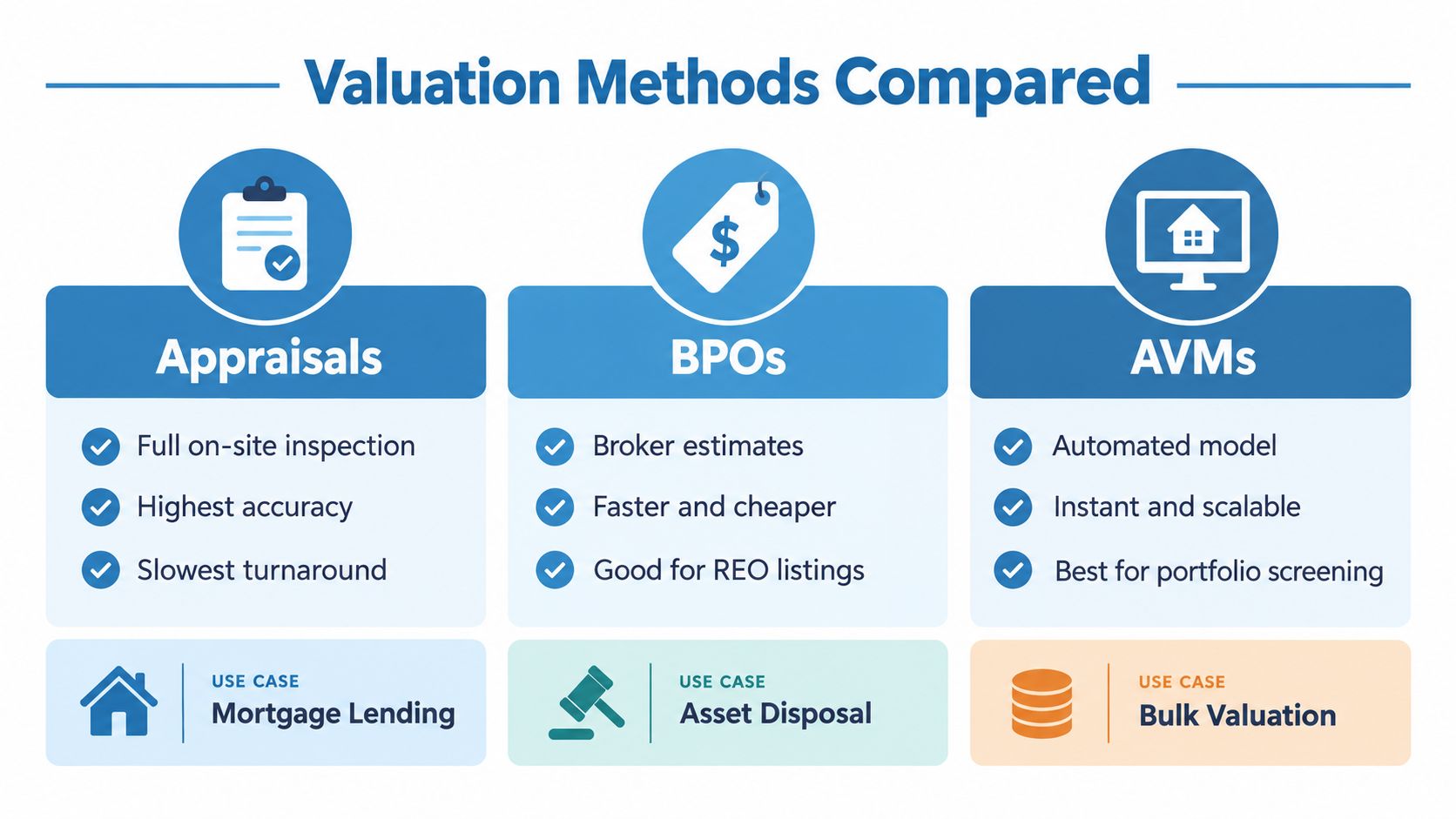
A full appraisal produces the deepest evidence package of the three. The assignment can include a defined inspection, verified comparable sales, disclosed methodology, reconciliation, and an appraiser's professional responsibility for the conclusion. That depth supports mortgage decisions, complex collateral, litigation, and other situations where the value must withstand review. The trade-off is higher cost and slower delivery than a broker opinion or model output.
A Broker Price Opinion, or BPO, captures a broker's market view. It can support REO pricing, asset disposition, servicing decisions, and an initial pricing assessment when the decision does not require a formal appraisal assignment. Its usefulness depends on the broker's local knowledge, the quality of the supplied property data, and the inspection scope. It provides less formal evidence and usually less analytical depth than a full appraisal.
An Automated Valuation Model, or AVM, converts structured property, transaction, and market data into a model-based estimate. That makes it suitable for pre-qualification, portfolio screening, repeated valuation runs, and monitoring changes in collateral values. An AVM can also act as an early routing layer in an underwriting API. Records with stable data and ordinary characteristics can follow an automated path, while unusual properties or weak comp sets can move to human review.
Match the method to the workflow
| Method | Primary contribution | Suitable uses | Main constraint |
|---|---|---|---|
| Full appraisal | Inspection, documented methodology, verified evidence | Mortgage decisions, complex assets, disputes | Higher cost and slower turnaround |
| BPO | Broker knowledge and a market-facing price opinion | REO pricing, disposal, preliminary review | Less formal evidence and inspection depth |
| AVM | Repeatable estimates at scale | Portfolio screening, monitoring, pre-qualification | Sensitive to data quality and comp availability |
Set the rule before the valuation request enters production:
- Mandate a full appraisal when collateral complexity, legal scrutiny, condition uncertainty, or loss severity makes a model-only estimate insufficient.
- Use a BPO when a local broker's market judgment is useful and the decision can operate below the evidentiary standard of an appraisal.
- Use an AVM when broad coverage, rapid refreshes, or an initial estimate matters more than inspection-level detail.
The practical trade-off is evidence depth versus speed and scale. A lender can use an AVM to route lower-risk files and reserve appraisal spend for exceptions. An investor can screen a portfolio with model outputs, then commission deeper analysis for customized properties, sparse comparable data, or material value changes. This comparison of AVMs and traditional appraisals outlines the distinction between the methods and helps teams design escalation logic.
How Are Valuation Reports Produced and Validated Against Standards?
Validation begins before a valuation request enters production. The workflow should establish the assignment, preserve the evidence used, and test whether the conclusion remains defensible for its intended use.
A report starts with the assignment identity: client, intended use, intended users, subject property, effective date, and report date. A technically complete document can still be unusable if it supports a different decision. The ingestion record should then reconcile property facts, including address, area, room or unit count, condition, zoning, and current use, against trusted property records and supplemental documentation. Conflicts should be flagged for review rather than overwritten.
Inspection scope changes how much confidence an analyst can place in the condition assessment. Capture whether the inspection was interior, exterior, drive-by, or desktop, along with its date and stated scope. The report should explain how physical condition was confirmed and what the inspection did not cover.
Methodology requires the same scrutiny. The report should identify the approaches used, explain why the sales comparison, cost, or income approaches were not developed when applicable, and summarize sales and transfer analysis. The Appraisal Institute's standards guidance provides the relevant framework. Missing rejection logic makes the conclusion harder to interpret, especially for investment assets where income, cost, and sales evidence can diverge.
Evidence review should cover comparable sources, transfer conditions, concessions, adjustments, assumptions, limiting conditions, and supplemental information. Any technology or analytical tool that influenced the conclusion should come with relevant supporting information and limitations. These disclosures let a data team distinguish a supported adjustment from an unexplained model input.
A structured pipeline can enforce the review without forcing every report into one visual format. Required-field rules flag missing effective dates, inspection scope, or methodology. Cross-document checks compare the report with tax, deed, listing, and ownership records. Evidence checks identify comparables without a specific source or transaction condition. Exception queues send unusual properties and unresolved conflicts to an analyst, while immutable versioning preserves the report and data state used in the original decision.
Teams mapping these records into a common schema can consult this real estate appraisal format guide. The goal is consistent, queryable evidence, not cosmetic uniformity.
Compliance principle: A PDF that parses successfully is not an approved valuation. Approval requires the property, method, evidence, inspection scope, and limitations to pass defined checks.
How Do Underwriters and Investors Read Reports for Decision Making?
Underwriters and investors should read a valuation report as a set of decision inputs, not as a single conclusion. For an income-producing asset, review market rent, operating assumptions, capitalization, lease terms, reversionary value, and the valuation date before accepting the indicated value.
A multifamily or commercial analyst may start with the income approach, then test whether the rent evidence reflects current market conditions or an optimistic operating forecast. Major-market valuation frameworks commonly derive value by capitalizing rental income and reversionary value, using current market rent from local rental comparables. Forecasted profits can include management assumptions that do not represent market rent.
Where the sensitivity sits
A report may depend on a rent schedule supported by local comparables and a selected capitalization rate. Those inputs should enter an investment model only after the analyst has checked their evidence, timing, and limitations.
- Trace rent to evidence. Confirm the comparable properties, lease characteristics, location, condition, and effective date.
- Separate contract rent from market rent. A current lease may differ materially from what a new tenant would pay.
- Review expenses independently. Operating assumptions change net operating income and, in turn, the capitalized value.
- Test the capitalization input. A small change in the selected rate can shift the value conclusion materially.
- Compare other approaches. Cost and sales evidence can reveal functional obsolescence, unusual construction, or market resistance.
- Tie the conclusion to the valuation date. Evidence from different market periods requires an explained adjustment.
The reconciliation explains why one approach receives greater weight for the asset and market. RICS' valuation report framework emphasizes reconciliation and a clear link between the conclusion and market conditions at the valuation date.

Turning a report into an underwriting model
A reliable workflow maps report fields into explicit model inputs. Structured records also let an API pipeline preserve source values, calculation inputs, and review status instead of burying them in narrative text.
| Report evidence | Underwriting use | Risk signal |
|---|---|---|
| Current market rent | Revenue underwriting and rent sensitivity | Weak or mismatched rental comparables |
| Lease terms | Cash-flow timing and rollover analysis | Short duration or unusual concessions |
| Capitalization evidence | Value range and scenario analysis | Unsupported or poorly reconciled rate |
| Physical condition | Capital expenditure assumptions | Deferred maintenance or limited inspection |
| Sales comparables | Market cross-check | Non-arm's-length transfer or vague source |
| Limiting conditions | Scope and exception management | Assumptions that affect collateral usability |
For investment committees, uncertainty is an output, not a footnote. A narrow conclusion supported by well-matched evidence may be stronger than a precise-looking number built on generic rents, unverified sales, or an optimistic expense profile. Analysts can then expose those inputs in portfolio monitoring, refresh changed fields through an API, and route material exceptions for human review.
When Do Valuation Reports Expire and Where Do Accuracy Limits Exist?
A valuation report has a useful life tied to its evidence, not to the permanence of the PDF. Independent guidance recommends requesting an update when a report is more than 12 months old, since construction costs and market conditions may have shifted. Insurers and underwriting teams may also reject documentation that no longer reflects current conditions. See Archipelago's property valuation report guidance for this practical standard.
The effective date carries more weight than the delivery date. A recently issued report may still rely on older comparable sales, dated rents, or an inspection completed before damage or renovation. A defensible refresh rule checks the valuation date, inspection date, market movement, property changes, and intended decision. Store those fields as structured attributes so an underwriting or portfolio system can test them consistently instead of relying on a reviewer to infer age from a document title.
Accuracy varies by property segment
Standard homes in active markets usually have more comparable evidence than luxury residences, customized assets, or properties in thin-transaction markets. AVMs and other standardized processes become less reliable when the subject has unusual design, little sales history, specialized income, or physical conditions poorly represented in the underlying data. The right response is to narrow the model's use, request better evidence, or escalate for professional review.
Independent coverage reports AVM error rates of roughly 10% to 20% for properties above $2 million, compared with approximately 2% to 6% for standard homes and active markets, in COR Advisors' analysis of AI-powered property valuation tools. These figures do not apply uniformly to every model or market. They support a practical control: segment confidence by property type, liquidity, data completeness, and comparable quality.
Refresh ordinary reports when the effective date no longer represents current market conditions. Escalate niche properties when matched comparables are sparse or weak. Review condition changes after renovations, damage, deferred maintenance, or major improvements. Separate model confidence from value precision, because extra decimal places do not create better evidence. Record the reason for reuse so an older report can support background analysis without being mistaken for approval of a new lending decision.
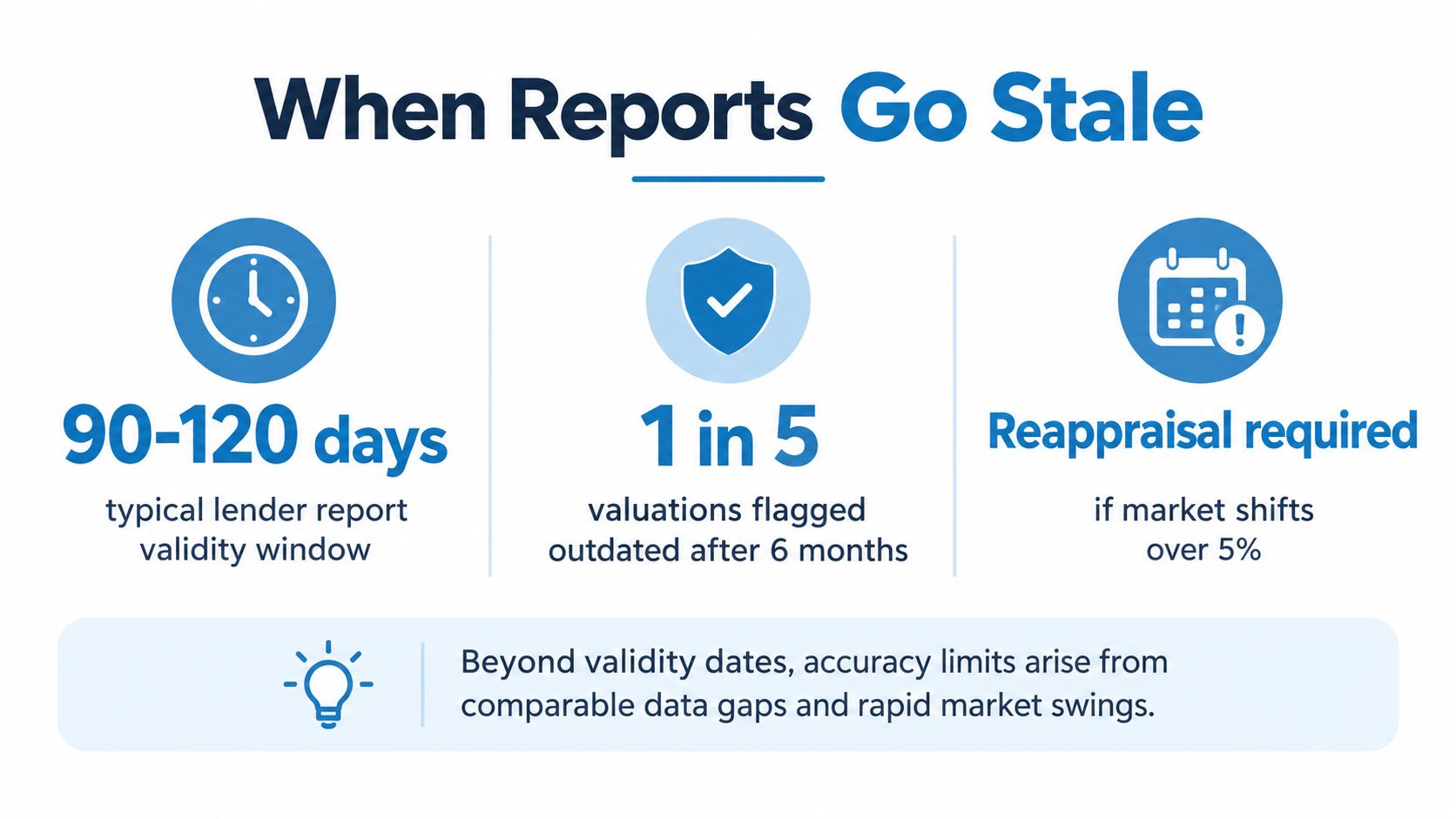
A risk-based expiration policy fits the decision. Portfolio monitoring may use automated refreshes to detect movement, while mortgage or insurance underwriting may require a new inspection or professional update. In either workflow, staleness is a data-quality condition that should trigger a defined action, not merely a calendar check.
How Do BatchData AVMs and APIs Automate Valuation Workflows?
An API-based valuation workflow converts property records, comparable sales, AVM outputs, ownership details, and monitoring events into machine-readable inputs for underwriting and investment systems. The practical gain is repeatability: systems can make the same calls, apply the same validation rules, and route exceptions without relying on repeated manual lookups.
Start with a stable property identifier and a normalized subject record. Retrieve current property characteristics and valuation signals, then store each response with its timestamp, source context, confidence information, and intended workflow. A portfolio-screening value should not be treated as approval for a formal lending decision.
A production workflow
Ingest and normalize. Resolve addresses and parcel identifiers, standardize property types, and retain source-level provenance. A faulty match can attach the wrong valuation to an asset and contaminate downstream portfolio analysis.
Retrieve valuation evidence. Pull AVM estimates, comparable sales, equity signals, mortgage and lien information, listings, permits, and other attributes required by the decision. Store each response as a dated observation, rather than overwriting the previous value. Standardized appraisal fields can sit alongside these observations, giving teams a consistent structure for comparing model output with documented property evidence.
Apply decision rules. Route assets by property type, valuation confidence, change from the prior observation, missing data, and intended use. A customized property with sparse comparable sales should receive analyst review even when the API returns a value.
Monitor changes. Trigger a refresh when ownership, listing status, permits, liens, property condition, or market evidence changes. Record the reason an asset entered the review queue, so analysts can distinguish a scheduled refresh from a material event.
Connect downstream actions. Send approved signals to underwriting, investment screening, servicing, or marketing systems. BatchRank-style propensity modeling can prioritize high-intent seller opportunities, but propensity output belongs in a separate workflow from collateral value and credit risk.
BatchData provides property records, valuation data, comparable-sales inputs, owner contact enrichment, and APIs for automated property workflows. Teams can use these capabilities for valuation-based screening, equity tracking, portfolio monitoring, and outreach while keeping the structured data current rather than treating one static report as the final source of truth.
Human escalation remains part of the design. Analysts must inspect unusual assets, reconcile contradictory records, and document why a model output fits the decision being made.
Keep four layers distinct: raw source data, normalized property facts, model outputs, and final underwriting decisions. This separation supports reproducible decisions, longitudinal valuation comparisons, and diagnosis of errors caused by matching, source data, model behavior, or human judgment.
If your team needs to operationalize property valuation data, BatchData provides APIs and bulk data workflows for valuations, comparable-property analysis, ownership signals, and portfolio monitoring. Define escalation rules and connect approved outputs to the underwriting or investment workflow.