






































SEO Title: Due Diligence Reporting for Real Estate Decisions
Meta Description: Learn what due diligence reporting should include, which KPIs matter, and how API-driven workflows improve real estate review quality.
Meta Keywords: due diligence reporting, real estate due diligence, property due diligence report, lien search, title review, AVM valuation, underwriting workflow, due diligence automation
Due diligence reporting is a multi-billion-dollar professional category, not a clerical afterthought. The global due diligence market was valued at $45.2 billion in 2022 and was projected to grow at an 8.3% CAGR from 2023 to 2030, while separate market research places the due diligence investigation market at $8.18 billion in 2025, $8.82 billion in 2026, and $11.83 billion by 2030 with a 7.8% CAGR according to the compiled market figures here. That scale tells you something simple. Operators, lenders, and investors have stopped trusting informal review.
If your report can't support a credit decision, a purchase price adjustment, or an escalation to counsel, it isn't a due diligence report. It's a packet. Good due diligence reporting assembles property facts, ownership evidence, lien exposure, condition findings, and valuation checks into one auditable decision file.
Here's the short version:
- A real report is evidence-led: it ties every conclusion to a source record, inspection item, or financial support.
- A usable report is structured for action: pass, renegotiate, escalate, or walk.
- A scalable report is machine-readable: your underwriting stack should be able to query it later.
- A modern report isn't a checklist: it's a decision-grade data assembly problem.
That distinction changes how you build the workflow, what you collect, and which tools belong in the stack.
What Due Diligence Reporting Actually Covers
Due diligence reporting is a structured review of an asset, borrower, seller, or counterparty before capital is committed. Sloppy reports cost money because they blur what matters: who owns the asset, what burdens it, what shape it's in, and whether the economics survive scrutiny.
What counts as due diligence reporting
A lot of teams still confuse diligence with appraisal, inspection, or title alone. That's wrong. An appraisal gives you an opinion of value. An inspection gives you observations. A title commitment gives you recorded interests and exceptions. Due diligence reporting pulls those threads together into one decision document.
For real estate, that usually means combining:
- Property identity: address normalization, parcel match, legal description, situs consistency
- Ownership proof: deed vesting, transfer history, entity linkage
- Encumbrances: mortgages, tax issues, judgments, HOA claims, lis pendens
- Physical condition: deferred maintenance, life-safety issues, capital needs
- Cash-flow support: rent roll, trailing operations, taxes, vacancy, normalized earnings logic where applicable
If you want a plain-language refresher on the transaction phase itself, a practical due diligence overview is useful for framing how findings affect closings and negotiations.
What good reports do that checklists don't
The best reports don't just summarize documents. They convert fragmented evidence into a single auditable record that someone can act on fast. That matters in acquisitions, refinances, REIT underwriting, warehouse line reviews, and construction lending. The transaction type changes. The reporting logic doesn't.
Practical rule: If a reviewer can't trace a conclusion back to a deed, tax record, inspection note, operating statement, or recorded lien, strike the conclusion.
Technical diligence in commercial property is a good example. A proper review is a systematic review of the physical characteristics of the asset and/or land, usually covering structure, building services, site conditions, and related risks. The report becomes useful only when it turns inspection findings into an action list with timing, cost implications, and remaining useful life estimates for major systems as described here.
For teams that still work from loose PDFs and email threads, a standardized property profile is the minimum starting point. This is why many operators move toward property profile reports that standardize the core record before anyone starts arguing about risk.
Where people waste time
Overkill usually shows up in the wrong places. Teams spend hours polishing narrative text while leaving basic identity mismatches unresolved. That's backwards. Fix the canonical property record first. Then verify ownership. Then clear encumbrances. Narrative comes last.
A report earns trust when it answers four questions without ambiguity:
- What exactly is the asset?
- Who controls it?
- What can impair transfer, value, or financing?
- What needs to happen next, and by when?
Core Components Every Report Must Assemble
Every due diligence report should assemble six data layers, and each layer needs defined outputs. If a section can't produce a decision-useful output, it doesn't belong in the report.
The minimum component set
| Component | Key Data Fields | Minimum Report Output |
|---|---|---|
| Property | Parcel ID, normalized address, legal description, lot size, building area, zoning, FEMA flood zone, last sale history | Confirmed asset identity and location risk summary |
| Legal | Vesting deed, transfer history, entity ownership, corporate filings, beneficial ownership linkage | Verified control chain and ownership exceptions |
| Financial | Rent roll, T-12 operating statement, vacancy, expense ratios, trailing tax bills | Underwriting-ready income and expense summary |
| Title | Chain of title, easements, covenants, restrictions, title exceptions | Transferability and title burden summary |
| Liens | Mortgage records, tax delinquencies, judgments, lis pendens, HOA dues | Encumbrance stack and payoff or cure flags |
| Condition | Inspection findings, capital needs, repair ranges, useful life estimates | Immediate repairs, deferred maintenance, capex watchlist |
What each layer needs to prove
Start with property. You need a clean parcel match, not just a mailing address. Addresses drift. Parcel identifiers don't. Lot size, building size, zoning, flood zone, and sale history tell you whether you're even underwriting the correct thing.
Then move to legal control. Vesting isn't enough if the seller sits behind multiple entities. Follow transfer history, entity registrations, and filings until you can explain who controls the asset and who has signing authority. If you can't map control clearly, escalate early.
Financial review is where teams either get disciplined or get fooled. In transaction work, good financial due diligence increasingly means reconciling reported statements, tax returns, management accounts, and general ledger data into one adjusted earnings figure, documenting each add-back and testing it against bank statements over a trailing twelve-month period and prior fiscal years as outlined here. In property deals, use the same mindset even when you aren't building full adjusted EBITDA. Reconcile the rent roll to collections, taxes, concessions, and actual operating leakage.
The report should expose distortions, not repeat them neatly.
Why title and liens deserve separate treatment
A lot of junior teams blur title and liens into one section. That creates bad calls. Title tells you the legal framework of ownership and recorded exceptions. Liens tell you what gets paid, cured, bonded around, or negotiated before closing.
Keep them separate because the remedies are different:
- Title issues often require endorsements, curative work, or legal review.
- Lien issues often require payoff verification, reserve treatment, or closing adjustments.
- Condition issues usually require pricing, escrows, or repair covenants.
For commercial real estate, the report package should also fit the deal type. Lender-driven diligence commonly centers on a Phase I ESA, PCA, title report, ALTA survey, zoning report, and appraisal, with deeper follow-up such as Phase II, seismic, structural, or capital-needs work only when the first pass surfaces risk as summarized here. That's the right approach. Universal checklists waste money.
A standardized due diligence checklist helps, but only if every item resolves to an output with a confidence level. Every layer should end with a confidence score, not a yes-or-no box. Clean, conflicted, missing, or unverifiable are not the same result.
The Stepwise Workflow Behind a Clean Report
A clean report comes from a staged workflow with controls at each handoff. Flat checklists produce flat thinking.
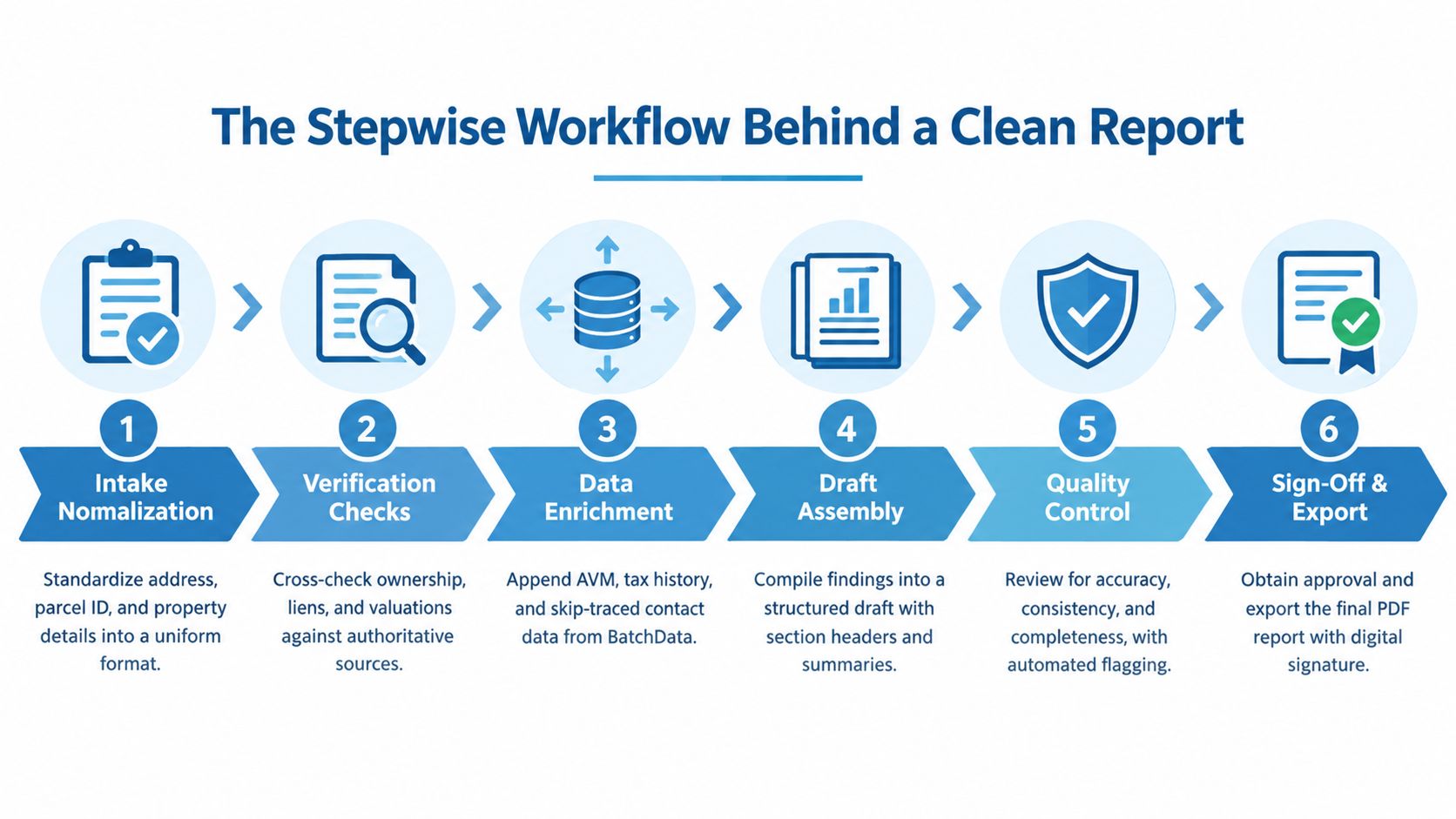
Intake normalization
The first job is to standardize the asset identity. Normalize the address, parcel ID, owner name, and transaction reference before you pull anything else. If intake is dirty, every downstream feed gets noisier.
I want one canonical record at this stage. One parcel, one owner string, one deal identifier, one folder structure.
Parallel acquisition and reconciliation
Stage two is data acquisition. Pull public records, assessor data, deed history, lien registries, valuation data, and borrower-provided documents in parallel. Sequential pulls are slow and they hide conflicts until the end.
Then reconcile. Square footage, owner names, assessed values, and transfer dates should be cross-checked across multiple sources with tolerance rules. Minor mismatches happen. Unexplained mismatches don't get waived.
Use a simple sequence:
- Pull broad first: property, deed, tax, lien, and market records.
- Compare key fields: parcel, owner, situs, legal description, area, sale dates.
- Trigger exceptions: route anything inconsistent into a manual review queue.
- Freeze the base file: once resolved, lock the canonical facts for draft assembly.
Financial and condition mapping
Once the asset record is stable, map operating data and condition findings into underwriting assumptions. Rent roll should tie to occupancy and collections. Tax bills should tie to the expense load. Inspection findings should tie to reserves, repairs, and post-close capex.
This is also where commercial property diligence benefits from discipline borrowed from regulated sectors. Reports increasingly need clear provenance and repeatable review logic because due diligence has shifted toward formal reporting obligations, particularly after major EU milestones such as the Anti-Tax Avoidance Directive in 2016, the 2019 amendments to the Directive on Administrative Cooperation with implementation due by June 30, 2020 and reportable arrangements starting from June 25, 2018, and the 2024 adoption of the Corporate Sustainability Due Diligence Directive as discussed in this market report overview.
If your process can't show who reviewed a line item, when they reviewed it, and what source they relied on, it won't survive serious scrutiny.
Risk scoring and sign-off
The final stages are exception drafting, risk scoring, and packaging. Every flagged issue should have a severity level, a recommended action, and a named owner. That output then gets locked into a report with timestamps, supporting references, and reviewer sign-offs.
I don't want anonymous edits. I want accountability. The final document should answer later challenges without forcing the team to reconstruct what happened from emails.
KPIs and Red Flags That Decide the Deal
The point of due diligence reporting is triage. A good report lets you decide in minutes whether to pass, renegotiate, or walk.
The trigger matrix
| KPI | Acceptable Range | Red Flag Trigger |
|---|---|---|
| Loan-to-value | Within lender or fund policy | Leverage outside policy or unsupported by collateral evidence |
| Debt service coverage ratio | At or above required credit threshold | Gap against underwritten minimum |
| Cap rate spread to submarket | In line with local market logic | Pricing that assumes an unjustified premium |
| Days on market delta | Consistent with asset class and submarket conditions | Marketing time that implies weak demand or stale pricing |
| Ownership entity layering depth | Simple, explainable control chain | Complex layering that obscures control or signing authority |
| Lien-to-value ratio | Encumbrances supportable by asset value | Burden stack that narrows refinance or exit options |
| Code violations per parcel | Minor, cured, or explainable | Active violations with life-safety, habitability, or permit risk |
The red flags that matter immediately
Not every issue deserves the same response. Some findings should stop the file cold.
Watch for these first:
- Undisclosed second-position liens: they change payout math and can kill proceeds.
- AVM below purchase price by more than 10 percent: that's a hard re-underwrite signal, not a formatting note.
- Owner-of-record changes inside 90 days of contract: fast flips and late transfers deserve explanation.
- Expired certificate of occupancy: occupancy risk isn't a footnote.
- Name mismatches across deed, tax, and borrowing entity: control and closing authority may be broken.
The point isn't that any one of these always kills a deal. The point is that each should trigger an immediate escalation path.
Use KPIs to force action
Reports fail when KPIs are descriptive instead of operational. "High" is useless. "Escalate if leverage breaches policy" is useful. "Complex ownership" is vague. "Escalate if ownership chain cannot be tied to a beneficial owner with filing support" is usable.
One weakness I see constantly is the implementation gap. In an OECD-based global survey of 10,000 firms, 45% said they had due diligence policies and management systems, but only 25% identified impacts and just 20% addressed those impacts as summarized in this OECD-based discussion. That's exactly what bad property reports do. They describe risk without forcing a decision.
A KPI belongs in the report only if it can trigger a clear next step.
Template Reports vs API-Driven Reports
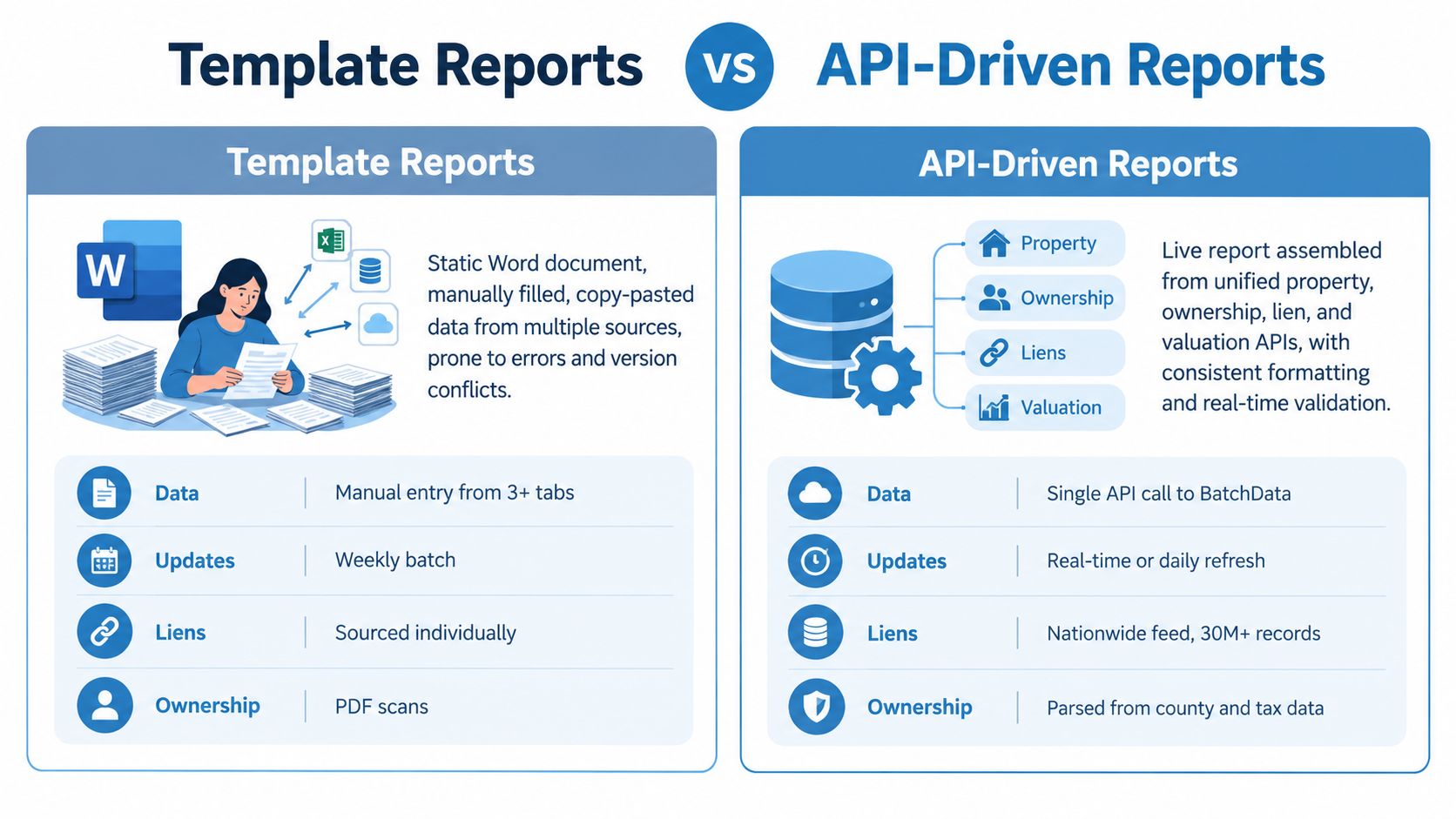
Manual template reports and API-driven reports are not the same product. One is a document. The other is a living data assembly process.
Side-by-side comparison
| Reporting Model | Strengths | Weaknesses | Best Use |
|---|---|---|---|
| Manual template | Familiar, easy to circulate as PDF, flexible narrative | Copy-paste risk, weak source freshness, poor audit trail, hard to scale | One-off bespoke reviews |
| API-driven report | Canonical parcel record, timestamped retrieval, easier refresh, machine-readable outputs | Requires setup, field mapping, and governance | Repeated underwriting, portfolio monitoring, lender workflows |
| Hybrid model | Keeps narrative summary while automating factual layers | Can drift if manual edits overwrite source truth | Teams migrating from manual processes |
What changes structurally
A Word template assembled by hand fragments facts across tabs, screenshots, PDFs, and analyst notes. That's slow, but speed isn't the biggest problem. The problem is provenance. You often can't tell whether a field is current, whether it came from a county source or a broker email, or whether someone retyped it incorrectly.
An API-driven report fixes the structure first. It starts with a canonical parcel or loan record, stamps each retrieval with a timestamp, and allows regeneration when ownership, valuation, or lien conditions change. That means your diligence file can support portfolio analytics later instead of dying as a static PDF attachment.
For teams considering automation paths, this overview of due diligence automation is useful because it frames automation as evidence collection and exception handling, not just faster report writing.
This walkthrough helps visualize the difference in practice:
What AI actually helps with
AI shortens cycle time in the parts humans are bad at. Classification. Extraction. Reconciliation prompts. Draft section assembly. It does not replace judgment on title defects, unsupported income, legal exposure, or pricing strategy.
Use AI for:
- Document sorting: classify leases, deeds, loan docs, estoppels, and inspection files
- Field extraction: pull parties, dates, balances, exceptions, and clauses into structure
- Conflict surfacing: flag name variance, transfer chronology issues, and duplicate records
- Draft generation: build the first pass of summary text from verified fields
Don't use AI as a substitute for source verification. If the model can't point to the record, the field doesn't belong in the final sign-off pack.
Wiring BatchData Into the Reporting Stack
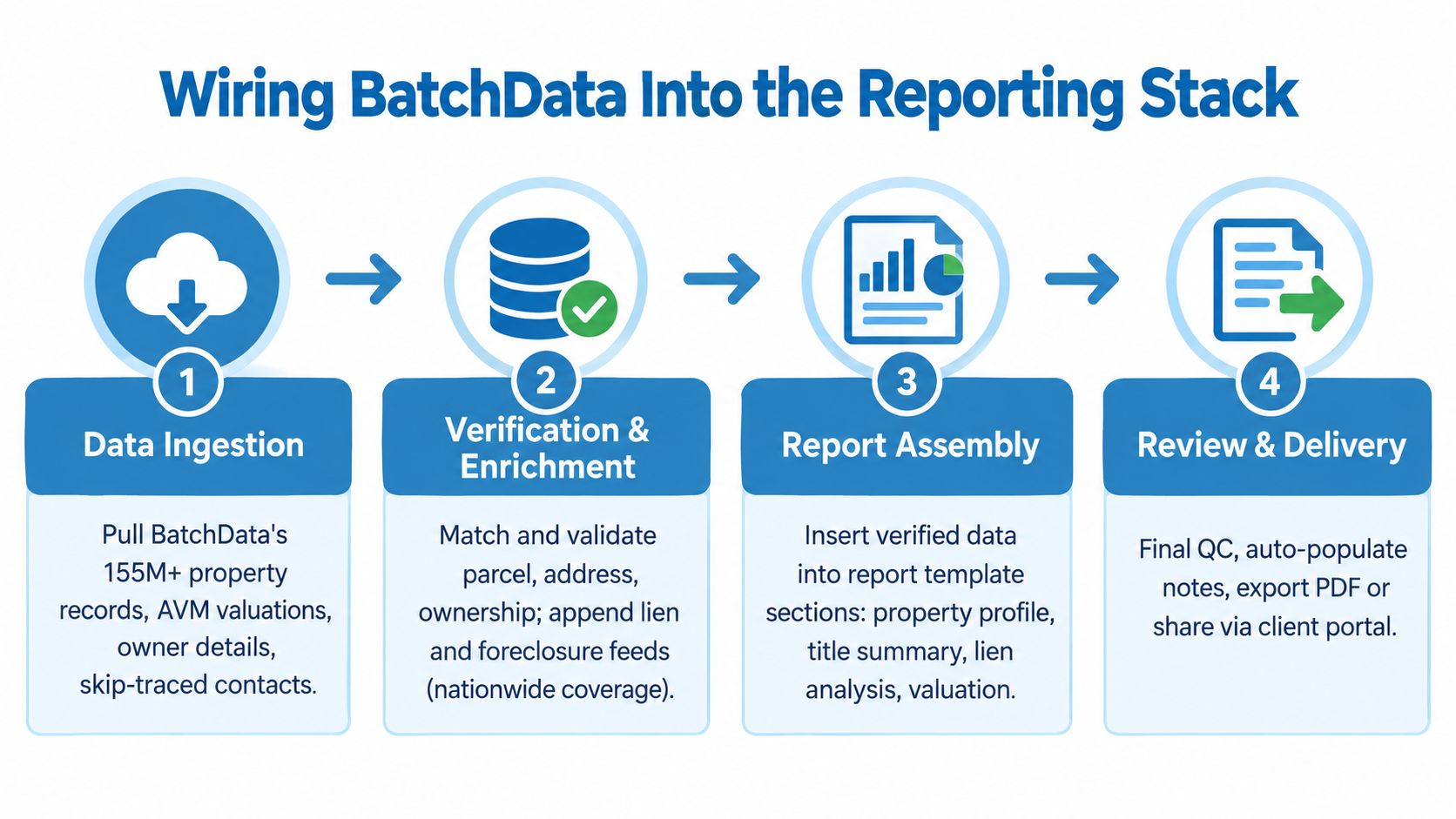
The fastest way to improve due diligence reporting is to feed the workflow from unified property, ownership, valuation, and lien data instead of stitching sources manually.
Where the data fits
At intake, you want address and parcel normalization immediately. In the property layer, you want lot size, structure details, sale history, and ownership history attached to the same record. In the legal and lien layers, you want recorded-document context and encumbrance signals before you waste time drafting around avoidable surprises.
BatchData fits here as one option for teams that need unified data inputs. The platform offers 155M+ U.S. property records, AVM valuations, owner details, skip-traced contact data, and nationwide lien and foreclosure feeds, which makes it usable for intake enrichment, ownership verification, valuation checks, and early encumbrance screening.
How operators should implement it
The cleanest setup usually looks like this:
- Scheduled jobs: refresh watchlists, portfolios, and pending files on a set cadence
- Webhook triggers: push alerts when a monitored record updates
- Direct API calls: populate report sections in real time during intake or underwriting
- Bulk delivery: load portfolio baselines into your warehouse for historical comparison
That architecture matters because due diligence reports shouldn't be dead-end documents. They should sit on top of a maintained data layer that your servicing, compliance, and portfolio teams can query later.
Build the reporting stack so analysts review exceptions, not raw records.
Where teams get immediate lift
The fastest gains usually come from four insert points:
- Intake enrichment for address, parcel, and ownership cleanup.
- Pre-title screening for liens, mortgages, foreclosure activity, and transfer oddities.
- Valuation cross-checks using AVMs alongside internal pricing assumptions.
- Outreach support with owner contacts for estoppels, violations, and cure discussions.
That's enough to compress cycle time and raise confidence before you touch more expensive outside review.
Operator Playbook for Faster, Sharper Reports
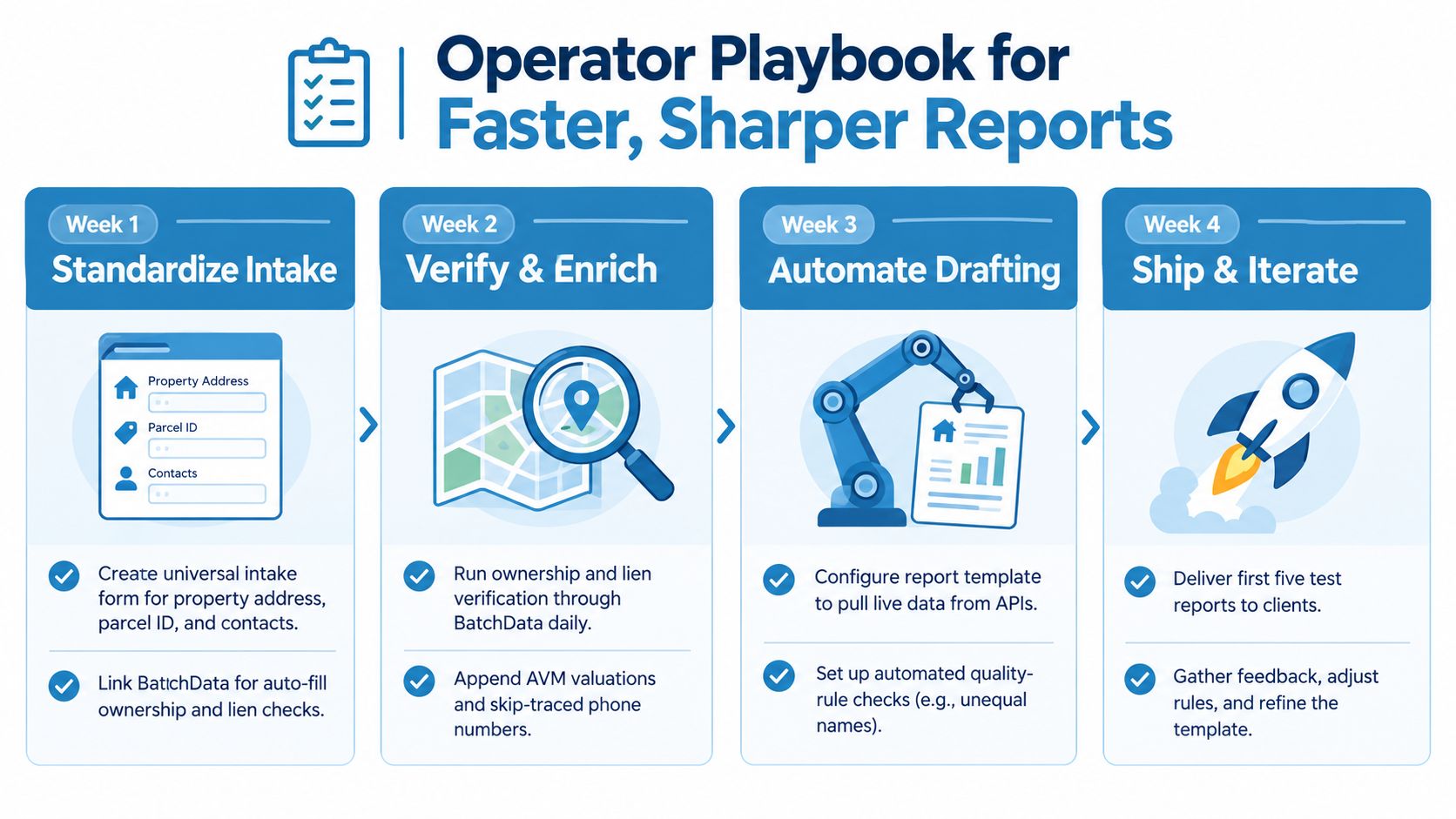
You can ship a better due diligence reporting workflow in 30 days if you stop waiting for perfect system design.
What to launch first
Day one priorities are boring, and that's why they work:
- Standardize intake: one form for property address, parcel ID, borrower or seller name, and deal type
- Verify ownership and liens immediately: don't let analysts start narrative work before this clears
- Take a valuation snapshot: establish your opening benchmark
- Use a fixed report shell: same section order, same risk labels, same sign-off path
What to automate next
In the next stretch, automate the pieces analysts shouldn't be rekeying:
- Property record pulls
- Owner contact enrichment
- Condition scoring inputs
- Draft section population
- Exception routing based on mismatched fields
Then spend the remainder of the month wiring in red-flag triggers, dashboard KPIs, and shadow testing against your legacy process. Compare outputs. Find misses. Tighten the rules.
The three escalations nobody should waive
These are essential:
- Undisclosed lien holders
- Last-minute ownership changes
- Material variance between automated AVM and broker price opinion
If your analysts can override those without documented escalation, your controls are weak. Fix that first.
The point of the playbook isn't elegance. It's decision speed with defensible evidence.
BatchData gives real estate teams access to property records, valuations, owner data, and lien signals that fit directly into modern due diligence reporting workflows. If you're still assembling reports from scattered PDFs and manual searches, visit BatchData and evaluate whether a unified data layer would clean up your intake, verification, and exception handling.