





































Data-driven decision making is the discipline of using evidence to choose and validate an action, not relying on instinct alone. In real estate, that means filtering candidate zip codes for acquisition by rent-to-price ratio, days-on-market trends, and comparable-sales absorption instead of selecting neighborhoods because they feel promising.
The popular advice, “just use more data,” misses the operational problem. Teams often have plenty of records but can't retrieve, reconcile, or trust them quickly enough to affect a decision. Independent reporting found that 76% of enterprises made decisions without consulting available data because access was too difficult, while 64% couldn't reliably access data for decision-making (Nexus Press research on data access barriers).
A practical definition of DDDM includes four linked capabilities:
- Evidence: Property, ownership, transaction, market, and engagement signals are available.
- Method: The team states how those signals influence a decision.
- Action: The result enters underwriting, CRM, marketing, or servicing workflows.
- Feedback: Actual outcomes are measured and used to improve the next decision.
The sections below connect those capabilities to acquisition, portfolio operations, marketing, governance, and AI readiness. The central lesson is simple: data only creates value when a real-estate team can move from accessible records to a repeatable action.
What Data-Driven Decision Making Really Means
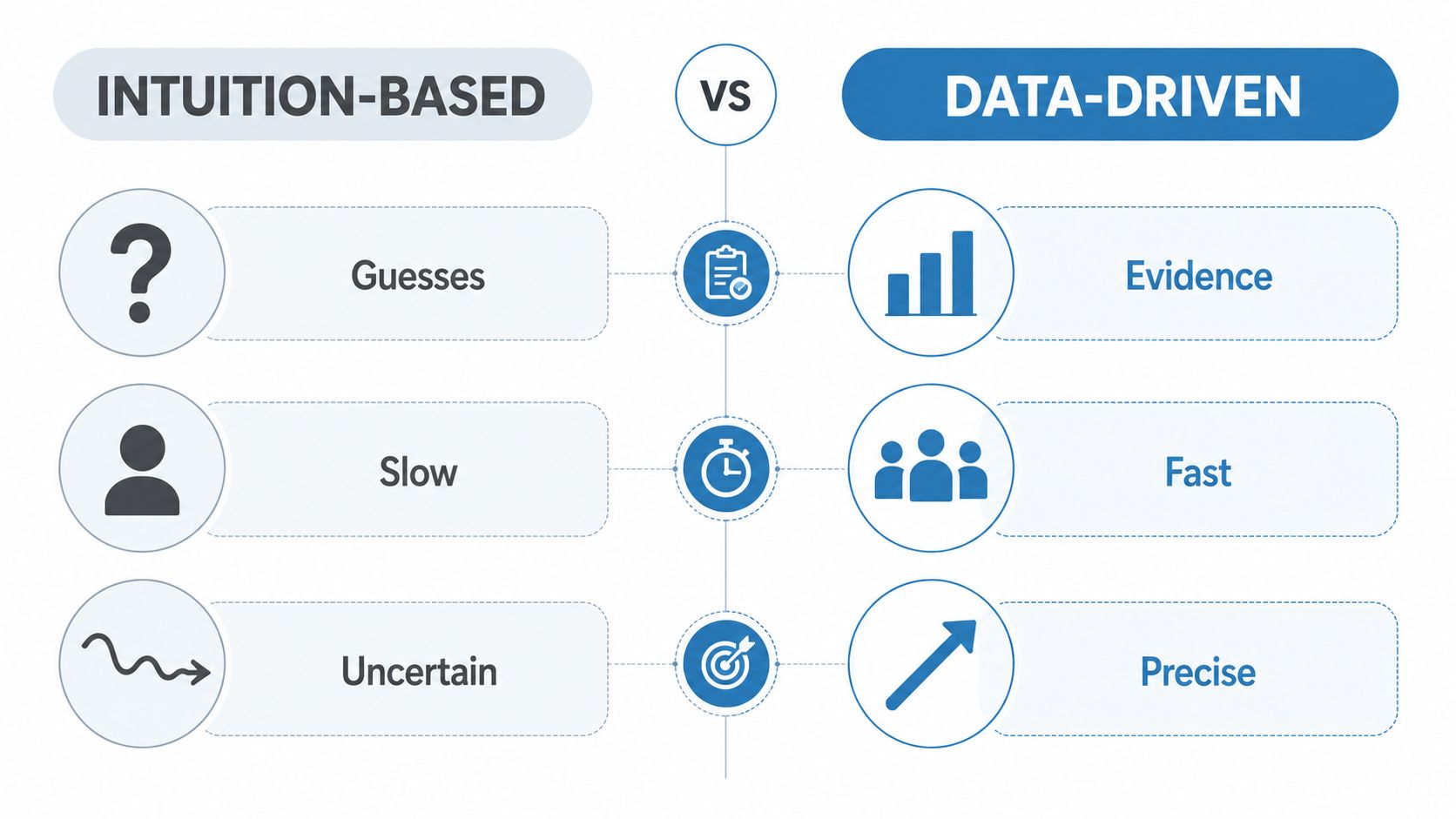
Data-driven decision making is the discipline of choosing actions by testing them against measurable evidence rather than instinct, anecdote, or the loudest opinion in the room. It doesn't eliminate professional judgment. It gives judgment a visible basis that another person can inspect, challenge, and improve.
Consider a single-family rental rollout. An intuition-led operator might choose three zip codes because a broker knows the area, recent listings look attractive, and local demand feels strong. A data-led operator starts with the same candidate list, then applies a stated filter using rent-to-price ratio, days-on-market trend, and absorption rate from comparable sales. The first approach can produce plausible choices. The second produces traceable and reviewable choices.
IBM describes DDDM as using data to inform decisions and validate a course of action before committing to it, rather than relying on intuition alone (IBM's definition of data-driven decision making). That distinction matters in real estate because the decision usually involves several linked assumptions, including achievable rent, resale liquidity, owner motivation, renovation cost, and financing risk.
The three properties of a real decision
A decision qualifies as data-driven when it has:
- Measurable inputs. The team can name the fields used, such as parcel identifier, assessed value, mortgage balance, listing history, or lead response.
- A stated method. The team can explain the rule, score, model, threshold, or comparison that converts inputs into a recommendation.
- A feedback loop. The team compares the recommendation with the outcome, such as accepted offers, realized rent, time to disposition, or renewal behavior.
If a manager can't identify the source record, calculation, or outcome review, the process may still be useful, but it remains opinion-driven in disguise. A dashboard that nobody uses in the next workflow is reporting, not decision intelligence. The operational distinction is explored further in this analysis of data overload and decision intelligence in modern proptech.
How DDDM Evolved Into a Core Business Discipline
Data-driven decision making became mainstream as organizations gained the ability to combine statistics, reporting, and analytics with operating decisions. The path from static reports to predictive systems is especially clear in real estate, where each technology era changed what an acquisitions or brokerage team could know before committing resources.
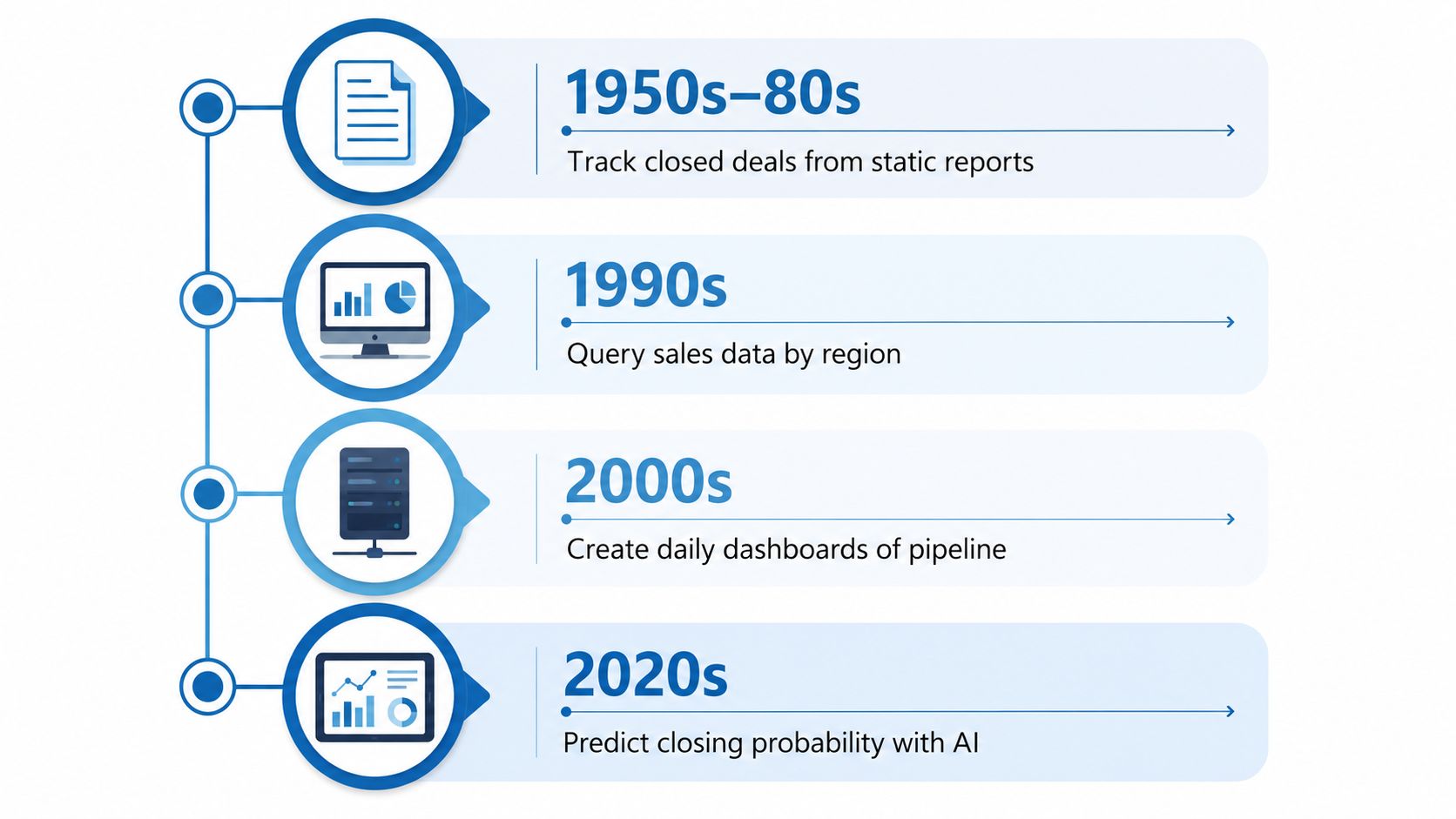
In the 1950s and 1960s, computers processed data and generated reports. A real-estate organization could use those systems to summarize closed transactions, but the output was primarily historical. An analyst could confirm what had happened, such as sales volume or revenue, after the event.
During the 1980s and 1990s, data warehousing and business-intelligence tools made it easier to store and analyze larger information volumes for marketing, sales, and operations (historical overview of DDDM and business intelligence). In a property operation, that capability meant pulling comparable sales or regional performance records on demand rather than assembling separate reports manually.
From description to prediction
The next shift was operational visibility. Business-intelligence dashboards brought pipeline, lead-source, list-to-sale, and inventory indicators into recurring management routines. Brokerage leaders could see movement in the funnel instead of waiting for an end-of-period report.
Modern stacks add geospatial data, propensity modeling, APIs, and automated enrichment. An operator can score properties or leads before allocating capital, then route the result into a CRM, underwriting sheet, or portfolio-monitoring workflow. The discipline is no longer limited to describing the past. It can support a forward-looking question, such as which owner segment deserves contact first or which asset requires review.
The underlying principle hasn't changed. Better infrastructure expands the decision window. The team that can access, compare, and validate signals before an offer or campaign has more control than a team that only receives a polished report after the decision is already made.
The Business Value Real Estate Teams Capture
The business case for DDDM is stronger when leaders connect analytics to operating metrics instead of describing it as “better reporting.” Research linked to MIT found that companies adopting data-driven decision making achieved output and productivity 5–6% higher than expected, after controlling for other investments and IT usage (MIT research brief on data-driven productivity). A separate peer-reviewed paper associated data-driven methods combined with analytics investment with an approximately 9–10% productivity increase (peer-reviewed analysis of DDDM and productivity).
For a real-estate operator, productivity can mean an analyst reviews fewer low-probability properties before sending a shortlist to investment committee. In a portal funnel, it can mean routing high-intent leads to the right agent sooner. In servicing, it can mean identifying a vacancy or default risk before the portfolio absorbs the full cost.
A global business survey reports that around 25% of organizations make nearly all strategic decisions data-driven, while 44% make most decisions data-driven. The same source reports that 90% of enterprise businesses say data is becoming increasingly important to their overall business (global DDDM survey and performance benchmarks).
| DDDM Gain | Real Estate Metric | Directional Impact |
|---|---|---|
| More productive analysis | Analyst review time, properties screened per cycle | Less manual review of weak opportunities |
| Better acquisition targeting | Qualified-lead rate, cost per funded deal | More capital directed toward viable prospects |
| Stronger customer acquisition | Listing appointments per agent, lead-to-close movement | Better prioritization across channels |
| Improved retention | Renewal behavior, managed-portfolio retention | Earlier intervention on accounts showing risk |
| Lower operating risk | Forecast versus realized performance, default monitoring | Faster escalation when assumptions deteriorate |
Independent business analysis also reports that highly data-driven organizations are 23 times more likely to excel at customer acquisition, about 19 times more likely to maintain profitability, and nearly seven times more likely to retain customers (business outcomes associated with DDDM). Those figures don't translate automatically into a real-estate return. They do show why funding data governance, tooling, and training can be a management investment rather than a discretionary dashboard expense.
A Practical Four-Stage Implementation Framework
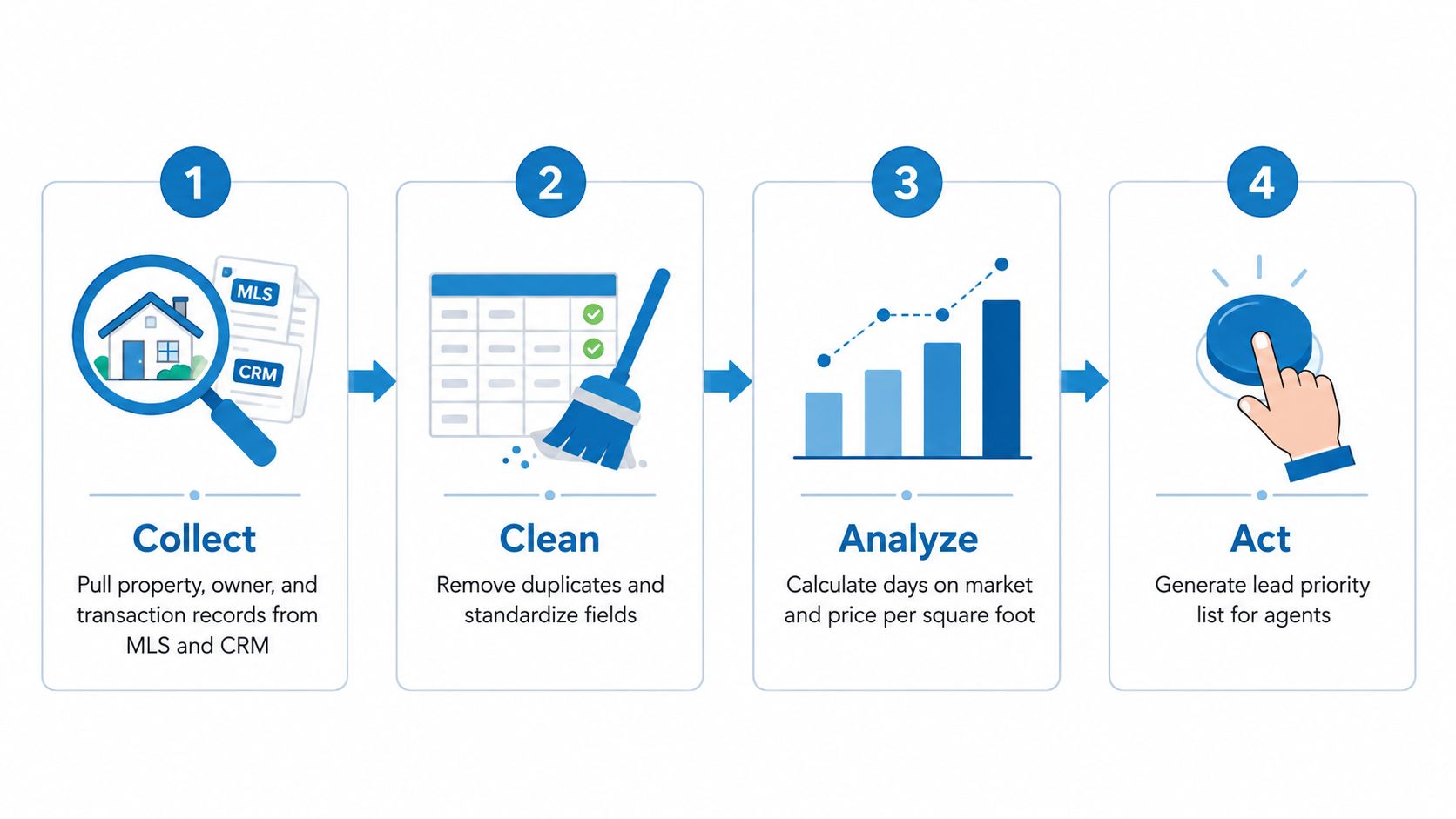
A real-estate team can operationalize DDDM through a four-stage pipeline: collect, govern, model, and act. The sequence matters because a score built on unmatched or stale parcels can create false confidence.
Collect the signals. Bring property, owner, transaction, market, and engagement records into an addressable layer. Sources can include public records, MLS data, CRM activity, listing platforms, permits, mortgage information, and servicing systems. For example, an acquisitions team might assemble parcel characteristics, ownership history, recent sale activity, and contact records for properties in a target county.
Govern the identity and quality. Assign a data steward, deduplicate records by APN or parcel ID, standardize addresses, and document the refresh cadence. If one system identifies a property by street address and another by parcel identifier, the team needs a matching rule before it calculates portfolio or neighborhood metrics. Research on operational data use identifies compatibility, coverage, interoperability, quality, IT systems, and analytical methods as determinants of success (Route Fifty analysis of data-driven decision challenges).
Model the decision. Convert governed records into transparent scoring rules or propensity models. Examples include absentee-owner likelihood, equity band, distress probability, vacancy risk, or predicted lead priority. Validate the model against a holdout or against outcomes that weren't used to create the rule. A score should explain which signals influenced it and what decision it is designed to support.
Act in the next workflow. Send the output into the CRM, dialer, underwriting worksheet, or portfolio queue. An owner-priority score has little value if analysts must export it manually and agents won't see it until the next campaign. The score should affect the next call list, review queue, offer decision, or intervention.
A useful implementation principle is to align every dataset and model with a defined business outcome, rather than collecting records because they might become useful later. Teams can apply the same discipline through a guide to aligning data strategy with business goals.
KPIs and Benchmarks That Actually Matter
A KPI belongs in a DDDM program only when a team can influence it and connect it to a decision. Vanity measures, such as total records acquired or dashboard logins, may describe activity without showing whether underwriting, marketing, or servicing improved.
The available evidence supports broad performance gains, but it doesn't provide verified proptech operating ranges for lead-to-close rate, equity capture, or time-on-market. The table therefore uses decision role rather than invented benchmark numbers. Managers should establish a baseline from their own historical records before setting targets.
| KPI | Category | Benchmark Range | What Better Data Improves |
|---|---|---|---|
| Cost per qualified lead | Acquisition efficiency | Establish an internal baseline | Audience selection, contact verification, channel allocation |
| Lead-to-close rate | Acquisition efficiency | Establish an internal baseline | Lead scoring, follow-up priority, source comparison |
| Average time to first contact | Acquisition efficiency | Establish an internal baseline | Routing, alerts, staffing, outreach sequencing |
| Equity capture ratio | Underwriting accuracy | Establish an internal baseline | Offer assumptions and owner-segment selection |
| Forecast versus realized ARV variance | Underwriting accuracy | Establish an internal baseline | Valuation review and model calibration |
| Default rate on scored segments | Risk monitoring | Establish an internal baseline | Early-warning rules and intervention timing |
| Time on market | Portfolio monitoring | Establish an internal baseline | Pricing, renovation, disposition decisions |
| Days to disposition | Portfolio monitoring | Establish an internal baseline | Workflow bottleneck detection |
| Occupancy retention | Portfolio monitoring | Establish an internal baseline | Renewal outreach and vacancy prevention |
| Channel-level acquisition cost | Marketing ROI | Establish an internal baseline | Budget movement toward productive channels |
| List-to-contract conversion | Marketing ROI | Establish an internal baseline | Segment definition and campaign design |
How to use the numbers you already have
Start with two anchor KPIs, not a sprawling dashboard. An acquisitions team might pair lead-to-close rate with time to first contact. A rental operator might pair forecast-versus-realized performance with days to disposition. A servicer might pair occupancy retention with a property-level risk indicator.
Each KPI needs a decision owner, source definition, refresh expectation, and review cadence. Technical research describes analytics as an indirect performance lever because it improves decision accuracy, timeliness, relevance, and actionability (research on analytics, decision quality, and performance). That means a metric is useful only when its definition matches the decision window and the team can do something with the result.
Real Estate Use Cases From Acquisition to Servicing
The same unified data layer can support different decisions across the property lifecycle. The value compounds when acquisition, portfolio, and marketing teams work from consistent property and ownership identities instead of building disconnected lists.
Acquisition underwriting
An acquisitions group scores 8,000 absentee owners in a target county, then filters to the top decile by equity and tenure. The analysts still review title, condition, valuation, and local market context, but they start with a prioritized universe instead of treating every record equally. The planned operating result is to reduce analyst review time by more than half, though that outcome must be measured against the team's own baseline rather than assumed.
The decision isn't “buy every high-equity property.” It is “allocate scarce review time to owners whose observable characteristics fit the acquisition thesis.” The score narrows the queue. Human diligence determines whether a property survives.
Portfolio monitoring
A servicer monitors a 12-building multifamily portfolio using occupancy, payment, property, and market signals. When modeled vacancy risk crosses the team's defined threshold, the servicer triggers a review of leasing velocity, pricing, concessions, and capital needs. The operator can then re-trade or intervene before net operating income deteriorates.
The model doesn't replace asset management. It changes when asset managers investigate. Instead of waiting for a monthly result to confirm a problem, the team uses an early signal to open a decision process.
Marketing and owner outreach
A brokerage routes SMS campaigns by owner segment. High-equity, long-tenure owners receive outreach from a senior broker, while colder lists enter a lower-touch sequence. The same property and ownership records used for acquisition can support contact selection, suppression rules, personalization, and response measurement.
A common data layer matters. If marketing can't reconcile lead history with ownership and transaction history, the team may contact the wrong person, repeat an old message, or misread campaign performance. DDDM becomes practical when each output reaches the employee who must act on it.
Operational test: If the model produces a list but no workflow assigns the next action, the organization has built an analytical artifact, not a decision system.
Why Most Data-Driven Programs Stall
The most common failure isn't a lack of enthusiasm for analytics. It's a broken access and governance layer. Independent reporting found that 76% of enterprises made decisions without consulting available data because it was too difficult to access, and 64% said they couldn't reliably access data for decision-making (research on enterprise data access friction).
Real-estate operations have several predictable stall points:
- Fragmented ownership records: County assessor data, MLS records, private sources, and CRM identities may describe the same owner or parcel differently. Diagnostic question: can your team resolve one property to one governed identity without manual investigation?
- Missing or stale attributes: Inaccurate, incomplete, duplicate, or outdated data can produce flawed conclusions and misguided actions (review of data-quality decision failures). Diagnostic question: which fields does underwriting trust, and when were they last validated?
- Inconsistent geocoding: Address variation can place a property in the wrong neighborhood, school boundary, market, or service territory. Diagnostic question: does your location analysis use a standardized geographic key or a text field?
- Siloed CRMs: Marketing may hold outreach history while transactions sit in another system. Diagnostic question: can an agent see prior contact, ownership context, and deal outcome in one workflow?
- Unowned accuracy: When nobody owns a field definition or refresh policy, quality decays. Diagnostic question: who is accountable when a score conflicts with the source record?
A 2025 survey found that 67% of respondents didn't fully trust the data their organization uses, and only 12% reported that their data was AI-ready. A separate 2025 industry report said data remained siloed in 86% of organizations, limiting real-time decisions and AI potential (2025 data integrity outlook).
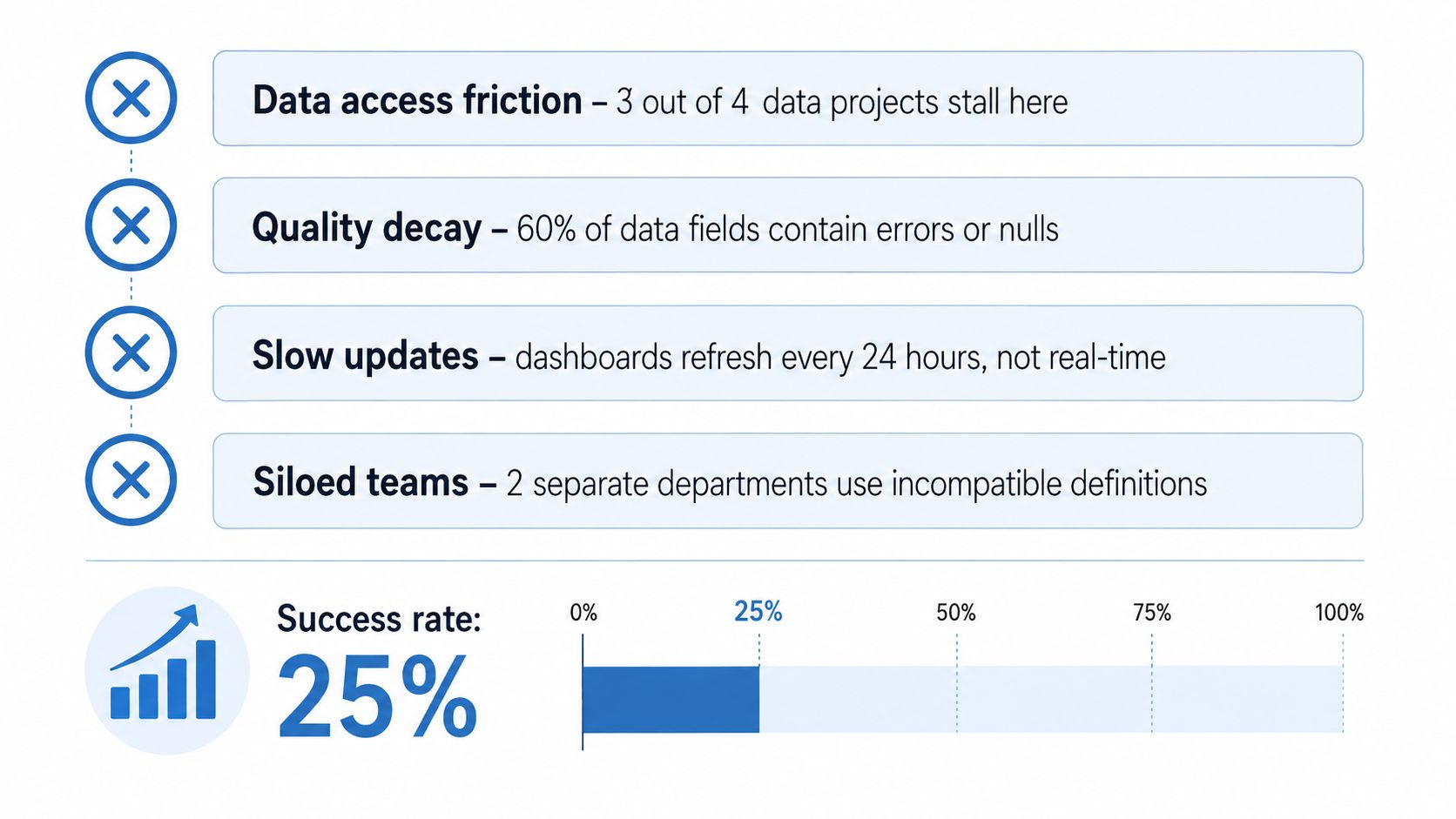
A dashboard won't fix these conditions. The practical remedy is to repair access, matching, definitions, ownership, and refresh processes before adding another layer of visualization or modeling.
Putting DDDM to Work and Preparing for AI
A 30-day starting sequence should be narrow enough for an operations lead to manage and complete:
- Audit current sources. List the systems that hold property, owner, transaction, market, and engagement data.
- Assign dataset ownership. Give one person responsibility for each source, definition, and refresh expectation.
- Choose two anchor KPIs. Select metrics tied to a decision, such as lead-to-close rate and time to first contact.
- Instrument one decision end to end. Trace a record from source through matching, scoring, workflow delivery, and outcome.
- Review weekly. Check whether users acted on the output and whether the outcome validated the original assumption.
Trust follows traceability. A team can't confidently use a propensity score if it can't identify the property record, ownership signal, model inputs, and refresh date behind that score. Poor-quality data can make analytics slower and can amplify bad assumptions, so DDDM isn't the same as collecting more data. It requires reliable, relevant, timely, and actionable evidence.
AI readiness follows the same logic. A model that predicts which homeowners may list in the next 90 days depends on unified property, ownership, and engagement signals. Machine learning can't compensate for incompatible identifiers, missing fields, or stale records. Teams building the evidence layer can also use an evidence-based signal library to improve how they define and test observable signals.
For a deeper implementation view, see this guide to AI integration and data readiness. Platforms such as BatchData can provide property and contact data through APIs and bulk delivery, with enrichment, matching, verification, and monitoring capabilities that support the access layer described above.
BatchData offers real-estate teams access to property, ownership, valuation, contact, mortgage, lien, listing, permit, and pre-foreclosure data through APIs and bulk delivery formats. Visit BatchData to evaluate whether its data access and enrichment services can connect your acquisition, marketing, underwriting, and servicing workflows.