



A UCC search can reveal a lien problem that never appears in a standard title search, and in commercial real estate that gap can change who controls critical assets attached to a property.
If you lend against business assets, buy an operating property, or build proptech workflows for underwriting, what is a ucc search is not a basic legal trivia question. It is a due diligence question tied directly to collateral priority, closing risk, and whether your data workflow can catch claims on equipment, inventory, receivables, and fixtures before money moves.
Core takeaways
- A UCC search checks public records of secured transactions filed under Article 9 to identify liens on personal property collateral before a loan or deal closes (InCorp).
- Search results matter because first-to-file or perfect generally controls priority, which is central in the $1.7 trillion U.S. commercial lending market (Wolters Kluwer).
- Real estate teams cannot treat UCC and title as separate silos when fixtures such as HVAC or built-in equipment may be subject to UCC filings (Skyline Title Support).
- Execution quality matters because the search must be run in the right jurisdiction and under the debtor’s exact legal name, not a loose variation (New York Department of State FAQ).
The practical issue is this: A UCC search is often the difference between relying on assumptions and knowing what collateral is already spoken for.
SEO Title: What Is a UCC Search? Liens, Fixtures, and Deal Risk
Meta Description: Learn what a UCC search is, what it reveals, how it affects real estate deals, and how teams can search and monitor liens correctly.
Meta Keywords: what is a ucc search, ucc search, ucc lien search, fixture filing, ucc search real estate, article 9 search, ucc due diligence, secured transactions
What Exactly Is a UCC Search and Why Was It Created
A UCC search is a search of public filing records under Article 9 of the Uniform Commercial Code to find whether a creditor has recorded a claim against a debtor’s personal property.
For real estate teams, that definition matters more than it first appears. Title work may show clean fee ownership and mortgage history, while a separate UCC filing may still reach building systems, operating equipment, lease receivables, or fixtures tied to the property’s use and value. If diligence stops at the land records, the deal team can miss liens that affect collateral, closing conditions, and post-close control.
Why the system exists
The UCC was created to standardize commercial law, which had previously been fragmented across states. The goal was practical. Credit markets needed a uniform notice system so lenders, buyers, and counterparties could check whether personal property collateral was already pledged without reworking the rules for each state.
That standardization is what made secured lending scalable.
A UCC filing does not prove ownership. It gives public notice that a secured party claims an interest in identified collateral. A UCC search tests whether that notice exists, who filed it, and whether it may interfere with the transaction in front of you.
Why this matters in real estate work
Real estate diligence often treats title and UCC as separate tracks. That is a mistake in deals involving hotels, senior housing, student housing, mixed-use projects, data-heavy buildings, energy equipment, or any property with meaningful operating assets.
The recurring problem is fixture risk. Personal property can become attached to real estate in ways that create priority questions between mortgage lenders, equipment financiers, mezz lenders, landlords, and buyers. A fixture filing may sit outside the title package a real estate team relies on day to day, even though the underlying collateral is physically part of the project.
That gap is operational, not academic. If a lender financed HVAC units, generators, kitchen lines, solar equipment, or specialized building systems, the recorded lien path may run through UCC records, local real estate records, or both. Due diligence has to bridge those systems.
| Concept | Primary focus | Typical examples |
|---|---|---|
| UCC search | Personal property collateral | Equipment, inventory, accounts, fixtures |
| Title search | Real property interests | Deeds, mortgages, easements, covenants |
| Coordinated diligence | Assets that cross both systems | Installed equipment, operating assets, fixture-heavy improvements |
Why practitioners run it early
UCC diligence answers a financing question before it becomes a closing problem. It helps the team identify liens that may need a payoff, termination, subordination, consent, or a narrower collateral reading.
It also prevents a common underwriting error. A property can look straightforward on title and still carry business asset liens that affect foreclosure value, tenant operations, or the lender’s collateral package.
Modern deal teams should not treat this as a manual side task. The records are fragmented across jurisdictions, debtor names have to be exact, and fixture-related filings can sit in places real estate analysts do not routinely check. That is why serious diligence now depends on data systems that connect UCC records with property, entity, and title workflows instead of leaving counsel and underwriting teams to reconcile the risk by hand.
What Information Does a UCC Search Reveal
A UCC search shows far more than the existence of a lien. It shows who filed it, against which legal debtor name, what collateral the filing reaches, when priority may have attached, and whether later filings changed or ended that claim. For a real estate team, that is the difference between assuming an installed asset transfers with the property and confirming whether a creditor has already claimed it.
The record also helps bridge a gap that title work does not solve by itself. If a property depends on revenue-producing equipment, tenant business assets, or systems that may be treated as fixtures, the UCC record can expose claims that affect value, possession, refinancing, and closing mechanics. Teams that already use location intelligence for underwriting, such as geospatial analysis for automated valuation models, still need entity-level lien data to see the full collateral picture.
The fields that matter
| Report field | What it shows | Why it matters |
|---|---|---|
| Debtor name | The exact legal name under which the filing is indexed | Search logic rises or falls on name accuracy. A missed suffix, merger change, or trust designation can hide a live filing |
| Secured party information | Creditor identity and address | Identifies who controls the lien and who must sign a payoff, release, subordination, or estoppel |
| Filing jurisdiction and date | Where and when the filing was recorded | Helps assess perfection, priority, and whether the filing was made in the correct office |
| Document number | Record identifier for the filing | Lets counsel pull the underlying record, amendments, and related filings quickly |
| Collateral description | The assets the secured party claims | Determines whether the lien covers accounts, equipment, fixtures, deposit accounts, proceeds, or after-acquired property |
| Status and filing history | Amendments, continuations, assignments, and terminations | Shows whether the filing is still effective and whether later documents narrowed, expanded, or transferred the claim |
Collateral description is where many diligence errors start. A filing that says "all assets" raises a very different risk profile from one limited to specified equipment at a named location. If the collateral language reaches fixtures, proceeds, replacements, or after-acquired equipment, the filing may matter to property operations even if the title report looks clean.
UCC-1 starts the record. UCC-3 often changes the outcome.
The initial financing statement is usually a UCC-1. It gives public notice of a claimed security interest. The legal and practical reading does not stop there.
A UCC-3 may continue the filing, terminate it, amend the debtor name, revise the collateral description, or assign the filing to a new secured party. That filing history matters because the current risk sits in the chain of record, not in the first document pulled from the index.
In practice, I treat the filing history as the working file. A broad UCC-1 followed by a narrowing amendment can be less concerning than it first appears. An old filing that was assigned twice and never terminated can create the opposite problem. That is common in portfolios handled by multiple lenders, servicers, and counsel over time, including matters shaped by ordinary commercial lending practices.
What a careful reader looks for
Dates matter, but only in context. Filing date, lapse timing, continuation timing, and amendment timing all affect whether a lien is still in play and how it ranks against competing claims.
The debtor identity matters just as much. Search results tied to a trade name may be irrelevant. Search results tied to a prior legal name, merged entity, or affiliated borrower may require much closer review, especially where the collateral includes operating assets at the property.
The practical question is always the same. Does this filing attach to assets that your deal depends on, and if so, what has to happen before closing?
Practical takeaway: Read the index, pull the documents, trace the amendments, and compare the collateral language to the actual assets at the property. That is how you catch the lien on the chiller plant, restaurant equipment, solar array, or tenant business assets before it turns into a funding or possession dispute.
How Do UCC Searches Impact Real Estate and Lending Due Diligence
A real estate file can look clean and still hide a collateral problem that delays funding, disrupts operations, or cuts asset value at closing.

That risk sits in the seam between title work and UCC diligence. Real estate counsel may confirm fee title, mortgages, easements, and tax status, while the lender or buyer still has no clear answer on whether the refrigeration system, solar equipment, kitchen line, modular plant, or other revenue-driving assets are already pledged under a separate security interest.
Fixture filings are the crossover risk
Fixture filings connect personal property law to real estate outcomes. An installed system can be part of how the property operates, affects valuation, and supports loan proceeds, but the lien analysis may require a UCC review, local real estate record review, or both.
That distinction matters in deals involving hotels, senior housing, self-storage, cold storage, medical space, restaurants, and industrial properties. In those assets, the building and the business equipment often function together. If a prior secured party has a claim on fixtures or operating equipment, a foreclosure, sale, or refinance can turn into a possession fight over assets the property cannot function without.
I do not treat that as a side issue. I treat it as a deal economics issue.
What title alone will miss
Title work usually will not answer whether:
- a tenant’s installed equipment is separately encumbered
- the seller granted a blanket lien over business assets used on site
- built-in operational systems are subject to a prior secured claim
- a foreclosure buyer will control the attached assets needed to operate the property
Those questions go straight to underwriting. If the collateral package assumes the property includes installed systems that can be removed, repossessed, or tied up in an intercreditor dispute, the lender may have overstated collateral coverage. The buyer may also be underwriting income from operations that depend on assets someone else can claim.
Teams that work on commercial lending practices already know the problem. The legal file is only as good as the search scope, the collateral mapping, and the discipline to compare lien records against what is physically at the site.
Why this matters for proptech teams
Proptech products often separate parcel, title, valuation, borrower, and lien records into different systems. That creates a reporting gap. A user may see a clean ownership chain and strong valuation signals while missing the secured claim on the assets that make the property operational.
The operational answer is data integration, not more manual guessing. Platforms that already improve underwriting with geospatial analysis for automated valuation models become much more useful when they also connect property records to UCC filings, fixture risks, and entity-level borrower data.
Key point: Real estate due diligence is incomplete if no one checks whether the fixtures and business assets tied to the property are already pledged to another creditor.
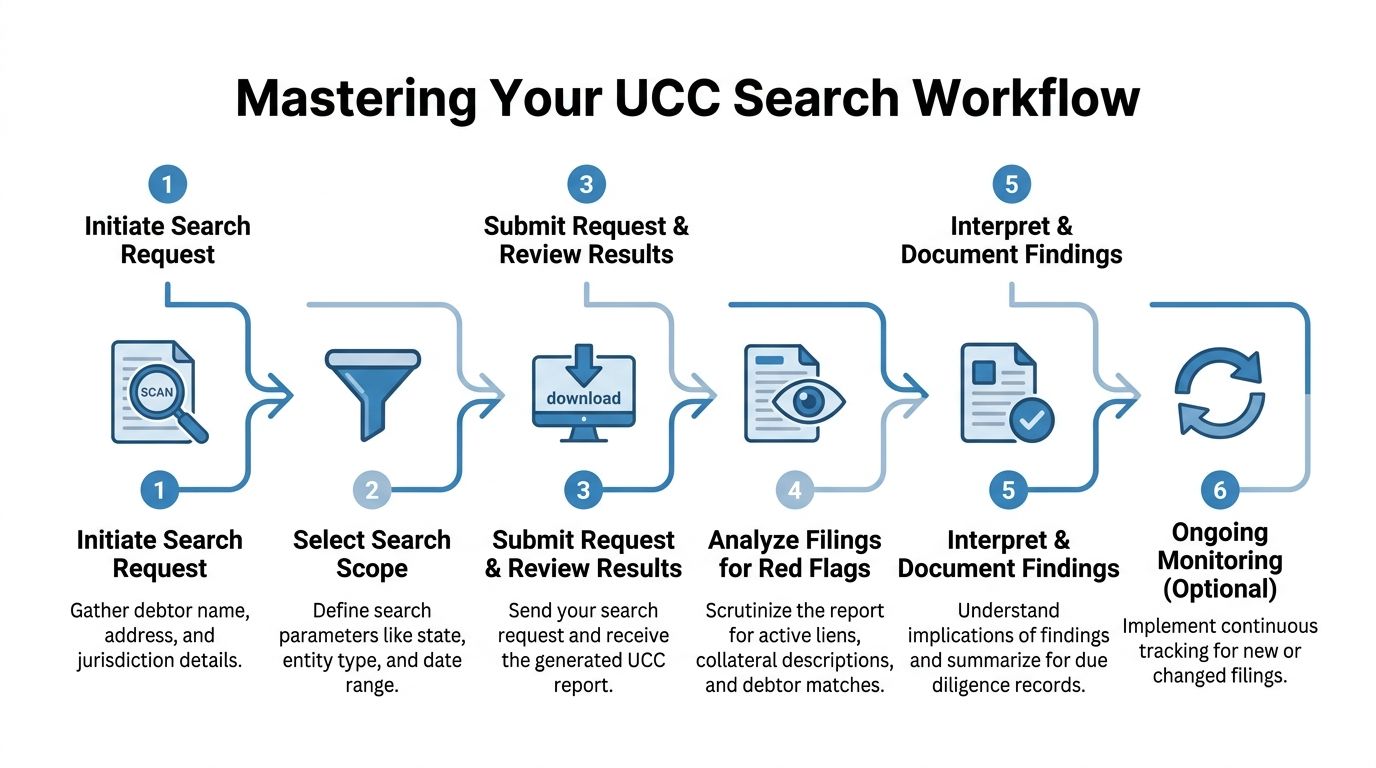
How Do You Run and Interpret a UCC Search Correctly
A UCC search fails at the setup stage more often than at the reading stage. If the debtor name is wrong, the jurisdiction is wrong, or the search scope ignores fixture filings and local records, the report can look clean while the deal remains exposed.
Start with the debtor, the jurisdiction, and the asset map
Run the search against the debtor’s exact legal name in the state where that debtor is organized. Use formation documents, not the trade name, website name, or a name pulled from a rent roll. Then identify whether the transaction also requires local real estate record review because the collateral may include fixtures, as-extracted collateral, or property-specific rights filed outside the central UCC index.
This step matters in real estate deals because the legal borrower, the property owner, the operating company, and the equipment lessee are often different entities. If a project relies on rooftop units, solar equipment, refrigeration, access systems, or other installed business assets, the search plan has to follow each relevant entity and each filing office that could hold a claim.
A clean title report does not answer that question.
Read the report in a priority sequence
After the results come back, review them in the order that affects risk and closing work:
- Debtor match. Confirm the filing is against your debtor, not a similar name.
- Filing office and date. Priority often turns on where and when the record was filed.
- Collateral description. Determine whether the lien reaches specific equipment, accounts, lease proceeds, fixtures, or all assets.
- Lifecycle status. Check for amendments, assignments, continuations, partial releases, and terminations.
- Property connection. Compare the collateral description against what is installed at the site and what the underwriting assumes will remain with the property.
That last step is where teams miss significant risk. A filing against “all equipment,” “all fixtures,” or “all assets” of an operating entity may reach property components that the buyer or lender has treated as part of the property package. Counsel then needs to determine whether the issue is a payoff item, an excluded asset, a permitted lien, or a problem serious enough to reprice or pause the deal.
Interpret the filing, not just the index hit
The index is only the start. The financing statement may be active but irrelevant, or old but still dangerous because a continuation was filed and no termination followed. Broad collateral language also needs context. If the debtor runs a hotel, senior housing facility, cold storage site, or mixed-use asset with operational infrastructure, business-personal-property liens can affect value, cash flow, and foreclosure assumptions.
Priority analysis is fact-specific. Earlier-filed records, fixture filings in county land records, landlord waivers, equipment leases, and intercreditor documents all change the answer. The work is legal, but it is also operational. The closing team needs enough detail to know what must be released before funding and what can stay in place without impairing collateral.
Build a repeatable workflow
A workable process usually includes:
- pulling exact legal names for every relevant entity in the deal structure
- searching each required state UCC index and any local filing office tied to fixture risk
- ordering full filing images, not just summary hits
- mapping each filing to the asset schedule, site inspection notes, and loan assumptions
- creating a closing list for terminations, payoff letters, consents, or carveouts
- scheduling post-closing monitoring for borrowers and key operating entities
Portfolio teams benefit from the same discipline at scale. If you are tracking exposure in California, a broader market overlay such as the California data in our Investor Pulse reports can help frame where asset-level diligence and entity-level lien monitoring deserve more attention.
Practical rule: If a filing could reasonably cover assets that make the property operable or financeable, treat it as an open collateral issue until the documents prove otherwise.
What Are The Critical Red Flags in a UCC Search Report
A UCC report becomes a real estate problem the moment a personal property lien reaches assets the property cannot operate without.
Teams miss this point in mixed-use, hospitality, senior housing, self-storage, data center, and industrial deals. The building may look financeable from the title report alone, yet a UCC filing can still reach HVAC units, backup generators, security systems, kitchen equipment, FF&E, receivables, permits tied to operations, or tenant-facing business assets. If those assets are part of cash flow or occupancy, the lien affects underwriting, not just legal cleanup.
The red flags that change deal economics
Earlier active filings against overlapping collateral
An earlier filing against the same debtor name and collateral class can leave your lender junior on day one. That is not a technical defect. It changes recovery value, refinance options, and what has to be paid off at closing.
Blanket collateral descriptions
A filing covering "all assets," "all personal property," or broad proceeds language deserves immediate document review. These filings often capture more than the deal team modeled, especially where the borrower owns both the property and the operating business.
In property-level diligence, broad language creates a matching problem. The UCC record sits in one system, title data sits in another, and the operating asset list usually lives in underwriting or a diligence tracker. Teams that monitor market signals, such as those in our Investor Pulse reports, are usually better positioned to spot where that disconnect is likely to matter.
Fixture-related collateral with a real estate footprint
Fixture overlap is the issue teams miss most often. If the filing appears to cover installed equipment or site-specific systems, the question is not just whether the lien exists. The question is whether removing, replacing, or foreclosing on that asset would impair the property's use, revenue, code compliance, or lender remedies.
A fixture filing recorded in local land records can be the obvious warning sign. A standard state-level UCC filing can create the same business risk if the collateral description is broad enough and the assets are operationally tied to the site.
Name mismatches that hide live risk
Search reports with near-match debtor names, prior legal names, merged entities, or trust and SPE variations require follow-up. Teams often clear these as noise. That is a mistake when the borrowing structure changed, the guarantor owns operating assets, or legacy filings remain effective against property-related business assets.
Amendments, assignments, and continuations that change the story
A summary hit rarely tells the whole story. An amendment may expand collateral. An assignment may put enforcement rights in different hands. A continuation may keep a filing alive far longer than the closing checklist assumes. Read the image set before treating a filing as stale or limited.
Lapsed filings can still block execution
A lapsed filing is not automatically harmless. If it was never terminated, it may still create title questions, closing friction, or insurer pushback, especially when the collateral touched fixtures or property operations. Counsel, title, and the closing team still need a release strategy or a documented reason the filing no longer affects the deal.
Here is a useful explainer on the broader context of UCC due diligence and filings:
What each red flag usually means in practice
| Red flag | Business impact | Typical next move |
|---|---|---|
| Earlier active filing | Recovery and priority assumptions may be wrong | Confirm collateral overlap, then require payoff, subordination, or carveout analysis |
| Blanket collateral language | More of the borrower's operating asset base may be encumbered than underwriting assumed | Compare the filing and security agreement against the asset schedule and property operations |
| Fixture-related filing | Building systems or site-specific assets may be subject to competing claims | Coordinate UCC counsel, title review, and property-level diligence |
| Name variance or legacy entity hit | A live lien may be missed if the search logic was too narrow | Run expanded debtor-name searches and pull organizational history |
| Unterminated lapsed record | Closing delays, title objections, or unresolved payoff questions | Obtain termination evidence or document why the filing no longer affects collateral |
Practical takeaway: A UCC report is clean only when the filing record, the real estate record, and the operating asset story all line up.
How Can APIs Streamline UCC Search and Monitoring
APIs streamline UCC work by turning a one-time manual search into a repeatable, portfolio-level control.

Manual UCC diligence breaks down in three places.
First, teams key in names inconsistently. Second, they search only when a deal is active. Third, the result lives in a PDF, not in the operating system that drives underwriting, servicing, or portfolio surveillance.
What automation fixes
An API-driven workflow can help teams:
- Standardize inputs so debtor names and jurisdictions are handled consistently
- Run bulk searches across portfolios rather than one borrower at a time
- Track updates over time instead of relying on a stale report
- Push alerts into internal systems when new filings or relevant changes appear
- Merge UCC signals with property and loan data so analysts do not have to reconcile separate datasets manually
That last point matters most for proptech and lending operations. Risk does not sit neatly in one database.
Why monitoring beats one-time search
A search at origination tells you what existed that day. It says nothing about what gets filed next month, whether a continuation is made, or whether a related filing changes the collateral picture.
For scaled operations, monitoring is the operational upgrade. It lets teams move from “we checked once” to “we maintain visibility.” That is a better fit for asset-based lending, servicing, acquisitions pipelines, and investor reporting.
A similar shift is happening across broader property intelligence workflows. Teams that already consume market and portfolio datasets through resources such as https://reports.batchdata.io/investorpulse-reports/ usually understand the core lesson quickly: once data becomes part of production systems, point-in-time manual review starts to look like a control gap, not a process.
The trade-off
APIs do not replace legal judgment.
The primary benefit is not that the machine “does the law.” The advantage is that lawyers, analysts, and credit teams spend more time on interpretation and less time chasing records.
Frequently Asked Questions About UCC Searches
Is a UCC search the same as a title search
No. A UCC search addresses personal property liens, while a title search addresses interests affecting real property. In commercial real estate, that line is not clean. Fixture filings, tenant equipment, operating assets, and ownership structures can create lien risk that does not appear in the title report alone.
That gap causes avoidable misses.
What does a UCC search cost
Cost depends on the filing office, the search type, and whether you need plain search results, certified records, or copies of underlying filings. State systems are often inexpensive for a single name search, but the direct fee is only part of the cost. Teams also spend time on debtor-name validation, multi-state coverage, record retrieval, and review.
For one-off matters, direct state ordering may be fine. For active lending or acquisitions pipelines, labor usually outweighs the filing-office fee.
Do I need the exact legal name
Yes. Name accuracy is the first control point.
A search run under a trade name, a shortened entity name, or the wrong individual name can miss a live filing. For registered organizations, the correct legal name usually comes from the formation record. For individuals, search logic is less uniform across offices, so review has to be more careful.
What is the difference between a UCC-1 and a UCC-3
A UCC-1 is the initial financing statement. It puts the market on notice that a creditor claims a security interest in identified collateral.
A UCC-3 updates that record. It may continue the filing, amend party or collateral information, assign the filing to another secured party, or terminate it. In practice, counsel should read the full filing chain, not just the first record that appears in search results.
Can an individual have UCC filings against them
Yes. Individuals can be named as debtors when personal property secures a loan or other obligation. That comes up in guarantor-backed transactions, sole proprietorships, agricultural collateral, high-value equipment finance, and certain mixed-use or closely held real estate structures.
Should teams search directly with the state or use a third-party provider
The right choice depends on volume, timing, and error tolerance.
Use the state system when:
- You are handling a limited number of debtors
- The jurisdictional scope is narrow and clear
- Your team can confirm exact legal names and review records manually
Use a provider or integrated workflow when:
- You need searches across multiple states or affiliated entities
- You need copies, continuations, amendments, and terminations tied together quickly
- You need UCC results connected to property, borrower, and loan data
- You need monitoring after closing, not just a pre-closing snapshot
For real estate teams, the last two points matter most. The practical problem is not just finding filings. It is linking personal property lien records to the parcel, borrower group, tenant, or fixture-related asset that affects the deal.
Are tax liens and judgments part of a UCC search
No. Tax liens and judgments sit in separate public record systems, even if the same credit file reviews them together. A clean UCC search does not answer whether those other lien categories exist.
What is the most common practitioner mistake
Treating the UCC search as an orderable product instead of a legal and operational review process.
The report itself is only the starting point. The work involves confirming the correct debtor names, selecting the right jurisdictions, reading the filing history, and testing whether the collateral description reaches assets that matter to the property or credit decision. In real estate deals, that includes asking a harder question than many teams ask: does any filing against business assets, installed equipment, or fixtures change the value, financeability, or transfer picture for this property?
If your team needs property, lien, and ownership data in one operational workflow, BatchData is built for that reality. It helps lenders, proptech platforms, and real estate operators move from fragmented diligence to connected due diligence with nationwide property records, lien-aware research, and portfolio-scale data delivery.