
































Internet Data Exchange (IDX) is the single most critical technology allowing real estate agents to display active MLS listings on their own websites. It's a system of broker reciprocity that transforms a basic agent website into a lead-generating property search engine, directly competing with portals like Zillow. Over 97% of all homebuyers use the internet in their search, and IDX is the framework that makes this possible for individual agents and brokers.
The core takeaways are simple:
- Definition: IDX is a policy and data feed allowing reciprocal sharing of MLS listings on members' websites.
- Function: It turns your website into a powerful property search tool to attract and capture leads.
- Limitation: IDX only shows on-market listings, creating a massive data gap for off-market opportunities and deep property intelligence.
This guide breaks down exactly what IDX is, how the technology works, the rules you must follow, and why it's no longer enough on its own.
What is the Core of IDX?
IDX, or Internet Data Exchange, is the policy framework and technical system that enables real estate brokers to display each other's active property listings from a Multiple Listing Service (MLS) on their personal websites. This system, governed by the National Association of Realtors (NAR) and local MLS boards, is founded on broker reciprocity. Brokers who participate agree to let other members display their listings; in return, they get to display everyone else's.
Before NAR introduced the IDX policy in May 2000, MLS listing data was locked in private systems accessible only to agents. Today, NAR reports that 97% of all homebuyers use the internet in their search, a reality made possible by IDX. This single policy transformed an agent's website from a static business card into a dynamic search portal, expanding its inventory from a few personal listings to the thousands available across the entire MLS. You can explore the policy's history at partnerwithez.com.
The Three Pillars of IDX
IDX is not a single piece of software but a combination of policy, technology, and business strategy.
| Component | Definition | Core Function |
|---|---|---|
| Policy | The set of rules from NAR and local MLS boards governing online data use and display. | Ensures fair play, data accuracy, and requires specific branding and disclaimers. |
| Technology | The data feed (typically the RESO Web API) that transfers listing data from the MLS to a website. | Provides the technical pipeline for data to flow, ensuring near real-time updates and reliability. |
| Business Strategy | The role IDX plays in an agent's marketing and lead generation plan. | Attracts and captures buyer leads by turning a website into a local search authority. |
These three components work in concert to create the online search experience that both agents and consumers now depend on.
IDX's primary function is to make an agent's website a legitimate alternative to Zillow or Redfin. It levels the playing field for generating leads directly from your own digital asset.
Without this cooperative system, the online real estate market would be fragmented and completely dominated by a few massive portals, leaving independent agents and brokers with virtually no viable online presence.
How do IDX Feeds Technically Work?
An IDX feed is the sanctioned data connection that pipes property information from a Multiple Listing Service (MLS) directly to a website. This is the mechanism that powers the property search on your site and your competitors' sites. The technology has evolved from clunky FTP (File Transfer Protocol) data dumps to the Real Estate Transaction Standard (RETS), and now to the modern gold standard, the RESO Web API, which enables near real-time updates.
This diagram shows the journey of data from the MLS database to a home buyer's screen.
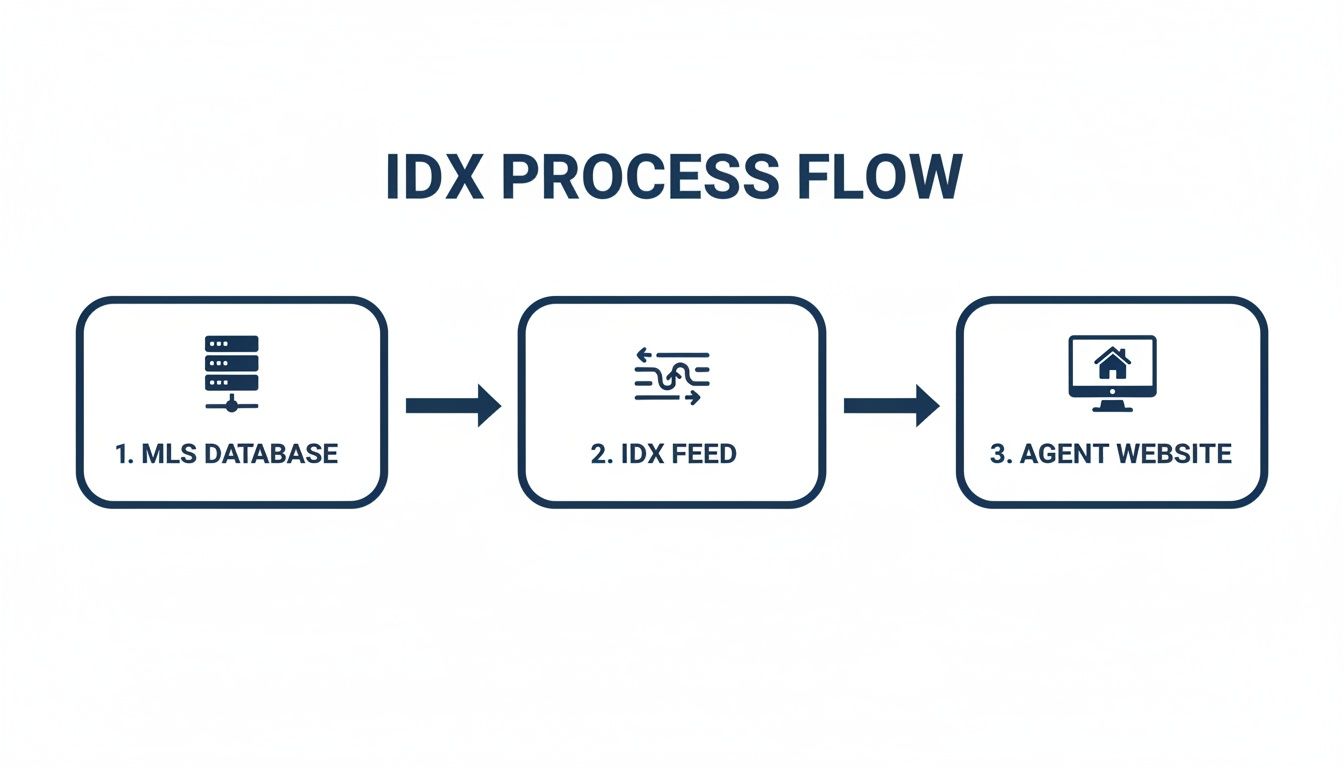
The IDX feed is the critical bridge translating raw MLS data into a searchable, user-friendly format for your website.
The Role of the IDX Vendor
Unless you are a developer with specific MLS permissions, you cannot connect directly to the feed. This is where an IDX vendor is essential. These companies are the technical and administrative middlemen that handle the entire process.
Here is what a vendor does:
- Manages the Connection: They handle the complex technical and contractual process of accessing the raw data feed from your MLS.
- Normalizes the Data: Raw MLS data is notoriously messy. A vendor's most crucial job is to normalize it—mapping disparate fields like "Baths" and "Bathrooms_Total" into a single, clean "Bathrooms" field so search filters function correctly.
- Delivers the Data: They provide this cleaned data to your website, typically through a website plugin, iFrame, or a dedicated API.
An IDX vendor acts as your data interpreter. They translate the technical language of the MLS into a structured, searchable format that your website can use to generate leads.
Update Frequency and Data Mapping
Two critical factors distinguish IDX providers: update frequency and data mapping. Some providers sync data only once or twice a day, while top-tier services refresh every 5-15 minutes. Faster is non-negotiable.
This matters for two reasons:
- User Trust: Showing a client an exciting property that went under contract yesterday is the fastest way to lose their confidence.
- SEO Value: Search engines prioritize fresh content. A constant stream of new and updated listings signals to Google that your site is active and authoritative.
Data mapping is the process of correctly associating hundreds of data fields from the MLS to the display on your website. This includes basics like price and beds/baths, but also the granular details buyers seek, such as HOA fees, parking specifics, and architectural style. Superior mapping, often enhanced with geospatial analysis, creates a richer user experience and more powerful search capabilities.
What are the Rules and Regulations of IDX?
Using IDX data is a privilege, not a right, governed by a strict set of rules from the National Association of Realtors (NAR) and over 500 local MLS boards. While the NAR sets the baseline policy, each local MLS adds its own specific requirements that agents are legally obligated to follow. Violating these rules can result in fines, suspension of your data feed, or even loss of your MLS membership.

The entire system is built on broker reciprocity—a cooperative agreement where brokers within an MLS allow other members to display their listings in exchange for the same privilege. This only works when everyone follows the playbook.
Common IDX Display Rules
While rules vary slightly between MLSs, several are universal. A reputable IDX vendor will handle most technical compliance, but the agent or broker is ultimately responsible.
Your site must include:
- Brokerage Branding: The listing brokerage’s name must be clearly and prominently displayed on every property detail page. You can never imply that another agent's listing is your own.
- MLS Attribution: The name of the MLS providing the data must be shown. This is typically located in the website footer or on individual listing pages.
- Data Accuracy Disclaimer: Every MLS requires a specific legal disclaimer stating that the data is "deemed reliable but not guaranteed." Your IDX provider must use the exact wording mandated by your board.
- Listing Freshness: The data on your site must be current. Most MLS boards require a data refresh at least once every 12 hours.
An IDX violation is not a minor infraction. Penalties can start at $500 per day and escalate to suspension of your feed or complete revocation of your MLS membership.
Prohibited Actions
Knowing what not to do is just as critical. These rules prevent data misuse and maintain a level playing field.
The three primary prohibitions are:
- No Data Scraping or Co-mingling: You are forbidden from scraping, downloading, or storing raw IDX data for any purpose other than display. You also cannot mix IDX listings with other property types (like For Sale By Owner) in a way that makes them indistinguishable.
- No Data Manipulation: You cannot alter the listing data in any way. This includes changing the price, editing the property description, or removing the listing agent's information. The data must be displayed as-is.
- No Unauthorized Distribution: The IDX data feed is licensed for your website only. You cannot sell, share, or otherwise pass it along to any other person, entity, or website.
What are the Strategic Pros and Cons of Using IDX?
IDX is the cost of entry for a modern real estate website, but treating it as your only tool is a strategic mistake. Integrating an IDX feed instantly populates your site with thousands of local properties, giving potential clients a compelling reason to stay within your digital ecosystem. With 97% of homebuyers starting their search online, a functional property search is non-negotiable.
Data confirms its impact. A 2023 NAR report found that 52% of buyers found the home they purchased on an agent's IDX-powered website. Furthermore, these agent-owned sites generate 70% of all broker leads, primarily because engaged visitors convert at a 15% higher rate than on generic portals, as highlighted in these findings from MLS Import.
The Upside: Lead Generation and SEO
The advantages of IDX extend beyond just displaying listings; it's a core business asset.
- Lead Capture Authority: When a user registers on your site to save a search or inquire about a property, that lead is 100% yours. You are building your own audience, not renting one from a portal.
- Enhanced SEO Performance: An IDX feed provides a constant stream of fresh content (new and updated listings). This, combined with increased user time-on-site, sends strong positive signals to Google, boosting your local search rankings.
- Brand Credibility: A professional, powerful search tool instantly positions you as a tech-savvy local expert, building trust before you even speak to a potential client.
The Downside: The Massive Data Gap
The single greatest weakness of IDX is its limited scope: it only shows what's actively for sale right now. It was designed for marketing, not deep analysis. This creates a critical data gap for any agent or investor who needs to understand the "why," "who," or "what if" behind a property.
IDX is for marketing active listings. It was never intended to be a comprehensive property intelligence tool for off-market prospecting or strategic analysis.
A standard IDX feed completely lacks the information needed for a truly proactive strategy. Here’s a sample of what’s missing:
- Complete ownership history
- Mortgage balances and lien details
- Pre-foreclosure and distress signals
- Data on the 98% of properties that are not on the market
This comparison table puts the trade-offs in stark relief.
| Attribute | Pros of IDX | Cons of IDX |
|---|---|---|
| Data Scope | Comprehensive view of active MLS listings. | Zero visibility into off-market properties, ownership history, or financials. |
| Lead Generation | Excellent for capturing in-market buyer leads. | Ineffective for proactive, off-market prospecting or identifying distressed sellers. |
| Cost | Relatively low cost for a full database of active listings. | Requires additional investment in data tools to fill critical intelligence gaps. |
| Data Depth | Provides basic property characteristics and photos. | Lacks crucial intelligence like mortgage balances, liens, and pre-foreclosure status. |
Understanding these limitations is what separates average agents from top producers. IDX is the starting point, not the finish line.
Why is IDX Alone Not Enough for Modern Real Estate?
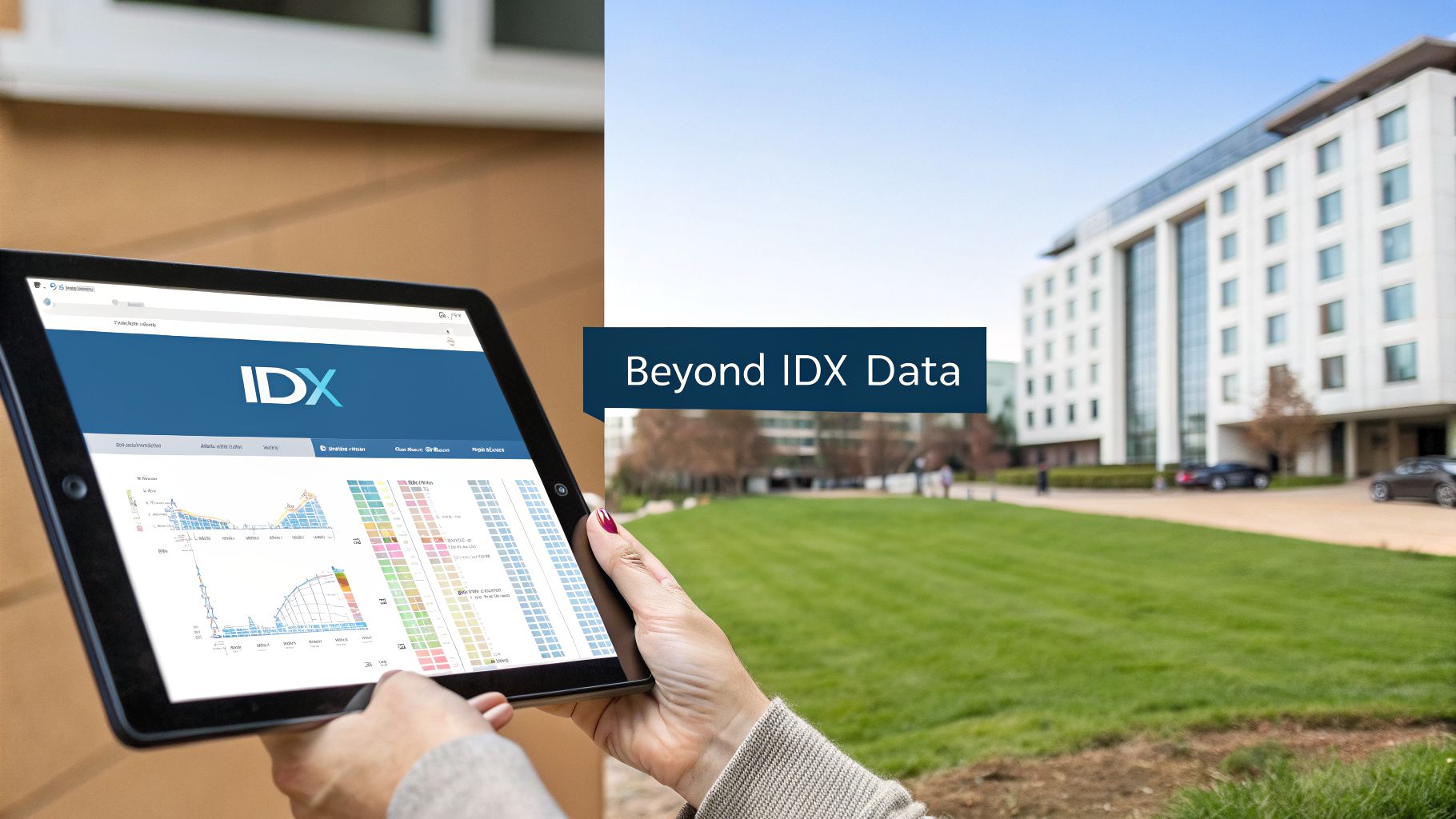
Relying solely on an IDX feed is like trying to win a chess match when you can only see your opponent's first move. It shows you the 1-2% of properties currently on the market but leaves you blind to the other 98% where the most valuable opportunities are hidden. IDX was designed to market active listings to the public, not to serve as a deep property intelligence tool for savvy investors, lenders, or proptech builders.
This data gap is where the real money is made. IDX shows you a house for sale, but it won't tell you about the second mortgage the owner just took out, the pre-foreclosure notice filed last week, or the five other properties in their portfolio. For any professional whose business depends on finding off-market deals or understanding true property risk, this surface-level view is insufficient.
What the IDX Data Gap Hides
The limitations of IDX are by design, not by defect. It intentionally omits sensitive data irrelevant to a typical homebuyer, creating critical blind spots for professionals.
- Deep Financials: No visibility into mortgage history, loan balances, or true equity—all critical for underwriting or identifying motivated sellers.
- Distress Signals: IDX feeds do not include liens (tax, HOA, mechanic's), pre-foreclosure filings, or bankruptcies, which are the clearest indicators of an impending off-market opportunity.
- True Ownership Details: You cannot find a verified owner's contact information, especially for properties held in an LLC or trust.
- Off-Market Properties: You are completely ignoring the vast majority of housing stock in your market.
This is why a comprehensive digital marketing for real estate agents strategy must incorporate data beyond the MLS.
How Comprehensive Data Platforms Fill the Void
Real estate data platforms like BatchData solve this problem by aggregating and unifying property information from hundreds of public and private sources. This process creates a complete, multi-layered profile for over 155 million US properties, regardless of their on-market status. It transforms a flat 2D map into a dynamic 3D model of the entire real estate landscape.
IDX tells you what is for sale. A comprehensive data platform tells you why it might be for sale, who to talk to, and what else they own. This is the difference between reactive marketing and proactive, data-driven acquisition.
This combined approach allows you to spot an active listing on your IDX site and instantly enrich it with the owner's entire property portfolio, their estimated equity, and any distress flags. This is a level of context the MLS alone can never provide, as seen in the market insights from our InvestorPulse reports.
From Simple Search to Strategic Intelligence
By pairing multi-source data with an IDX feed, professionals can build smarter tools and execute more effective strategies.
- For Lenders: Underwrite loans with higher confidence by verifying true ownership, pulling complete lien histories, and assessing a borrower's portfolio-wide risk.
- For Investors: Target off-market deals by filtering for distress signals like pre-foreclosure or tax delinquency, then use verified contact data to reach owners directly.
- For Proptech Platforms: Build more accurate Automated Valuation Models (AVMs), create powerful portfolio analysis tools, and offer sharper market forecasts.
IDX is the essential operating system for displaying listings. But to gain a true competitive edge, you need to install the right software. Comprehensive data platforms are that software.
What are the most frequently asked questions about IDX?
Here are direct answers to the most common questions about Internet Data Exchange.
What is the difference between IDX and Zillow?
The primary difference is control and cost. Your IDX website is your privately-owned digital asset where you control the user experience and own 100% of the leads generated. Zillow is a third-party advertising portal where you pay to rent space, often buying back leads that originated from your own listings. With IDX, the lead is yours, period.
How much does IDX cost?
IDX costs have two parts: an MLS fee and a provider fee.
- MLS Data Access Fee: This is a direct fee from your local MLS to access the raw data feed, typically costing $10 to $50 per month.
- IDX Provider Fee: This is for the software and service that processes the data and displays it on your site. Costs range from $50 per month for a WordPress plugin from vendors like Showcase IDX or iHomefinder to several hundred for a fully custom solution.
Is IDX the same as the MLS?
No, they are different but related systems. The MLS (Multiple Listing Service) is the private, members-only database where agents input and manage their listings. IDX (Internet Data Exchange) is the policy and technology that allows a portion of that MLS data to be displayed on public-facing agent websites. The MLS is the secure warehouse; IDX is the public showroom. You can see how this data informs our reports on market dynamics and property data.
Can I build my own IDX website?
Technically, yes, but it is impractical and extremely difficult for 99.9% of agents. Building a compliant IDX solution from scratch requires direct MLS approval, expert-level knowledge of the RESO Web API, and continuous maintenance to adhere to changing compliance rules. Partnering with a professional IDX provider is vastly more efficient and cost-effective.
Stop guessing and start targeting. BatchData provides the comprehensive property intelligence—from ownership details to pre-foreclosure signals—that IDX leaves out. Enrich your data and find opportunities before they hit the market.