





































A title search in North Carolina is not a formality; in a market with an average of 64 new residents arriving per hour, it is your single most critical piece of due diligence. This guide delivers a direct, actionable framework for conducting title searches, covering manual methods, legal requirements, and scalable automation for real estate professionals.
A title search is a comprehensive investigation into public records to verify a property’s legal ownership and uncover any claims, debts, or restrictions that could invalidate the transaction or lead to significant financial loss. The explosive growth across North Carolina’s 100 counties is placing unprecedented strain on public record systems, increasing the frequency of costly title defects. Skipping a thorough search exposes investors to ownership disputes, undisclosed liens, and clerical errors that are becoming increasingly common.
- Key Takeaway: North Carolina’s population boom directly increases title risk.
- Actionable Advice: Every search must verify the chain of title, identify all liens (mortgage, tax, mechanic’s), and uncover encumbrances like easements or covenants.
- Critical Mandate: A licensed North Carolina attorney must provide a formal title opinion to legally close any real estate transaction.
This guide will now dissect the process, risks, and solutions for conducting a title search in North Carolina.
What Are the Real Risks in North Carolina’s Real Estate Market?
A title search is your primary risk management tool in North Carolina’s supercharged real estate environment. The state’s explosive population and economic growth have thrown the market into overdrive, creating a landscape where hidden title defects can have devastating financial consequences. For real estate investors, proptech teams, and lenders operating at scale, ignoring these risks is a direct path to a failed investment.
The equation is straightforward: more transactions equal a higher probability of title defects. As a national leader in population growth, North Carolina’s county offices are recording a staggering volume of deeds, mortgages, and liens daily. This high-velocity activity amplifies the exact issues a title search is designed to intercept.
The Impact of Population Growth on Title Risk
North Carolina’s phenomenal growth directly strains housing inventory and the public record systems that track property ownership. Between July 2022 and July 2023, the state welcomed 97,984 new residents, making it the third most popular state for inbound moves.
This is not a temporary trend. The state’s population has swelled by over 490,000 since the 2020 Census, pushing it past 10.9 million people. With projections showing North Carolina will hit 14 million residents by 2050, the demand for housing—and the need for meticulous title work—will only intensify. You can see the full economic context on the Wake County government news site.
This high transaction velocity dramatically increases the odds of encountering a title defect.
A title search is a historical investigation into a property’s past to secure its future. In a market as hot as North Carolina’s, skipping this step is like navigating a minefield blindfolded—the risks are too high and the potential losses too great.
Before diving into how to perform a search, it is critical for any investor or lender to understand what a title search actually protects them from.
Key Risks Mitigated by a Title Search in North Carolina (2026)
| Risk Type | Description | Potential Financial Impact |
|---|---|---|
| Undisclosed Heirs | A previous owner dies without a will (intestate), and their legal heirs, who have a valid claim to the property, were never identified. | Complete loss of ownership and substantial legal fees to defend your title. |
| Mechanic’s Liens | A contractor or supplier files a lien against the property for unpaid work, which can happen up to 120 days after the work is completed. | You inherit the debt and could be forced to sell the property to satisfy the lien. |
| Unpaid Property Taxes | The previous owner was delinquent on property taxes, creating a priority lien that can lead to foreclosure by the county. | Paying off back taxes, penalties, and interest, or losing the property in a tax sale. |
| Fraudulent Deeds | A forged signature or improperly executed deed in the property’s history makes the transfer of ownership legally invalid. | Your claim to the property is void, resulting in a total loss of your investment. |
| Clerical Errors | Mistakes in the public record, such as typos in legal descriptions or names, create confusion and potential ownership challenges. | Costly legal action to correct the public record (a “quiet title” action). |
| Boundary Disputes | An old survey is incorrect, or an easement was never recorded, leading to conflicts with neighbors over property lines or access. | Legal fees, loss of usable land, and diminished property value. |
Understanding these potential pitfalls underscores why a title search is not about procedure; it is about protecting capital and ensuring your exit strategy remains viable.
Core Components of a North Carolina Title Search
A search focuses on three critical areas that form the legal foundation of a property’s ownership.
-
Chain of Title: This is the property’s ownership timeline. A searcher traces the title backward, typically 40-60 years in North Carolina, to ensure every transfer was legitimate. They are looking for any gaps or “breaks” in the chain that could call the current owner’s rights into question.
-
Liens: A lien is a legal claim for payment attached to the property. Common examples in North Carolina include unpaid property taxes, mortgages, mechanic’s liens from contractors, and court judgments. A title search flags these debts, which must be paid off before the property can be sold with a clean title.
-
Encumbrances: These are non-financial claims or limits on how a property can be used. This includes utility easements, restrictive covenants in an HOA, or local zoning laws. Uncovering these is vital for determining a property’s true development potential.
By methodically examining each of these areas, a title search provides a clear, unvarnished picture of a property’s legal and financial health. For a deeper dive into the market dynamics that influence these risks, you may want to check out our quarterly national property data reports. This groundwork is absolutely essential for making smart investment decisions.
How Do You Conduct a Manual Title Search in North Carolina?
The process begins by identifying the correct county Register of Deeds office and assembling an unbroken chain of title. This is not a casual search; it is a methodical, document-by-document investigation to verify a property’s ownership history.
This hands-on due diligence is the bedrock of all real estate transactions in the state. The primary goal is to trace the ownership history back a minimum of 40 to 60 years, while simultaneously uncovering any financial claims (liens) and usage restrictions (encumbrances).
As transaction volume grows, so does the potential for title defects to surface.
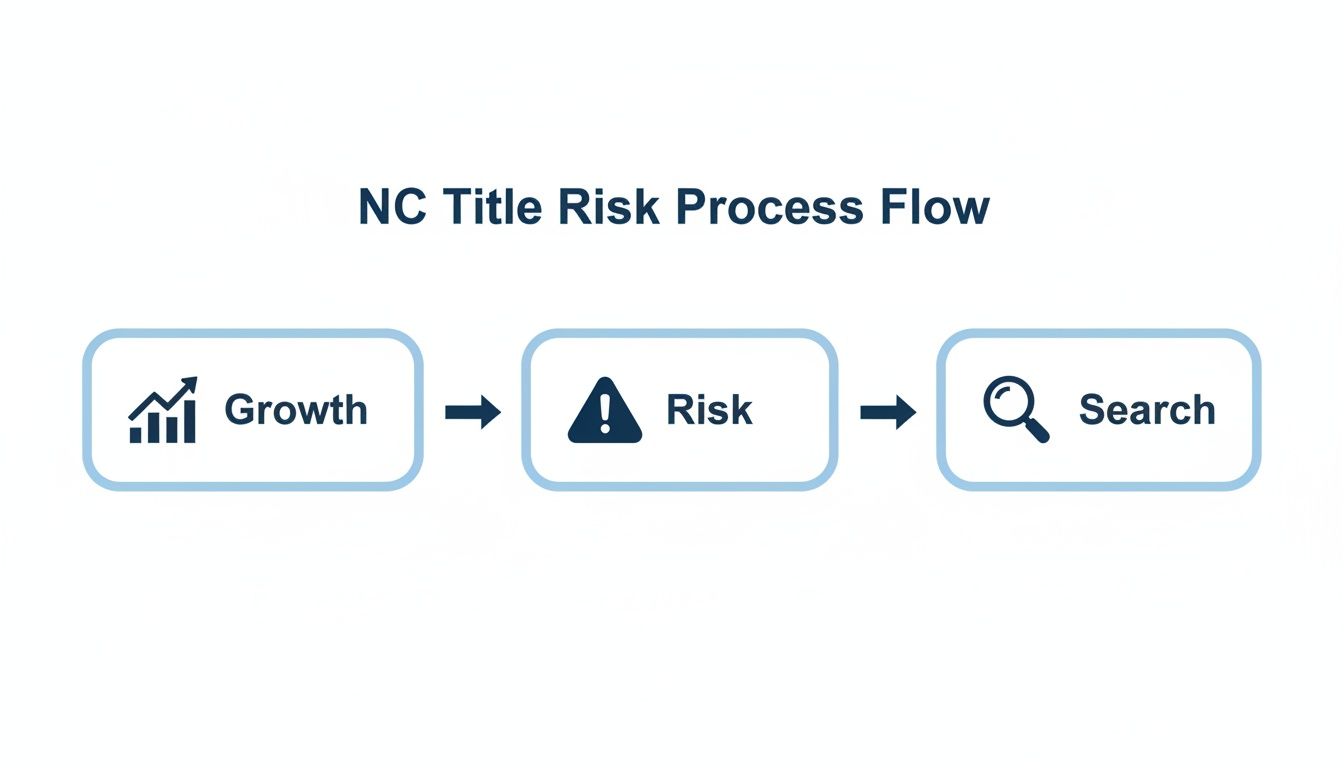
This flow illustrates how economic expansion fuels transactions, which naturally increases title risk and makes a thorough search absolutely critical.
Locating and Accessing County Records
First, you must identify the correct Register of Deeds office. Each of North Carolina’s 100 counties maintains its own siloed property records. There is no statewide database for a manual search; you must proceed county by county.
Access methods vary significantly:
- Modern Portals: Major urban counties like Wake, Mecklenburg, and Durham provide excellent online systems for searching and viewing decades of scanned documents.
- Hybrid Systems: Many counties offer an online index (names, dates, document numbers), but require a physical visit to the Register of Deeds office to view the actual documents.
- In-Person Only: Some smaller, rural counties still operate on physical record books and card catalogs. For these, an on-site visit is the only option.
Building the Chain of Title
The core of the search is the grantor-grantee index, which logs every property transaction. Your search starts with the current owner (the grantee). You find the deed where they took title, which will name the seller (the grantor).
From there, you work backward. Search for that grantor’s name in the grantee index to find how they acquired the property. Repeat this process, link by link, moving back in time.
Pro Tip: Use a spreadsheet to track every link in the chain: grantor, grantee, document type (e.g., Warranty Deed), recording date, and book/page number. This document becomes your roadmap and proof of a diligent search.
Common obstacles include:
- Name Variations: “John Smith,” “John A. Smith,” and “J.A. Smith” could be the same person. Search every possible variation to avoid missing a key document.
- Breaks in the Chain: A missing deed is a major red flag, often caused by un-probated estates or unrecorded transfers. This “gap” must be resolved, typically with an attorney’s help.
- Corporate Entities: If an LLC or trust is in the chain, you may need to cross-reference records with the NC Secretary of State to confirm the entity’s legal standing.
Identifying Liens and Encumbrances
While tracing the ownership chain, you must also hunt for any documents that place a claim or restriction on the property.
- Mortgages and Deeds of Trust: For every owner in your chain, search their name in the grantor index to find any loans. The critical next step is to locate a corresponding “Satisfaction of Mortgage” document proving the loan was paid. An open, unsatisfied mortgage is a major title defect.
- Tax and Judgment Liens: Check separate county databases or court records for unpaid property taxes, federal tax liens, or civil judgments against any owner. These claims attach to the property itself and must be cleared.
- Mechanic’s Liens: These are filed by contractors for unpaid work. In North Carolina, a “Claim of Lien on Real Property” can be filed up to 120 days after the work is finished, so a final search right before closing is crucial.
- Plats and Covenants: Always pull the property’s plat map. This shows easements (like for utility access) and boundary lines. You must also search for any recorded Covenants, Conditions, and Restrictions (CC&Rs) that might dictate property use.
In a market like North Carolina’s, these searches are non-negotiable. The state’s robust economy, which in September 2024 saw 279,000 job openings—an increase of 23,000 from the previous month—constantly fuels housing demand. With a 5.3% job opening rate outpacing the national 4.5% average, the pressure on housing inventory in hubs like Charlotte and Raleigh is intense, making clean title more important than ever.
For a deeper dive into one of the state’s most active markets, check out our Investor Pulse reports.
How Much Does a Title Search Cost and How Long Does It Take?
The cost and timeline for a title search in North Carolina depend entirely on the method you choose. Conducting a DIY search for preliminary research is fundamentally different from engaging a full closing service that includes a legal opinion and title insurance. Budgeting and managing expectations for time and cost are non-negotiable for investors, lenders, and proptech teams.
Breaking Down the Cost Structure
The price can range from under $50 (for DIY copy fees) to several thousand dollars. The final cost depends on the property’s transaction history, any known title issues, and the specific county’s recording fees.
Here is a realistic breakdown for a standard residential property:
- Preliminary Title Report/Abstract: For a basic report outlining ownership and flagging obvious liens, an independent title abstractor will charge between $150 and $400. This is a research product, not a legal opinion or insurance policy.
- Full Closing Service with Title Opinion: North Carolina is an “attorney-state,” meaning a licensed real estate attorney must oversee the closing and issue a formal title opinion. This comprehensive service—covering the search, legal review, and closing—typically runs from $1,500 to $3,000+.
- Title Insurance: This is a separate, one-time premium paid at closing, with the cost tied to the purchase price. For a $400,000 property, a lender’s policy might cost around $500, while an owner’s policy could add another $800 to $1,200.
Market conditions directly affect these costs. As of February 2026, Wake County’s median home price was holding at $450,000. Deed of trust recordings have shown consistent volume since early 2023, a trend you can track with platforms like BatchData.
This high transaction velocity keeps title professionals busy, underpinning their value in a market where the statewide median price has climbed to $368,000. You can dive deeper into these trends to see the 2026 North Carolina housing market for yourself.
Title Search Options in North Carolina: A Cost vs. Speed Comparison
Choosing the right approach depends on your goal, risk tolerance, and required speed. The table below outlines the trade-offs between different methods.
| Method | Typical Cost (2026) | Estimated Timeline | Best For |
|---|---|---|---|
| DIY Manual Search | Minimal (gas, copies) | 1-5 days | Preliminary research, experienced investors, low-risk properties. |
| Hiring a Title Abstractor | $150 – $400 | 3-7 business days | Obtaining a detailed property history report without legal interpretation. |
| Engaging a Real Estate Attorney | $1,500 – $3,000+ | 7-21 days | Legally required for closings, complex properties, and obtaining a formal title opinion. |
| Using a Data API (e.g., BatchData) | Subscription/Per-Call Fee | Near-Instantaneous | High-volume investors, lenders, and proptech platforms needing to scale due diligence. |
This comparison makes it clear: for one-off deals where legal assurance is paramount, an attorney is the only path. For high-volume analysis, however, only technology can deliver the required speed.
The single biggest bottleneck in a traditional title search is the human element. A manual search that takes days of digging through county records can be replicated by a data API in seconds. It delivers ownership history, mortgage data, and lien information almost instantly. This speed is a complete game-changer for anyone operating at scale.
This is the fundamental difference between modern, data-driven methods and the time-honored manual process. A hands-on search provides deep insight into one property; it is not practical for vetting hundreds of assets quickly. For that, automation is the only way forward.
What is the Role of Real Estate Attorneys in North Carolina?
A licensed North Carolina attorney is legally required to handle the closing and provide a formal title opinion. North Carolina is an “attorney-closing state,” a non-negotiable mandate that sits at the heart of how a title search in North Carolina is finalized.
A search report from an abstractor or data platform is raw information. A title opinion, in contrast, is a professional legal judgment. The attorney analyzes the search findings, interprets the legal weight of every document, and issues a formal statement on the quality of the title. This opinion provides the legal assurance that the title is “marketable”—clean enough that a reasonable buyer would not reject it.

This requirement protects all parties by ensuring a qualified expert has vetted the property’s single most critical asset: its ownership. Without an attorney’s sign-off, the transaction cannot legally close.
Navigating North Carolina’s Recording Laws
An attorney’s expertise is especially critical for interpreting North Carolina’s unique recording statutes, particularly the Conner Act. This law is a “pure race” statute, meaning the first person to record their deed with the Register of Deeds wins any ownership dispute, regardless of who signed a purchase contract first. An attorney’s review ensures all documents are correctly filed the moment the closing is complete, protecting a buyer’s claim.
When to Engage an Attorney Early
Smart investors involve attorneys far sooner than the closing date. The moment a potential title issue appears, it is time to engage legal counsel.
Bring in an attorney early for these scenarios:
- Complex Chains of Title: Properties with generational transfers, un-probated wills, or missing deeds require an attorney who understands estate law to clear the title.
- Significant Liens: A major IRS or mechanic’s lien requires a legal strategy to negotiate a release or settlement before it destroys the deal.
- Commercial Property Deals: Commercial transactions involve complex leases, corporate ownership structures, and zoning restrictions that demand specialized legal review.
- Foreclosure or Bankruptcy: Properties emerging from foreclosure or bankruptcy have a complicated paper trail of court filings that only a legal expert can properly navigate.
Do not wait until the 11th hour. The moment your title search uncovers anything more complicated than a simple mortgage, call your attorney. Their early involvement can save a deal that would otherwise collapse.
Beyond the immediate transaction, attorneys are crucial for long-term asset protection. Many provide comprehensive estate planning services, where property transfers must be handled flawlessly to avoid clouding the title for future generations. Waiting to engage them is a strategic error.
How Can You Automate and Scale Title Searches in North Carolina?
You can automate title searches by using a property data API to bypass the slow, fragmented, county-by-county manual process. For proptech firms, lenders, and high-volume investors, automation is not a luxury; it is a core component of an effective operational strategy.
Instead of dispatching abstractors to courthouses, an API delivers the necessary data in seconds. This fundamentally changes the economics of due diligence, converting a process that takes days into a near-instantaneous one.

This modern approach replaces manual legwork with code, allowing teams to vet properties across all 100 counties from a single, unified interface.
The Power of an Aggregated Data Feed
Platforms like BatchData aggregate scattered public records into one clean, low-latency API feed. Instead of navigating 100 different county websites, you gain access to a national database of over 155 million property records.
This consolidation enables capabilities impossible with manual methods:
- Bulk Analysis: Screen thousands of properties simultaneously for specific title attributes.
- Portfolio Monitoring: Automatically track properties for new liens, ownership changes, or pre-foreclosure activity.
- Real-Time Integration: Feed live property data directly into your underwriting models, CRM, or marketing software.
The strategic shift is from finding data to using data. An API delivers structured data points—ownership history, mortgage details, lien data—that can be programmatically analyzed to drive automated decisions at scale.
A manual search yields a static PDF. An API delivers dynamic, machine-readable information that can power an entire operation. For a deeper look at how these data models are evolving, see our article on how geospatial analysis enhances automated valuation models.
How Different Teams Can Scale Title Verification
Automation is a flexible toolkit for different roles. A proptech developer has different needs than an investor screening leads.
| User Role | Automation Application | Key Benefit |
|---|---|---|
| Proptech Developers | Integrate property data API directly into underwriting models or consumer portals to pull full property profiles, including chain of title and lien data. | Enables real-time, data-driven features and automates core verification processes within their own applications. |
| High-Volume Investors | Use bulk capabilities and set up automated alerts to monitor a large portfolio for emerging risks like new liens or pre-foreclosure filings. | Proactive risk management and the ability to act immediately on new information without manual oversight. |
| Marketing & Acquisition Teams | Apply advanced filters to pull highly targeted property lists based on title characteristics, such as “Free & Clear” status or the absence of involuntary liens. | Increases marketing ROI by focusing outreach on properties with clean titles that are more likely to result in a smooth transaction. |
This technical framework allows developers to weave robust property data into their applications, automating key parts of title verification.
Key Features That Enhance Due Diligence
Modern data platforms provide features that offer a much deeper understanding of a property, making the entire due diligence process smarter, not just faster.
- Daily Updates: Access to daily record updates ensures you are working with the most current information, reducing the risk of being blindsided by a recently filed lien.
- Automated Valuation Models (AVMs): An AVM provides an instant, data-driven estimate of a property’s value, which is critical for quickly assessing equity and loan-to-value ratios.
- Verified Owner Contacts: Integrated skip tracing provides verified phone numbers and email addresses for property owners, accelerating direct outreach and negotiations.
Ultimately, automating the title search North Carolina process provides a competitive edge through better data. It enables teams to move faster, make smarter decisions, and scale operations in a way that is impossible with manual workflows.
Frequently Asked Questions About NC Title Searches
How long is a title search valid in North Carolina?
A title search is only valid for the exact moment it is completed. It is a snapshot in time. A search finished this morning cannot account for a new lien or deed filed this afternoon. This creates a “gap” in coverage between the initial search and the closing. To mitigate this risk, a final “bring-down” or “date-down” search is performed immediately before closing to ensure no new documents have been recorded.
What is the difference between a title search and title insurance?
A title search is the process of investigation; title insurance is the product of financial protection.
| Concept | Definition | Purpose |
|---|---|---|
| Title Search | The process of examining public records to verify ownership and discover known defects like liens or judgments. | To identify existing, recorded risks before a transaction. |
| Title Insurance | An indemnity policy that financially protects the owner or lender against losses from title defects the search may have missed. | To protect against unknown or unrecorded risks, such as fraud, forgery, or undisclosed heirs. |
A title search finds the known risks. Title insurance protects you from the unknown ones. You need both for comprehensive protection.
Can I do my own title search for a foreclosure property?
No. While technically possible, performing a DIY title search on a North Carolina foreclosure is extremely risky and strongly advised against. Foreclosures are notorious for complex title issues, such as subordinate liens that are not extinguished by the sale. Furthermore, North Carolina has a 10-day statutory redemption period after a foreclosure auction, during which the previous owner can reclaim the property. Missing one of these details can lead to a total loss of your investment.
What are the most common title problems in North Carolina?
North Carolina’s mix of rapid development and historic rural land creates several recurring title issues.
| Title Problem | Description | Where It’s Most Common |
|---|---|---|
| Undisclosed Heirs | A previous owner died without a proper will (intestate), and their legal heirs, who have a valid claim, were never identified. | Rural properties and family-owned land passed through generations without formal estate planning. |
| Boundary Disputes | The legal description on the deed does not match the physical property lines, often due to old, inaccurate surveys. | Mountainous regions in Western NC and large rural tracts where surveys are infrequent. |
| HOA Liens | Homeowners’ Associations file liens for unpaid dues, which can lead to foreclosure if ignored. | Master-planned communities and suburban developments around Charlotte, Raleigh, and the coast. |
| Access Issues (Easements) | A property is “landlocked” with no legally recorded right-of-way, or an unknown utility easement limits development. | Both rural parcels and older, subdivided urban lots where access was assumed but never formalized. |
Recognizing these regional risks provides a significant advantage, allowing you to focus your due diligence and engage a real estate attorney proactively.
For teams that need to scale due diligence beyond single properties, BatchData provides the property data infrastructure to vet thousands of assets instantly. Access comprehensive ownership history, lien data, and mortgage details across all 100 North Carolina counties through a unified API.
Learn how to automate your title verification process at https://batchdata.io.