



Buying a property without title insurance is like buying a car without checking its VIN; you are willfully ignoring its entire history and exposing your investment to catastrophic risk. Title insurance is the non-negotiable financial backstop that defends your ownership rights against legal and financial claims originating from the property’s past. Unlike homeowners insurance that covers future events, this is a one-time premium paid at closing that acts as a financial shield against historical defects.
For nearly every transaction involving a mortgage, lender’s title insurance is a mandatory requirement, securing the lender’s investment. However, this policy offers zero protection for the buyer’s equity. This guide explains the entire process, distinguishes between policy types, and details the specific risks title insurance mitigates.
- Key Takeaway 1: Title insurance is a one-time premium protecting against past title defects, not future physical damage.
- Key Takeaway 2: A Lender’s Policy protects only the bank; an Owner’s Policy protects your equity.
- Key Takeaway 3: Technology, specifically big data and AI, now allows for underwriting in minutes, not weeks, drastically improving accuracy and reducing costs.
This deep dive will break down precisely how these services function and why they are a critical component of any real estate transaction.
What Is the Function of Title Insurance Services?
Title insurance services are a specialized form of indemnity insurance that protects real estate owners and lenders from financial loss due to defects in a property’s legal ownership history, also known as the title. It is a backward-looking insurance product. The service begins with an exhaustive search of public records—deeds, mortgages, tax records, and court judgments—to uncover any “clouds” or defects on the title. If the title is deemed clear, a policy is issued. Should a covered historical issue unexpectedly emerge after the sale, the policy covers legal defense costs and financial losses up to the policy’s limit.
That single premium, paid at closing, provides this protection for as long as you or your heirs own the property.
Core Components of Title Insurance Services
Title insurance is a comprehensive service, not just a document. It is designed to deliver a clear, legally defensible title.
- Title Search: This is the investigative phase. A title professional or attorney examines decades of historical records to verify the seller’s legal right to transfer the property and identify any outstanding issues.
- Risk Mitigation: If the search uncovers problems—like an unpaid contractor’s lien or a previously unknown heir—the title company works to resolve them before closing. This proactive “curative” work prevents most legal issues from ever materializing for the new owner.
- Indemnity Coverage: This is the actual insurance policy. It serves as your financial safety net, promising to defend your ownership rights in court and cover financial losses if an unknown defect from the property’s past emerges after the transaction is complete.
Why Is Title Insurance More Than a Closing Cost?
It is easy to misclassify title insurance as just another line item on a closing statement, but its function is fundamentally different from other transaction costs. A home inspection protects you from physical defects like a bad foundation. An appraisal confirms the property’s market value for the lender.
Title insurance protects you from financial and legal defects tied to the property’s ownership history. It is the only component of the transaction that defends your fundamental right to own the asset you are purchasing, shielding your equity from claims that originated long before you received the keys. Our market analysis in the Investor Pulse Reports provides deeper context on how market dynamics influence these transactional risks.
Title Insurance Services At a Glance
This table summarizes the core components, their purpose, and the party they protect in a real estate transaction.
| Component | Primary Function | Who It Protects |
|---|---|---|
| Title Search | Investigate historical public records for title defects. | Buyer and Lender |
| Title Examination | Analyze search findings and identify legal risks. | Buyer and Lender |
| Curative Work | Resolve identified title issues before closing. | Buyer and Lender |
| Insurance Policy | Provide financial indemnity against future claims from past events. | Owner or Lender |
Each step is integrated to ensure that when you close on a property, your ownership is as secure as legally possible from historical claims.
How Does the Title Insurance Process Work?
The title insurance process is a systematic, multi-step forensic investigation of a property’s legal history, designed to build a financial shield around your ownership rights. From the moment a purchase agreement is executed to the final policy issuance, every step is designed to ensure your claim to the property is clear and protected. The entire process is initiated when a real estate agent, lender, or attorney places an order with a title company.
Step 1: The Title Search
The process starts with the title search. A title professional, known as an abstractor, conducts a deep dive into the public records associated with the property. This is a meticulous examination of the property’s entire recorded history, tracing the chain of title backward 50 years or more to confirm an unbroken line of ownership. The abstractor analyzes documents for anything that could create a future legal problem, including:
- Deeds, to verify every historical transfer of ownership.
- Mortgages and Liens, to identify outstanding loans or claims from creditors, such as unpaid contractors (mechanic’s liens) or tax authorities.
- Easements and Covenants, to uncover rights-of-way or restrictions that limit land use.
- Court Records, to find judgments, bankruptcies, or divorces that could cloud the title.
The objective is to identify any “clouds” on the title—historical issues that could compromise the new owner’s rights. While this once required weeks in courthouse archives, modern technology platforms provide instant access to over 155 million property records, drastically accelerating the process.
Step 2: The Title Examination
Once the search is complete, the collected documents are reviewed by a title examiner. This is the analytical phase where a legal expert scrutinizes the findings for gaps, defects, and red flags that a basic search might miss. The examiner looks for specific issues like forgeries, unknown heirs with valid claims, clerical errors in public filings, or conflicting ownership claims. The examiner’s analysis produces a complete legal picture of the property and determines the risk of insuring it, which dictates whether a clear title can be transferred.
This examination is a critical legal component of the closing process. To understand its role in the broader transaction, it’s useful to know what attorneys do in a real estate transaction, as their interpretation of these findings shapes the next steps.
Step 3: The Title Commitment
Following a successful examination, the title company issues a title commitment. This document is not the final policy but a formal promise to issue one, provided certain conditions are met. It acts as a preliminary report on the title’s health.
Think of the title commitment as a roadmap to closing. It lists all terms, requirements, and exceptions for coverage. For example, it will identify existing liens that must be paid off by the seller before the final policy can be issued.
This document provides the buyer, seller, and lender with a transparent view of the title’s status and an opportunity to resolve outstanding issues before closing.
This flow chart visualizes the journey from investigation to final protection.
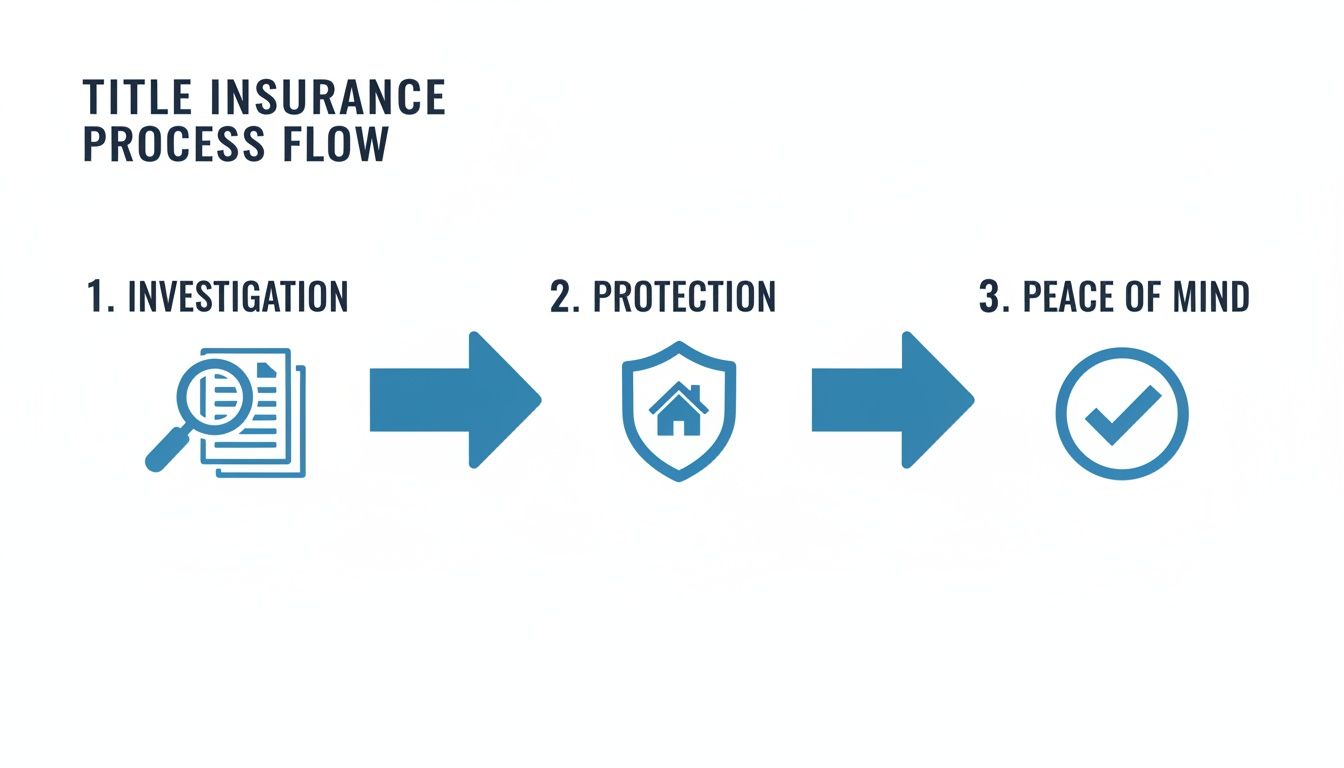
The process transitions from active investigation to passive, long-term protection, providing the certainty required to close the transaction.
Step 4: Closing and Policy Issuance
At the closing table, once all conditions in the title commitment are satisfied—such as the seller paying off their mortgage—the transaction is finalized. At this moment, the title insurance policies are issued. The one-time premium is paid as part of the closing costs, and protection begins immediately. An owner’s policy secures the buyer’s equity, while the lender’s policy protects the bank’s investment.
Step 5: Handling Post-Closing Claims
While the upfront due diligence catches over 99% of potential issues, title insurance is primarily for the unexpected “black swan” event. If a covered problem surfaces after closing—such as a forged signature on a deed from 30 years ago—the policy is activated. The owner files a claim, and the title insurer covers the legal costs to defend the title and pays for any financial losses incurred, up to the policy’s face value.
What is the Difference Between an Owner’s Policy and a Lender’s Policy?
There are two distinct types of title insurance policies: the Lender’s Policy and the Owner’s Policy. A Lender’s Policy is almost always mandatory in a financed transaction and protects only the bank’s financial interest. In contrast, the Owner’s Policy is your personal safeguard, protecting your equity and your legal right to own the property.
The lender’s policy protects the loan; the owner’s policy protects your down payment and every dollar of equity you accumulate.

The Lender’s Policy: Mandatory Protection for the Bank
If you secure a mortgage, the lender’s policy is non-negotiable. Its sole purpose is to guarantee the bank’s loan is a valid and enforceable first-position lien against the property. Should a historical title defect ever threaten the lender’s ability to foreclose and recover its capital, this policy makes the lender whole.
Key characteristics include:
- Coverage Amount: The policy’s value is tied to the outstanding mortgage loan amount and decreases as you pay down your loan.
- Duration: Coverage lasts only until the mortgage is fully paid off or refinanced.
- Beneficiary: The mortgage lender is the sole beneficiary.
This policy provides zero financial protection for your personal investment in the property.
The Owner’s Policy: Your Personal Financial Shield
An Owner’s Policy is what protects your financial stake in the property—your down payment and all future equity. It is typically optional but fundamentally necessary. You pay a one-time premium at closing for long-term protection against a wide range of hidden title defects.
The market’s reliance on this protection is telling. Owner’s title insurance policies were valued at USD 1.5 billion in 2023 and are projected to reach USD 2.1 billion by 2032. In North America, where the market is expected to hit USD 2.8 billion by 2032, owner’s policies are included in over 80% of residential transactions, demonstrating their perceived necessity. You can explore full projections on HousingWire to see how these trends are shaping the global title insurance market.
Unlike the lender’s policy, an owner’s policy covers you for the full purchase price of the home. The coverage amount does not decrease; it protects your full investment for as long as you or your heirs own the property.
This permanent security is what makes an owner’s policy a critical asset for any property owner.
Direct Comparison: Owner’s vs. Lender’s Policy
This table provides a direct comparison of the two policies.
| Feature | Owner’s Policy | Lender’s Policy |
|---|---|---|
| Who It Protects | The Homeowner (Buyer) | The Mortgage Lender (Bank) |
| Is It Required? | Usually optional, but highly advised | Almost always required for a mortgage |
| Coverage Amount | The full purchase price of the property | The outstanding mortgage loan amount |
| Cost | One-time premium paid at closing | One-time premium paid at closing |
| Coverage Duration | For as long as you or your heirs own it | Until the mortgage is paid off |
Forgoing an owner’s policy to save a fraction of the purchase price at closing is a significant gamble, leaving your largest asset exposed to the very risks that title insurance services were designed to eliminate. The lender is protected; you should be too.
What Hidden Risks Does Title Insurance Cover?
Even the most exhaustive title search cannot uncover every historical defect. Title insurance services exist to protect you from problems that are undiscoverable in public records—the “hidden clouds” that can emerge months or years after closing. Your policy is a safeguard against issues that can lead to devastating legal fees or, in a worst-case scenario, the total loss of your property.
Undisclosed Liens and Debts
An undisclosed lien is a legal claim on a property to cover an unpaid debt. If that debt isn’t settled, the creditor can force a sale to recover their money. For example, if a previous owner failed to pay a contractor $30,000 for a remodel, that contractor can file a mechanic’s lien. If that lien was misfiled or missed during the title search, you, the new owner, could be held responsible for that debt or face foreclosure.
Forgery and Fraud
Criminal fraud, such as a forged signature on a deed, can destroy a property’s chain of title in ways that are nearly impossible to detect. For instance, a property might have been “sold” using a forged power of attorney from an elderly owner. Years later, the owner’s true heirs could appear with proof of fraud and a legitimate claim to the house you now occupy. Title insurance is designed specifically for this type of catastrophe, covering your legal defense and financial losses.
This protection is critical, as a title defect from 50 years ago can have the same devastating impact as one from last year. These tangled ownership histories are particularly prevalent in older, high-density markets. Our Investor Pulse reports track ownership and transaction history county by county, including Los Angeles, which shows where properties have changed hands most often.
Errors in Public Records
Human error is another significant risk. A county clerk might mis-index a document, making it invisible to a standard search. A deed might contain the wrong legal description or a misspelled name. A simple typo in the property’s legal description could mean you legally own part of your neighbor’s lot instead of your own backyard, a problem you might not discover until you attempt to sell or build a fence.
Undiscovered Heirs and Wills
An undiscovered heir can also threaten your ownership. The seller may have believed they were the sole owner, but if a forgotten will or a long-lost relative with a valid claim emerges, your ownership is immediately challenged. These situations frequently occur when property passes through a family without a clear will, leaving an heir out of the probate process who still retains a legal claim to their share of the property.
How Is Technology Reshaping Title Underwriting?
The title industry, historically defined by manual courthouse searches and paper records, is undergoing a technological transformation. This shift, powered by real estate data APIs and machine learning, is fundamentally changing how risk is managed in real estate. Underwriters can now access massive digital databases instantly, automating large portions of the title search, reducing operational costs, and achieving a level of accuracy previously unattainable.
The title insurance market was valued at USD 66.6 billion in 2024 and is projected to reach USD 124.4 billion by 2030, an 11% compound annual growth rate (CAGR). This growth signals to proptech platforms and lenders that integrated data solutions are now a competitive requirement. You can learn more about the market’s trajectory in this detailed industry report.
The Role of Big Data and Machine Learning
Modern title underwriting is built on data. By integrating with comprehensive property databases, insurers can train algorithms to identify risk factors with high precision. A platform like BatchData, for instance, provides access to over 155 million property records, each containing critical underwriting data points:
- Complete Ownership History: Trace the chain of title digitally to spot gaps or breaks.
- Tax and Assessment Data: Automatically flag unpaid tax liens and other assessments.
- Lien and Mortgage Records: Get a real-time snapshot of every encumbrance on the property.
This data feeds machine learning models that detect patterns invisible to the human eye. Advanced tools applying Machine Learning in the Insurance Industry transforming underwriting don’t just review documents; they calculate a probabilistic risk score for each property, enabling underwriters to make faster, more confident decisions.
Practical Use Cases in Modern Underwriting
This data-driven approach is already being used by insurers, lenders, and proptech firms to solve real-world problems. An underwriter can now view a smart map that provides a visual overview of risk across an entire geographic area, turning raw data into actionable intelligence.

Key applications today include:
- Automated Title Searches: Algorithms can execute a preliminary title search in minutes, flagging red flags and freeing human experts to focus on complex cases.
- Proprietary Risk Scoring: Many firms use internal scoring systems, like BatchRank, to instantly grade a property’s title risk. A low-risk score may greenlight an express closing, while a high-risk score triggers a full manual review.
- Real-Time Portfolio Monitoring: Data APIs allow lenders and investors with large portfolios to receive instant alerts if a new lien is filed or a property enters pre-foreclosure, enabling proactive risk management.
This data-first approach adds a new layer of security by cross-verifying information from multiple sources, drastically reducing the risk of human error or fraud. An API can check an owner’s contact details against several public and private databases to confirm identity with greater certainty. Layering in spatial data, as explained in our guide on how geospatial analysis enhances automated valuation models, makes this process even more precise.
Technology is making title insurance services faster, more affordable, and more reliable for all parties in a transaction.
How Much Does Title Insurance Cost and Who Pays?
Title insurance is a one-time premium paid at closing, not a recurring expense. The cost is determined by the property’s sale price, loan amount, and state regulations, but typically falls between 0.5% and 1.0% of the home’s purchase price. For a $400,000 property, the premium would be between $2,000 and $4,000.
Who pays is determined by local customs and negotiation:
- Lender’s Policy: The buyer almost always pays this cost as a condition of securing the mortgage.
- Owner’s Policy: This is negotiable. In some markets, the seller pays for the owner’s policy to affirm they are delivering a clean title. In others, the buyer purchases their own policy.
Is Title Insurance Necessary For a Cash Purchase?
Yes. An owner’s policy is the only real defense against historical title defects, even without a lender mandating it. Paying in cash does not eliminate the risk of a forged deed from 20 years ago, a previously unknown heir, or a clerical error in public records that could jeopardize your ownership.
When you buy a property with cash, you put 100% of your investment at risk from day one. If a past claim surfaces, you are solely responsible for all legal fees and potential losses, which could wipe out your entire equity.
The one-time cost of an owner’s policy is a negligible price for securing an asset worth hundreds of thousands of dollars.
How Long Does Title Insurance Coverage Last?
The duration of coverage is a critical distinction between the two policy types.
- A Lender’s Policy provides coverage only until the mortgage is paid off or refinanced. Once the loan is satisfied, the policy is terminated.
- An Owner’s Policy protects you and your heirs for as long as you maintain ownership of the property.
Your owner’s policy never expires. It acts as a permanent shield against any covered title issues that may arise from the property’s history, long after the closing is complete.
At BatchData, we provide the property data foundation that empowers modern title underwriting. Access over 155 million property records to automate searches, verify ownership, and assess risk with unparalleled accuracy. Discover how our low-latency APIs and bulk data services can transform your operations at https://batchdata.io.