






































SEO Title: Third-Party Collection Agency Guide for Lenders
Meta Description: Learn how third-party collection agencies work, how compliance changes operations, and how lenders should evaluate cost, risk, and integration.
Meta Keywords: third-party collection agency, debt collection outsourcing, assigned debt vs sold debt, Regulation F collections, collection agency compliance, contingency fee collections, collection agency API integration, skip tracing for collections
Third-party collections touch a large share of the consumer credit market. For lenders and servicers, that means outsourcing recovery is a routine operating decision, not a special-case tactic.
For mortgage servicers, proptech platforms, and consumer lenders, a third-party collection agency sits inside the core servicing workflow. The agency affects borrower contact strategy, complaint exposure, remittance controls, and the quality of account data flowing back into your system of record. If placement files arrive with missing fields, bad phone consent flags, or weak status mapping, recovery drops and compliance risk goes up at the same time.
The operating model has changed. Regulation F forced agencies and creditors to tighten call controls, validation workflows, dispute handling, and electronic communication procedures. Email and text can lower contact costs, but only when consent, opt-out logic, time-of-day rules, and message logging are configured correctly. An agency that still runs on batch files, manual notes, and delayed exception reporting will create work for your servicing team, not remove it.
The practical decisions are usually more operational than legal at first glance. Who holds settlement authority. How often balances, fees, and payment statuses sync. Whether disputes post back in real time or sit in a queue for three days. Whether the agency can return a full communication history when a regulator, investor, or audit team asks for evidence.
Core takeaways
- Placement structure drives control. Assigned debt, sold debt, and post-charge-off servicing each change who owns the account, who approves settlements, and whose name the borrower associates with the collection experience.
- Compliance now depends on system design. Regulation F is not just a policy issue. It affects message cadence, channel permissions, record retention, and exception handling.
- Cost-to-collect is only one metric. Net recovery, liquidation speed, dispute rates, complaint volume, and right-party contact quality usually tell you more about agency performance.
- Integration quality changes the economics. API-based placements, standardized status codes, and audit-ready event logs reduce manual reconciliation and lower vendor-management risk.
A lender can accept a 20 percent to 35 percent contingency fee if recoveries are clean, disputes are controlled, and reporting closes the books without manual cleanup. That same fee looks expensive fast when account data is incomplete, payments take days to post, or your staff has to reconcile every bankruptcy, cease-and-desist, and settlement exception by hand.
Introduction
Millions of collection accounts are still worked by outside agencies every year. For lenders, mortgage servicers, and proptech platforms, that makes third-party collections a routine operating decision, not a rare exception. The harder question is no longer whether to outsource. It is whether the agency can recover dollars inside your servicing stack without creating compliance failures, borrower complaints, or manual reconciliation work your team has to clean up later.
That trade-off has changed in the last few years. Regulation F raised the bar for how agencies handle communications, disputes, and recordkeeping. At the same time, borrowers now expect text, email, portals, and self-service payment options, even on delinquent accounts. If your agency cannot control consent, message frequency, and event logging across those channels, recoveries can stall while risk rises.
The operational burden shows up fast. A file transfer that looks acceptable at placement can break down as soon as a borrower disputes a balance, files bankruptcy, submits a cease-and-desist, or makes a partial payment through the wrong channel. In practice, the true cost of outsourcing is rarely just the contingency fee. It is the hours spent matching account statuses, correcting balances, reviewing call notes, and proving what happened when audit, legal, or investor teams ask for documentation.
The first decisions are practical:
- How account, payment, and dispute data will move between systems
- How quickly communications and status changes post back to the servicer
- Who controls settlement authority and exception handling
- What evidence the agency can return for complaints, disputes, and exams
A third-party collection agency can reduce internal staffing pressure and improve reach on aged accounts. It can also increase vendor risk if the agency runs on batch files, unclear status codes, and channel practices your compliance team cannot test or monitor.
For modern servicing organizations, agency selection is now part collections strategy, part systems design, and part compliance control. That is the standard the rest of this guide uses.
What Is a Third-Party Collection Agency
A third-party collection agency sits outside the creditor or servicer, but works the creditor's accounts under a defined placement agreement. In assigned placements, the lender still owns the receivable. The agency gets limited authority to contact the consumer, collect funds, document outcomes, and return account status data on a schedule the client can audit.
That legal distinction matters because the operating model changes with it. If a mortgage servicer places defaulted or seriously delinquent accounts with an agency, the servicer usually keeps control over settlement limits, dispute escalation, complaint handling, and investor reporting. If the debt is sold instead, the buyer controls the account and the original creditor gives up much of that day-to-day authority, along with much of the direct customer relationship.
A simple comparison helps:
| Model | Who owns the debt | Who usually controls settlement authority | Brand exposure |
|---|---|---|---|
| First-party collections | Original creditor | Original creditor | Highest direct exposure |
| Assigned third-party collections | Original creditor | Usually creditor, sometimes with delegated limits | Still significant |
| Sold debt | Debt buyer | Debt buyer | Reduced direct exposure, but transfer impact remains |
For servicers and proptech platforms, assigned third-party collections are usually the practical middle ground. They reduce internal calling volume and extend coverage on older accounts, but they do not transfer compliance accountability. Under Regulation F and related state rules, the creditor still needs confidence that the agency can control channel consent, store communication records, suppress bankrupt or represented accounts quickly, and return evidence when a borrower disputes a balance or files a complaint.
That is why a third-party agency should be evaluated as both a recovery vendor and a data counterparty.
After placement, the agency's job is broader than making calls. It must work from the client's account data, apply client-specific rules, send notices, handle inbound consumer responses, process authorized payments, code disputes correctly, and post results back into the servicing environment without creating reconciliation problems. If borrower contact data is stale, performance drops fast, which is one reason many teams pair agency operations with better data inputs such as API-based skip tracing workflows that improve match accuracy.
Modern agencies also differ in how visible their work is to the client. Some provide near real-time status feeds, event logs, call recordings, and payment files that fit cleanly into a servicer's platform. Others still rely on batch reports, broad status buckets, and manual exception handling. On paper, both are third-party collection agencies. In practice, one behaves like an extension of servicing operations, and the other creates audit and customer-experience risk.
Executives evaluating outsourcing models often focus first on placement rates and contingency fees. That is too narrow. The better question is whether the agency can operate inside your controls without slowing down borrower resolution or creating compliance noise. For a higher-level operating view, see these collection strategies for C-suite executives.
How the Third-Party Collection Workflow Operates
The workflow is straightforward on paper and messy in practice. Once a creditor places accounts, the agency has to turn static account records into controlled outreach, consumer engagement, payment handling, and documented outcomes. The weak point is usually not collector effort. It's data quality and integration.
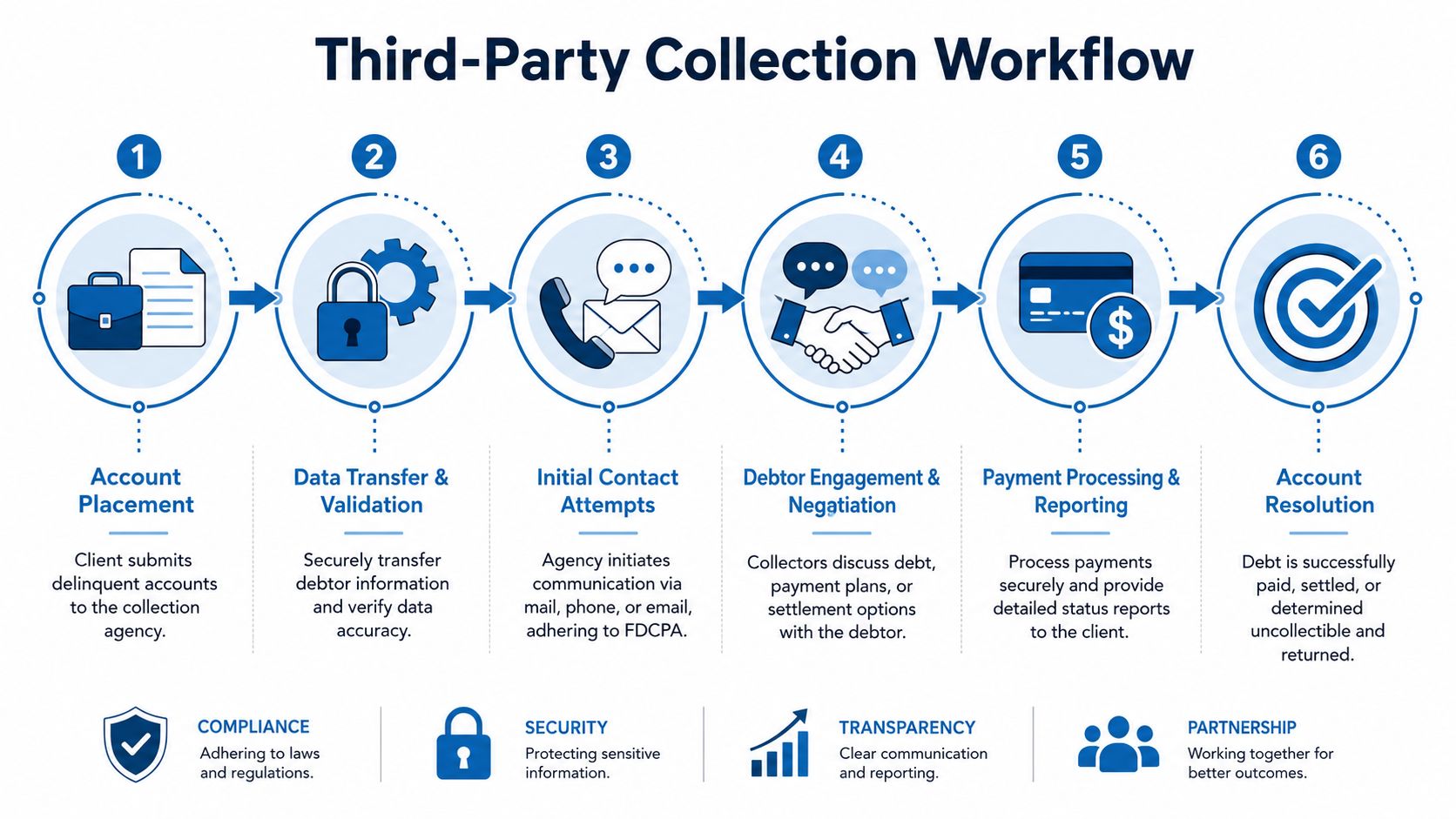
The six operational stages
Third-party collection is an outsourcing model where the agency handles communication through a centralized collection management system, or CMS, used to store account data, track call outcomes, manage consumer discussions, and process payments. In practice, that makes collections as much a software and data integration problem as a staffing problem (how collection agencies work operationally).
A workable workflow usually looks like this:
Account placement
The creditor sends account-level data, balance details, borrower identifiers, prior contact history, and any servicing notes that affect communication.Data validation
The agency standardizes fields, checks for missing or conflicting records, and verifies whether contact channels appear usable before outreach starts.Initial communication
The agency sends required notices and begins contact attempts inside approved rules and channel policies.Engagement and resolution work
Collectors or digital workflows handle inbound responses, payment options, disputes, hardship conversations, and negotiated outcomes.Payment and status reporting
Payments must post accurately, and the creditor needs status codes back in a form its servicing or finance team can use.Return or closure
Accounts resolve through payment, settlement, dispute escalation, withdrawal, or return as uncollectible.
Where operations usually fail
The most common failure isn't effort. It's a broken handoff between systems.
If the file arrives with stale phone numbers, fragmented borrower identities, or poor account notes, the agency wastes contact attempts, triggers wrong-party risk, and slows recovery. That's why skip tracing and data hygiene matter before volume hits the queue. Teams looking at executive-level collection planning often benefit from broader frameworks like these collection strategies for C-suite executives, especially when collections are tied to cash forecasting and vendor oversight.
For digital-first programs, the handoff should also support enrichment and verification workflows. A useful example is this look at how APIs enhance skip tracing accuracy, because API-fed contact refreshes are easier to govern than repeated manual file passes.
What works and what doesn't
| Workflow choice | What works | What fails |
|---|---|---|
| Data handoff | Structured fields, clear account status taxonomy, documented suppression rules | Ad hoc CSVs with free-text notes |
| Communication control | Channel-level permissions, logging, and templates tied to policy | Collector discretion without system guardrails |
| Client reporting | Near-real-time status mapping back to servicing systems | Weekly PDFs that finance and compliance can't reconcile |
A modern agency should be able to explain its workflow in system terms, not just collector terms. If it can't map data in, actions taken, and data back out, recovery will be harder to trust.
Navigating the Legal and Compliance Landscape
A collection program can post solid liquidation rates and still create expensive risk if the agency cannot control outreach by rule, channel, and account status. In mortgage servicing and proptech environments, compliance failures usually start in the handoff. Missing cease-and-desist flags, stale consent records, bad time-zone data, and incomplete dispute history all turn into collector actions that should never have happened.

What the rules change operationally
Third-party agencies operate under the FDCPA and Regulation F. For lenders and servicers, those rules are not abstract legal requirements. They dictate file design, outbound controls, audit retention, complaint handling, and how quickly account updates have to flow between systems.
That matters more now because agencies do not work only from phone queues. They use email, text, letter vendors, dialers, payment portals, and client APIs. If those systems are not tied together, a consumer can dispute by email, pay through a portal, and still receive a collection text because the suppression did not post in time.
Agencies that handle this well usually have controls in five areas:
- Contact history across channels with a single account-level record
- Time-zone and timing controls enforced by system logic, not collector memory
- Validation notice and dispute workflows that route work and freeze outreach when required
- Consent, revocation, and channel-permission tracking that can be audited
- Complete action logs for client reviews, complaints, and regulator requests
Manual work breaks first at scale. A shop can survive with spreadsheets at low volume. It usually fails once placements expand across multiple channels or portfolios. Teams reviewing dialer and messaging controls should look closely at TCPA compliance for automated outreach, because the same controls matter even in partially automated programs. The practical standard is simple: consent and suppression data need to be machine-readable and synced fast enough to stop the next contact.
Regulation F turned compliance into a systems requirement
Regulation F raised the bar for process discipline. It pushed agencies to prove what was sent, when it was sent, to whom, and what happened after the consumer responded. That changes the cost-benefit analysis for outsourcing. A lower contingency rate is not cheaper if weak controls create complaints, rework, or client remediation.
I have seen this trade-off play out in servicing portfolios. An agency may look efficient on gross collections, but if it cannot ingest nightly bankruptcy updates, deceased flags, attorney representation, and payment-plan status, the client ends up paying in exceptions management and oversight hours.
| Compliance area | Operational requirement | Common failure |
|---|---|---|
| Contact controls | Rule-based limits by channel, account status, and local time | Over-contact, wrong-time contact, complaint exposure |
| Validation and disputes | Searchable records, workflow holds, documented resolution steps | Continued outreach during unresolved disputes |
| Digital communication | Consent capture, revocation tracking, message retention | Messages that cannot be defended in an audit |
| Servicing data sync | Frequent status updates through API or governed batch feeds | Paid, bankrupt, or represented accounts staying active |
Strong agencies can show exactly how a cease flag, dispute, payment, or bankruptcy update moves through the platform and stops downstream actions. If the answer is "the collector notes it," the control is weak.
Security belongs in the same review. Agencies hold identity data, loan details, balances, and payment activity. Vendor diligence should include testing depth, incident response discipline, access controls, and independent review of security controls, including SOC 2 pentesting solutions when you are assessing how a vendor protects sensitive servicing and consumer data.
A useful reminder on the operational side is below.
The practical takeaway is straightforward. Compliance works when policy, data, and system controls match. It gets expensive when a servicer outsources recovery without validating how the agency enforces rules across digital channels and how fast those controls react to new account data.
Analyzing Costs and Measuring Performance
Most third-party placements run on a contingency model. The agency gets paid only when it recovers money. That sounds simple, but the incentive structure deserves a hard look because it shapes outreach strategy, data needs, and how performance should be judged.
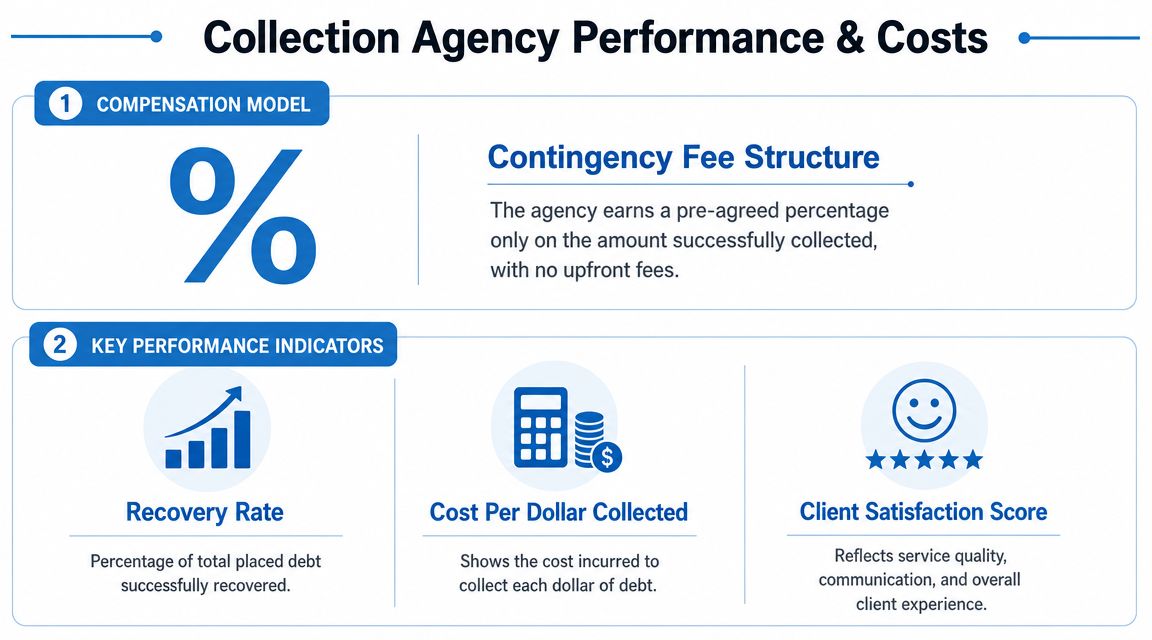
Why contingency changes behavior
Industry guidance identifies contingency compensation as the dominant commercial model, and that structure creates a direct link between an agency's data quality, right-party-contact rates, and net recovery. Agencies that improve account cleansing, matching, and workflow automation gain a measurable advantage in cash-flow performance (contingency model and collections operations).
That has two consequences for creditors.
First, you don't need to guess what the agency is optimizing for. It's optimizing for collectible dollars that can be reached compliantly and converted efficiently.
Second, bad input data becomes expensive even without an upfront fee. If the portfolio has stale contacts, duplicate consumers, poor placement logic, or weak segmentation, the agency burns labor and channel capacity on low-quality attempts.
The KPIs that matter
A lender or servicer should track more than gross dollars collected. The useful KPIs are operational.
Net recovery rate
This is the core financial outcome. It tells you what portion of placed balances ultimately turns into recovered cash after the agency does its work.Right-party contact quality
This is the clearest signal that the agency's data processes work. If the firm reaches the wrong person repeatedly, everything downstream gets worse.Cost to collect
This shows how much economic friction sits inside the program. High recovery with chaotic effort may still be a poor operating result.Dispute and complaint handling
This reveals whether the agency is creating avoidable compliance exposure while chasing balances.
Operator note: A high recovery story with weak dispute controls is usually an unstable program, not a strong one.
Outsourcing versus internal recovery
| Decision factor | Outsource to agency | Keep internal |
|---|---|---|
| Cost structure | Variable and tied to recoveries | Fixed staffing, systems, and training burden |
| Specialization | Access to focused recovery workflows and channel operations | Stronger internal brand control if your team is mature |
| Oversight need | Requires vendor governance and reporting discipline | Requires in-house management depth and compliance support |
What works in practice is targeted outsourcing, not blind outsourcing. Place account types the agency can handle cleanly. Keep tight authority limits. Demand transparent reporting. Measure both cash and control.
The Business Case for Outsourcing Collections
Outsourcing makes sense when the agency can recover delinquent balances more efficiently than your internal operation without degrading borrower treatment or control. It doesn't make sense when the vendor becomes a reporting blind spot, a complaint generator, or a security exception you struggle to supervise.
Outsourcing Collections Pros vs. Cons for Creditors
| Factor | Pros of Outsourcing (Using an Agency) | Cons of Outsourcing (Risks to Manage) |
|---|---|---|
| Specialization | Agencies focus on recovery workflows, dispute handling, and regulated communications every day | Specialists can still be misaligned with your servicing standards if scopes are vague |
| Cost structure | Converts part of collections expense from fixed internal overhead to variable external cost | Variable cost can hide inefficiency if you only watch dollars recovered |
| Scalability | Easier to absorb account surges without hiring and training internally | Volume scaling can expose data quality problems faster |
| Compliance operations | Agencies often invest in dedicated controls, logging, and policy-driven workflows | You still retain vendor oversight risk and reputational exposure |
| Customer experience | A disciplined agency can create structured, less emotional recovery interactions | A poor agency can damage trust quickly because consumers associate the experience with your brand |
| Technology | Mature vendors can offer dashboards, API reporting, and workflow automation | Weak vendors rely on flat files, delayed reporting, and manual exception handling |
| Data security | Strong agencies may have more mature handling processes than smaller internal teams | Any external transfer expands your attack surface and vendor review burden |
Where outsourcing creates real value
The strongest use case is not “we don't want to collect.” It's “we want a specialist to handle a defined segment under controlled rules.”
For mortgage servicers and property-linked lenders, that often means outsourcing when:
- Delinquency volume spikes beyond internal staffing capacity
- Account segmentation matters and different borrower cohorts need different treatment
- Digital outreach and tracing require tools the in-house team doesn't operate well
- Compliance logging has to be tighter than current servicing workflows support
The 2026 scorecard mindset
A useful vendor scorecard combines four lenses:
Control
Can you define authority, pause accounts, retrieve evidence, and audit actions quickly?Data discipline
Can the agency accept clean structured feeds, enrich contactability, and return standardized statuses?Consumer treatment
Does the borrower experience stay professional, documented, and aligned with your brand tolerance?Operational transparency
Can servicing, finance, compliance, and vendor management all see the same truth without manual reconciliation?
Agencies win in 2026 when they function like a governed extension of your platform. They lose when they still operate like an outsourced call floor wrapped around spreadsheets.
How to Evaluate and Integrate a Modern Agency
The industry is at a crossroads. Slow technology adoption still limits progress, and the best agency is increasingly the one that reaches the right person with fewer wrong-party contacts and lower compliance risk. That makes data quality and automation a competitive advantage, not just an efficiency upgrade (modern collections technology outlook).
What to test before signing
A modern agency should pass four tests.
Compliance technology
Ask how rules are enforced in the platform. You want audit trails, channel controls, dispute workflows, and configurable policies that reduce collector discretion where it creates risk.
Security posture
Don't stop at policy documents. Ask how the agency handles access control, payment data, consumer identity data, incident response, and testing.
Integration model
API connectivity matters more than polished sales demos. If placements, suppressions, disputes, payment events, and closure statuses still depend on manual file swaps, the relationship will drag operations down.
Performance analytics
Dashboards should show account flow, contactability, dispute queues, and client-visible outcomes in a way your servicing and compliance teams can reconcile.
What integration should look like
| Capability | Strong implementation | Weak implementation |
|---|---|---|
| Account placement | API or structured automated feed with field validation | Email attachments and one-off templates |
| Status reporting | Standardized event mapping back to your system | Narrative updates and inconsistent codes |
| Contact data support | Enrichment and verification workflows tied to governance | Collectors updating records ad hoc |
| Exception handling | Clear queues for disputes, deceased, bankrupt, cease, and suppression states | Manual side conversations and delayed escalations |
One practical reference point for the tooling side is this guide to legal tech for law firms. Different sector, same lesson. Regulated workflows perform better when documentation, tracking, and system control are built in rather than bolted on.
If you're assessing the platform layer itself, it's also worth reviewing what modern collection company software should support. For data-driven programs, one option in the workflow stack is BatchData, which provides property and contact data services, including skip tracing and verification support that can feed collections operations where accurate reachability matters.
Choose the agency that can explain exceptions clearly. Standard cases don't expose operational weakness. Exceptions do.
The selection question isn't “Who promises the highest recovery?” It's “Who can deliver recoveries with evidence, control, and clean integrations?”
Conclusion
A third-party collection agency is an outsourced recovery partner, but in practice it's also part of your compliance machinery, your data supply chain, and your customer-contact layer. That's why the basic definition isn't enough.
The key decision resides in the operating model. Are you assigning or selling? Can the agency ingest clean data and return usable statuses? Does its system control outreach well enough to support regulated digital communication without creating avoidable risk?
Cost still matters. Recovery still matters. But modern vendor selection turns on three harder questions: technology, compliance rigor, and integration quality. Agencies that treat data hygiene, auditability, and controlled omnichannel workflows as core capabilities will keep gaining ground. The ones that depend on manual workarounds won't.
If you're building or managing a collections workflow that depends on accurate borrower and property-linked contact data, BatchData can support the underlying data layer with APIs, skip tracing, contact verification, and structured delivery options that fit modern servicing and recovery operations.