



92% of property operators say manual processes slow financial operations. In receivables, that delay shows up as late invoices, slow payment matching, weak follow-up, and less confidence in near-term cash. For real estate businesses, those gaps are expensive because every missed handoff affects liquidity, reserve planning, and portfolio decisions.
A receivables management system matters because cash flow in real estate is tied to asset-level facts, not just customer balances. A lender, mortgage servicer, or proptech platform needs to know whether an invoice was sent on time, whether payment behavior is changing, and whether the account is tied to a property event such as a transfer, vacancy shift, lien, or ownership change. Teams that connect receivables operations with property intelligence get a better collections strategy than teams working from ERP records alone.
That is the gap between basic payments and receivables workflows and a modern RMS built for operational control.
For real estate operators, servicers, and proptech teams, the practical implications are clear:
- RMS coordinates the full receivables workflow. It supports billing, payment capture, collections, disputes, and reporting in one operating layer.
- Integration drives performance. ERP sync improves financial control. Property data enrichment gives collections teams better timing, better contact strategy, and better risk visibility.
- Real estate has different collection patterns. Mortgage servicing, lien recovery, HOA payments, rent collections, and property-backed receivables depend on asset data that generic B2B AR tools often ignore.
- Manual exception work is where teams lose margin. Unapplied cash, disputed balances, broken payment plans, and outdated contact records slow collections and distort forecasting.
The critical question is whether your current stack can turn receivables into predictable cash, especially when account risk depends on property-level context as much as invoice status.
What Exactly Is a Receivables Management System?
A receivables management system is an integrated platform that manages the full accounts receivable lifecycle, from invoice creation through payment matching, collections, dispute handling, and reporting.
Basic accounting software records what happened. An RMS helps your team decide what to do next. That’s the practical distinction.
A ledger is a map. An RMS is a navigation system. It shows open invoices, flags risk, routes work to the right collector, tracks broken promises to pay, and gives finance leaders a current view of expected cash.
Where RMS sits in the finance stack
Organizations often first encounter receivables pain as a workflow problem. Invoices go out late. Payments arrive without clean remittance data. Collectors work from spreadsheets. Disputes sit in email threads. Finance closes the month with too many open questions.
A modern RMS fixes that by sitting between transaction systems and collection workflows. It usually connects to ERP, accounting, banking, customer communication channels, and payment infrastructure.
According to SAP’s overview of accounts receivable automation, advanced receivables management systems centralize open item monitoring and exception-based processing through real-time ERP integration, and can reduce DSO by 10% to 20% through automated credit risk scoring, dispute resolution, and multi-channel collections.
That’s why I don’t treat RMS as a back-office add-on. It’s a control layer for cash flow.
What an RMS actually changes
The value shows up in operational discipline:
- Invoice control: Billing goes out consistently, with fewer missing fields and fewer avoidable delays.
- Collection sequencing: Reminder logic, escalation paths, and account prioritization stop living in tribal knowledge.
- Exception handling: Disputes, short pays, unapplied cash, and broken remittance formats move into trackable queues.
- Cash visibility: Treasury and servicing teams get a more reliable view of what’s collectible now versus what needs intervention.
Practical rule: If your AR team spends more time finding information than acting on it, you don’t have a collections problem. You have a systems problem.
For teams that need a broader primer on how billing, settlement, and collections fit together, Comfi’s guide to payments and receivables is useful context because it frames the payment side and the AR side as one operating system, not two separate functions.
Why real estate teams should care
In real estate, receivables aren’t always simple invoices. They can involve mortgage payments, servicing advances, lien-related balances, structured payment schedules, escrow-linked issues, and account outreach tied to property ownership records.
That changes implementation priorities. A generic AR tool might handle billing. A real-world RMS for this sector has to support collections strategy, identity resolution, property context, and risk signals around the receivable itself.
If the platform can’t help your team answer who owes, what they owe, how collectible it is, and what action should happen next, it’s not doing enough.
What Are the Core Modules of a Modern RMS?
A modern RMS has seven core modules. Together, they turn AR from a recordkeeping function into an operating workflow.
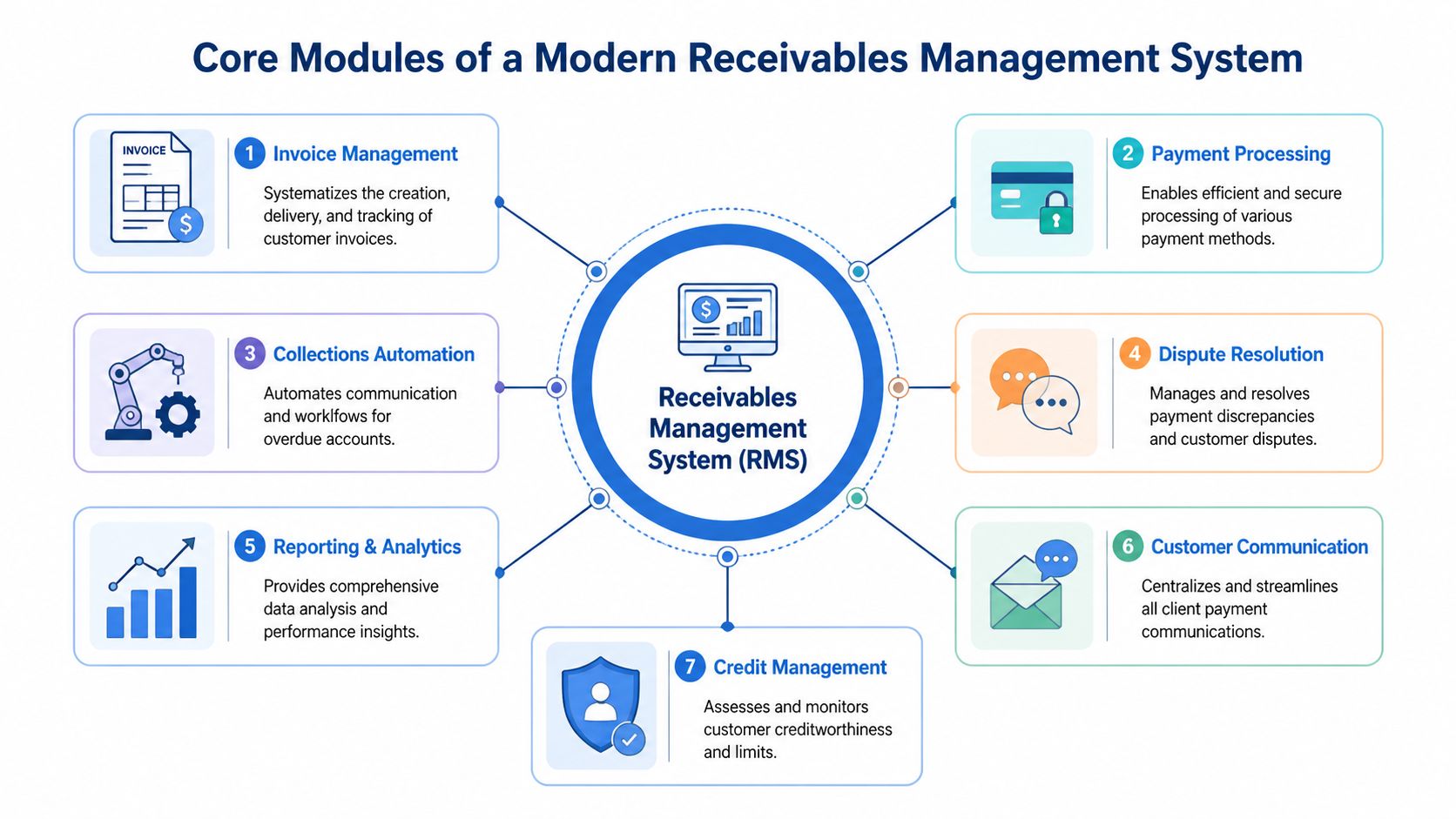
Invoice management
This module governs invoice creation, delivery, status tracking, and document integrity.
For technical teams, the important question is not “can it generate an invoice?” Most systems can. The real question is whether it can generate the right invoice, from the right source event, with the right customer and contract metadata, and push it through the right delivery channel without manual repair.
A solid invoice module should handle:
- Template logic: Different invoice structures by product, borrower type, tenant type, or servicing scenario.
- Delivery orchestration: Email, portal, and file-based delivery with status visibility.
- Audit traceability: Timestamps for issue date, delivery, reissue, and access history.
Bad invoice management creates downstream noise. Collections teams then chase balances that were never presented clearly in the first place.
Payment processing
This module captures payments and records settlement activity across channels.
In weaker setups, payment acceptance and AR posting are loosely connected. Finance sees the money. AR still has to figure out where it belongs. That gap creates unapplied cash and unnecessary customer outreach.
Strong payment processing does three things well:
- Supports multiple payment paths
- Returns payment status quickly
- Feeds posting and reconciliation workflows without delay
That matters in real estate because payments may arrive through portals, lockbox, ACH-related workflows, servicing channels, or structured recurring arrangements. If the system treats all of that as one normalized stream, your downstream reporting improves.
Collections automation
At this point, an RMS starts paying for itself operationally.
Collections automation applies rules to open receivables and determines when to send reminders, when to escalate, when to assign a collector, and when to pause outreach because a dispute or promise-to-pay exists.
The best systems don’t just automate volume. They automate sequencing.
- Early-stage nudges: Soft reminders before due dates or immediately after missed due dates
- Escalation logic: Higher-touch workflows for aging balances, broken payment commitments, or higher-risk accounts
- Task routing: Assignment by account owner, portfolio, territory, or risk profile
Collections shouldn’t start at the moment an invoice becomes overdue. Good systems shape payment behavior before that point.
Dispute resolution
Disputes are where many AR programs break down. Not because teams can’t resolve them, but because they can’t see them clearly.
A dedicated dispute module tracks reason codes, ownership, status, documentation, and resolution deadlines. It keeps collectors from chasing balances that shouldn’t be chased yet, and it keeps finance from aging a balance as collectible when it’s stuck in review.
For lenders and servicers, this can include documentation mismatches, payoff disagreement, servicing transfer confusion, fee challenges, or contact misalignment.
Reporting and analytics
Reporting is the layer that converts activity into control.
You need dashboards that separate collectible balances from blocked balances, show aging trends, expose collector workload, and track whether invoice quality is getting better or worse. The goal is not prettier charts. The goal is faster decisions.
A useful RMS analytics layer should answer:
| Question | Why it matters | Typical decision |
|---|---|---|
| Which balances are aging fastest? | Aging concentration signals process failure or account risk | Reprioritize outreach or revise credit controls |
| Which disputes are stuck? | Long-lived exceptions distort true AR health | Add owners, deadlines, or documentation rules |
| Which channels produce better payment behavior? | Communication method affects response quality | Shift reminders toward the channels that work |
Customer communication
Many teams underestimate this module because they assume it’s “just email.” It isn’t.
Customer communication inside an RMS should centralize outbound reminders, inbound responses, invoice notices, promise-to-pay records, and account history. When collectors switch between inboxes, CRM notes, and spreadsheets, context disappears.
In real estate use cases, communication history is often the difference between a coordinated servicing action and a duplicated outreach mistake.
Credit management
Credit management sits upstream from collections. It decides how much exposure you’re comfortable carrying before the account becomes a problem.
In B2B real estate operations, that can mean setting rules around terms, reviewing account behavior, and using portfolio signals to tighten or loosen treatment. In servicing and property-linked receivables, the principle is similar even when the workflow looks different. You still need a structured way to identify risk before the receivable ages badly.
An RMS without credit management is reactive. It helps you collect. It doesn’t help you prevent avoidable risk.
How Do You Measure RMS Performance with KPIs?
A small shift in collections speed can change the economics of a real estate portfolio. If cash arrives days later than expected, lenders carry more working capital, servicers absorb more follow-up cost, and proptech operators lose room to fund growth. KPI tracking matters because it shows whether the RMS is shortening that cycle or just documenting it.

Three metrics do most of the work: DSO, ART, and CEI. They answer different questions, and real performance management starts when teams stop treating them as interchangeable.
DSO
Days Sales Outstanding measures how long receivables stay open on average. The formula is (Accounts Receivables at the end of the period / Gross revenues over the period) × (Number of days in the period).
DSO gets executive attention because it ties directly to liquidity. Rising DSO usually means cash conversion is slowing somewhere in the process. Common causes include invoice timing problems, incomplete account data, payment misapplication, unresolved disputes, or weak follow-up rules.
In real estate, DSO gets more useful when you break it down beyond the company total. Portfolio-level averages can hide the underlying issue. A lender may have stable aggregate DSO while one geography, property segment, or servicer queue is deteriorating fast. Property-linked segmentation often surfaces risk sooner than customer-level reporting alone. Teams that already use parcel, ownership, and location intelligence for underwriting can apply the same logic here. For example, geospatial analysis in valuation workflows shows how location context sharpens decision-making, and the same principle applies to receivables prioritization.
ART and CEI
Accounts Receivable Turnover Ratio measures how often receivables convert to cash during a period. The formula is Net Credit Sales ÷ Average Accounts Receivable. A higher ratio usually indicates faster collections and tighter receivables control. A lower ratio usually means balances are sitting too long, whether because of credit policy, billing friction, or poor collection execution.
Collections Effectiveness Index is the metric I trust most for day-to-day operations. It measures how much of the collectible balance the team collected during the period. That makes it better than DSO for judging collector performance, because it strips out some of the noise created by terms, seasonality, or invoice timing.
ApprovalMax’s accounts receivable KPI summary is a useful reference for how finance teams benchmark ART, CEI, aging, and bad debt. The practical interpretation is straightforward:
- DSO shows how long cash is tied up.
- ART shows how efficiently receivables cycle through the business.
- CEI shows whether the collections team is converting balances that were realistically collectible.
A mixed KPI pattern usually points to the source of the problem. High DSO with solid CEI often means the issue sits upstream in billing, terms, or dispute intake. Weak CEI usually points to prioritization, workflow design, staffing, or outreach quality inside collections.
Aging and loss metrics
Headline KPIs are not enough. An RMS also needs guardrails that catch deterioration before it becomes write-offs.
Aging buckets still matter, especially AR over 90 days. Bad debt rate matters too. These metrics answer a different question. They show whether the system is helping teams intervene early enough to keep receivables recoverable.
For proptech, mortgage servicing, and lender workflows, I would not stop at a single aging report. Track aging by portfolio, property type, owner status, delinquency cohort, collector, and channel. If your RMS can enrich accounts with current property and contact data, those views become much more actionable. The platform is no longer just reporting arrears. It is helping the team decide which accounts deserve immediate human attention and which can stay in automated treatment.
What to do with the numbers
KPIs only matter if they change queue logic, staffing, or account treatment. Dashboards alone do not improve cash flow.
| KPI | What it signals | What to do next |
|---|---|---|
| DSO | Cash conversion speed | Audit invoice release timing, dispute backlog, and payment posting delays |
| ART | Receivables cycling efficiency | Review terms, segment-level exposure, and whether follow-up starts early enough |
| CEI | Collections execution on collectible balances | Inspect queue prioritization, collector capacity, outreach history, and exception handling |
The strongest RMS teams tie each KPI to an owner, a threshold, and a response playbook. That discipline matters even more in real estate, where one missing ownership update or one stale property record can send a collector after the wrong party and slow recovery on the right one.
How Do Receivables Systems Integrate with Other Platforms?
Receivables systems integrate through ERP, accounting, payment, banking, CRM, and data APIs. The technical goal is simple. Keep the receivable record current without forcing humans to reconcile every status change by hand.

The baseline integration layer
At minimum, an RMS needs bidirectional connectivity with the system of record. That’s usually an ERP or accounting platform.
Inbound data typically includes:
- Customer and account master data
- Invoice and credit memo records
- Contract or billing schedule data
- Posted payment and adjustment entries
Outbound data usually includes collector notes, promise-to-pay status, dispute codes, cash application results, and workflow outcomes.
If that loop is weak, teams start maintaining shadow ledgers. Once that happens, nobody trusts the number on screen.
Cash application is the proving ground
The integration test that matters most is cash application. If a system can’t reliably ingest payment and remittance data, match it to open items, and post the result back into finance systems, the rest of the workflow gets noisy fast.
According to HighRadius on accounts receivable management, AI-powered cash application achieves 95%+ straight-through processing rates by extracting remittance data from unstructured sources and automatically matching payments to open invoices, reducing manual processing time from hours to seconds.
That changes how teams allocate labor. Instead of spending the day on payment matching, they can work the true exceptions.
Why property data changes the equation
Generic AR integration stops at financial systems. Real estate teams need more.
Mortgage servicers, lenders, and proptech platforms often need to enrich receivable records with:
- Verified owner or contact data
- Property and parcel context
- Lien and mortgage information
- Valuation and equity signals
- Pre-foreclosure or distress indicators
Receivables management systems become intelligence systems. The system isn’t just storing a balance. It’s ranking collectability, improving contact strategy, and helping teams decide whether to escalate, restructure, or defer.
A lender managing a distressed portfolio doesn’t just want to know that an account is late. The team wants context around the property and borrower environment before deciding the next move.
Integration patterns that actually work
For technical implementation, the strongest pattern is event-driven where possible and batch where necessary.
Here’s the practical stack:
| Integration target | Data flow type | Why it matters |
|---|---|---|
| ERP or accounting | Event plus scheduled sync | Keeps invoices, adjustments, and statuses aligned |
| Payment rails or lockbox feeds | Near-real-time ingest | Reduces unapplied cash and stale account status |
| CRM or servicing platform | Context sync | Gives customer-facing teams current AR state |
| Property data APIs | Enrichment on demand or scheduled | Improves prioritization and recovery strategy |
Property context also gets stronger when you combine receivables logic with spatial intelligence. Teams working on valuation-linked decisions can get useful context from BatchData’s article on how geospatial analysis enhances automated valuation models, especially when receivable treatment depends on location-sensitive asset signals.
Integrations fail less often because the API is weak than because the ownership model is weak. Decide which system owns each field before you map anything.
What doesn’t work
Three patterns create most RMS integration failures:
Too many manual overrides
If users routinely edit matched payments, statuses, or customer records without governance, the system degrades quickly.No exception taxonomy
When every unmatched payment becomes a generic error, root causes stay hidden.Financial data without operational context
In real estate, balance data alone won’t tell collectors who to call, what means of influence exist, or whether the receivable is likely recoverable.
That last point is the competitive edge. Teams that combine RMS workflows with property-linked data don’t just collect faster. They make better servicing decisions.
Should You Build or Buy a Receivables Management System?
Most firms should buy a receivables management system unless AR workflow is a core product differentiator and the company already has strong internal platform engineering capacity.
The appeal of building is obvious. You get exact workflow control. The problem is everything that comes with it: workflow design, reconciliation logic, auditability, integrations, security review, and constant maintenance as business rules change.
The real trade-off
Finance and servicing leaders usually underestimate how much of an RMS lives in edge cases.
It’s easy to imagine building invoice tracking and reminder logic. It’s much harder to maintain robust handling for disputes, unapplied cash, role-based approvals, audit logs, communication history, ERP sync issues, and customer-specific exceptions over time.
Buying shifts that burden to a vendor. Building keeps it on your roadmap indefinitely.
Build vs buy a receivables management system
| Factor | Build (In-House) | Buy (Vendor Solution) |
|---|---|---|
| Initial fit | Can be tailored tightly to existing workflows | Usually requires process adaptation and configuration |
| Implementation speed | Slower, because product, engineering, QA, and integration work all sit with your team | Faster, because core modules already exist |
| Customization depth | Highest potential flexibility if you keep investing | Good for common workflows, weaker for highly unusual edge cases |
| Maintenance burden | Owned internally across releases, bugs, compliance, and support | Mostly handled by vendor, with internal admin still required |
| Integration effort | Full ownership of every connector and data contract | Vendor often provides standard ERP and payment integrations |
| Scalability risk | Depends on internal architecture discipline | Usually stronger out of the box for standard AR scale patterns |
| Control over roadmap | Complete control, but also complete responsibility | Shared with vendor priorities and release cycles |
| Long-term operating model | Best for firms treating AR workflow as strategic software IP | Best for firms that want AR performance without building a software business |
A practical decision filter
Build if these conditions are true:
- Your workflow is differentiated
- You already run internal financial systems successfully
- Your engineering team can support long-lived operational software
- You need deep embedding inside a broader proprietary servicing platform
Buy if these conditions are true:
- Your main problem is execution, not invention
- You need reliability faster than you need uniqueness
- Your integrations are standard enough for vendor connectors
- Your team wants to focus on policy and portfolio strategy, not AR infrastructure
If your team says “we’ll build the simple version first,” assume the hard version is the one you’ll own for years.
A partial path often works best. Buy the RMS foundation. Build only the estate-specific logic that creates your edge.
What Are Real-World Use Cases for Real Estate and Proptech?
Receivables management systems are underused in real estate and mortgage servicing, even though the sector deals with the same core AR problems as other industries. ReviewOB notes that most RMS coverage focuses on healthcare, while real estate teams lack guidance on using APIs that unify tax, lien, and valuation data, including datasets such as BatchData’s 155M+ U.S. property records, to automate AR aging reports and propensity modeling in property-linked workflows, as described in its discussion of AR process gaps.

Mortgage servicer
A mortgage servicer usually starts with fragmented borrower contact data, inconsistent outreach timing, and weak prioritization across delinquent accounts.
Before RMS adoption, the team often works from aging queues and collector judgment. That creates a predictable problem. High-effort outreach gets spent on low-probability accounts, while accounts with stronger recovery potential don’t get enough attention soon enough.
After a proper implementation, the servicer can:
- Segment delinquent accounts by risk and recovery context
- Route outreach based on current account status and documentation state
- Use enriched property and lien data to prioritize accounts with stronger recovery logic
- Maintain a single action history across collectors and servicing staff
The operational change is subtle but important. The team stops treating all late accounts the same.
Commercial lender
Commercial lenders deal with more structured receivables than a typical B2B operator. Payment schedules may vary by loan structure, servicing agreement, fee type, or covenant event.
Without an RMS, that often means spreadsheet-driven billing, manual reminder calendars, and exception management through email. Finance closes get messy because the source of truth is split across systems.
With an RMS in place, a lender can centralize scheduled billing, track payment commitments, document disputes, and keep the collections workflow tied to the original receivable and account relationship.
What improves isn’t just collection speed. Governance improves. The lender can explain why a balance is open, who owns the next action, and whether the issue is collectible risk or documentation friction.
Proptech platform
Proptech platforms often discover AR complexity after they launch. Rent collection, fee billing, owner statements, tenant communication, and payment exceptions all look manageable at low volume. Then support demand rises and manual work expands faster than product teams expected.
That’s where an RMS gives the platform a service layer. It can automate reminders, normalize payment status, route exceptions, and expose receivable state to customer-facing tools.
For operators evaluating tenant-facing payment tools, a market overview like this list of best rent collection apps can help frame what tenants and property managers now expect from billing and payment experiences. The RMS question sits one layer deeper. Can your internal system support those experiences without chaos behind the scenes?
What changes after implementation
Across all three use cases, the “after” state usually looks similar:
| Persona | Before RMS | After RMS |
|---|---|---|
| Mortgage servicer | Collector effort spread evenly across poor and strong prospects | Prioritized outreach based on account and property context |
| Commercial lender | Billing and follow-up managed through fragmented workflows | Centralized control over schedules, exceptions, and account history |
| Proptech platform | Payment experience scales faster than back-office controls | Customer-facing collections supported by structured internal workflows |
A useful benchmark for portfolio-level market context can come from property trend reporting such as Investor Pulse reports, especially when collections and servicing decisions need to be interpreted against broader real estate conditions.
In real estate, the receivable is rarely just a balance. It’s attached to an asset, an owner record, and a changing risk profile.
That’s why generic AR software often feels incomplete in this sector. The workflow works. The context is missing.
How Do You Select and Implement the Right RMS?
Select an RMS by testing integration depth, workflow fit, reporting quality, and exception handling discipline. Implement it in phases, with data ownership and process design settled before configuration starts.
What to look for during selection
Start with operational fit, not feature-sheet volume.
Check integration reality
Ask the vendor how the system syncs with ERP, payment channels, customer portals, and servicing tools. Request field-level examples, not just logos on a slide.Inspect exception handling
Review how the platform manages unapplied cash, short pays, disputes, and broken remittance formats. A polished demo on clean invoices tells you almost nothing.Test reporting against your decisions
The dashboard should support credit, collections, servicing, and finance decisions. If the system only reports totals, your team will rebuild analysis outside the tool.Review role design and auditability
In real estate and lending workflows, action history matters. You need clean permissions, visible ownership, and a reliable audit trail.Check sector adaptability
The vendor doesn’t need to be real-estate-only. It does need to support property-linked workflows, document-heavy exceptions, and account segmentation beyond simple customer tiers.
A rollout sequence that works
Implementation usually goes better when teams treat it as an operating model change, not a software install.
Scope and team assembly
Define the receivable types, business rules, escalation model, and system owners first. Put finance, servicing, operations, and engineering in the same working group.
Data migration and configuration
Clean customer and account data before migration. Map invoice, payment, dispute, and collector fields carefully. If your data model is sloppy at launch, automation will scale the mess.
Integration and testing
Run scenario-based testing. Include happy paths, but spend more time on the ugly cases: partial payments, duplicate remittances, stale contacts, disputed balances, and reassigned accounts.
Training and go-live
Train by role. Collectors need queue logic and communication history. Finance needs posting confidence. Managers need dashboard fluency. Don’t rely on one generic enablement session.
Post-launch optimization
Use the first operating cycles to tune reminder logic, workload distribution, and exception routing. For market context during ongoing portfolio reviews, teams in real estate can pair RMS outputs with region-level signals from our Investor Pulse reports.
The mistake to avoid
The biggest implementation error is automating a broken process without rewriting the rules first.
If invoice quality is poor, contacts are unreliable, or no one agrees on escalation ownership, the software won’t fix that on its own. It will just make failure happen faster and more consistently.
Choose the system that your operators can trust at 4 p.m. on a quarter-end close, not the one with the flashiest demo.
BatchData helps real estate teams turn raw property records into usable operating intelligence. If your receivables strategy depends on owner verification, lien context, valuations, equity signals, or portfolio monitoring, explore BatchData to see how its property data platform can support underwriting, servicing, collections prioritization, and decision workflows at scale.