



A mortgage subordination is a legal agreement that reorders lien priority, allowing a new loan to take first position ahead of an existing one. In a typical refinance involving a junior lien, the process usually takes 2 to 6 weeks and costs $200 to $400, and if the agreement isn't signed, the junior lien can move into first position and derail the new loan.
You're probably here because a refinance, HELOC, or construction loan suddenly hit a title problem that looked minor until someone said “subordination required.” That's the moment lien priority stops being legal jargon and starts affecting closing dates, pricing, recoveries, and whether a deal funds at all.
For lenders and investors, the issue isn't just understanding the term. It's confirming who sits in first position, whether that priority was preserved correctly, and how to monitor that status across a portfolio instead of one file at a time.
| Topic | What matters in practice | Why it matters |
|---|---|---|
| Mortgage subordination | A junior lienholder agrees to remain behind another lien | Preserves first-lien status for the new loan |
| Refinance risk | Without a signed agreement, lien priority can flip | Closings fail and collateral protection weakens |
| Junior-lien economics | Lower priority means worse foreclosure recovery | Pricing, underwriting, and approval get tighter |
| Operational reality | The process takes time and often stalls on LTV or payment history | Pipeline management and pre-close verification matter |
| Data solution | Priority has to be verified in recorded documents, not assumed | Scalable monitoring beats manual guesswork |
The hard part isn't defining mortgage subordination. The hard part is proving, with recorded data, that lien priority is what everyone thinks it is.
Introduction
A borrower starts a refinance expecting a rate conversation. Then the title report shows an old HELOC still attached to the property. The new first mortgage can't close cleanly until that HELOC lender agrees to stay junior, and suddenly a routine transaction turns into a documentation problem with real timing and credit risk.
That's what mortgage subordination is built to solve. It's the legal mechanism that keeps lien order intact when a new loan replaces or sits alongside an existing one. If that sounds administrative, it isn't. Priority determines who gets paid first if the property goes into foreclosure, and that single ordering rule drives pricing, recoveries, and approval decisions across residential and construction lending.
Practical rule: Never treat lien priority as implied. Treat it as a recorded fact that has to be verified.
Most consumer explanations stop at “a second mortgage goes behind the first.” That's too shallow for anyone underwriting loans, buying notes, managing servicing exposure, or reviewing title at scale. The key questions are operational.
- What triggers subordination: Refinances, junior-lien lending, and some construction structures
- What breaks deals: Missing signatures, weak borrower payment history, and combined debt that no longer fits lender policy
- What changes economics: Junior liens face weaker foreclosure recovery, so they're priced and underwritten differently
- What reduces risk: Checking recorded instruments, not relying on a loan file summary or verbal confirmation
The practical lens matters because lien order has downstream effects. It influences whether a refinance closes on time, whether a junior lender agrees to subordinate, whether a building loan can preserve priority against mechanics' liens, and whether a portfolio review catches a collateral problem before default exposes it.
How Does Lien Priority Work and What Does Subordination Change
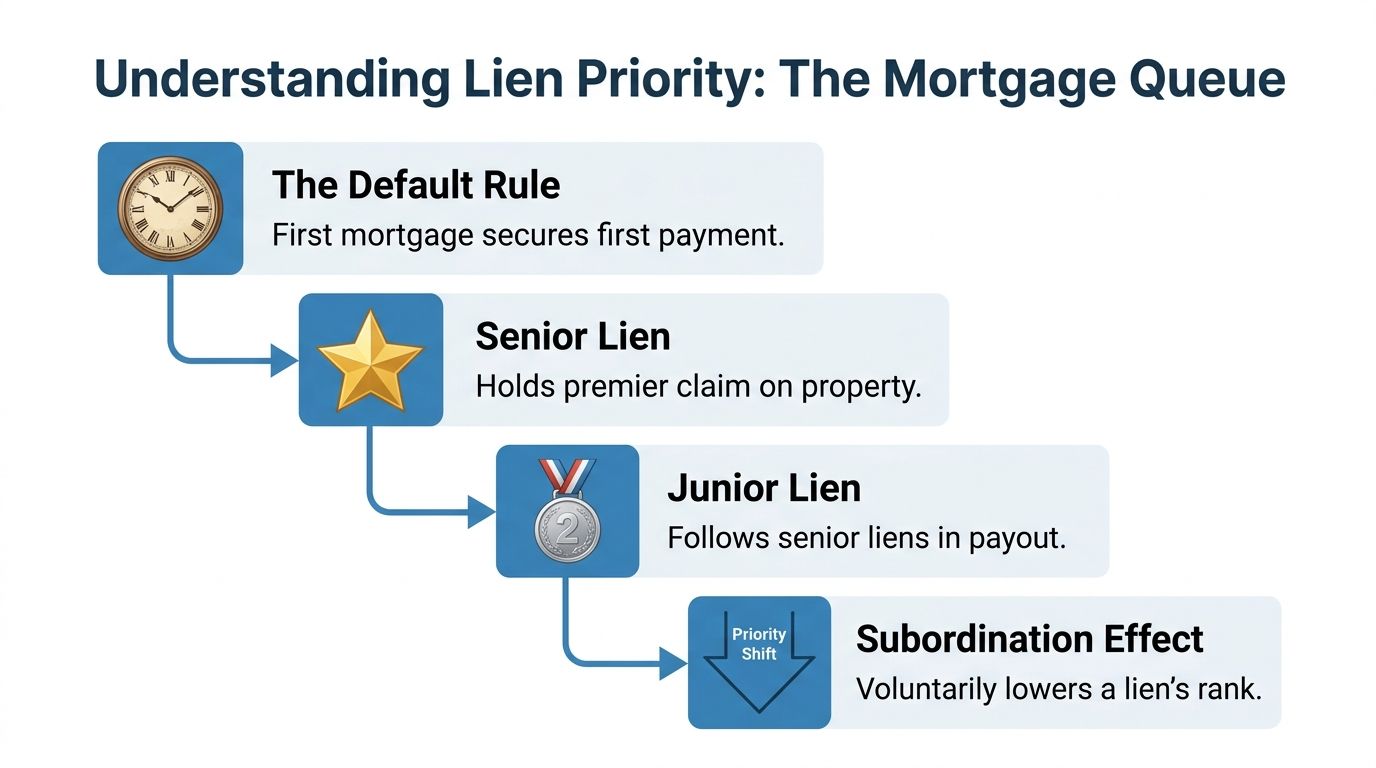
Lien priority decides the order in which creditors get paid from the property. By default, the lien recorded first usually gets paid first, and later liens stand behind it unless a law or recorded agreement changes that order.
Think of liens as a payment queue tied to the county record. The first lender in line has the strongest claim on sale proceeds. The second lender waits. The third waits even longer. If the foreclosure sale doesn't generate enough proceeds, the lenders at the back of the line can recover little or nothing.
The default queue
This is the core rule lenders build around. A first mortgage is senior. A HELOC recorded later is junior. A judgment lien recorded after that may fall behind both, depending on state law and the underlying facts.
If you want a parallel from the construction side, this overview of Hawaii construction lien information is useful because it shows how lien priority disputes expand beyond standard mortgages when contractors and property owners collide over unpaid work. Different lien categories can change the risk picture fast.
For a basic refresher on the debt itself, this explanation of what a mortgage lien is helps separate the lien from the note. That distinction matters because a loan can exist contractually while priority turns on the recorded security instrument.
What subordination actually changes
Subordination changes the queue on purpose. A lender with a higher or potentially disruptive position agrees, in writing, to rank behind another lien.
That usually happens because everyone involved prefers the new transaction to close rather than forcing a payoff. In a refinance, the junior lender often agrees to remain junior so the borrower can replace the original first mortgage. In other situations, a creditor may subordinate because the broader financing package improves the property or preserves the borrower's ability to perform.
The document doesn't erase a lien. It changes where that lien stands.
That distinction matters. A subordinated lien still exists, still secures the debt, and still clouds title until released. It accepts a lower payout position.
Why the distinction matters in real underwriting
From a credit standpoint, senior and junior aren't labels. They're recovery assumptions.
A loan officer may focus on rate lock and borrower documents. A title officer focuses on recordation and releases. An investor cares about liquidation order. The subordination agreement sits at the center because it aligns all three.
What doesn't work is assuming the old order survives automatically after a refinance. It often doesn't. The release of the original first mortgage can create a gap, and that gap is exactly where priority mistakes happen.
When Is a Mortgage Subordination Agreement Required
A mortgage subordination agreement is required when an existing lien could interfere with the intended priority of a new loan. In practice, that usually means a refinance with a HELOC or second mortgage, but it also appears in junior-lien originations and construction finance.

The trigger is simple. If one creditor's recorded position needs to move, stay put, or be clarified so another lender can safely fund, someone needs a signed and recordable agreement.
The three scenarios that show up most
| Scenario | Primary Goal of Transaction | Junior Lienholder's Incentive to Subordinate |
|---|---|---|
| Refinancing an existing first mortgage | Replace the senior loan while keeping the new mortgage in first position | Preserve borrower performance and avoid forcing a payoff |
| Adding a second mortgage or HELOC | Layer new debt behind an existing first mortgage | Enter the capital stack while accepting junior risk |
| Construction financing with competing lien concerns | Protect mortgage priority against later lien claims | Enable project funding under a structure recognized by law |
The refinance case is the most common. A borrower has a first mortgage and a HELOC. The borrower refinances the first mortgage, but the HELOC remains open. Unless the HELOC lender signs a subordination agreement, the new first lender may not get the senior position it expects.
The second scenario is less dramatic but just as important. When a property already has a first mortgage and the owner adds a HELOC or second mortgage, the new lender is knowingly taking a junior position. That junior status affects pricing, underwriting, and future workout options from day one.
Construction loans are a different animal
Construction lending introduces a separate layer of priority risk because mechanics' liens can complicate the stack. In Pennsylvania, Act 117 of 2014 says an open-end construction mortgage regains super-priority over mechanics' liens if at least 60% of the loan proceeds are intended to pay or used to pay costs of construction, and that threshold allows proceeds to cover soft costs such as permits and title insurance while preserving priority.
That matters because construction lenders don't just underwrite borrower credit. They underwrite draw use, filing order, and statutory compliance. A mortgage that looks senior on paper can lose practical protection if the governing rule wasn't satisfied.
Here's the older lesson from Pennsylvania practice: before that statutory change, priority disputes could turn on whether proceeds were used entirely for hard construction costs. Small deviations had outsized consequences for lenders trying to preserve mortgage superiority.
A short video helps if you want to see the issue in transaction form rather than read it in statute language.
What tends to work and what tends to fail
- Works: Early identification of every recorded junior lien before the refinance package goes out
- Works: Direct communication with the junior lienholder about whether the line will stay open, be frozen, or be paid down
- Fails: Discovering an active HELOC at final title review and assuming the lender will sign quickly
- Fails: Treating construction priority as a standard refinance problem when mechanics' lien law controls the outcome
If the transaction depends on priority, the subordination request should be part of the opening checklist, not the closing scramble.
What Are the Legal Mechanics of a Subordination Clause
A subordination clause is the part of the agreement that makes one lienholder accept a lower priority position. Its legal force comes from clear language, proper execution, and recording, not from the parties' assumptions.
In U.S. refinancing, a formal Subordination Agreement such as Fannie Mae Form 3747 is legally required to put the junior lien behind the new refinance mortgage. Without that agreement, the junior lien can automatically move into first position when the original first mortgage is released, which destroys the new lender's secured priority and can cause the refinance to fail, as outlined in this explanation of mortgage subordination and refinance priority.
Clauses that actually matter
Most subordination agreements contain a few core elements. The wording varies, but the legal job stays the same.
Identification of the liens
The document names the property, the existing security instrument, and the new debt that needs priority protection.Unconditional ranking language
The key phrase is usually some form of “unconditionally subordinate.” That means the junior creditor isn't offering a tentative concession. It is agreeing that its lien sits behind the new mortgage.Coverage of extensions or renewals
Strong forms address not just the immediate refinance but later renewals or extensions so the lender doesn't lose position over a technicality.Execution and recording requirements
If it isn't signed properly and recorded where the property sits, the agreement may not do the work everyone expects.
Why legal review goes beyond the mortgage itself
A clean mortgage file doesn't guarantee clean priority. You also need to know whether there are other filings that affect collateral rights. That's why lenders often pair title review with a UCC search in secured transactions, especially when the borrower structure, project collateral, or cross-default package extends beyond a single deed of trust or mortgage.
That doesn't mean every residential refinance needs a sprawling legal memo. It means document review should match the actual collateral complexity.
Documentation test: If the agreement doesn't clearly state which lien moves behind which debt, it's not doing enough.
The real consequence of getting it wrong
Priority failures are rarely dramatic at signing. They show up later, when the loan is sold, securitized, modified, or enforced.
The common operational mistakes are predictable:
- Wrong instrument referenced: The agreement points to the wrong mortgage book and page or the wrong recording number
- Release timing mismatch: The original first mortgage is released before the new lender's priority is protected
- Unrecorded assumption: The parties signed a document, but no one confirmed county acceptance and indexing
- Loan changes ignored: The refinance terms changed, but the subordination package didn't
For lenders, the point isn't to become title counsel. It's to understand that the clause is not ceremonial. It's the legal hinge that decides whether the new loan is first.
How Do Lenders and Investors View Subordination Risk
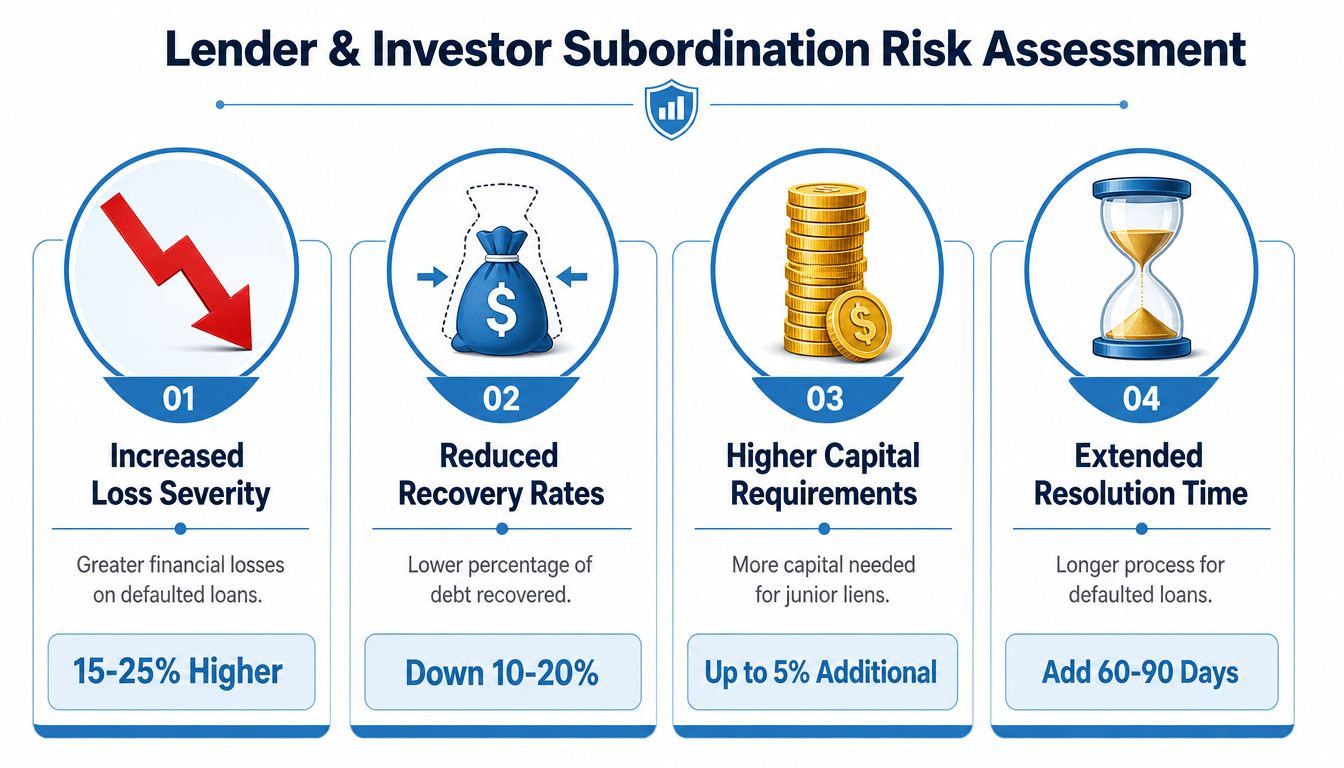
A lender prices a loan assuming a certain place in the capital stack. If that position is junior, or could become junior because the lien record is unclear, expected recovery changes fast.
Lenders and investors treat subordination risk as a collateral recovery and verification problem. Pricing follows from that. The first question is simple. In a default, who gets paid first from the property, and how confident are you that the recorded documents support that answer?
That priority gap is why junior debt costs more. SoFi's discussion of subordinate mortgage risk and pricing explains the basic economics well. Junior lienholders get paid only after the senior lien is satisfied, which can leave little or nothing in a low-equity foreclosure. The same overview notes that subordinate mortgages often price several points above first mortgages because the loss severity is materially higher.
For investors buying loans or securities, the issue is broader than coupon spread. A pool with weak priority documentation can force repurchase fights, delay servicing transfers, and reduce execution when the asset is sold. On paper, a loan may look like a clean first lien. In file review, it may depend on an unrecorded or misindexed subordination agreement. That difference affects bid levels.
Why junior lienholders sometimes agree anyway
A junior lender can still benefit from subordination when the refinance improves the borrower's ability to pay, lowers default pressure, or replaces a senior loan that was already becoming unstable. Staying in second position behind a healthier first mortgage may preserve more value than forcing a payoff the borrower cannot make.
That decision is still an underwriting call, not a courtesy.
Junior lienholders usually focus on current payment status, combined loan-to-value, remaining borrower equity, and whether the refinance changes risk in practice even if the legal position stays junior either way. A denial often signals that the second-lien holder sees shrinking collateral protection or weakening borrower performance.
A subordination denial often points to credit deterioration before the file ever reaches default.
What sophisticated buyers actually worry about
The headline risk is loss severity, but operational risk drives many real-world losses. Investors and warehouse lenders look for file defects that can break the assumed lien order, including recording errors, missing signatures, inconsistent loan identifiers, and county indexing problems.
At scale, that becomes a data problem. Reviewing one refinance file manually is manageable. Reviewing hundreds across counties, servicers, and acquisition channels is where mistakes survive long enough to affect pricing and eligibility. If your team cannot confirm recorded lien order quickly and consistently, you are not only taking credit risk. You are taking document risk that may not show up until enforcement, securitization, or due diligence on sale.
That is why better buyers do not stop at the note rate or the title summary. They test whether the claimed priority is supported by recorded evidence.
Historical context matters
Structured finance provides the clearest warning. In the run-up to the financial crisis, mortgage pools often layered risk through heavy subordination structures. NYU Stern's analysis of MBS ratings and the credit boom found average mortgage subordination rates of 93.1% for certain mortgage-backed security pools, compared with 82.4% for other subprime deals. The same paper links those structures to amplified losses once home values fell.
The lesson is narrower than “all subordinate debt is bad.” Subordination can be rational, priced correctly, and fully enforceable. The core problem is assuming priority instead of verifying it. For lenders and investors, that means treating lien position as something to confirm from the record, then monitor as loans are refinanced, modified, sold, or transferred.
How Do You Verify and Monitor Lien Subordination
A refinance closes on Friday. By Monday, your acquisitions team has the loan tape, a title summary, and a seller representation that the new mortgage holds first position. That sounds clean until you pull the county record and find an active HELOC recorded before the refinance, with no clearly indexed subordination agreement tied to the new loan. At that point, lien priority is no longer a legal abstraction. It is a pricing, eligibility, and enforcement problem.
You verify mortgage subordination by confirming the recorded lien chain, the subordination instrument, and the timing of releases and new recordings. Priority claims belong to the public record, not to a closing memo or a data field copied from an LOS.
The manual method is still workable for a single asset. Pull the first mortgage, the junior lien, the refinance instrument, and any recorded subordination agreement from the county recorder. Then confirm that the original senior loan was released, that the refinance was indexed correctly, and that the subordination document references the right parties, property, and loan.
That process breaks down at portfolio scale. County indexing varies. Recording lags create temporary blind spots. Junior liens can stay open after payoff assumptions were made upstream. A signed agreement in the closing package does not help if it was never recorded, misindexed, or recorded against the wrong instrument number.
A practical verification review should cover five points:
- Recorded order: Confirm which mortgage or deed of trust appears first in the public record
- Subordination document: Verify the junior lienholder executed and recorded the agreement tied to the refinance
- Release sequence: Check whether the old first lien was released and whether that release timing affects the claimed priority of the new loan
- Indexing accuracy: Match borrower names, legal description, parcel identifiers, and referenced instrument numbers
- Open-end exposure: Determine whether a HELOC was subordinated only, or also frozen, reduced, or terminated
Those checks answer the key underwriting question. Does the refinance loan sit where the file says it sits?
For lenders, servicers, and investors buying across multiple counties, monitoring requires a repeatable data process rather than repeated manual searches. Teams generally start with property, ownership, and mortgage history, then flag refinance events where an active junior lien existed before the new loan recorded. From there, they test for a corresponding release or subordination instrument and route exceptions to title or legal review.
A workable workflow looks like this:
- Ingest property and mortgage history for the assets under review.
- Detect refinance events from newly recorded mortgages, satisfactions, and payoff patterns.
- Identify junior liens that were active before the refinance date.
- Search for a recorded subordination or release connected to those liens.
- Flag exceptions where document sequence, indexing, or record completeness does not support the claimed lien position.
This is also where title and servicing teams need to separate curable defects from insurable ones. A short primer on what is title insurance helps frame what a policy may cover after closing versus what should have been caught before funding or purchase.
Exception review gets better when lien priority is modeled explicitly. Analysts can store each recorded instrument, status, and recording date, then run logic against the chain instead of relying on free-text notes. That makes it easier to catch cases where the refinance mortgage exists, but the supporting subordination record does not.
For teams building or improving that process, this guide to common title verification issues in property due diligence is useful because subordination failures often surface as indexing errors, chain-of-title gaps, or document-reference mismatches.
A simple data model for exception review
{
  "property_id": "internal-asset-id",
  "current_owner": "Borrower Name",
  "liens": [
    {
      "type": "First Mortgage",
      "recorded_date": "YYYY-MM-DD",
      "status": "released"
    },
    {
      "type": "HELOC",
      "recorded_date": "YYYY-MM-DD",
      "status": "active"
    },
    {
      "type": "Refinance Mortgage",
      "recorded_date": "YYYY-MM-DD",
      "status": "active"
    }
  ],
  "subordination_found": true,
  "exception_flag": false
}
The point is straightforward. Lien subordination can be tested, audited, and monitored with recorded-data logic. Teams that do that well reduce purchase exceptions, tighten pricing discipline, and spend less time discovering priority defects after the loan has already been funded or sold.
If your team needs to verify mortgage and lien position across large portfolios, BatchData gives lenders, investors, servicers, and proptech platforms access to nationwide property, mortgage, lien, ownership, and title-related data through developer-friendly APIs and bulk delivery. That makes it easier to flag refinance events, detect unresolved junior liens, and turn lien-priority review from a manual county-by-county task into a repeatable due-diligence workflow.