






































SEO Title: How to Get Address From Latitude and Longitude
Meta Description: Learn how to reverse geocode coordinates into addresses, scale batch lookups, and improve parcel-level accuracy for real estate workflows.
Meta Keywords: how to get address from latitude and longitude, reverse geocoding, batch reverse geocoding, geocoding API, parcel level accuracy, property data enrichment, latitude longitude to address
A coordinate pair is not a property record. Reverse geocoding turns latitude and longitude into an address, but the critical work starts when you need that result to be reliable enough for underwriting, portfolio monitoring, outreach, or analytics.
Most tutorials stop at a single API call. That is not where production systems fail. They fail on rate limits, interpolated matches, rural coverage gaps, stale data, and the jump from one lookup to a file full of coordinates. Since GPS became widely adopted in the early 2000s and Google launched its public reverse geocoding API in 2006, reverse geocoding has become a core geospatial function. In proptech, it helps mortgage lenders match 90%+ of pre-foreclosure lat/long points to verified addresses and supports portfolio monitoring across 100% of U.S. counties through unified property data workflows (YouTube reference).
What matters in practice
- Single lookup is easy: Most APIs can return a formatted address from one coordinate.
- Scale changes everything: Batch jobs need throttling, retries, caching, and fallback logic.
- Address string is not enough: Regulated real estate workflows need parcel-level verification and enrichment.
- Tool choice matters: Free endpoints are useful for small jobs, but brittle at volume.
- Downstream use drives design: A workflow built for delivery apps is not the same as one built for lien review, underwriting, or location-based marketing.
Teams using geospatial data for investment and servicing also need market context, which is why reports such as https://reports.batchdata.io/investorpulse-reports/ become useful after the address match is complete.
Introduction From Coordinates to Customers
How to get address from latitude and longitude is the simple version of a harder data problem. You are not just converting coordinates. You are deciding whether the output is good enough to trigger a mailer, price risk, monitor a portfolio, or attach a legal parcel record.
At small scale, reverse geocoding looks clean. Send lat/lng to an API. Parse the JSON. Store the formatted address. Done.
At production scale, that approach breaks fast.
Where teams often go wrong
A common error is assuming the first returned address is the truth. It is often only the nearest plausible match. That may be acceptable for a map pin. It is not acceptable when a bad match can misroute a notice, distort a valuation workflow, or point your marketing system at the wrong property.
Three trade-offs drive the design:
- Precision versus coverage: Some providers return broad locality matches when street-level data is weak.
- Cost versus throughput: Cheap or free services are attractive until queue times and usage limits slow the pipeline.
- Address versus property identity: A mailing address does not automatically resolve to a parcel, APN, or owner record.
Practical rule: If the address will drive money, compliance, or contact decisions, treat reverse geocoding as a matching pipeline, not a lookup widget.
What a reliable pipeline does
A working production setup usually needs more than one component:
| Requirement | Basic approach | Production approach |
|---|---|---|
| Convert one point | Web UI or single API call | API with validation and logging |
| Process a file | Loop through rows | Chunked, parallel batch pipeline |
| Judge confidence | Accept first result | Inspect match quality fields |
| Link to property | Store formatted address | Match to parcel and enrichment data |
That is the gap between coordinates on a spreadsheet and customers, owners, assets, or loans in a usable system.
What Are Your Reverse Geocoding Options
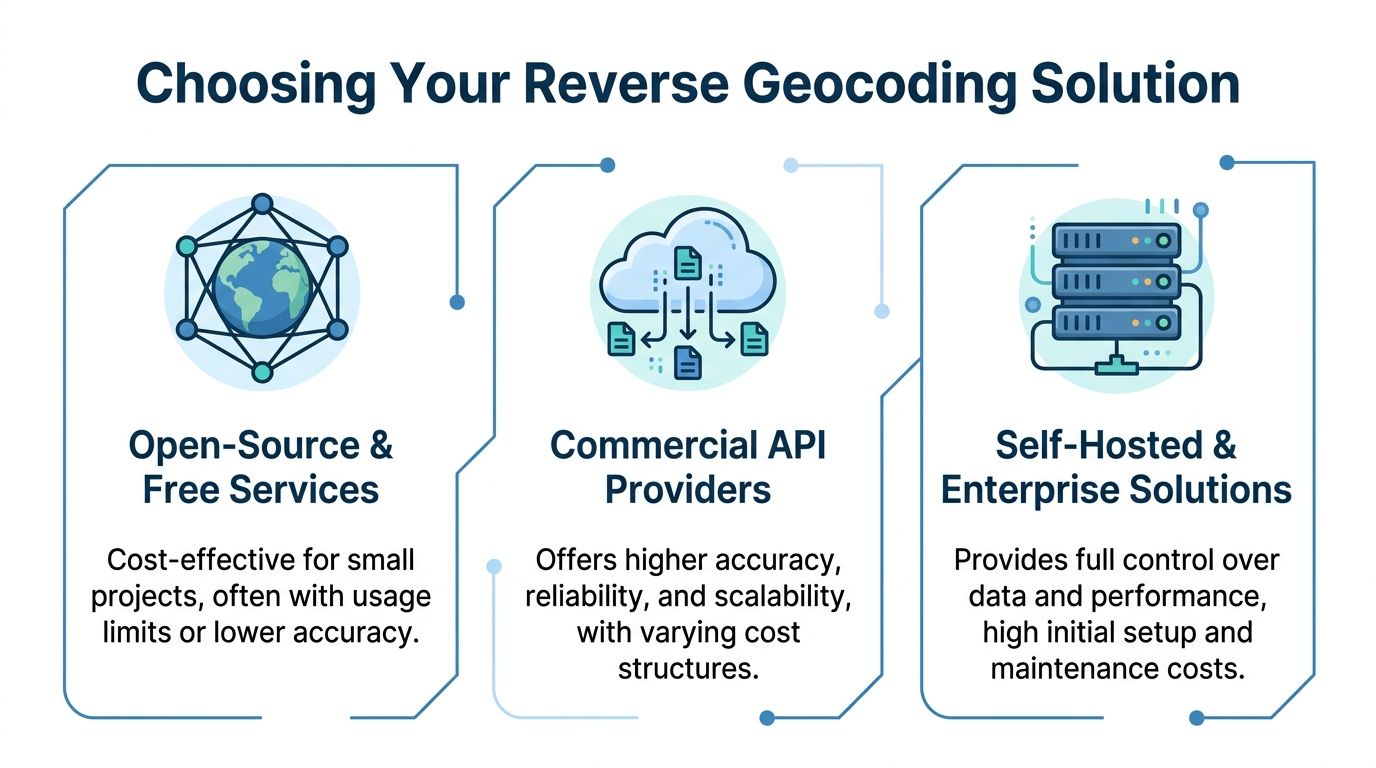
Reverse geocoding is easy at one request per minute and hard at 1 million records per day. Your options differ less on whether they return an address and more on how they behave under load, how much metadata they expose, and whether their output can support parcel-level matching.
Which category fits your workload
Commercial APIs are the standard entry point for production systems. Google Maps Geocoding API, HERE, TomTom, and similar services return structured results, maintain global coverage, and usually document their rate limits and error behavior well enough for engineering teams to build against them. The trade-off is cost, licensing limits, and occasional gaps in rural or newly developed areas.
Open data services and OSM-based vendors work well for testing, low-volume scripts, and cost-sensitive jobs where some inconsistency is acceptable. They are less forgiving when traffic spikes or when the business needs stable service levels, support, and contractual uptime. For proptech use cases, that matters once lookup output starts feeding outreach, underwriting, or servicing workflows.
Programming libraries such as geopy are implementation aids, not data providers. They reduce boilerplate in Python and make provider swapping easier, but they do not improve match quality, remove quota constraints, or solve compliance questions around storing returned address data.
Self-hosted GIS and enterprise location stacks make sense when data residency, offline processing, or custom spatial overlays drive the architecture. That route gives your team more control over local reference data and parcel boundaries. It also adds maintenance work, data refresh obligations, and operational ownership for every failure mode.
Comparison of common reverse geocoding paths
| Option | Best for | Strengths | Limits |
|---|---|---|---|
| Commercial API | Applications, customer-facing products, repeatable batch jobs | Structured JSON, support, broad coverage, clearer SLAs | Usage cost, licensing restrictions, provider lock-in |
| OSM-based service | Prototypes, research, internal tools, low-volume jobs | Open ecosystem, low entry cost, flexible experimentation | Throughput constraints, uneven coverage, fewer guarantees |
| Library wrapper | Faster development | Cleaner code, easier provider abstraction | No effect on accuracy, quotas, or service reliability |
| Self-hosted GIS stack | Regulated environments, custom spatial logic, offline workflows | Full control, custom overlays, local processing | Higher ops burden, data refresh complexity, slower setup |
What matters in provider selection
Teams buying a reverse geocoder for real estate or finance should screen for five things.
- Match granularity: Can the provider return rooftop or entrance-level results, or does it often fall back to street or postal centroid?
- Response detail: You need component fields, confidence indicators, and result types. A formatted address string alone is weak input for downstream systems.
- Licensing terms: Some APIs are easy to call and harder to store, cache, or reuse in internal databases.
- Batch behavior: Check rate limits, retry guidance, and whether the provider supports asynchronous or bulk workflows.
- Coverage where you operate: Dense urban neighborhoods, suburban subdivisions, and rural parcels fail in different ways.
That last point gets underestimated. A provider that looks excellent in downtown Chicago can degrade fast on new-build subdivisions in Phoenix or on rural land records where the nearest mailable address is not the parcel itself.
What works in practice
For a product prototype or internal tool, a commercial API is usually the fastest path. It gets coordinates into usable address fields with minimal setup.
For recurring batch jobs, open endpoints and hobby-grade usage assumptions break down fast. Queueing, retries, duplicate suppression, and provider-specific throttling become part of the design. At that point, API price per request is only one line item. Engineering time, reprocessing costs, and bad-match cleanup often cost more.
For parcel-level workflows, reverse geocoding is only the first pass. The returned address should be treated as a candidate record, then matched against parcel data, assessor files, building footprints, or owner datasets. That is how teams get from “nearest plausible address” to “correct property record.”
A practical selection filter
Use a simple rule set.
- Low volume, fast delivery: Start with a commercial API that returns structured fields and documented confidence signals.
- Internal experimentation or budget pressure: Use an OSM-based option, but cap throughput and expect more manual validation.
- Property resolution matters: Add parcel and property reference data after geocoding.
- High-volume recurring jobs: Choose a provider and architecture based on retry behavior, storage rights, and batch economics, not just ease of the first API call.
Selection rule: Pick the option whose failure mode your business can tolerate. For a map pin, “close enough” may work. For valuation, compliance, lending, or owner outreach, the system needs address quality controls and a path to parcel identity.
How Do You Implement API Based Reverse Geocoding
A reverse geocoding API is easy to call and easy to get wrong. The hard part is not sending lat,lng to an endpoint. The hard part is deciding whether the returned address is precise enough to trust in a production workflow, then storing enough metadata to defend that decision later.
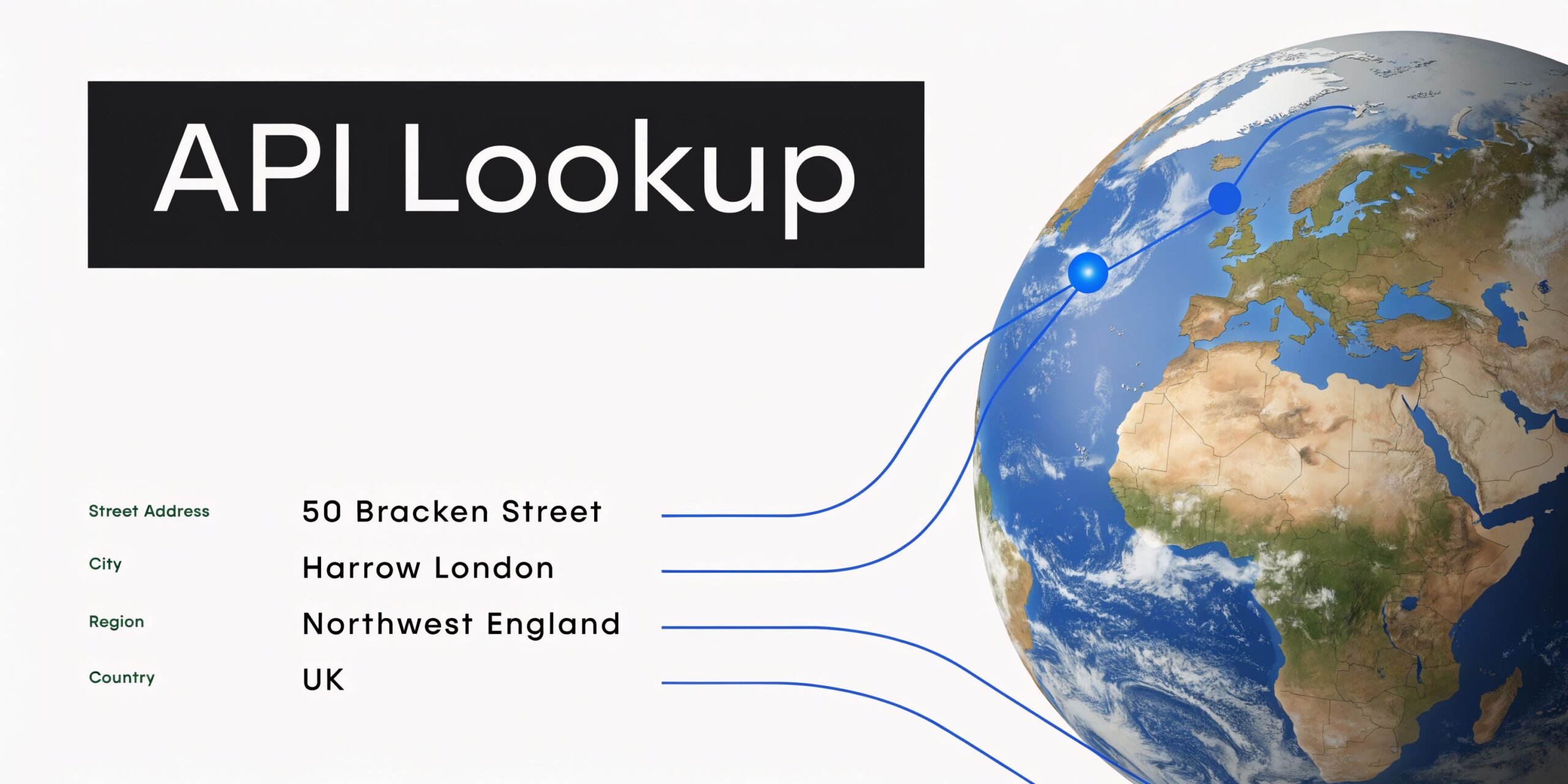
For a consumer map, the nearest plausible address may be acceptable. For lending, valuation, skip tracing, or property operations, that standard is too loose. Reverse geocoding should return a candidate address, a precision signal, and stable identifiers you can use in downstream matching.
The request shape
A typical request includes the coordinate pair, authentication, and optional parameters that control localization and result type. Small request choices affect quality. Region bias can change which candidate ranks first. Output language can change formatting. Filters can reduce noisy results when the use case only wants street addresses.
A Google-style endpoint looks like this:
https://maps.googleapis.com/maps/api/geocode/json?latlng=40.714,-74.006&key=YOUR_KEY
Before sending requests, validate the inputs. Reject nulls, swapped coordinates, impossible latitude or longitude values, and malformed decimals. That one step prevents a surprising amount of bad output and wasted API spend.
What to parse from the response
formatted_address is not enough for production use. It is a display field, not a data model.
Parse the fields that help with normalization, ranking, and auditability:
results.formatted_addressfor displayaddress_componentsfor structured fields such as street number, route, locality, admin area, and postal codegeometry.location_typefor match precisionpartial_matchfor weaker candidate detectionplace_idor provider equivalent for deduplication, caching, and change tracking
Multiple candidates are common, especially near parcel boundaries, apartment clusters, rural roads, and new developments. Pick a ranking policy that matches the business task. A delivery app may accept the top candidate. A property data pipeline should score candidates against known parcel centroids, building footprints, ZIP constraints, or existing address records before accepting one.
The field that decides whether the result is usable
Precision metadata matters more than the address string itself.
With Google-style responses, geometry.location_type gives a fast read on quality. ROOFTOP usually indicates a point-level match. RANGE_INTERPOLATED means the provider estimated the location along a street segment. That can be fine for city-level analytics and still fail for parcel resolution, ownership matching, or compliance workflows.
Store that precision field with the result. Store the raw provider response or a normalized version of the quality flags as well. If an operations team later finds a mismatch, they need to know whether the provider returned an interpolated result, a partial match, or a locality-level fallback.
Practical rule: Persist the address, the structured components, the quality flags, the provider name, the lookup timestamp, and the source coordinates. Without that record, QA turns into guesswork.
A minimal production flow
- Validate coordinates before calling the provider.
- Send the request with explicit parameters for region, language, and filters where needed.
- Parse structured fields instead of storing only the formatted string.
- Evaluate precision metadata and reject or flag weak matches.
- Cache by provider identifier or normalized coordinate hash to reduce repeat calls.
- Log failures and ambiguous results for review, not silent drop-off.
The trade-off is simple. Strict acceptance rules reduce false positives but increase the number of records that need a second pass. Loose acceptance rules improve coverage but create cleanup work later. In proptech and finance, the cleanup usually costs more.
If you are wrapping third-party geocoders behind an internal service, keep the contract stable even when providers change. Consistent error codes, idempotent request handling, and versioned response schemas prevent downstream breakage. These API design best practices are useful when you need one interface for multiple geocoding providers and one standard for address quality across the business.
How Do You Handle Batch Processing at Scale
The difference between a demo and a production reverse geocoding system shows up at 100,000 rows. At that point, rate limits, retries, duplicate coordinates, and weak matches matter more than the API call itself.

A basic for loop over a CSV is enough for testing. It is not enough for property operations, lender audits, or market-wide enrichment jobs. Once volume climbs, the key bottlenecks are provider quotas, uneven latency, replaying failed requests, and keeping an audit trail of what happened to each row.
The first scaling move is simple. Stop treating each lookup as an isolated event. Treat it as a job with state.
What breaks first in large runs
Throughput is usually the first problem teams notice, but it is rarely the only one. One slow provider region can stall a whole batch. A burst of 429 responses can turn a one-hour job into an overnight rerun. Duplicate points from portfolio exports or field apps can waste a large share of your paid calls if caching is weak.
Data quality also gets worse under load. A million-row batch will contain bad coordinates, repeated coordinates, points snapped to roads, and points that fall near parcel edges. If the pipeline only stores a formatted address, there is no clean way to review disputed results later.
A batch design that survives real workloads
Use separate components with clear responsibilities:
- Ingestion: Read files or warehouse tables into a validated schema with stable record IDs.
- Partitioning: Split work by batch size, geography, or customer job so retries stay targeted.
- Worker execution: Run concurrent requests within each provider’s published limits.
- Rate control: Enforce queue-based throttling instead of hoping thread counts stay safe.
- Retry handling: Retry only transient failures, with backoff and a retry cap.
- Dead-letter queue: Isolate records that need human review, provider fallback, or corrected coordinates.
- Persistent result store: Save normalized fields, provider metadata, precision indicators, and processing status.
That structure works in Python, Airflow, Dagster, Spark, dbt-driven warehouse workflows, and serverless jobs. The tool matters less than the control points.
Concurrency helps, but only with guardrails
Parallel workers increase throughput. Unbounded concurrency gets accounts throttled or blocked.
For many teams, the right answer is found by load testing with real coordinates, then setting conservative limits per provider and per customer job. Small batches are easier to retry and inspect. Larger batches reduce orchestration overhead but make failures more expensive.
A county-scale property workflow often starts with a source file of parcel coordinates and pushes each coordinate through a managed queue instead of running ad hoc scripts on analyst laptops. Once the addresses resolve, our Investor Pulse reports add county-level market context for markets like Los Angeles County.
Cost control starts with caching and deduplication
At scale, repeated coordinates are common. Apartment portfolios, servicing data, inspection routes, and CRM exports all contain duplicates. If the same latitude and longitude pair appears 500 times, paying for 500 identical lookups is an avoidable mistake.
Cache by normalized coordinate hash, and decide your rounding strategy based on the use case. Aggressive rounding improves cache hit rate but can blur parcel boundaries in dense urban areas. Tight rounding preserves precision but reduces reuse. For parcel-sensitive work, keep the cache key strict and pair it with provider-specific IDs when available.
Multi-provider pipelines are usually the practical choice
One provider keeps operations simple. It also ties cost, uptime, and precision to one vendor.
A better pattern for enterprise jobs is staged routing. Send every row through a lower-cost provider first. Screen the response for rooftop or parcel-adjacent precision, full address components, and acceptable confidence metadata. Only escalate weak, ambiguous, or failed records to a second provider. That keeps spend under control without forcing the whole portfolio through the most expensive API.
| Pipeline stage | Primary action | Why it helps |
|---|---|---|
| First pass | Send all valid rows to the lower-cost provider | Keeps baseline processing cost predictable |
| Quality gate | Check precision, completeness, and match quality | Stops weak results from flowing downstream |
| Fallback pass | Reprocess only failed or low-quality rows with a stronger provider | Improves completion rate where it matters |
| Reconciliation | Store final source, timestamps, and decision reason | Preserves auditability for compliance and QA |
The trade-off is operational complexity. You need a stable internal schema, provider-specific adapters, and consistent quality rules. The payoff is real when you are running six-figure or seven-figure monthly lookups.
A visual walkthrough helps if you are explaining this pattern to analysts or ops teams:
Operational advice: Measure queue depth, cache hit rate, retry volume, provider latency, and low-confidence output rate on every batch. Those metrics tell you whether the system is scaling cleanly or just failing.
How Do You Maximize Accuracy and Enrich Address Data
A street address is not the same thing as a verified property match. That is the line many teams miss when they move from maps to real estate, mortgage, or insurance workflows.

Why address strings break in regulated workflows
Standard reverse geocoding often returns the nearest street-level answer. That can be enough for a map label. It is not enough for lien analysis, servicing, underwriting, or owner outreach.
The problem is precision. The geocoder may interpolate a point along a road segment instead of tying it to an actual parcel. In regulated property workflows, that creates avoidable risk. Without verified owner contacts, mortgage servicing can see a significant false positive rate, and the deeper problem remains unresolved because the coordinate is still not linked to a specific APN (LatLong reference).
What parcel-level accuracy really means
Parcel-level accuracy means the coordinate resolves to the legal property record, not just a plausible address nearby.
That usually requires:
- Parcel geometry or centroid matching
- APN linkage
- Legal site address validation
- Ownership and mailing record association
- Current tax, mortgage, lien, or valuation context
A plain reverse geocoder does not specialize in that chain. It specializes in locating the nearest known addressable feature.
What enrichment adds beyond geocoding
Once the point is matched to a property identity, the record becomes usable for business decisions.
| Output type | What you get | What you still lack |
|---|---|---|
| Basic reverse geocode | Formatted address | Parcel identity, owner, tax context |
| Structured address parse | Street, city, ZIP, country | Verification against property records |
| Parcel-linked enrichment | Address plus APN and property context | Depends on provider and refresh cycle |
For property intelligence workflows, teams often need to join the geocoded result with valuation and market layers. Geospatial modeling becomes more useful here than text-only address handling, and this write-up on https://batchdata.io/blog/how-geospatial-analysis-enhances-automated-valuation-models is a good example of how location data gets turned into valuation inputs.
One practical way to close the gap
If the use case is real estate, a property data platform can sit after the reverse geocoder and perform the parcel match plus enrichment. BatchData is one example. It provides reverse geocoding and property record enrichment across 155M+ U.S. property records with 1,000+ attributes and daily updates, which makes it relevant when a lat/lng must become a verified address tied to ownership, valuation, tax, mortgage, or pre-foreclosure context.
Working standard: If a result cannot be tied to a parcel or verified property record, do not treat it as ground truth for lending, servicing, insurance, or acquisition decisions.
Frequently Asked Questions About Reverse Geocoding
A reverse geocoder that works for one lookup can still fail badly in production. The test is whether it handles bad inputs, rural coverage gaps, provider disagreements, and cost pressure without corrupting downstream records.
Can I do this with free tools only
Free tools are fine for testing, QA spot checks, and low-volume internal workflows.
They break down once the job shifts from a few coordinates to sustained batch processing. Rate limits, weaker SLAs, thinner metadata, and licensing restrictions show up fast. Some commercial APIs are also expensive enough that a careless design turns a simple enrichment step into a material line item. For business use, the right question is not “can this return an address” but “can this return a traceable result at scale, at a cost the model can support.”
What if the coordinate is in a rural area
Rural coordinates produce more ambiguous results.
The nearest address may be far from the point. Roads may be private, unnamed, or inconsistently mapped. Some providers return a locality or road segment instead of a true site address, which is unacceptable if the record drives lending, underwriting, servicing, or acquisition logic.
Treat rural results as lower-confidence by default. Use confidence thresholds, inspect feature type, and send weak matches to a second pass that checks parcel data or property records.
Should I store only the formatted address
No. Store enough detail to re-evaluate the match later.
Keep the original latitude and longitude, parsed address components, provider name, response timestamp, confidence or match indicators, and the raw response payload if your retention policy allows it. That record is what lets an operations team explain why a coordinate resolved to a given address six months earlier, or rerun only the questionable rows after a provider update.
How should I handle coordinates that return nothing
Treat null results as a valid outcome, not a bug to hide.
Common causes include swapped latitude and longitude, bad decimal precision, points over water, new construction, and gaps in provider coverage. A forced nearest match can look clean in a CSV while introducing false addresses into the system. If approximation is allowed, label it explicitly. If it is not allowed, keep the record unresolved and route it for review or alternate matching.
Is forward geocoding the same as reverse geocoding in validation
No. They answer different questions.
Forward geocoding checks whether a text address resolves to a location. Reverse geocoding checks whether a location resolves to an addressable feature. A roundtrip test can catch obvious problems, but it does not prove parcel-level correctness. In property workflows, the stronger validation step is confirming that the coordinate falls on the parcel or building you expect.
When do I need a custom internal service
Build an internal service once multiple teams depend on reverse geocoding and each team starts writing its own wrappers, caches, and fallback rules.
A shared service gives every consumer the same contract. It can standardize provider selection, enforce caching, track quality metrics, and separate rooftop-level matches from approximate ones. It also makes vendor changes much less painful. Swap providers in one place instead of rewriting pipelines across product, analytics, and operations.
If your workflow needs more than a display address, BatchData is worth evaluating as part of the stack. It can help turn coordinates into verified property records with parcel, ownership, valuation, and market context, which is the difference between a map result and an operational dataset.