






































Finding motivated sellers isn't luck; it's a systematic, data-first hunt for predictable life events that create a need for a fast and convenient sale. A motivated seller is an owner whose circumstances make speed and certainty more valuable than achieving the absolute maximum price. This approach shifts your prospecting from random chance to a targeted, high-ROI strategy.
The primary driver for motivated sellers today is not financial ruin, but rather major life events, accounting for over 74% of off-market transactions. By leveraging property data, you can identify these sellers before they even hit the market.
Key Takeaways at a Glance:
- Focus on Life Events: Divorce, inheritance, and job relocation are stronger motivators than simple financial distress.
- Data Stacking is Critical: Combining multiple signals (e.g., high equity + vacancy + out-of-state owner) isolates the most qualified leads.
- Propensity Models Offer an Edge: Machine learning algorithms predict a property's likelihood to sell with greater accuracy than manual analysis.
- Compliance is Non-Negotiable: Adhering to TCPA regulations during outreach is essential to avoid severe financial penalties.
This guide provides a direct framework for using data to find and engage these sellers effectively.
What is a motivated seller in today's market?
The direct answer is an equity-rich homeowner whose primary driver is a life event, not a lack of cash. The outdated stereotype of a motivated seller facing foreclosure is no longer the main story. Today's motivated sellers value a fast, certain, and hassle-free sale far more than waiting months for a top-dollar offer on the traditional market.

Consider the "tired landlord" facing another tenant issue, a couple navigating a divorce, or an heir managing an inherited property from three states away. For them, the logistical and emotional burden of a conventional sale is a massive pain point. They seek a simple solution, which is precisely where data-driven investors create opportunity.
Shift from Distress to Life Events
Thinking of motivation purely in terms of financial trouble means you're missing the largest segment of the market. Modern data shows that major life changes are the real catalysts. In fact, life events now trigger over 40% of all motivated seller activity as of 2025.
Specific triggers include:
- Divorce: Accounts for 15% of these sales.
- Death or estate transitions: Make up 13%.
- Job relocations: Drive 7%.
- Retirement decisions: Contribute another 5%.
These events create a clear and predictable data trail long before a "For Sale" sign appears. A divorce filing, a probate court record, or an out-of-state mailing address for a local property are all digital breadcrumbs. You can explore the data behind these trends to understand what truly drives sellers.
The core principle is this: Motivation is about circumstance, not just finances. A seller with 80% equity who must relocate for a new job in 30 days is just as motivated as someone behind on their mortgage—and is often much easier to transact with.
Identify Actionable Data Signals
To consistently find these sellers, you must learn to recognize their digital footprints. This is where you move from theory to action. The goal is to connect a specific life event to a specific property and its owner. Advanced platforms like BatchData are built for this, aggregating and analyzing countless public and private data sources to transform the search from a needle-in-a-haystack hunt to a calculated, data-driven process.
Top Signals Of Seller Motivation
| Signal Category | Specific Indicator | Data Source (Example) |
|---|---|---|
| Life Transition | Divorce Filing | County Court Records |
| Inheritance | Probate Court Filing | County Probate Court Records |
| Financial Distress | Pre-Foreclosure Notice (Lis Pendens) | County Recorder's Office |
| Ownership Fatigue | Vacant Property | USPS Data, Utility Records |
| Regulatory Pressure | Code Violation Notice | Municipal Code Enforcement |
| Market Disconnect | Expired MLS Listing | Multiple Listing Service (MLS) Data |
| Age & Equity | Long-Term Owner (15+ Years) | Tax Assessor Records |
Each of these signals tells a story. A code violation suggests a neglected property and a frustrated owner. An expired listing indicates a seller who tried the traditional route and failed. Learning to read these signs lets you zero in on the people who not only want to sell but need to sell.
How do I source and stack high-quality property data?
To find motivated sellers at scale, you need a systematic, digital-first approach to sourcing raw intelligence, moving beyond single data points to build a complete profile of a property and its owner. This is where modern investors gain their most significant competitive advantage.

The entire strategy is built on three core categories of data. When combined, they create a clear picture of potential motivation.
Core Data Sources
Effective sourcing isn't about finding one "magic" list; it's about pulling from multiple reliable sources. While you could access public information directly, it's often slow and inefficient. The real power comes from platforms that aggregate this data for you.
Public Records: This is the bedrock of property intelligence. County records offices hold tax data (delinquencies, assessed value), lien filings (mechanic's or HOA liens), and critical court documents like probate and divorce records. These are the most direct indicators of financial or circumstantial pressure.
MLS History: Data from the Multiple Listing Service tells the story of a property's journey on the open market. Expired listings are goldmines, pointing to sellers who tried and failed with a conventional sale. Other key signals include frequent price drops, delistings, and long days on market—all suggesting a growing need for a different solution.
Specialized Providers: This is where you gain a serious edge. Companies like BatchData unify billions of data points into a single, searchable platform. Instead of manually pulling records from dozens of county websites, you get a clean, comprehensive feed that includes everything from owner contact info to vacancy status and permit history, all updated daily.
The most expensive mistake an investor can make is acting on outdated or disconnected data. A property listed as pre-foreclosure might have already been resolved. A unified data platform is non-negotiable for avoiding wasted time and marketing dollars.
The Power of Data Stacking
Sourcing data is just step one; the real art is data stacking. This is the process of layering multiple datasets to identify hyper-targeted leads. A single signal, like high equity, is interesting. But when combined with other signals, it becomes incredibly powerful.
Imagine this scenario:
- Pull a list of all single-family homes in a target zip code with over 40% equity.
- Stack a list of vacant properties, filtering for only those that are both high-equity and unoccupied.
- Cross-reference this refined list with pre-foreclosure notices.
The result is a small, high-intent list: vacant, high-equity homes whose owners are actively facing foreclosure. This is a warm list of homeowners with multiple, verifiable reasons to consider a fast cash offer. Learn more about finding the right tools in our guide on how to choose the best real estate data provider.
Building a Competitive Edge
Disconnected spreadsheets and one-off list pulls are relics. A modern acquisition machine requires a cohesive data strategy. Using a central platform saves time and unlocks insights that siloed data could never provide.
| Feature | Manual Data Sourcing | Unified Platform (e.g., BatchData) |
|---|---|---|
| Speed | Extremely slow; takes weeks to compile | Instant; real-time search and filters |
| Accuracy | High risk of outdated, inaccurate information | Daily updates ensure data is current |
| Stacking | Manual, complex, and prone to errors | Seamless; apply multiple filters in seconds |
| Cost | "Free" but carries high time/opportunity cost | Subscription-based, delivering high ROI |
| Scalability | Not scalable beyond a handful of markets | Easily scalable across any U.S. market |
By embracing a unified data environment, you shift from tedious data collection to high-value analysis and outreach. To efficiently locate such properties, leverage a specialized deal finder tool to streamline your search. This allows you to spot opportunities before the competition.
What are the strongest motivated seller signals?
The direct answer is a combination of financial, situational, and property-related distress signals. Getting raw data is the start; the art is turning that information into a laser-focused list by identifying quantifiable clues that point to a seller’s motivation.
A single late mortgage payment is noise. A tax delinquency notice paired with a recent code violation is a story of a deeper problem—and a massive opportunity.
Foundational Signals
The most reliable indicators of motivation are tied to a property's financial health or the owner's personal situation. These are the core filters you’ll use to find promising leads.
- High Equity (>40%): This is non-negotiable. A seller needs enough equity to accept a cash offer below market value and still walk away with cash.
- Long-Term Ownership (10+ Years): An owner of a decade or more likely has significant equity, may be older and ready to downsize, or is tired of being a landlord. Their low cost basis makes a cash offer more attractive.
- Vacancy Status: A vacant property is a liability, draining cash for taxes, insurance, and upkeep with no offsetting income. This creates a powerful ticking clock.
- Tax Delinquency: This is a major red flag. If an owner is behind on property taxes, it signals serious financial trouble and the risk of a tax sale, creating huge pressure for a quick solution.
Advanced Signals
The real competitive edge comes from digging deeper into specialized datasets. These require a more robust data platform but will help you uncover highly motivated sellers your competition overlooks. A 2023 study found that 66% of motivated sellers were driven not by distress, but by the convenience of an attractive offer. Platforms like BatchData, with its 155 million property records, are indispensable for spotting these complex scenarios. Read more about these industry statistics on motivated sellers to understand market shifts.
These advanced signals include:
- Probate Filings: When a property owner passes away, the home often lands in probate. Heirs, especially those out of state, are rarely interested in becoming long-distance landlords and are usually motivated to sell quickly.
- Owners with Multiple Distressed Assets: An owner struggling with one problem property is often struggling with others. Identifying someone with several vacant or tax-delinquent properties may reveal a systemic financial issue and a seller ready to liquidate their portfolio.
- Failed Flips: Look for properties with recently pulled but unfinalized construction permits. This can indicate a flipper who ran out of money or time and is now stuck with an unfinished project they need to unload fast.
The most profitable leads come from stacking multiple signals. A single indicator is a hint. A combination of three or four is a screaming buy signal.
Real-World Stacking Scenario
Here is how you turn a list of 50,000 properties into a handful of perfect leads.
- Initial Filter: Start with all properties in your target county (50,000 properties).
- Stack #1 (Ownership): Filter for properties owned by an out-of-state individual. This shrinks the list to 5,000 properties.
- Stack #2 (Financial): Add a high-equity filter (>50%). This ensures they can afford to take your offer. The list narrows to 2,000 properties.
- Stack #3 (Condition): Layer on a vacancy filter. An empty house hundreds of miles away is a major headache. Now you're down to 300 properties.
- Stack #4 (Distress): Add a filter for a recent code violation notice. The owner just received a documented problem they must fix from afar.
You are now left with a hyper-targeted list of 10-15 prime leads. Each is an out-of-state owner with a vacant, high-equity property and a fresh, documented problem. This is no longer cold calling; it's a precise, data-backed intervention.
How do I prioritize leads effectively?
The direct answer is to use lead scoring, either manually or through an automated propensity model, to rank prospects scientifically. A long list of potential sellers is an illusion of progress; without prioritization, you're staring at noise that will chew through your marketing budget. This ensures you focus your time and outreach only on those most likely to sell.
Think of it as a funnel. You start with a massive pool of raw data, filter it down, and end up with a handful of prime, actionable leads.
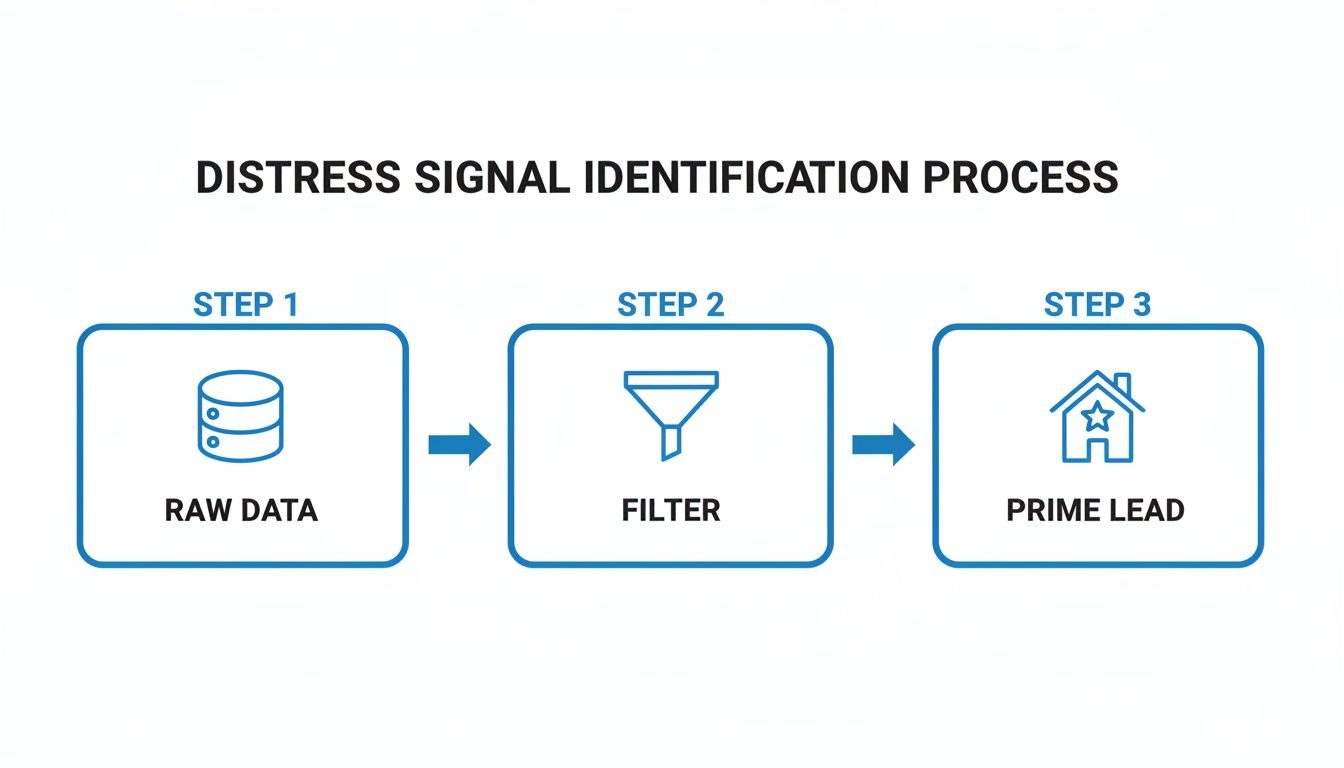
This process is essential for getting the most out of every dollar you spend.
Manual Lead Scoring
Manual lead scoring is the foundational method for prioritizing leads. You assign a point value to each distress signal, creating a simple hierarchy to rank leads based on the combined weight of their motivation signals. This method helps you internalize which factors truly matter in your market.
A basic scoring model could look like this:
- Pre-foreclosure: +10 points
- Tax Delinquency: +8 points
- Vacant Property: +5 points
- Out-of-State Owner: +3 points
- High Equity (>50%): +2 points
An out-of-state owner of a vacant, high-equity property in pre-foreclosure would score 20 points—a top-tier lead to contact immediately. A local owner with only high equity would score 2 points, landing at the bottom of your list for a long-term nurture campaign.
Advanced Propensity Modeling
While manual scoring is a solid start, it's limited. Propensity modeling uses machine learning algorithms to analyze thousands of data points—far more than any human can—to predict a property's likelihood to sell.
Propensity models don't just count signals; they understand the complex interplay between them. For instance, an algorithm might discover that a recent death of an owner combined with a minor tax delinquency is 2.5x more predictive of a sale than a pre-foreclosure on its own.
Tools like BatchData’s BatchRank are built on this principle. They analyze historical sales data against property characteristics and owner profiles to give every property a simple, actionable "propensity to sell" score. This provides a statistically proven reason to call one lead before another. You can dive deeper into how machine learning is changing likelihood to sell predictions.
High-ROI Workflow
A repeatable system that turns a massive dataset into high-priority conversations combines broad filtering with precision scoring.
Here’s a real-world application:
- Start Broad: Pull a list of 10,000 properties in your target market.
- Apply Distress Filters: Use data stacking to apply core filters (vacancy, high equity, tax issues). This might narrow the list to 500 qualified prospects.
- Deploy Propensity Scoring: Run these 500 prospects through a propensity model like BatchRank, which will score each property based on its statistical likelihood to sell.
- Isolate the Top Tier: Segment the list based on the score. The top 10% (50 leads) becomes your "Tier 1" list for immediate, aggressive outreach (phone calls, personalized mail). The next 150 are "Tier 2" for automated follow-ups, and the rest go into a long-term nurture sequence.
This methodical process ensures your resources are aimed at targets with the highest probability of converting, systematically improving your marketing ROI.
How do I execute outreach that gets a response?
The direct answer is to use a calculated, multi-channel approach with empathetic, compliant messaging tailored to the lead's specific situation. A perfect list means nothing if you can't connect with the people on it. This is where your playbook shifts from data science to human interaction.

The goal is to start a conversation, not force a sale on the first try. Your approach must be empathetic, provide real value, and—above all—be compliant.
Choosing Your Outreach Channel
Every channel has its own costs, response rates, and ideal use cases. A multi-channel approach is most effective, but knowing where each one shines is key to allocating your marketing budget wisely.
Outreach Channel Performance Comparison
| Channel | Average Cost Per Lead | Typical Response Rate | Best For |
|---|---|---|---|
| Direct Mail | $0.50 – $2.00 per piece | 0.5% – 2% | Older demographics, high-equity owners, creating a tangible, professional impression. |
| Cold Calling | $3.00 – $7.00 per connected call | 1% – 3% | Immediately qualifying leads, building rapport quickly, targeting high-urgency lists like pre-foreclosures. |
| SMS/Texting | $0.05 – $0.15 per message | 15% – 30% | Reaching a broad audience quickly, getting fast "yes/no" responses, engaging younger or absentee owners. |
| < $0.01 per email | < 0.5% | Nurturing lower-priority leads over time, delivering detailed information, and follow-up sequences. |
SMS has a significantly higher response rate, but cold calling is unmatched for immediate qualification. Direct mail can still cut through the digital noise and impact certain sellers.
Crafting Empathetic and Compliant Scripts
Your initial message is your only shot at a first impression. Pushy or generic scripts are a one-way ticket to being ignored. Effective outreach is concise, empathetic, and offers a clear, low-pressure solution.
Here are real-world script examples:
Empathetic SMS Message:
"Hi [Owner Name], my name is [Your Name]. I'm a local buyer who specializes in helping owners with properties like the one on [Street Name]. If you've ever thought about a simple, no-hassle cash offer, I'd be happy to provide one with no obligation. Reply STOP to opt out."
Direct Cold Call Opener:
"Hi, am I speaking with [Owner Name]? My name is [Your Name], and I know this call is out of the blue. I'm calling about your property on [Street Name]. I'm a local investor, and I was wondering if you’d ever be open to considering a cash offer for it?"
Value-Driven Direct Mail Copy (Postcard):
Front: "A Simple Way to Sell Your House at [Street Name]"
Back: "Thinking of selling? We offer a fast, fair cash price for your property. No repairs, no agent fees, no waiting. Call [Your Name] at [Your Number] for a no-obligation offer in 24 hours."
Each script is personalized, clearly states the value proposition (a simple cash offer), and gives a clear call to action. No fluff, just a direct and respectful offer to help.
The Non-Negotiables: Accuracy and Compliance
Before any outreach, you must get two things right. Ignoring them wastes your budget and can expose you to serious legal trouble.
- Data Accuracy via Skip Tracing: Your lead list is useless without correct contact information. Skip tracing is the process of finding an owner's phone numbers and emails. Using a professional service ensures current data and increases your contact rate.
- Phone Verification: Not all phone numbers are valid. Some are disconnected, recycled, or belong to litigators. It's critical to verify numbers are active and safe to contact, as detailed in our guide on how phone number validation improves real estate outreach.
- TCPA Compliance: The Telephone Consumer Protection Act (TCPA) governs telemarketing. For SMS and cold calling, you must scrub lists against the National Do Not Call Registry, provide a clear opt-out ("Reply STOP"), and adhere to legal calling hours. Penalties for non-compliance can be as high as $1,500 per violation.
Executing great outreach is a game of precision and empathy. By choosing the right channels, using respectful messaging, and ensuring your data and processes are compliant, you build a sustainable system for turning leads into deals.
How do I track and optimize my acquisition funnel?
The direct answer is by rigorously tracking Key Performance Indicators (KPIs) and using a data-driven feedback loop to systematically improve results and lower acquisition costs. Finding motivated sellers is not a one-time campaign; it's a living system demanding constant refinement. Tracking every interaction—from the first text to the final closing—is the only way to determine what works and eliminate what doesn't.
Defining Your Core Acquisition KPIs
To optimize your funnel, you must measure it. Vague feelings about which campaigns "seem" to be working are worthless. You must zero in on a handful of Key Performance Indicators (KPIs) that tell the true story of your marketing performance.
- Contact Rate: The percentage of leads you successfully contact. A low contact rate (below 8-10% for cold calling) usually points to bad skip-traced data.
- Cost Per Lead (CPL): The total campaign spend divided by the number of interested seller leads generated.
- Conversion Rate: The percentage of qualified leads that become signed contracts. This is the ultimate report card on your sales process.
- Cost Per Acquisition (CPA): Your north star metric—the total marketing and sales cost to acquire one property. If your average profit is $30,000 and your CPA is $5,000, you have a healthy 6:1 return on spend.
Tracking these numbers in a CRM or spreadsheet is not optional. Without this data, you're guessing.
The A/B Testing Framework
With baseline KPIs, you can start optimizing. The most effective method is A/B testing, where you test one variable at a time to see what drives better results. The goal is to make small, incremental improvements that compound into massive gains.
The Discipline of Data: Your entire optimization strategy hinges on one thing: logging every single touchpoint. Every call, text, email, and response must be recorded to build a dataset that provides reliable, actionable insights.
For example, run a direct mail test to 1,000 absentee owners:
- Campaign A (500 owners): A postcard with a problem-focused message: "Tired of being a long-distance landlord?"
- Campaign B (500 owners): A postcard with a solution-focused message: "Get a fair cash offer for your house in 24 hours."
If Campaign B pulls a 1.5% response rate while Campaign A gets 0.8%, you have a clear winner. You then adopt that messaging for all future mail and move on to testing the next variable, like postcard design.
Building A System For Continuous Improvement
Effective optimization requires a systematic process. Consistently tracking KPIs and running controlled experiments allows you to methodically improve every part of your funnel. This data-driven discipline is what separates pros from amateurs.
| Funnel Stage | Metric to Track | Optimization Tactic (Example) |
|---|---|---|
| List Building | List-to-Lead Rate | A/B test different distress signal combinations (e.g., vacant + tax lien vs. vacant + probate). |
| Outreach | Contact/Response Rate | Test different SMS scripts or cold call openers to see which one gets more positive replies. |
| Conversion | Lead-to-Contract Rate | Refine your offer presentation or follow-up sequence to improve your closing percentage. |
This continuous feedback loop does more than find the next deal. It builds a resilient, efficient acquisition machine that becomes more profitable over time.
What are the most common questions about finding motivated sellers?
The direct answer is that investors want to know the fastest methods, the legal rules for outreach, and how to budget effectively. Here are the clear, data-backed answers to these critical questions.
What is the fastest way to find a motivated seller?
The fastest route is using a data platform with built-in propensity modeling. These systems analyze millions of data points in real-time to surface homeowners statistically primed to sell, sidestepping the painstaking process of manually pulling and stacking lists. Instead of spending weeks building a decent list, you can identify the top 1% of potential sellers in your market in minutes, focusing your time and money on high-probability outreach.
Is it legal to contact property owners using skip-traced data?
Yes, it is legal, but you must adhere strictly to regulations, primarily the Telephone Consumer Protection Act (TCPA). Compliance is not optional.
To protect your business, you must:
- Scrub all calling lists against the National Do Not Call Registry.
- Provide a clear and simple opt-out method in every SMS message.
- Adhere to calling time restrictions (generally no calls before 8 a.m. or after 9 p.m. in the recipient's local time).
Ignoring these rules can lead to fines as high as $1,500 per violation.
How much should I budget for marketing to motivated sellers?
The most effective way to set your marketing budget is to work backward from your target Cost Per Acquisition (CPA). This starts with the profit you require on each deal.
For example, if your target profit on a flip is $30,000 and you aim for a 5:1 return on investment (ROI) for marketing, your maximum CPA is $6,000. You then allocate that $6,000 across your chosen channels (direct mail, SMS, data subscriptions) based on their cost and conversion rates. Tracking your CPA is the only way to know if your marketing is profitable and scalable.
Ready to stop guessing and start targeting? With BatchData, you get access to over 155 million property records and advanced propensity models to build hyper-targeted lists of motivated sellers in minutes. Explore our platform and see how data-driven precision can transform your acquisition strategy today.