






































Most deal pipelines don't fail because there aren't enough opportunities, they fail because teams never built a conversion system. In deal flow management, the core job isn't collecting names, it's turning a noisy stream of leads into a controlled pipeline that filters early, scores objectively, and advances only the deals that fit the thesis. That's why a strong system combines process, tools, and people, not just sourcing activity, and why conversion can be below 1% when qualification is sloppy and the top of funnel leaks badly (Predict Ventures guidance).
The practical takeaway is simple. Deal flow management is the operating system that moves opportunities from first touch to close, while sourcing is only one input to that system (Prospeo on deal flow management). If the CRM is messy, the stages are vague, and the team can't explain why a deal passed, the pipeline will always look busy and perform weakly.
- Deal flow management is broader than sourcing. It covers intake, qualification, diligence, committee review, and closure.
- Quality matters as much as volume. Filtering early matters more than collecting more raw leads.
- The system has to be measurable. Conversion rate, time-in-stage, source quality, and win rate should be tracked monthly (Predict Ventures guidance).
- The fastest teams treat pipeline as a repeatable operating model. They standardize criteria, assign ownership, and keep one source of truth.
A good outside reference for acquisition-minded operators is the guide to deal flow for acquisition entrepreneurs, because it frames the same problem in plain terms: more options only matter when the pipeline can convert them.
Why Deal Flow Management Is More Than Sourcing
A deal pipeline fails in the handoff between interest and decision, not at the point of first contact. Teams usually have enough names in the funnel, but the process around them is loose, the data is inconsistent, and ownership breaks down once a deal starts moving. Deal flow management fixes that by treating the pipeline as a full lifecycle operating model, with clear stages, a defined tool stack, and people who know exactly when they are making judgment calls.
Process, tools, and people
The cleanest way to work is to separate the system into three layers. Process sets the stage logic and the rules for advancing a deal. Tools hold the records, automate repetitive tasks, and keep one source of truth. People make the final calls, but they should be working from the same intake standards and the same scorecard.
Practical rule: If a deal can move forward without a documented reason, the pipeline is too loose.
That matters in real estate and private deal environments because opportunity volume only helps when the team can compare one deal against another. Carta's guidance is clear that effective management depends on early filtering, defined criteria, and a repeatable pipeline with standardized screening, diligence, and committee review, supported by CRM and automation (Carta deal flow overview). In practice, that means the team should not be debating whether a deal is attractive until it has already cleared the same first screen every other opportunity faced.
A strong pipeline also creates usable memory. Teams should be able to see where a deal came from, who owns it, what rubric score it received, and why it advanced or passed. Without that record, the pipeline fills up with activity that looks alive but does not convert.
What a real operating model looks like
Good operators build for control, not just volume. They use sector, stage, size, and geography filters to keep the team focused on opportunities the firm can underwrite and execute. They also keep a record of why a deal was passed, because that history protects the team from revisiting weak fits and helps sharpen future screening.
The guide to deal flow for acquisition entrepreneurs makes the same practical point in plain language, more options only matter when the pipeline can turn them into real decisions. That is the part many teams miss. They count inbound interest, but they do not build the operating discipline that turns interest into a closed transaction.
A pipeline that works across the full lifecycle depends on high-quality property data and propensity modeling, not just a busy top of funnel. Clean records let the team spot which sources produce serious opportunities, which segments convert, and which deals should move fast because they match the firm's historical win profile. That is where conversion improves, because the system starts filtering for likelihood, not just availability.
When the process, the tools, and the people are aligned, the pipeline stops being a storage bin for leads. It becomes a decision system that shows which opportunities deserve time, which ones need more proof, and which ones should be passed before they consume attention.
Building a Stage-Gated Pipeline With Clear Exit Criteria
A pipeline only holds up when every stage has a clear gate. Open-ended stages create drift, stale deals, and fake momentum, so the operating goal is simple, fewer handoff failures and cleaner conversion from intake to close. The structure below starts with clean intake and ends with a hard outcome, won or passed.
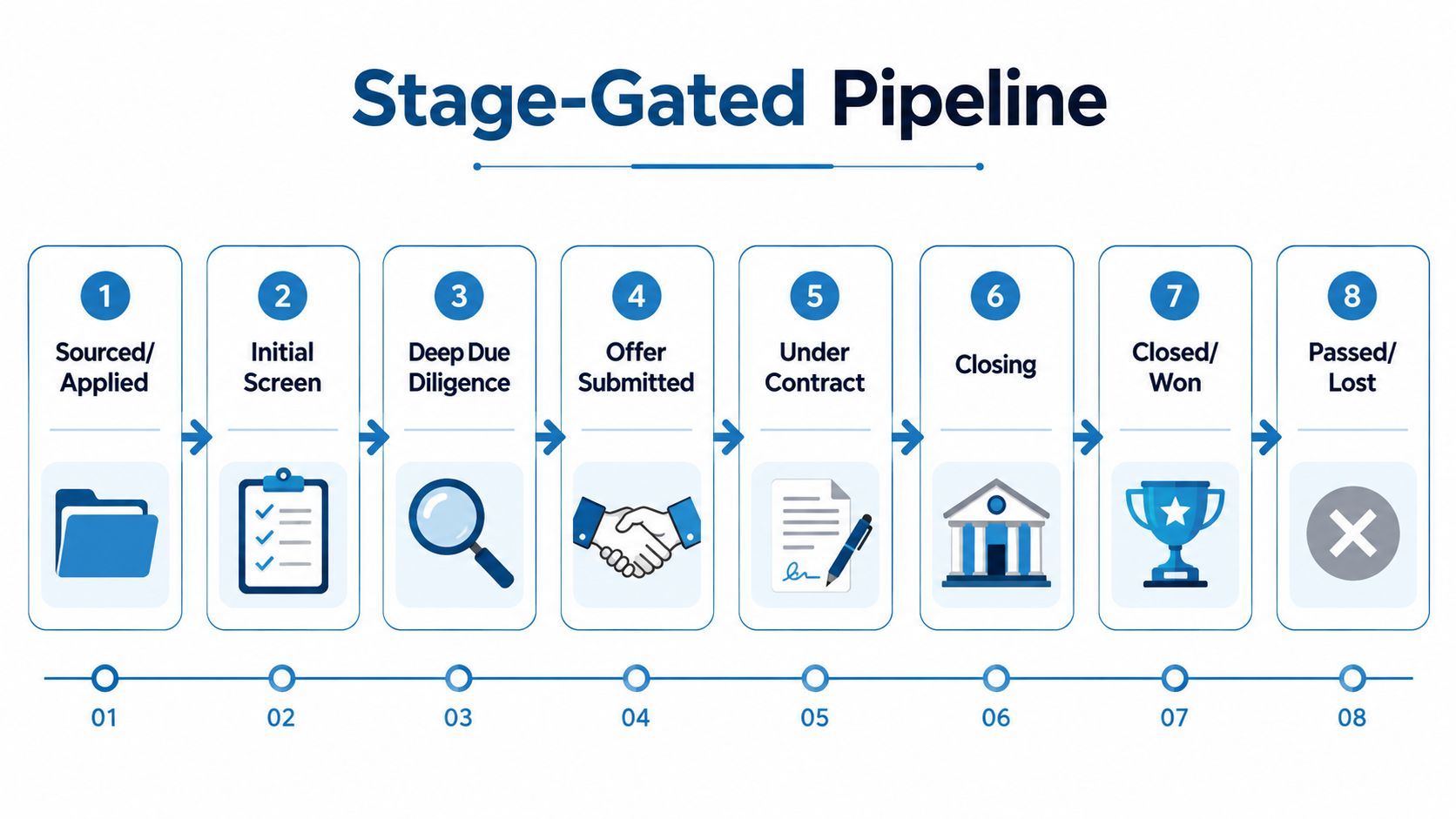
The Grasp CRM lesson lays out an eight-stage structure, Sourced / Applied, Initial Review, First Meeting, Deeper Due Diligence, Investment Committee, Term Sheet Out / Committed, Closed / Won, and Passed / Lost. It also specifies the deal-level fields a CRM should hold, including company name, website, sector, founding team, deal source, rubric scores, traction/TAM notes, next step, follow-up date, and owner (Grasp CRM lesson). That field design keeps a deal from dissolving into a loose note in someone's inbox.
Eight stages, one owner, one gate
The structure below makes leakage visible.
| Stage | Entry condition | Exit criteria | Typical owner |
|---|---|---|---|
| Sourced / Applied | New lead arrives from a form, referral, outbound list, or manual import | Basic identity captured, source logged, deal created | Ops or coordinator |
| Initial Screen | Deal exists in CRM with required fields | Fit confirmed or rejected against criteria | Analyst or associate |
| First Meeting | Opportunity meets the first screen and gets contact time | Meeting complete, notes logged, next step defined | Deal lead |
| Deeper Due Diligence | Initial meeting suggests real fit | Diligence checklist complete, gaps flagged | Analyst, operator, or specialist |
| Investment Committee | Deal is complete enough for decision | Approve, request more work, or pass | Committee |
| Term Sheet Out / Committed | Approval exists and terms are drafted | Terms accepted or deal stalls with a recorded reason | Deal lead or legal |
| Closed / Won | Contract or close process is finished | Transaction recorded cleanly | Closing owner |
| Passed / Lost | Any stage where the answer is no | Loss reason recorded and archived | Deal lead |
A failed handoff shows up fast when the stage names look right but the data is wrong. A lead can move from Initial Screen to First Meeting because someone marked it as “qualified,” then the conversation stalls because no one captured ownership, timing, or the reason it cleared the screen. The result is familiar, the team thinks the deal advanced, the sponsor thinks diligence is underway, and the record contains nothing that helps the next person act. Clear exit criteria stop that kind of phantom progress.
The operating rule is plain. If a stage does not have a required exit condition, it is a storage slot, not a process step. That is why the CRM has to carry the same deal fields every time, so the team can see where the opportunity came from, where it stands, and who has the next move. The trackable fields should include property or company identity, owner and contact details, sector and source, rubric scores and notes, next step, follow-up date, and owner.
Practical rule: If a record can move stages without updating the next step, it is already starting to rot.
Automation should handle the intake work immediately. The lesson also shows a useful pattern, when a startup or property lead comes in through a website form, a new deal should be created automatically in Sourced / Applied. That keeps intake from turning into an email-only black hole, and it gives the team a clean starting point for qualification and routing.
Stage gates work best when the team treats them as operational controls, not reporting labels. That means the person advancing a deal has to own the proof that it belongs in the next stage, and the person receiving it has to trust the record enough to act without rechecking everything from scratch.
Scoring and Prioritization Using Propensity Modeling
Deal flow breaks down when every inbound record gets treated like it deserves the same attention. Scoring separates likely closers from noise, and propensity modeling makes that ranking repeatable instead of opinion-driven. If a team cannot explain why one opportunity sits above another, it does not have a real prioritization system.
Build the score from property and contact signals
Strong scores combine property-level and contact-level signals. Property-level inputs can include equity, listing status, permit activity, mortgage position, lien detail, and pre-foreclosure activity. Contact-level inputs can include reachability, verified phone and email confidence, and response history. The point is to avoid scoring a lead on one isolated signal when the answer sits in the full record.
A practical data set gives operators enough detail to score without guessing from partial information. BatchData provides property records, valuations, verified owner contacts, equity positions, mortgage and lien details, and pre-foreclosure activity, along with enrichment and skip tracing workflows that support ranking and outreach (BatchData product overview). That is enough raw material to build a working rubric instead of relying on gut feel.
| Signal type | Examples | What it tells you | How to use it |
|---|---|---|---|
| Property signal | Equity, listing status, permit activity | Likelihood of motivation or readiness | Apply a heavier score band when equity is high and permit activity suggests near-term movement |
| Ownership signal | Verified owner contact, ownership history | Whether the lead is reachable and clean | Route clean ownership records to outreach first, then send uncertain records to verification |
| Risk signal | Mortgage, lien, pre-foreclosure | Pressure, constraint, or timing sensitivity | Raise urgency when pre-foreclosure is active, and lower fit when lien complexity is too high |
| Engagement signal | Response history, phone and email confidence | Whether contact attempts are likely to work | Shift channel choice toward the highest-confidence contact path before the first call |
Use propensity modeling to rank intent
Propensity modeling predicts which records are most likely to move. The internal guide on what propensity modeling is is useful for teams that want the mechanics without marketing language. The right way to use it is not as magic, but as a repeatable way to rank likely outcomes from structured signals.
For practical work, start with explicit rules. Define criteria by sector, stage, size, and geography, then assign points or bands for each signal. Do not let the team adjust the rubric ad hoc because one deal feels exciting. That is how scoring turns into theater.
A score only helps if the team trusts it enough to act on it. Set the model so higher-propensity records reach the right rep, the right channel, and the right follow-up sequence without extra debate. Lower-confidence records should not disappear, but they should sit lower in the queue until the data improves.
Make the rubric operational
A scoring system works only when people use it the same way every time. The checklist has to be short enough to finish, specific enough to guide action, and strict enough to reject weak signals. When teams do this well, the result is cleaner prioritization, faster follow-up, tighter sourcing, and less time spent on dead-end records.
Data Integration and Automation Architecture
A pipeline is only as good as the data feeding it. Teams lose time when property records, contact data, and CRM fields drift apart, then someone has to clean up the mismatch by hand before a deal can move. The architecture that holds up in practice is straightforward, one source of truth, enriched records, and automation rules that move data and tasks without making a person copy the same facts twice.
Connect the data layer to the CRM
The cleanest setup connects a CRM or pipeline tool to property and contact data through API calls for live records and through bulk delivery for heavier syncs. That keeps deal records current without forcing manual imports, and it works best when the underlying data is already enriched with property characteristics, ownership history, AVMs, mortgage details, listings, permits, and pre-foreclosure data. The same approach also fits teams that want Snowflake data integration to support warehouse-first reporting while keeping the operational CRM stable.
The architecture should look like this:
- Inbound lead arrives through a form, import, referral, or outbound capture.
- Enrichment runs automatically against property and contact data.
- The CRM writes the record into the correct pipeline stage.
- Rules trigger follow-up when the record meets fit criteria.
- Owners update the outcome so the source of truth stays clean.
If the data does not enrich before the first touch, the sales or acquisitions team is already working blind.
Automate intake, enrichment, and follow-up
The system should behave like an active process, not a static database. Inbound leads trigger skip tracing, phone verification, and contact enrichment immediately, which reduces the number of stale records that reach a rep. Smart Property Search and Portfolio Monitoring APIs can surface new opportunities automatically, which helps keep a live watchlist from turning into a stale spreadsheet.
For teams that route data into Snowflake, the warehouse-first pattern keeps analytics downstream without forcing the CRM to carry every reporting burden. It also makes it easier to separate operational workflows from historical analysis, which matters once multiple teams start touching the same pipeline.
A practical rule here is simple. Never let a record advance with missing core fields. If ownership is unclear, the source is not logged, or the next step is not assigned, the record stays where it is. That friction feels annoying at first, but it keeps bad data from spreading into scoring, forecasting, and handoff decisions.
Analytics and KPIs That Predict Pipeline Health
A pipeline can look busy and still be unhealthy. The metrics that matter show movement, friction, and source quality. If the team only watches volume, it usually misses the core issue, which is slow conversion or a clogged stage.
| Metric Category | Vanity Metric Avoid | Operational Metric Track | Why It Matters |
|---|---|---|---|
| Top-of-funnel | Raw lead count | Conversion rate | Shows whether intake quality is real |
| Stage management | Meetings booked only | Time-in-stage | Exposes stuck deals early |
| Source tracking | Source volume alone | Source quality | Identifies which channels produce workable deals |
| Outcome reporting | Contacts made | Win rate | Measures how often the pipeline closes |
| Pipeline health | Total records in CRM | Velocity | Shows whether deals are moving or stalling |
The benchmark data is useful because it shows how much work the funnel can require. 800 to 2,000 outreach touches may be needed to produce 50 to 100 conversations, 10 to 20 NDAs, 5 to 10 books reviewed, 2 to 3 LOIs, and 1 closed deal (CTA Acquisitions deal flow guide). That is not a reason to spray harder. It is a reason to track which channels, lists, and owners create real progress.
The same benchmark says deals closed in under 50 days win 47% of the time versus about 20% after 50 days, which makes velocity a direct health signal, not a vanity metric. When a deal sits too long in stage, the problem is usually qualification, follow-up discipline, or both.
Weekly reporting should answer three questions, what moved, what stalled, and where to reallocate effort. A real estate data analysis workflow helps because once the data is structured, the review becomes much more honest. If the team cannot answer those questions quickly, the dashboard is reporting activity instead of pipeline health.
Common Pitfalls and How to Learn From Passed Deals
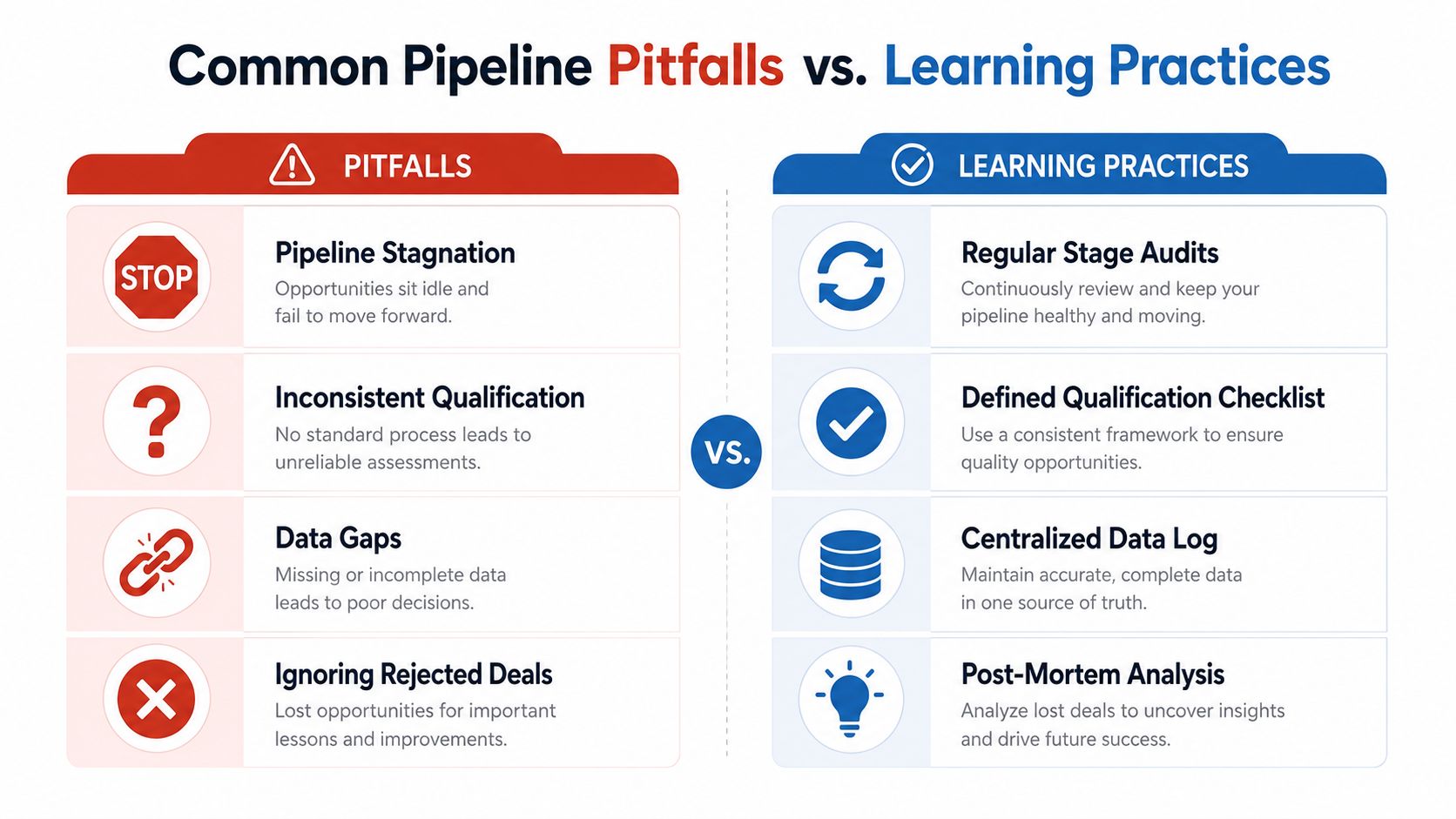
The most expensive pipeline mistake is not a bad deal, it's a deal that goes nowhere and teaches the team nothing. Stagnation, inconsistent qualification, and data gaps are obvious failures. The subtler failure is treating passed deals as dead ends instead of as training data for better sourcing and underwriting.
Capture pass reasons before the context disappears
A pass without a reason is a wasted data point. Teams should tag rejected deals with a small set of reasons, such as price, timing, condition, competition, or fit, then preserve the record in a centralized log. That log becomes the only honest way to see what the funnel filtered out and whether the filters are working.
The gap in most deal flow content is exactly this, how to learn from rejected or pass deals rather than only tracking wins. Modern frameworks say every pass should feed back into the pipeline as a data point, but many teams never operationalize that loop or build a workflow that turns rejection history into better sourcing and underwriting decisions (V7 Labs on venture capital deal sourcing). That's a missed edge.
Audit the pipeline, not just the outcomes
Pipeline problems usually show up in predictable ways.
- Pipeline Stagnation: Deals sit too long because nobody owns the next action.
- Inconsistent Qualification: Different people apply different standards.
- Data Gaps: Missing fields make reporting and scoring unreliable.
- Ignoring Rejected Deals: The team keeps seeing the same bad patterns.
The fix is operational discipline. Run regular stage audits, keep a defined qualification checklist, maintain a centralized data log, and do post-mortem analysis on rejected opportunities. Those are not fluffy process improvements. They're the only way to prevent the same mistakes from repeating.
Practical rule: A rejection history is valuable only if someone can search it, segment it, and use it to change sourcing criteria.
Handoff failures deserve the same attention. If one person screens a deal and another person inherits it without context, the record loses momentum immediately. That's why ownership fields, follow-up dates, and written pass reasons matter. They make it possible to learn from the pipeline instead of just looking at it.
Implementation Checklist and Next Steps
The fastest way to improve deal flow management is to stop running it like a spreadsheet and build it like an operating system. One team I've seen move from ad hoc tracking to a fully instrumented pipeline started with a simple rule, every deal had to have a stage, an owner, a source, and a next step before anyone could call it active. The change was uncomfortable for a week, then obvious.
The order that works
- Define stages and exit criteria. Write down what gets a deal in and out of each stage.
- Choose one source of truth. Don't split records across inboxes, sheets, and half-migrated CRMs.
- Integrate data sources. Pull property and contact data in through APIs or bulk delivery.
- Add scoring rules. Use a rubric that includes property and contact signals, not gut feel.
- Automate enrichment and follow-up. Trigger the first cleanup and next-step sequence automatically.
- Track the right KPIs. Focus on conversion, time-in-stage, source quality, win rate, and velocity.
- Review weekly. If a deal is stuck, someone should own the decision.
The first 30 days should be about cleanup and structure, not fancy forecasting. Standardize fields, remove duplicates, backfill missing records, and make sure the team knows what has to happen before a deal advances. If that foundation is weak, every downstream metric will lie.
The short version is this. Build the pipeline first, then optimize it. A team that can reliably capture, enrich, score, and review deals will always outwork a team that just has more leads in circulation.
If you want a deal flow stack that turns property and owner data into cleaner pipeline movement, BatchData provides the enrichment, verified contacts, and propensity modeling operators need to keep records moving. It fits deal flow management because it helps teams source, score, and monitor opportunities with one data layer instead of juggling disconnected tools.