





































Off-market real estate deals let you buy properties before they hit the MLS, often at 10-30% below market value. The key? Acting within the first 6 months after distress signals – like tax liens, divorce filings, or pre-foreclosure notices – appear in public records. These early signs help identify motivated sellers prioritizing speed over price.
Key Takeaways:
- Timing Matters: The 6 months window begins after distress events like missed payments or legal filings.
- Motivated Sellers: Over 74% of off-market sales stem from life changes like divorce, inheritance, or relocations.
- Data Signals: Public records (e.g., Notices of Default, tax liens) reveal seller intent early.
- Tools to Use: Platforms like BatchData combine property data with tools like skip tracing and predictive analytics to streamline research and outreach.
Acting quickly and using data-driven strategies can help secure deals before competition heats up.
7 Proven Ways to Find Off-Market Real Estate Deals in 2025 (Legal & Ethical)
sbb-itb-8058745
The 6 Months Pre-Listing Window Explained
The 6 months window is a crucial grace period where homeowners can negotiate their debt situation to avoid foreclosure. During this time, accepting a cash offer can help homeowners sidestep the negative impact on their credit. Typically, this window starts after a Notice of Default or Lis Pendens is filed, which usually happens after at least 120 days of missed payments. Depending on the circumstances, this negotiation phase can last anywhere from 6 months to over a year before the property reaches public auction.
This period is a prime opportunity because it allows investors to skip the competition and frenzy of the MLS or public auction. Properties in this early stage often sell for 70-80% of their market value, as sellers prioritize speed and certainty over maximizing profit. For homeowners facing financial challenges or major life transitions, the focus is on finding a quick solution rather than waiting for the highest bidder. This gives investors a unique chance to secure deals before the properties become widely known.
What Triggers Pre-Listing Activity
There are three main types of events that can push property owners to sell long before they involve a real estate agent.
- Financial triggers include situations like tax liens, bankruptcy filings, or mortgage defaults. For instance, foreclosure starts rose 23% year-over-year in Q3, affecting 103,000 properties.
- Life event triggers, such as divorces, relocations, or other personal changes, drive over 74% of off-market transactions. These events often create tight timelines that don’t align with traditional listing processes.
- Physical property triggers include signs like code violations, overgrown yards, or utility shut-offs, which often indicate vacancy or that the owner has reached their limit.
Interestingly, the landscape has shifted: in 2023, 66% of motivated sellers were driven by the convenience of a quick, attractive offer rather than financial distress alone. For example, a seller with significant equity who needs to relocate for a new job in 30 days is just as motivated as someone struggling with mortgage payments – they just require a different approach.
How Public Records Reveal Seller Intent
These triggering events often leave a documented trail, making it possible for investors to identify motivated sellers well before their properties hit the market. Public records are a treasure trove of information, offering early insights into seller intent.
- A Notice of Default (NOD) indicates the borrower has fallen behind on their loan and specifies the amount needed to bring the loan current.
- A Lis Pendens signals a pending lawsuit involving the property title, which is common in judicial foreclosure states.
- Tax delinquency notices highlight serious financial trouble and the potential for a tax sale.
- Expired MLS listings are another key indicator, as they show that the owner has already tried – and failed – to sell through traditional means, making them highly motivated during the following 6 months off-market window.
This data, updated daily in county recorder’s offices and tax assessor databases, is readily available. The key difference between successful investors and those who miss opportunities lies in monitoring these signals and acting quickly.
Finding Motivated Sellers Through Data Signals
Savvy investors use data signals to pinpoint motivated sellers as early as 6 months before a property hits the market. This data-focused strategy is essential for locking in off-market deals ahead of public listings.
Early Warning Signs of Seller Distress
One of the clearest signs of seller distress is tax delinquency. In 2024, over 5 million U.S. homeowners fell behind on property taxes, marking the highest numbers since 2008. Reaching out within 30 days of a tax delinquency filing allows investors to connect with homeowners who are still exploring their options.
Another critical signal is pre-foreclosure notices, such as Notices of Default (NOD) or Lis Pendens. These legal filings are public records that investors monitor to identify properties at risk of foreclosure.
Life events also play a major role in motivating sellers. Events like divorce (15%), death or estate transitions (13%), job relocations (7%), and retirement (5%) often lead to properties being sold. These occurrences are recorded in county court and probate filings. As BatchData explains:
“Motivation is about circumstance, not just finances. A seller with 80% equity who must relocate for a new job in 30 days is just as motivated as someone behind on their mortgage”.
The likelihood of a sale increases significantly when multiple factors overlap. For example, combining indicators like tax delinquency, high equity (over 40%), long ownership (10+ years), and a significant life event can raise the probability of a sale from 40% to 75%. An out-of-state owner dealing with a tax lien and a recent probate filing is far more likely to sell than someone with just one of these indicators.
| Signal Category | Specific Indicator | Where to Find It |
|---|---|---|
| Financial Distress | Tax Liens, IRS Liens | County Tax Assessor, Federal Records |
| Life Transitions | Divorce Filings, Probate Cases | County Court Records, Probate Court |
| Ownership Fatigue | Vacant Property, Absentee Owner | USPS Data, Tax Assessor Records |
| Physical Distress | Code Violations, Permit Issues | Municipal Code Enforcement |
| Failed Sale Attempts | Expired MLS Listings | MLS Historical Data |
How BatchData Provides Access to These Signals
BatchData simplifies the process of identifying motivated sellers by aggregating over 155 million property records. It combines public records – such as tax data, liens, probate filings, and divorce records – with specialized datasets like vacancy status and permit history.
Using BatchData’s property data enrichment tools, you can layer distress indicators such as tax delinquencies with other factors like high equity or out-of-state ownership. Their Automated Valuation Models (AVMs) provide instant market value estimates and equity calculations, allowing you to quickly evaluate the financial potential of a deal.
Using BatchData for Property and Owner Research
Once you’ve identified early distress signals, the next step is diving into detailed property and owner research. BatchData makes this process seamless by offering access to billions of data points through a real estate API. These include ownership history, tax delinquencies, mortgage balances, and even vacancy status – all essential for understanding a property’s situation and potential opportunities.
Property Data Enrichment for Better Analysis
BatchData’s tools for property data enrichment allow you to refine your search by layering distress indicators. This approach helps you zero in on motivated sellers who may be ready to act quickly.
For example, Automated Valuation Models (AVMs) provide instant estimates of a property’s market value. You can calculate equity using the formula: AVM Value - Estimated Mortgage Balance. This is a vital step because sellers need enough equity to accept below-market cash offers while still walking away with a profit. BatchData also features BatchRank, a machine learning-driven tool that assigns a “propensity to sell” score. This score is based on factors like historical sales data and property characteristics, helping you prioritize leads with precision.
Once you’ve enriched your property data, the next move is verifying owner contact details using advanced skip tracing tools.
Skip Tracing and Contact Verification Tools
Finding property owners, especially those hidden behind LLCs or trusts, can be tricky. BatchData’s skip tracing tools simplify this by cross-referencing property addresses with consumer databases. This process retrieves verified mobile and landline numbers, email addresses, and even confidence scores for each contact, giving you a clear roadmap for outreach.
To stay compliant with federal regulations, BatchData includes automatic DNC (Do Not Call) scrubbing. This ensures you’re not contacting individuals on the Do Not Call list. Focus on reaching out to contacts with “high” confidence scores to get the best results. Once you have accurate contact information, take a multi-channel approach: start with a text message, follow up with a phone call, and then send direct mail for a well-rounded outreach strategy.
5 Steps to Secure Off-Market Deals
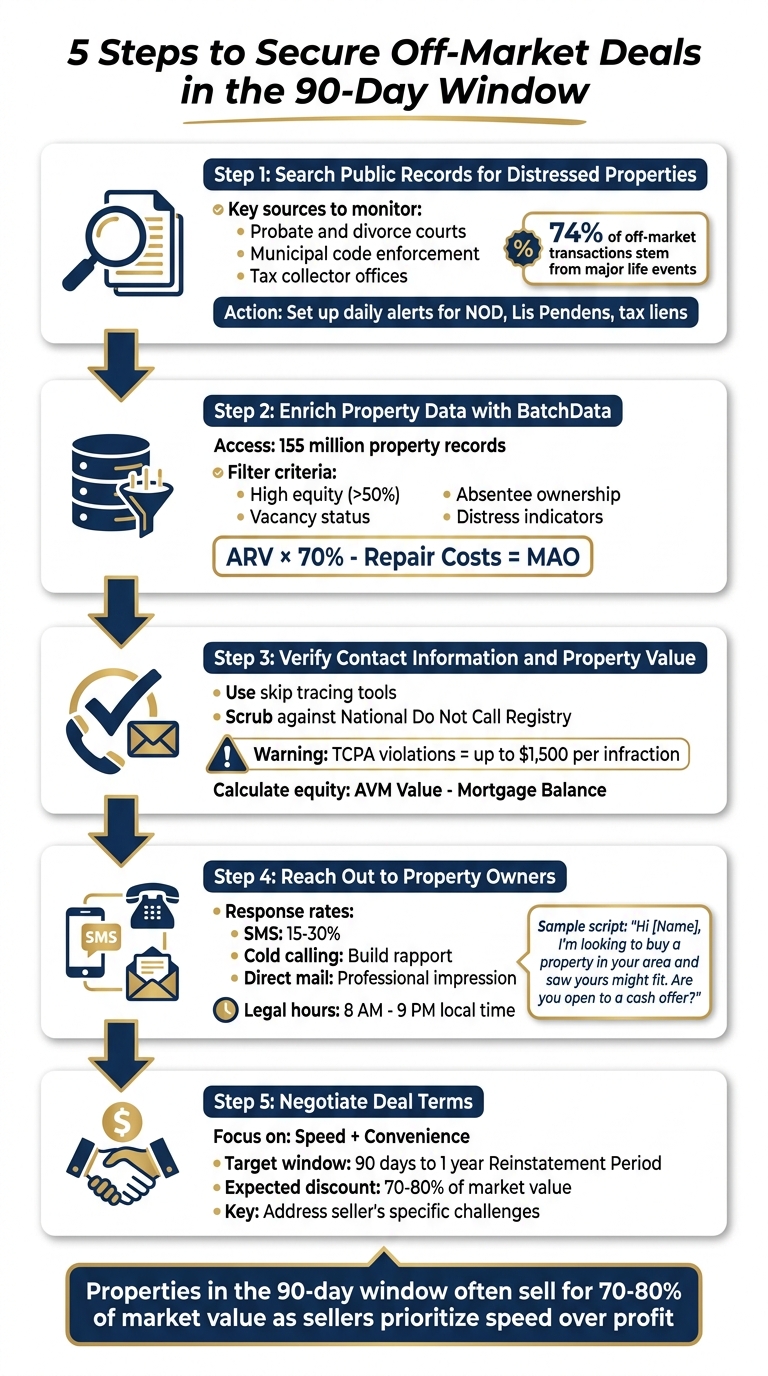
5-Step Process to Secure Off-Market Real Estate Deals in 6 months
Here’s a step-by-step guide to help you turn raw data into successful transactions during the crucial 6 months pre-listing window.
Step 1: Search Public Records for Distressed Properties
Start by diving into county public records to pinpoint properties showing signs of distress. Focus on three key sources:
- Probate and divorce courts: These records often reveal properties tied to estate transitions or divorces.
- Municipal code enforcement: Look for properties with unresolved violations, like structural issues, that rack up daily fines.
- Tax collector offices: Identify properties with delinquent taxes or those marked for tax sales.
Properties that appear on multiple distress lists are your best bets. For instance, a home that’s tax delinquent, absentee-owned, and has code violations is a stronger lead than one with just a single issue. Set up daily alerts for new tax liens, Notices of Default (NOD), or Lis Pendens filings in your target areas. Being the first to reach out can make all the difference.
“Motivation is about circumstance, not just finances. A seller with 80% equity who must relocate for a new job in 30 days is just as motivated as someone behind on their mortgage.”
- BatchData
Interestingly, over 74% of off-market transactions stem from major life events.
Step 2: Enrich Property Data with BatchData
Once you’ve identified distressed properties, take your research deeper with enriched data. BatchData gives you access to a massive database of 155 million property records. Use this to apply filters like high equity (over 50%), vacancy status, absentee ownership, and distress indicators. Their Smart Searches feature even sends real-time alerts when a property enters a distressed state.
BatchRank’s AI can help you prioritize leads by scoring properties based on their likelihood to sell. This ensures you focus your time on the most promising opportunities. When making offers, rely on the Maximum Allowable Offer (MAO) formula:
ARV x 70% – Repair Costs = MAO
This formula helps you craft offers that are profitable while still appealing to sellers.
Step 3: Verify Contact Information and Property Value
With your refined list of properties, the next step is to verify key details. Use BatchData’s skip tracing tools to confirm owner contact information. Scrub your list against the National Do Not Call Registry to avoid costly TCPA violations, which can lead to penalties of up to $1,500 per infraction.
Next, use Automated Valuation Models (AVMs) to estimate the market value of each property. Calculate equity by subtracting the estimated mortgage balance from the AVM value. This step is essential because sellers need enough equity to accept below-market offers while still walking away with cash.
Step 4: Reach Out to Property Owners
Once you’ve verified the details, it’s time to connect with property owners. Use a mix of outreach methods like SMS, cold calling, and direct mail:
- SMS: This method often generates response rates between 15% and 30%, making it great for quick yes/no replies.
- Cold calling: Ideal for building rapport and qualifying leads on the spot.
- Direct mail: Creates a polished, professional impression.
When reaching out, keep your tone low-pressure. Try a script like:
“I know this call is out of the blue… I was wondering if you’d ever be open to considering a cash offer?”
Frame your outreach as a way to solve their problem, not as a sales pitch. Reference specific data points – like a recent code violation or vacancy status – to show you understand their situation. A/B test your messaging to find what works best, and remember to stick to legal calling hours (between 8 a.m. and 9 p.m. in the recipient’s local time).
Step 5: Negotiate Deal Terms
When it’s time to negotiate, focus on speed and convenience. Sellers motivated by life events – like divorce, probate, or relocation – often prioritize a quick, stress-free sale over getting top dollar. Present a simple cash offer that directly addresses their challenges. Be upfront about how you calculated your number, factoring in market conditions, repair costs, and comparable sales.
For pre-foreclosure properties, the Reinstatement Period (6 months to 1 year after a Notice of Default) is the ideal time to negotiate. During this window, sellers are typically more open to creative solutions before the property heads to auction. Use the enriched data you’ve gathered to tailor offers that align with their specific needs and timeline.
Using Predictive Analytics to Evaluate Properties
Predictive analytics transforms a variety of data points into actionable insights, helping investors identify properties likely to close within 6 months. This method complements early data signals, uncovering off-market opportunities well before they hit public listings. Tools like BatchRank use machine learning to assign a “propensity to sell” score by analyzing historical sales and ownership trends. This shifts property analysis from guesswork to a more precise, data-driven approach.
An effective tactic in this process is data stacking – combining multiple signals to pinpoint high-potential leads. For instance, layering high equity (over 40%) with vacancy status and out-of-state ownership creates a much stronger lead than relying on a single factor. Today, over 90% of real estate investment decisions are based on data analytics rather than intuition. Investors who leverage predictive tools gain a clear edge, identifying motivated sellers faster than their competition. These insights also pave the way for a more detailed understanding of property conditions and ownership trends.
Analyzing Property Conditions and Ownership Patterns
Predictive analytics uncovers patterns that often go unnoticed with manual research. For example, reviewing building permit histories can reveal failed flips – properties with incomplete permits suggesting the original investor couldn’t secure a profitable exit. Similarly, municipal code violation notices can highlight properties under regulatory pressure, where owners may face mounting fines. When combined with ownership trends, these condition-based signals offer a fuller picture of seller motivation.
Targeting non-owner-occupied properties with long-term ownership (10+ years) and recent code violations can help identify landlords who are ready to sell. Likewise, heirs managing inherited properties, particularly from out of state, often lack the time or interest to maintain them, making these properties strong candidates for quick sales. Additionally, owners with multiple distressed assets may need to sell underperforming properties to stabilize their finances. BatchData’s extensive property database makes it possible to detect these opportunities.
Integrating BatchData APIs into Your Workflow
Once you’ve gained predictive insights, integrating BatchData APIs can streamline your workflow, enabling real-time decision-making. For instance, the Smart Property Search API allows instant property lookups and automates portfolio monitoring. It can send alerts for critical events like new liens, ownership changes, or pre-foreclosure filings.
For larger-scale analysis, bulk data delivery through platforms like Snowflake or S3 supports machine learning training and in-depth market research. Real-time updates – now the industry standard – have replaced outdated quarterly refreshes, cutting manual data collection time by more than 50%. This allows your team to focus on deal structuring and negotiations instead of tedious data gathering. You can also set up automated alerts for your database to identify the best outreach moments, such as changes in loan-to-value ratios, new liens, or ownership transfers.
Conclusion
The 6 months pre-listing period is a crucial window for real estate investors. It’s when you can directly negotiate with homeowners, avoid the frenzy of public auctions, and secure properties at 70–80% of their market value. As Ivo Draginov explains:
“The core advantage of pre-foreclosure investing is negotiating from a problem-solving standpoint. You aren’t just buying a house; you are providing a viable exit strategy for a homeowner in a difficult financial situation”.
This is where BatchData becomes an essential tool. By tapping into its extensive property records, predictive models, and real-time alerts for key events like new liens or ownership changes, you can spot motivated sellers as soon as distress signs emerge. Features like data stacking – combining high equity, vacancy status, and out-of-state ownership – turn scattered public records into actionable insights.
On top of that, automated workflows streamline the data collection process, giving you more time to focus on crafting deals. Acting quickly on these signals allows you to acquire properties before they hit the open market. With foreclosure starts climbing 14% year-over-year and the U.S. distressed commercial real estate balance reaching $116.4 billion, the opportunities are immense. Success in this space belongs to those who move first, and BatchData ensures you stay ahead of the competition.
FAQs
How do I find the best distress signals in my county?
Finding distressed properties in your area starts with using reliable property data to identify key indicators. Look for signs like pre-foreclosure status, tax liens, code violations, and recent ownership changes. These factors can point to motivated sellers who may be more open to negotiating.
Pay special attention to properties showing multiple distress signals. For instance, a home in pre-foreclosure that also has tax liens is a strong candidate. Additionally, tracking ownership changes – especially when new owners are LLCs or trusts – can help you spot distressed properties early, often before they officially hit the market.
What data points should I stack to spot the most motivated sellers?
To spot motivated sellers, it’s all about layering different data points. Look for life-event clues like divorce or inheritance, property distress signs such as pre-foreclosure or tax liens, ownership details like absentee landlords or properties owned by LLCs, and behavioral patterns such as recent mortgage inquiries or vacant property status. By combining these insights, you can better predict who might be ready to sell, giving you a clear advantage in discovering off-market deals.
How soon should I contact an owner after a new filing shows up?
You should contact the owner as soon as you can, preferably within 24 to 48 hours. Moving quickly gives you a better chance to secure the opportunity before the property becomes publicly available.