
The real estate industry depends on seamless data sharing, but fragmented systems have made integration costly and slow. RESO (Real Estate Standards Organization) introduced data standards like the Data Dictionary and Web API to solve these issues, creating a common language for over 500 MLSs. These standards reduce development time, lower costs, and simplify scaling.
Key takeaways:
- Before RESO: Each MLS used different field names (e.g., "Listing Price" vs. "Ask Price"), requiring manual mapping and custom integrations.
- With RESO: Standardized data fields and modern APIs replaced outdated methods, cutting integration times by up to 92%.
- Examples: Homes.com reduced MLS integration time from 165 hours to 16 hours. TRIBUS cut its data process from 10 steps to 2.
- Modern Tools: RESO’s Web API uses open standards like JSON and OAuth, enabling real-time, secure data exchanges.
RESO standards have transformed how real estate data flows, making operations faster and more efficient for brokers, vendors, and developers.
How RESO Is Transforming Global Real Estate with Data Standards – Sam DeBord, CEO of RESO
The Problem: Fragmented Data in Real Estate
Before the adoption of RESO standards, integrating real estate data was a logistical nightmare. Each MLS (Multiple Listing Service) operated as a silo, using its own unique field names, data structures, and transfer methods. For instance, one system might call it "Listing Price", another "Ask Price", and yet another "Offer Price". These differences forced vendors to create custom integrations for every MLS, which not only escalated costs but also slowed down innovation. The result? Higher expenses and delayed scalability across the industry.
Development teams found themselves stuck in a repetitive, manual cycle of mapping and remapping data fields. For a single integration, this process could involve as many as 10 separate steps.
Inconsistent MLS Data Formats
The problem of fragmented data formats wasn’t just theoretical – it had real-world consequences. These inconsistencies created significant roadblocks to scaling operations. Take TRIBUS, for example. In September 2018, their VP of Product Development, Katie Ragusa, led a painstaking data integration process that required 10 distinct steps. This included mapping fields through trial and error, importing samples, collecting client feedback, and repeating the process until the data aligned properly.
This fragmented approach made scaling incredibly expensive. Custom integrations often required on-the-fly data transformations, which complicated efforts to ensure accuracy and maintain consistency. Instead of focusing on building software features to support brokers and agents, development teams were stuck wrestling with data alignment issues.
Legacy Protocols and Proprietary Systems
Outdated technology only added to the industry’s challenges. The Real Estate Transaction Standard (RETS), introduced in 1999, had served its purpose for years but eventually became a stumbling block. By the late 2010s, RESO officially deprecated RETS, leaving companies still reliant on it burdened with mounting technical debt. Proprietary systems also created vendor lock-in, forcing businesses to rely on costly, custom-built solutions.
Consider the case of Homes.com. Their initial MLS integration, which relied on proprietary methods, required a staggering 228 hours of development work. Even as the team gained experience, every new MLS integration still demanded a unique, time-intensive approach. This left organizations investing more resources into managing incompatible systems than into addressing the actual needs of brokers and agents.
The Solution: How RESO Standards Fix Integration Problems
RESO standards were developed to tackle the chaos caused by fragmented data systems in the real estate industry. By creating a universal language, RESO eliminated the need for expensive and time-consuming custom data mappings. Today, this framework is used across more than 500 certified MLSs.
Organizations that have adopted RESO standards can now implement solutions that work seamlessly across multiple markets. As Michael Wurzer, President and CEO of FBS, explained: "The cost benefits of adopting the RESO API and Data Dictionary become clear by making future implementations far less work". Let’s break down how RESO’s key components achieve these efficiencies.
RESO Data Dictionary: A Unified Field Structure
The RESO Data Dictionary acts as the standardized blueprint the industry has long needed. It organizes data into a clear, hierarchical structure with three main levels: Resources (broad categories like Property, Member, and Office), Fields (specific data points such as Community Features or Pool Features), and Lookups (enumerated options like "Chain Link" or "Vinyl" for fencing types) . With over 1,700 fields and 3,100 lookups, the guesswork of matching field equivalencies is eliminated. This standardization not only minimizes mapping errors but also accelerates the onboarding of new technology products, effectively addressing the industry’s long-standing fragmentation issues.
What’s more, the Data Dictionary balances standardization with flexibility. While it defines common field values for universal use, it also allows for local fields to accommodate unique regional needs – ensuring interoperability without sacrificing local relevance.
In addition to structured fields, RESO has modernized the way data is exchanged, as demonstrated by its Web API.
RESO Web API: Modernizing Data Exchange
The RESO Web API replaced the outdated, proprietary RETS protocol by adopting modern, open technology standards widely used across industries. Built on RESTful architecture, OData, and JSON, the API leverages familiar, off-the-shelf tools, making adoption faster and more straightforward. To encourage this shift, RESO officially deprecated RETS in favor of these more versatile standards.
The Web API supports live queries, incremental updates, and improved security through OAuth. It also includes standardized metadata, which serves as a built-in guide for understanding the structure of the data. Recognizing the advantages this brings, the National Association of REALTORS® now mandates that MLSs owned by REALTOR® associations provide data access through the RESO Web API. These modern capabilities allow for seamless integration across different MLS systems, eliminating the technical hurdles that once required costly custom solutions.
sbb-itb-8058745
RESO Standards vs. Legacy Approaches: A Comparison
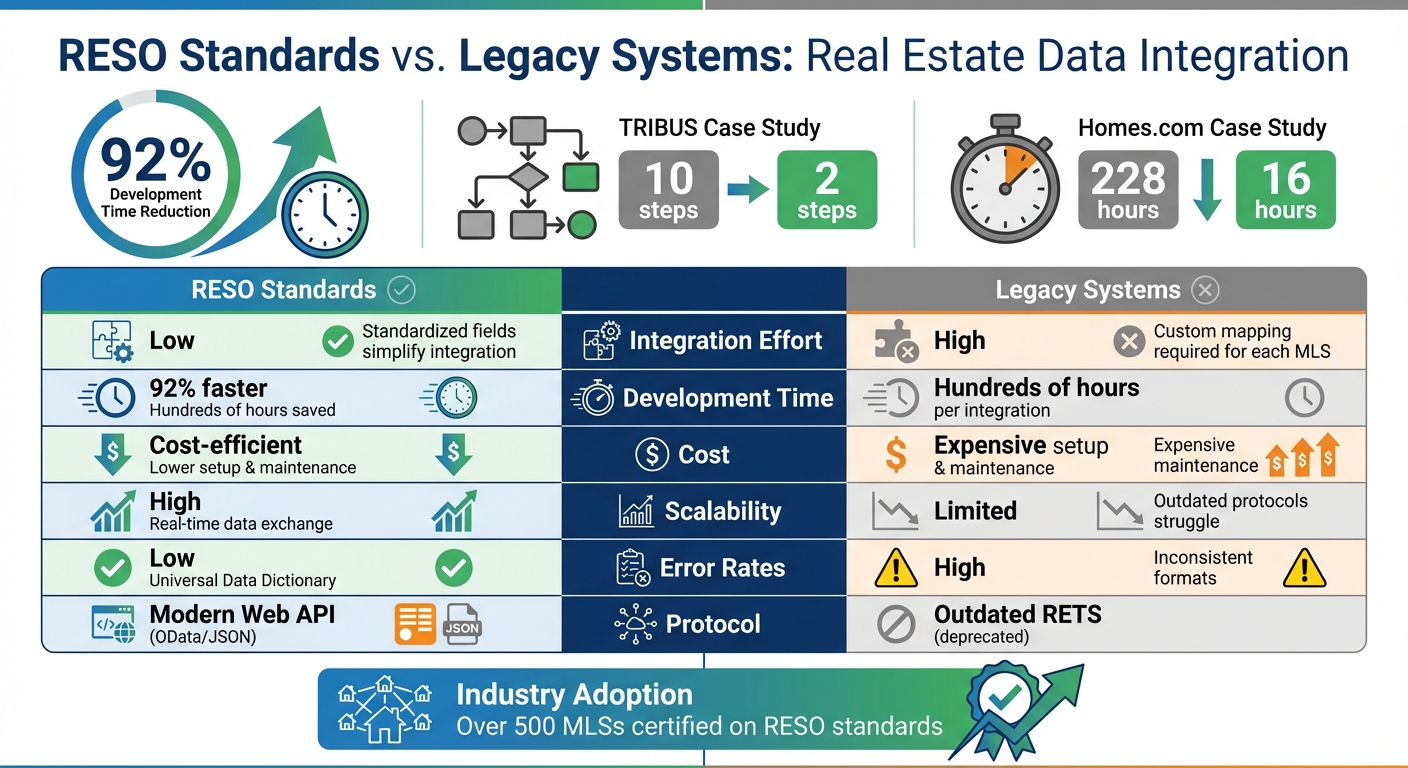
RESO Standards vs Legacy Systems: Integration Time and Cost Comparison
Switching from outdated legacy systems to RESO standards has revolutionized the way real estate data is integrated. Companies that have embraced RESO standards report substantial reductions in both development time and ongoing costs.
Take TRIBUS, for instance. They managed to cut their data acquisition process from 10 steps down to just 2. In fact, case studies reveal that development time can be slashed by as much as 92% when using RESO standards.
The benefits go beyond just time savings. Legacy systems often come with hefty maintenance costs that pile up over time. In contrast, RESO’s vendor-neutral framework enables organizations to allocate resources toward innovation rather than grappling with inefficient data transfers.
To put these differences into perspective, here’s a side-by-side comparison of RESO standards and legacy systems:
Comparison Table: RESO vs. Legacy Systems
| Feature | RESO Standards | Legacy Systems |
|---|---|---|
| Integration Effort | Low; standardized fields simplify integration with modern API endpoints | High; requires custom mapping for fragmented data and proprietary protocols |
| Development Time | Fast; up to 92% faster compared to legacy methods | Slow; often requires hundreds of hours for integration due to manual mapping cycles |
| Cost | Cost-efficient; saves development hours through industry-wide interoperability | Expensive; high setup and maintenance costs due to lack of standardization |
| Scalability | High; supports real-time data exchange and cloud-native infrastructure | Limited; depends on bulk delivery or outdated protocols that struggle with real-time demands |
| Error Rates | Low; universal Data Dictionary ensures consistent field structures | High; frequent errors caused by inconsistent MLS data formats and manual "best guess" mapping |
| Protocol | Modern Web API (OData/JSON) | Outdated RETS (introduced in 2002) or proprietary APIs |
Scalability stands out as a major advantage of RESO standards, especially for organizations looking to grow. Legacy systems become increasingly complicated as more data sources are added, requiring constant on-the-fly transformations for every transfer between platforms. In contrast, RESO’s standardized approach keeps things simple, whether you’re connecting to five MLSs or 500.
These advancements highlight the undeniable importance of adopting data standards for seamless real estate integration.
Implementing RESO Standards with BatchData

BatchData has built its data infrastructure to align with modern standards, echoing RESO’s goal of seamless real estate data integration. With a database of over 155 million property records and more than 1,000 standardized data points (such as beds, baths, square footage, MLS status, and ownership history), BatchData eliminates the manual mapping headaches often associated with legacy systems. This standardized framework ensures data flows smoothly across platforms, making it easier to adopt RESO standards for modern real estate applications.
BatchData’s API Capabilities for Real Estate Integration
BatchData’s real-time APIs are designed to deliver property data quickly and efficiently through low-latency RESTful JSON endpoints that adhere to RESO standards. Developers can integrate features like standardized property searches, contact enrichment, or skip tracing into their applications in just a matter of minutes. The platform guarantees a 99.99% uptime SLA and sub-second response times.
This level of performance translates into tangible time savings for real estate operations:
"What used to take 30 minutes now takes 30 seconds. BatchData makes our platform superhuman"
Beyond speed, BatchData’s API ecosystem includes automated compliance tools, such as DNC and TCPA litigator scrubbing updated every 24 hours. With access to over 16 million phone numbers and 6 million email addresses for contact enrichment, the platform extends its data capabilities far beyond basic property details.
Custom Solutions for Data Enrichment and Integration
BatchData doesn’t stop at providing robust APIs – it also offers tailored solutions through its professional services team. These experts specialize in streamlining outdated data pipelines by transforming legacy formats into standardized structures that meet today’s industry standards. Services include custom data matching, bespoke dataset creation, and system audits to pinpoint inefficiencies.
To meet diverse operational needs, BatchData supports data delivery through real-time APIs for instant lookups or bulk options like Snowflake, Amazon S3, CSV, JSON, and Parquet. The platform’s proprietary linking logic goes a step further by connecting corporate entities (such as LLCs and Trusts) to individual decision-makers, offering deeper insights into ownership than what’s available in standard public records. With data accuracy verified at 99.9% through multi-source validation from over 50 providers, businesses can confidently rely on BatchData’s information to power their systems.
Conclusion
The days of fragmented data and isolated systems in real estate have made integration a costly and time-consuming process. RESO standards address this issue by introducing a unified framework for data exchange. Today, over 500 MLSs are certified on RESO standards, supporting nearly two million real estate professionals. This widespread adoption highlights the industry’s commitment to standardization as the way forward.
Mark Lesswing, Former CTO of the National Association of REALTORS®, puts it plainly:
"Without standards, it gets very, very expensive to add new vendors in"
This statement emphasizes that adopting RESO standards is more than a technical improvement – it’s a strategic move that reduces costs and accelerates product development. These efficiencies pave the way for more practical and scalable platforms.
Building on the advantages of RESO standards, BatchData brings this vision to life by offering extensive, standardized property data. Its infrastructure eliminates the need for complex legacy system mapping, while its professional services provide hands-on support to help organizations transition to standardized systems.
FAQs
How do RESO standards help lower integration costs in real estate?
RESO standards make real estate data integration easier by utilizing a standardized, JSON-based Web API with uniform field names. This approach removes the hassle of managing duplicate local databases and simplifies the process of mapping data.
By cutting down on development challenges and reducing maintenance demands, RESO standards allow businesses to save both time and money, offering a more efficient way to handle data integration.
What are the benefits of using the RESO Web API compared to older systems?
The RESO Web API provides a modern, faster, and more secure solution compared to older systems like RETS. Its RESTful structure relies on lightweight JSON instead of the heavier XML format, enabling developers to request only the specific data they need. This approach boosts efficiency and cuts down on bandwidth usage.
When it comes to security, the API stands out with OAuth-based authentication and advanced encryption techniques. These features offer a much higher level of protection than the basic, often unsecured methods used by legacy systems.
Another major benefit is the API’s simplified integration process. With standardized field names and a shared data dictionary, it eliminates the hassle of creating custom mappings across different MLSs. This not only saves time and money but also reduces the likelihood of errors. Plus, its scalable, cloud-native architecture handles high-volume requests with ease, making it a perfect fit for today’s real estate applications.
What makes the RESO Data Dictionary essential for consistent MLS data management?
The RESO Data Dictionary plays a key role in ensuring consistency across Multiple Listing Services (MLSs). It establishes a standardized framework of field names, data types, and values, allowing property listings, ownership records, and market data to be understood the same way across different systems. This shared structure eliminates confusion caused by proprietary terms, making data sharing easier, cutting down on the need for costly custom mappings, and enabling smoother integrations.
Managed by the Real Estate Standards Organization, the Data Dictionary is continually updated to keep pace with industry shifts. These updates help incorporate new property features or regulatory changes, ensuring MLSs stay synchronized and up-to-date. BatchData relies on this standard to provide enriched property and contact data, simplify integrations, and deliver accurate, consistent information tailored to the U.S. real estate market.