


































USPS‘s new v3 REST API has left developers frustrated in 2026. The January shutdown of the legacy Web Tools XML API introduced strict rate limits (60 requests/hour), making it impractical for high-volume use. For example, validating 10,000 addresses now takes almost a week. Developers also face challenges like expiring OAuth tokens and confusing field name changes. These issues make the tool unsuitable for production environments, especially in industries like real estate.
BatchData has emerged as a preferred alternative, offering:
- Speed: Over 10,000 requests per minute.
- Reliability: 99.9% uptime SLA.
- Data Enrichment: Property details like ownership, valuation, and geocoding.
- Flexible Pricing: Options for per-lookup, subscriptions, or enterprise plans.
While USPS remains free, hidden costs for workarounds and its lack of scalability push many toward BatchData for faster, more detailed, and scalable address verification.
1. USPS Address Verification
The USPS manages a database with over 165 million U.S. delivery points, making it the go-to source for validating domestic addresses. This system functions on two key levels: CASS™ (Coding Accuracy Support System), which standardizes address formatting and assigns ZIP+4 codes, and DPV® (Delivery Point Validation), which confirms whether specific addresses, like house or unit numbers, actually exist.
In a 2026 test involving 500 real-world e-commerce addresses, USPS validation achieved an accuracy rate of 99.0%. While this was slightly behind commercial tools like Smarty (99.8%), it outperformed Google (97.0%). The USPS database is updated monthly, and CASS-certified software must use data no older than 105 days to maintain certification. However, newly constructed properties can take an entire update cycle to appear, creating challenges for developers working with new addresses. Below, we break down how USPS’s processing limits and integration complexities affect its real-world applications.
Processing Capabilities
The v3 REST API imposes a default limit of 60 requests per hour, which can create major bottlenecks in production settings. Since it doesn’t support batch processing, developers are forced to send requests one at a time. While it’s possible to request higher limits through the USPS Developer Portal, approval isn’t guaranteed and requires a formal business justification. This makes the free tier difficult to use for real-time operations, like processing large property lists or verifying borrower addresses. These limitations add another layer of complexity for seamless system integration, as discussed below.
Integration Options
In January 2026, the USPS upgraded its protocol stack by introducing the v3 REST API, which uses JSON formatting and OAuth 2.0 authentication, replacing the older XML/SOAP gateways. However, this transition brought its own challenges. Developers now have to manage expiring OAuth tokens and adapt to a reversed field-naming convention (e.g., ‘Address1’ now maps to ‘secondaryAddress,’ while ‘Address2’ corresponds to ‘streetAddress’).
"The gap between ‘starting point’ [60 req/hr] and ‘production-ready’ is a canyon that requires architectural changes to bridge." – RevAddress
Building a direct integration with proper OAuth token management, rate-limit queuing, and error handling can cost anywhere from $10,000 to $50,000 annually in developer resources. Adding a 30-day caching layer can reduce redundant API calls by 60–80%, but this requires additional infrastructure. These challenges highlight why high-volume operations often turn to alternative solutions.
Real Estate Suitability
For industries like real estate, where accuracy is critical, USPS address validation plays a key role in ensuring legal documents reach the right delivery points. Undeliverable mail costs U.S. businesses over $20 billion annually, so verifying addresses is essential to avoid legal complications or regulatory fines. However, the free API tier lacks Residential Delivery Indicator (RDI) data, which differentiates residential from commercial properties – a critical feature for real estate investors managing shipping surcharges or property classifications. Additionally, the system struggles with complex multi-unit addresses and doesn’t offer property enrichment data, such as owner information, square footage, or automated valuation models, which are increasingly important for modern proptech platforms.
Pricing
While the v3 REST API is free, using it effectively comes with hidden costs. Developers must invest in solutions to handle rate-limit smoothing, implement queue-based processing (targeting around 55 requests per hour to avoid errors), and maintain OAuth infrastructure. For real estate firms processing thousands of addresses each day, the 60 requests per hour cap forces a choice: either accept slower processing times or invest in commercial tools that can handle higher volumes more efficiently.
sbb-itb-8058745
2. BatchData Address Verification
BatchData combines CASS-certified address validation with in-depth property data, offering a specialized solution for real estate and proptech industries. By adhering to strict accuracy standards, it enhances address verification with over 1,000 data points per property, drawn from a massive database of 155 million U.S. records. This goes beyond simple validation, transforming address checks into comprehensive property insights, including details like owner information, mortgage history, tax records, and even vacancy indicators.
Processing Capabilities
The platform is built for speed and scale, handling more than 10,000 requests per minute. BatchData supports both real-time single-record APIs and bulk processing through cloud platforms like Snowflake and S3. Chris Finck, Director of Product Management, highlighted its efficiency:
"What used to take 30 minutes now takes 30 seconds. BatchData makes our platform superhuman".
Its fuzzy matching algorithms are another standout feature, assigning confidence scores to addresses with minor errors. Matches above 95% are automatically approved, while those scoring between 70% and 94% are flagged for manual review.
Integration Options
BatchData provides flexible integration options with a 99.9% uptime SLA. Developers can choose from:
- Real-time APIs for instant property searches.
- Bulk data delivery via Snowflake or S3 for large-scale market analysis.
- Custom services for tailored data matching and migration needs.
Additionally, the platform updates lists against the NCOALink® database every 95 days, ensuring compliance with USPS Move Update standards and helping businesses maintain postage discounts. These features make it a robust tool for property analytics and real estate-specific insights.
Real Estate Suitability
BatchData connects validated addresses to detailed property records, offering data like Automated Valuation Models (AVM), estimated equity, loan-to-value (LTV) ratios, open lien balances, and pre-foreclosure status. It also distinguishes between absentee and owner-occupied properties, identifies corporate versus individual ownership, and provides listing agent details. For businesses focused on skip tracing or finding motivated sellers, the platform enriches contact data with mobile and landline numbers, as well as DNC and litigator scrubbing. These capabilities make it a powerful tool for real estate professionals looking to gain deeper insights into property data.
Pricing
BatchData supports its advanced platform with three flexible pricing models:
- Per-Lookup Pricing: Ideal for variable volumes, charging a fraction of a cent per validated address.
- Tiered Subscriptions: Monthly or annual plans, such as 50,000 lookups per month.
- Enterprise Plans: Custom pricing for unlimited lookups, including dedicated support.
For businesses handling large datasets, bulk file processing offers a lower cost per record compared to real-time API calls. This commercial pricing model includes fully integrated infrastructure, removing the need for additional development or maintenance. By offering cost-effective and scalable solutions, BatchData helps real estate developers streamline operations and unlock comprehensive data insights.
Pros and Cons
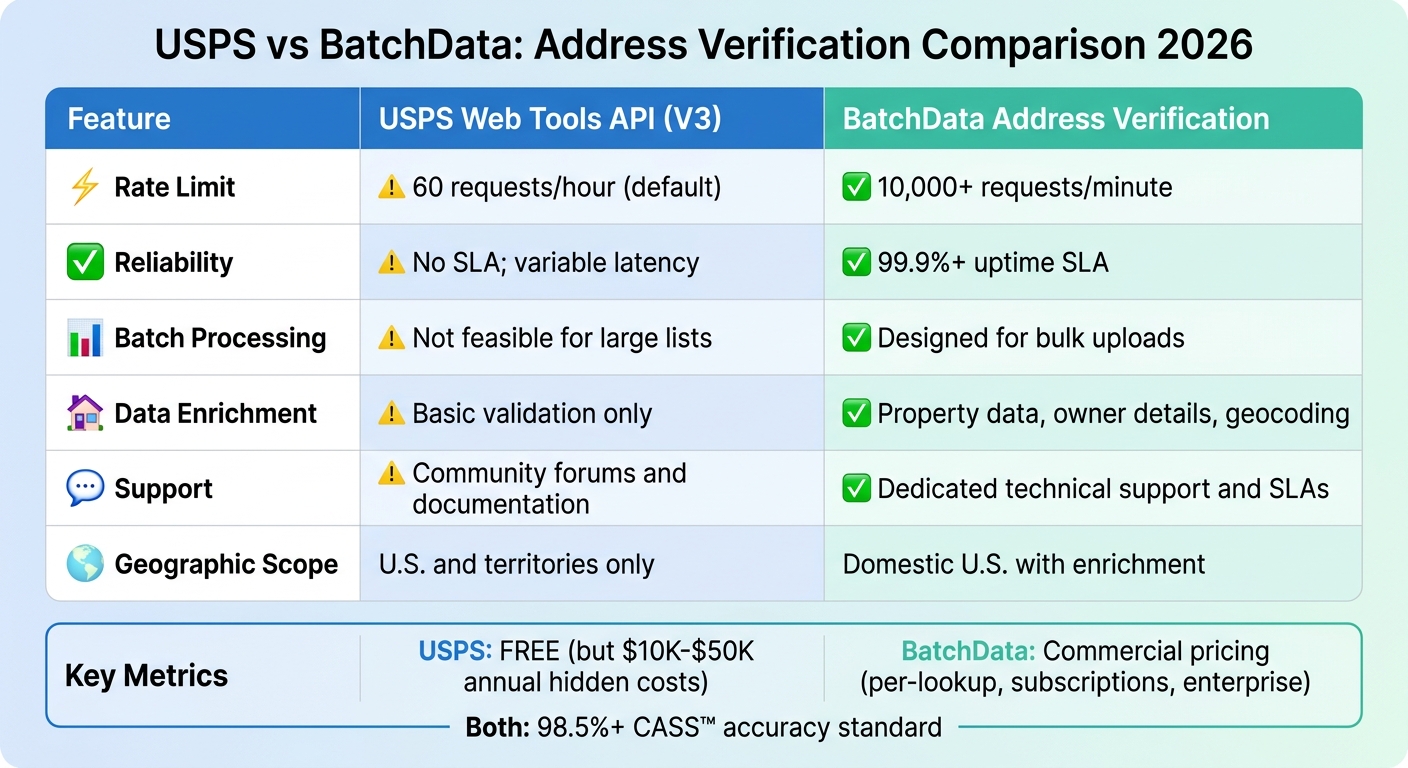
USPS vs BatchData Address Verification: Feature Comparison 2026
Both USPS and BatchData meet the CASS™ accuracy standard of 98.5%. However, their performance diverges significantly when it comes to handling high volumes or delivering enriched data for real estate applications. For developers working in this space, understanding these differences is key to choosing a solution that balances reliability and scalability. While USPS struggles with throughput limitations, BatchData is built to handle over 10,000 requests per minute and guarantees a 99.9% uptime SLA. This contrast highlights the practical differences between the two platforms.
Although USPS offers free access, it comes with hidden engineering costs. Developers often spend $10,000–$50,000 annually to manage OAuth tokens, address inconsistent error messages, and develop workarounds for rate limits. In contrast, BatchData’s commercial pricing – whether per-lookup at fractions of a cent, tiered subscriptions, or custom enterprise plans – includes fully integrated infrastructure and dedicated technical support, removing these additional labor expenses.
The disparity becomes even more pronounced for real estate applications. USPS only offers basic address validation. On the other hand, BatchData goes beyond validation, delivering property insights such as owner details and precise geocoding. This transforms a simple address check into a tool for market analysis and compliance workflows.
Here’s a breakdown of the key differences:
| Feature | USPS Web Tools API (V3) | BatchData Address Verification |
|---|---|---|
| Rate Limit | 60 requests/hour (default) | 10,000+ requests/minute |
| Reliability | No SLA; variable latency | 99.9%+ uptime SLA |
| Batch Processing | Not feasible for large lists | Designed for bulk uploads |
| Data Enrichment | Basic validation only | Property data, owner details, geocoding |
| Support | Community forums and documentation | Dedicated technical support and SLAs |
| Geographic Scope | U.S. and territories only | Domestic U.S. with enrichment |
This comparison underscores the practical and financial considerations for developers, particularly those working in real estate, where enriched data and scalability are often essential.
Conclusion
As outlined earlier, evolving production requirements call for more than just basic address validation. The transition from USPS to BatchData in 2026 highlights a growing industry need: modern applications require solutions that can scale effectively. While USPS offers a free service, its limitations – like a 60-request-per-hour cap and inconsistent uptime – make it less suitable for production environments. In contrast, BatchData handles over 10,000 requests per minute and guarantees a 99.9% uptime SLA.
For real estate professionals, it’s not just about validating addresses; it’s about accessing enriched data. BatchData goes beyond validation by providing details like property ownership, attributes, and accurate geocoding. These features are critical for tasks such as market analysis, regulatory compliance, and deal sourcing. With address data decaying at a rate of over 2% per month, having up-to-date, enriched insights can set businesses apart.
Proptech teams should prioritize solutions offering over 99% accuracy, real-time capabilities, and the ability to scale. BatchData’s free tier is an easy way to test its effectiveness – if your needs exceed one address per minute, upgrading becomes a no-brainer.
In 2026, BatchData stands out as the practical choice for real estate applications, delivering the speed, reliability, and enriched data that modern workflows demand.
FAQs
How do I increase USPS v3 API rate limits?
To push past the default limit of 60 requests per hour on the USPS v3 API, you’ll need to get in touch with USPS directly. They offer higher rate limits for enterprise users, but this requires coordination with their API team. In the meantime, you can optimize your usage by implementing strategies like caching frequently used data and queuing requests to stay within current limits. Contact USPS to discuss your requirements and request an increase in your quota.
What’s the easiest way to verify 10,000+ addresses fast?
The fastest way to check over 10,000 addresses is by leveraging automated tools designed for bulk processing. BatchData offers solutions that can instantly validate and correct massive datasets. These tools identify errors, standardize address formats, and verify deliverability using official postal databases like USPS. This approach ensures precise results, saves time, and minimizes manual work – making it perfect for industries such as real estate and proptech, where managing large volumes of address data is a daily task.
Can address verification include property data too?
Address verification can include property data like geographic, risk, and demographic details. By using APIs, businesses can automate data enrichment and validation, offering deeper property insights for a range of uses.