


































Want to close more real estate deals? Engage with homeowners before they list.
Here’s why:
- 40% of motivated sellers are driven by major life events (divorce, relocation, retirement) that occur up to 6 months before listing.
- 74% of off-market sales are situational, not financial, with sellers prioritizing speed and ease over the highest price.
- Connecting early improves your closing rate to 60-70%, compared to cold leads.
Proactive outreach using data-driven insights (like equity growth, life events, or renovation permits) helps you identify potential sellers before the competition. Tools like BatchData streamline this process by offering property data, predictive analytics, and skip tracing to pinpoint high-intent homeowners.
The result? Less competition, higher conversion rates, and more revenue.
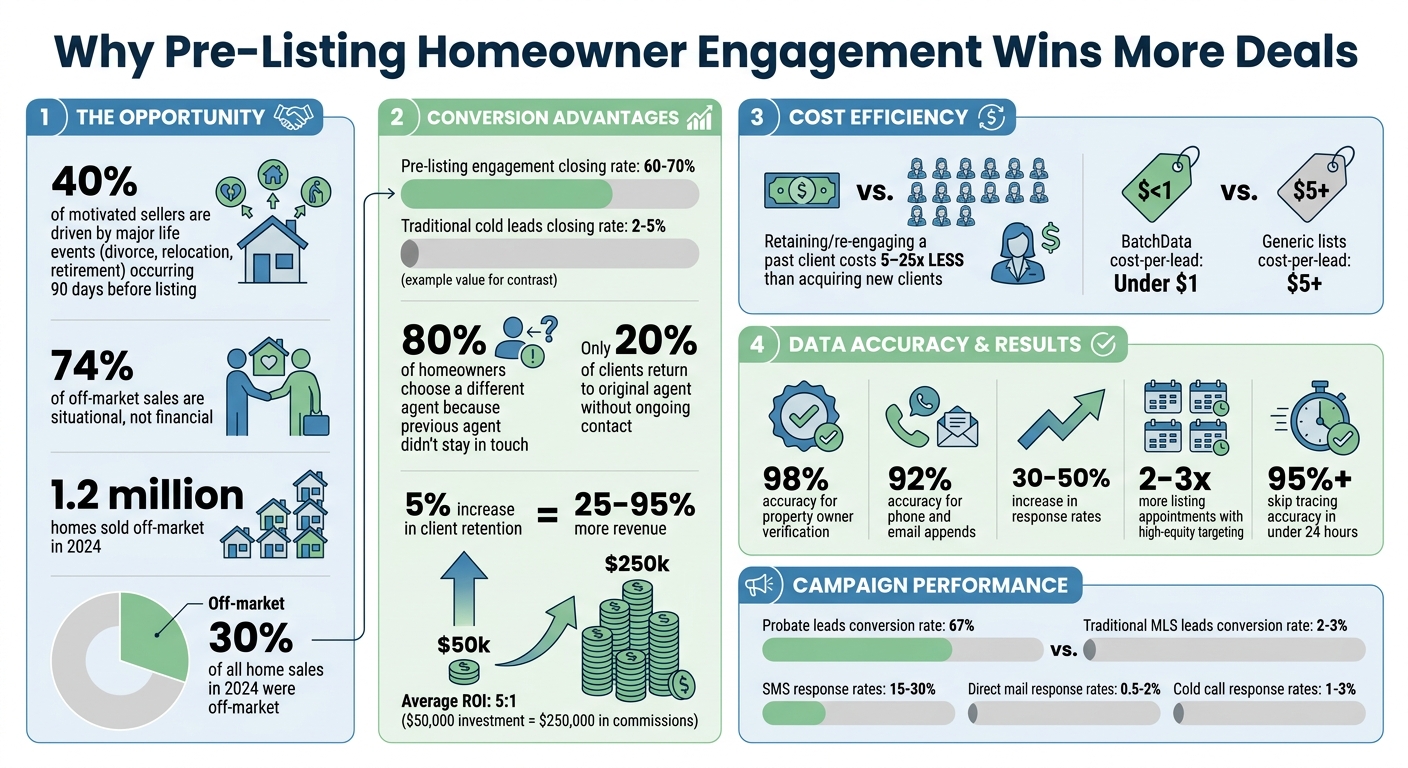
Pre-Listing Homeowner Engagement Statistics and ROI for Real Estate Agents
Win More Real Estate Listings with a Pre-Listing Packet – The Chris and Garry Show Episode 13

sbb-itb-8058745
Why Reaching Homeowners Before Listing Works Better
Connecting with homeowners before their property hits the market gives you a significant edge. By reducing competition, this approach can improve your closing rate to an impressive 60%–70% compared to working with cold leads. This advantage isn’t just about better odds – it also brings measurable gains in revenue and reduces costs.
Re-engaging a past client is far more cost-effective than finding a new one. In fact, retaining or reconnecting with a client can cost five to 25 times less than acquiring someone new. However, many agents miss this opportunity. Around 80% of homeowners end up choosing a different agent for future transactions simply because their previous agent didn’t stay in touch during the years of ownership. Instead of chasing cold leads, focusing on nurturing these existing relationships can set you apart from competitors who pour resources into prospecting.
Higher Conversion Rates with Less Competition
Once a home is listed, the competition among agents skyrockets. But if you connect with homeowners early, you’re often the only professional they’re considering. This exclusivity can directly translate into more revenue. For example, increasing client retention rates by just 5% can result in 25% to 95% more revenue.
To stand out, consider offering a pre-listing package. Include your biography, client testimonials, and a tailored marketing plan. These materials not only demonstrate your expertise but also build trust, making you the obvious choice when it’s time to sell.
Building Trust Through Early Contact
Reaching out early gives you the chance to build trust long before the listing process begins. Life events like divorce, job relocations, or estate settlements often trigger the need to sell a home. If you position yourself as a trusted advisor during these transitions, you’re more likely to secure the listing. As Xara put it, “Positioning yourself as a trusted agent beforehand, and during the closing process, is the number one factor in closing deals!”.
Using data-driven insights can make your outreach feel personal and relevant. For instance, using precision property search to track equity milestones or other key life changes allows you to send tailored messages that resonate. If a homeowner’s equity has grown significantly, it’s a natural time to reach out with advice about refinancing, remodeling, or even upgrading to a new home. This kind of thoughtful communication not only strengthens your reputation but also makes your efforts more efficient and profitable.
Consistency is key. Regular, personalized updates – like monthly “Homeowner Digests” with property value estimates and market trends – keep you top of mind. Without this ongoing connection, only 20% of clients typically return to their original agent for future transactions. By staying in touch, you ensure that when homeowners are ready to sell, you’re the first person they think of.
Finding Pre-Listing Homeowners Using Data
Securing listings often starts with identifying potential sellers early, and data plays a key role in this process. In 2024, over 1.2 million homes sold off-market across the United States, accounting for nearly 30% of all home sales. Tapping into this market requires proactive data-driven strategies.
Data Sources
Different data sources can uncover homeowners who may be preparing to sell, each offering unique insights. Public records, for example, provide detailed ownership information, including equity levels and how long a property has been owned. While these records are great for spotting long-term trends, their slower update cycles make them less effective for identifying immediate opportunities.
MLS data can highlight expired or withdrawn listings, which often indicate homeowners who previously tried to sell but faced challenges. Pre-foreclosure records are another key resource, pointing to homeowners under financial stress who may be motivated to sell quickly. Similarly, lien records can signal financial difficulties, though not every lien suggests an imminent sale.
Other valuable signals come from property characteristics. For instance, USPS data can identify vacant properties, while code violations and building permit activity might hint at upcoming sales. Renovation permits, in particular, often suggest homeowners are preparing their property for the market. Life events also play a major role – job relocations, divorces, or other significant changes frequently trigger off-market transactions. As Ivo Draginov from BatchData explains:
“Motivation is about circumstance, not just finances. A seller with 80% equity who must relocate for a new job in 30 days is just as motivated as someone behind on their mortgage”.
By combining these data points, you can build a clearer picture of potential sellers and their motivations.
Using Predictive Analytics to Find Motivated Sellers
Taking this a step further, predictive analytics transforms raw data into actionable insights. These tools assign properties a “propensity to sell” score by analyzing factors like equity levels, ownership duration, local trends, and renovation activity. For instance, BatchRank uses machine learning to uncover patterns that manual research might miss. A minor tax delinquency paired with a recent death, for example, is 2.5 times more likely to predict a sale than pre-foreclosure data alone.
The strength of predictive analytics lies in its ability to stack filters, refining your target list into a smaller, higher-quality pool. For example, combining absentee ownership, a 10-15 year ownership period, and 40%+ equity can pinpoint landlords ready to sell. Alternatively, filters like “senior owner + multi-story home + long ownership” can help identify homeowners likely to downsize. Probate leads derived this way boast a conversion rate of about 67%, with an average ROI of 23.4% – a stark contrast to the 2-3% conversion rate typical of traditional MLS leads. When multiple signals align, your outreach becomes not only more relevant but also far more effective at closing deals.
BatchData Tools for Pre-Listing Lead Generation
Once you’ve pinpointed the data sources and predictive signals that matter, the next step is acting on that information efficiently. BatchData provides a suite of tools designed to help real estate professionals connect with pre-listing homeowners. Let’s break down how these tools can supercharge your pre-listing lead generation efforts.
Property and Contact Data Enrichment
BatchData’s enrichment services turn basic property lists into highly targeted lead databases. They append verified contact details and detailed property insights, including owner names, phone numbers (landline and mobile), email addresses, ownership history, mortgage details, and estimated equity levels. With 98% accuracy for property owner verification and 92% for phone and email appends, the data is both reliable and actionable.
This level of accuracy drives results: response rates increase by 30–50%, and agents often secure 2–3× more listing appointments by focusing on high-equity homeowners. By providing precise, timely data, BatchData helps agents engage with homeowners at the perfect moment, ensuring early and effective outreach.
Covering 99% of U.S. properties, BatchData ensures its data is up-to-date and relevant. The platform tracks pre-listing signals like equity growth and life events, sourcing information from public records, MLS, and proprietary datasets for over 150 million properties, updated daily. Its proprietary linking technology also identifies decision-makers behind LLCs and trusts, giving agents access to hidden property owners.
Skip Tracing and APIs for Real-Time Data
For homeowners who aren’t easily located in standard databases, BatchData’s skip tracing feature is a game-changer. Using advanced algorithms to cross-reference public records, utility data, and proprietary sources, the platform delivers contact information with 95%+ accuracy in under 24 hours. This speed allows agents to connect with homeowners showing early signs of selling.
BatchData’s real estate APIs take things a step further by offering real-time data access via simple RESTful endpoints. These APIs integrate seamlessly with CRM tools, delivering instant property values, owner details, and market trends in JSON format. For example, a Texas-based team using the API to automate 1,000 daily searches saw pre-listing appointments jump by 35%, while no-contact rates dropped from 60% to 20%. With sub-second response times and 99.99% uptime, these APIs ensure reliable access to critical data when timing is everything.
These tools make it easier to scale targeted campaigns, setting agents up for success in competitive markets.
Custom Solutions for Pre-Listing Campaigns
For agents managing large-scale campaigns, BatchData’s custom solutions offer tailored options to meet specific business needs. Bulk data exports are available in CSV or Excel formats, and datasets can be filtered by criteria like equity thresholds, recent movers, or probate indicators. These tailored datasets are delivered weekly or on-demand, giving agents the ability to focus their efforts during key pre-listing phases.
Custom solutions can scale campaigns to over 10,000 leads monthly. For instance, a Miami-based team targeting “empty nesters” through a mix of direct mail and SMS achieved a 28% conversion rate, securing 150 listings from 5,000 leads.
Pricing is competitive, starting at $0.10–$0.50 per record, with subscriptions beginning at $99/month for 1,000 enrichments. Skip tracing costs range from $0.15–$0.25 per successful trace, with volume discounts available. Users report a cost-per-lead under $1, far lower than the $5+ for generic lists, and enjoy 2–4× higher listing win rates. In a 2025 analysis of 10,000 BatchData users, the average ROI was 5:1, with a $50,000 investment generating $250,000 in commissions from pre-listing deals.
Effective Methods for Pre-Listing Engagement
Having the right data is just the beginning; building trust with homeowners before they list their properties is where the real magic happens. The top-performing agents use BatchData’s enriched property and contact details alongside thoughtful outreach strategies. The goal? To become a trusted advisor rather than just another salesperson.
Circle Prospecting and Personalized Outreach
Circle prospecting focuses on connecting with homeowners in neighborhoods where you already have a track record of success. Instead of relying on generic mass marketing, this strategy allows you to craft highly specific messages. These messages can reference local market trends, recent sales, and neighborhood-specific insights, making your outreach feel relevant and personal. BatchData’s verified contact information and detailed property insights make this approach even more effective.
To stand out, tailor your outreach based on the homeowner’s situation. For example:
- High-equity, long-term owners (15+ years): Offer consultations on downsizing or equity reports that show how much their home value has grown.
- Expired or withdrawn listings: Present a fresh marketing plan or a new pricing strategy that addresses past hurdles.
- Absentee owners, especially out-of-state landlords: Position yourself as a resource for managing tenant issues or liquidating their assets.
Pair these personalized efforts with regular, informative updates to keep homeowners engaged and thinking of you as a helpful resource.
Providing Value Early: Market Updates and Free Valuations
In addition to personalized outreach, providing timely and useful market insights can strengthen relationships with homeowners. People appreciate agents who share valuable information without pushing for a sale. Regular updates, such as automated market reports, help you stay top-of-mind even during the quieter times of homeownership. Tools like “Homeowner Digests” can deliver updates on home values, equity growth, and local market trends, reinforcing your role as a trusted advisor.
Timing is everything. For instance, BatchData’s insights can alert you when a homeowner’s equity increases by $50,000 or when their loan-to-value ratio dips below 80%. These are ideal moments to suggest ways they could use their equity for renovations or as a down payment on a new home. Similarly, monitoring building permit activity lets you follow up with updated property valuations after renovations are completed.
The numbers back up this approach. Research shows that acquiring a new client costs five to 25 times more than retaining an existing one. Yet, only 20% of clients return to their original agent for future transactions due to inconsistent follow-ups. Even a small 5% boost in client retention can increase revenue by 25% to 95%. Early, value-driven engagement can make all the difference.
These strategies not only build trust but also set the stage for more focused campaigns down the line.
Using Predictive Analytics for Targeted Campaigns
Predictive analytics takes your outreach to the next level by identifying homeowners who are most likely to sell. By analyzing behavioral signals and life events, you can focus your efforts on those who are closer to listing their properties. BatchData tracks key pre-listing indicators such as equity growth, ownership duration, and property characteristics, helping you zero in on high-intent sellers.
Lead stacking is another powerful tool. By combining data from various sources – like public records, MLS data, and lien filings – you can create highly targeted lists. BatchData then refines these lists with verified contact information, ensuring you’re reaching out to the right people at the right time.
When you combine predictive analytics with personalized outreach, you’re not just chasing real estate wholesale lead generation – you’re building meaningful connections with homeowners who are ready to take the next step. This proactive approach ensures your efforts are focused where they’ll have the greatest impact.
Tracking and Improving Pre-Listing Engagement Results
You can’t fix what you don’t measure. Keeping an eye on key metrics is the backbone of any successful pre-listing outreach strategy. The difference between agents who consistently close deals and those who struggle often boils down to how well they track and fine-tune their campaigns using real data.
Key Metrics for Pre-Listing Performance
Start with the contact rate – this is the percentage of leads you actually manage to reach. If your cold-calling contact rate falls below 8%–10%, it’s likely a sign of poor data quality. This metric can tell you whether you’re working with accurate contact information or wasting time on outdated numbers and addresses.
Next up, track response rates – aim for 15%–30% for SMS and 0.5%–2% for direct mail. These benchmarks give you a sense of how well your outreach efforts are landing. Other critical metrics include your lead-to-close ratio – the percentage of leads that turn into closed deals – and your Cost Per Acquisition (CPA), which divides your total marketing spend by the number of closed deals. Together, these numbers help you understand whether your campaigns are not only effective but also profitable and scalable.
“Your optimization strategy hinges on logging each touchpoint. Record each touchpoint to build a reliable, actionable dataset.” – BatchData
To refine your campaigns, try A/B testing. For example, swap out problem-focused messaging for solution-focused messaging and see which approach gets a better response. Even minor improvements in response rates can make a big difference when scaled across your outreach efforts.
Once you’ve established these metrics, tools like BatchData’s analytics platform can help you track and refine your results. By analyzing the data regularly, you can make timely adjustments to ensure your outreach stays effective and aligned with changing market conditions.
Using BatchData for Ongoing Optimization
BatchData’s analytics platform provides a clear view of where your campaigns might be falling short. One of its standout features is data stacking, which allows you to layer multiple signals – like high equity, vacancy, and tax delinquency – to create highly targeted segments that are more likely to convert. With the help of machine learning, you can zero in on prospects who are most likely to take action.
The platform also helps identify leaks in your sales funnel. For example, if your contact rate is low, BatchData’s skip tracing and phone verification services can improve the accuracy of your lead data. If certain segments aren’t performing, you can tweak your filters or experiment with different messaging strategies. Additionally, BatchData’s professional property services team can assist in building custom data pipelines and refining your targeting criteria based on what the numbers reveal.
Conclusion: Closing More Deals with Early Homeowner Engagement
Timing makes all the difference. Reaching homeowners before they list gives you an edge – less competition, better conversion rates, and the opportunity to position yourself as a trusted advisor from the start.
Life changes are behind more than 74% of off-market transactions, showing how early, strategic engagement can open up major opportunities. These numbers highlight the power of acting early and using data-driven insights.
With BatchData, this approach becomes seamless. Their platform consolidates over 155 million property records into one easy-to-access feed, cutting out the hassle of manual cross-referencing. Tools like BatchRank use AI to score properties based on their likelihood to sell, helping you channel your marketing efforts toward homes most likely to hit the market in the next 6–12 months. One Houston-based investor saw a 9x ROI using BatchRank, proving how valuable pre-listing engagement can be.
“BatchRank represents a complete reimagining of how businesses connect with customers in the property ecosystem. We’re giving companies the ability to see around corners and get ahead of the market.” – Ivo Draginov, Co-founder of BatchData
Pairing data stacking with swift outreach turns early engagement into a game-changer. By focusing on signals like high equity, vacancy, and out-of-state ownership, you can pinpoint highly targeted leads. BatchData’s APIs make outreach nearly instant, with SMS campaigns yielding response rates of 15%–30%, cold calls averaging 1%–3%, and direct mail achieving 0.5%–2%.
Early engagement isn’t just about being first – it’s about being ready, precise, and informed. BatchData’s tools for property intelligence, skip tracing, and real-time automation help you connect with homeowners primed to sell, ensuring your timing is always on point.
FAQs
How do I know which homeowners will list soon?
Predictive analytics allows you to spot homeowners who might list their properties soon by examining behavioral and demographic signals. These include life events like marriage or job changes, mortgage inquiries, and equity milestones. By identifying patterns such as property ownership trends, you can anticipate selling intent with impressive precision. This approach gives you the opportunity to connect with motivated sellers up to 6 months before they officially list, giving you a head start on closing deals.
What should I say in my first pre-listing outreach?
Your first pre-listing outreach should aim to create a friendly, personalized connection backed by useful data. For example, you could say:
“Hi, I came across your property at [address] and was curious if selling has crossed your mind. I specialize in working with homeowners like you and can share data to help you explore your options. Would you be open to a quick conversation?”
Keep the tone approachable, the message brief, and focus on providing helpful insights.
Which metrics tell me if my outreach is working?
Key metrics to focus on are higher answer rates and conversion rates when reaching out to motivated homeowners. Data analysis also reveals optimal contact times, ensuring you’re connecting with people when they’re most likely to engage. Additionally, identifying peak calling windows can significantly boost engagement. These insights, backed by call-time data, play a crucial role in evaluating and enhancing the success of your outreach strategies.