


































Real estate faces a data problem. Professionals juggle 5–10 data providers and up to 40 disconnected platforms, wasting time on manual research instead of making informed decisions. This inefficiency costs U.S. businesses $3.1 trillion annually and slows property evaluations, often taking weeks to assess just a handful of sites.
Here’s the solution: data intelligence. By centralizing fragmented data with a real estate API, automating workflows, and leveraging AI, firms can analyze 100+ properties in hours, predict market trends, and boost decision-making speed. The results? Over 10% increases in net operating income, faster deal closures, and reduced costs.
Key Takeaways:
- Fragmented Data: 70% of time is spent searching for information, costing $300,000 annually per 100 properties.
- Manual Research: Slows operations; automation can cut analysis time by 90%.
- AI Benefits: Predictive analytics improve property valuations by 15% and cut maintenance costs by 20%.
- Proven Results: Firms using data intelligence report up to 45% ROI increases and faster portfolio growth.
The future of real estate is clear: centralized data, automation, and AI-driven insights are transforming how decisions are made.
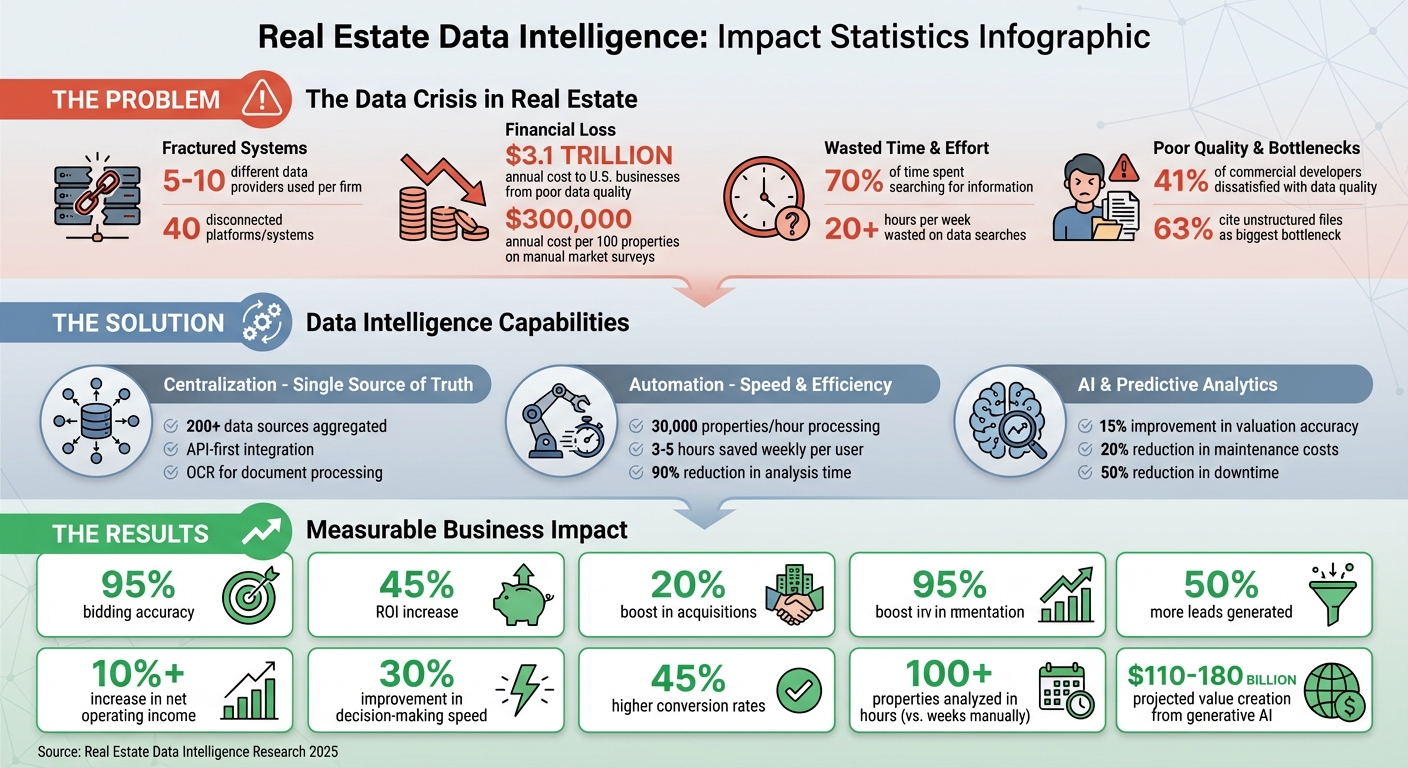
Real Estate Data Intelligence: Key Statistics and ROI Impact
Main Challenges in Real Estate Decision-Making
Scattered and Incomplete Data Sources
Real estate professionals often rely on 5 to 10 different data providers and up to 40 disconnected systems to manage their operations. This fragmented setup leads to inconsistent and incomplete records. For example, a single property might have varying square footage listed across databases, while outdated mortgage balances or missing liens can go unnoticed in financial records.
This lack of data integration comes at a cost. U.S. businesses lose an estimated $3.1 trillion annually due to poor data quality. Employees spend 20 or more hours per week – nearly 70% of their time – searching for information scattered across disconnected platforms. For property managers handling 100 properties, this inefficiency translates to about $300,000 annually wasted on manual market surveys.
"You need an ontology to make it easier for people to get information and integrate it with AI. You need to have a shared learning model as well as shared data."
- Richard Reyes, CEO and Executive Director, OSCRE
Fragmented data becomes an even bigger obstacle when firms attempt to adopt AI solutions. Machine learning models require structured and consistent data to function effectively. Without this, the result is a "garbage in, garbage out" scenario. This creates a cycle of inefficiency, where manual research becomes the only way to fill in the gaps, further burdening decision-making processes.
Time-Consuming Manual Research
The fragmented data environment forces real estate professionals to rely heavily on manual processes, which drastically slows down operations. This dependence on manual labor creates a scalability issue – firms often need to hire one additional analyst for every 10–15 properties. Meanwhile, professionals lose about 20% of their weekly time pulling rental comps and reconciling conflicting records.
In 2025, a real estate consulting firm implemented an automated decision intelligence system to combat these inefficiencies. The results were impressive: 95% bidding accuracy, a 20% boost in acquisitions, and a 45% increase in ROI.
"In a market where timing and accuracy drive margins, relying on manual data collection means you’re not just losing hours, you’re losing opportunities."
Manual processes also increase the risk of human error. Over 50% of real estate teams still rely on manual data cleaning or re-entry before they can analyze anything. This copy-paste workflow often leads to broken links, version control problems, and typing mistakes. Additionally, 63% of real estate professionals say unstructured files – like PDFs, emails, and inconsistent spreadsheets – are their biggest operational bottleneck. This reliance on manual tasks not only slows decision-making but also obscures real-time market insights, making it harder to stay competitive.
Limited Insight into Market Trends and Property Valuations
Accurately predicting market trends becomes a challenge when data is scattered across property management systems, financial platforms, and public records. Inconsistent definitions and a lack of standardization only add to the problem, making it difficult to form a reliable view of the market.
This "bad data" crisis has real consequences. Around 41% of commercial developers are dissatisfied with the quality of the data they use. Inaccurate or incomplete data can inflate asset values or hide risks, such as unreported lease expirations that lead to unexpected vacancies. However, the potential of data intelligence is huge – big data analytics could improve property valuation accuracy by up to 15%. Predictive maintenance, powered by better data, could also cut building maintenance costs by 20% and reduce downtime by 50%.
For instance, in 2025, Ernst & Young (EY) partnered with a major real estate investor to implement a Master Data Management (MDM) system. By creating clear taxonomies and data quality rules, the project delivered a 20% improvement in operating performance within just one year.
"AI can accelerate CRE operations, but when the underlying data is unreliable, it undermines the efficiencies that AI promises to deliver."
In today’s competitive market, time is money. Yet, teams often find themselves stuck reconciling mismatched datasets instead of focusing on strategic analysis. This reactive approach turns what could be predictive, data-driven decisions into guesswork.
sbb-itb-8058745
Real Estate Data Masterclass 2025: AI + Automation
How Data Intelligence Solves Real Estate Challenges
Data intelligence turns complex real estate challenges into practical, measurable solutions.
Centralizing Property Data for Unified Insights
Fragmented data is a common hurdle in real estate, but data intelligence platforms tackle this by creating a "Single Source of Truth". These platforms consolidate property records, foot traffic data, satellite imagery, tax information, and MLS feeds into one cohesive dashboard. Through API-first strategies and ETL pipelines, data is automatically pulled, cleaned, and standardized from hundreds of sources. Even scanned documents like deeds and PDFs are converted into searchable data using OCR and AI. Master Data Management (MDM) systems then ensure consistency across leasing, accounting, and forecasting teams by applying standardized taxonomies and quality rules.
In 2025, a major real estate consulting firm collaborated with Xtract.io to automate the aggregation of data from 200 sources across the U.S. Using hourly bots and a cloud data lake, the firm achieved impressive results: 95% bidding accuracy, 20% more acquisitions, and a 45% ROI increase within a year.
"A holistic data strategy that addresses disparate, fragmented data sources can enable powerful front- and back-of-house insights."
- Brian Taylor, EY Americas Real Estate Consulting Leader
This approach has proven to boost net operating income by over 10% for some companies. Considering that poor data quality costs U.S. businesses $3.1 trillion annually – with real estate accounting for 17% of this – centralizing data is a game-changer.
Once data is unified, automation takes decision-making to the next level.
Using Automation to Speed Up Decision Cycles
Modern systems now link property data APIs directly to CRMs, automating processes like data retrieval, valuation updates, and tailored lead outreach. This eliminates the need for manual data collection. Practitioners report saving 3–5 hours weekly on research, cutting preparation time from 20–30 minutes to under 5 minutes, and processing up to 30,000 property records per hour.
For example, an investment firm using EightGen AI reduced its weekly analysis time from over 30 hours to less than 2 hours. By integrating data from 27 sources, they saw a 13.5% ROI increase and grew their portfolio by 40% without adding staff. Companies leveraging automation have also reported up to a 30% improvement in decision-making speed and accuracy.
"The consistent results come from the process you build around the data, not the data itself."
- Shital Gohil, Co-founder and COO, Styldod
This shift moves the industry from static data searches to predictive insights. Instead of sifting through lists, predictive systems now highlight properties likely to sell, based on behavioral data and economic trends. In fact, 89% of real estate executives see automation and analytics as the most disruptive technologies in their field.
Automation lays the groundwork for AI to not only analyze data but also forecast future trends.
AI-Driven Market Trends and Predictive Analytics
With unified data and automated workflows as a foundation, AI models are now offering clearer insights into market trends. These models go beyond historical analysis, evaluating factors like rental cash flow, market demand, and economic indicators (e.g., employment rates, interest rates) to uncover undervalued assets. Automated Valuation Models (AVMs) further enhance decision-making by combining public records, sales history, and infrastructure changes to deliver real-time property estimates.
Scenario simulations are another powerful tool, using historical data and predictive modeling to test market conditions. Predictive analytics can also assess tenant risks and forecast vacancies by analyzing financial and industry trends, allowing for proactive leasing strategies.
One Real Estate Investment Trust (REIT) partnered with EY to centralize data across leasing, accounting, and forecasting. By integrating historical and market data, they developed predictive insights for deal closures and automated key metrics, leading to a 20% improvement in operating performance within a year.
AI’s impact extends to lead generation and conversions. Companies using AI for outreach have reported 50% more leads and 45% higher conversion rates compared to traditional methods. Additionally, generative AI is projected to create $110 billion to $180 billion in value for the real estate sector. The PropTech market, valued at $19.5 billion in 2022, is expected to grow to $32.2 billion by 2030.
"Real estate data intelligence is like having a crystal ball for property decisions."
- Clyde Christian Anderson, CEO, GrowthFactor.ai
The future of real estate lies in hyperlocal accuracy. By analyzing unconventional data points like Yelp reviews, foot traffic, and flood risk maps, companies can pinpoint emerging market opportunities months before traditional indicators catch up. This evolution from reactive to predictive decision-making sets leading firms apart from those relying solely on intuition.
Practical Applications of Data Intelligence in Real Estate
Harnessing unified data and automation, modern tools are transforming how real estate professionals operate. From securing better leads to managing portfolios more effectively, these applications are helping investors, agents, and managers close deals faster, minimize risks, and simplify their workflows.
Improving Lead Qualification and Off-Market Deal Sourcing
Did you know agents spend 60% of their time chasing unqualified leads? That’s a staggering waste of effort. AI-powered lead scoring is changing the game by analyzing behaviors like search frequency and property views, alongside demographic data. The result? A 128% boost in conversion rates and a 67% increase in revenue per agent.
But it doesn’t stop there. The way deals are sourced is evolving too. For example, the U.S. commercial real estate market currently holds $116.4 billion in distressed properties. Investors are leveraging data points like tax liens and code violations to find motivated sellers. Instead of blanketing areas with generic mailers, they’re using hyper-personalized outreach. By verifying distress indicators – such as active Notices of Default – this targeted approach delivers 30–50% higher returns on marketing campaigns.
Once leads are qualified, these tools also enable real-time portfolio management, taking efficiency to the next level.
Better Portfolio Management with Predictive Insights
Predictive analytics is revolutionizing portfolio management by shifting from periodic reviews to continuous, real-time monitoring. AI models can now flag early warning signs, such as tenants with declining credit, irregular payments, or oversaturated markets, allowing managers to reallocate resources proactively. Companies using these data-driven strategies are seeing measurable improvements in performance and asset efficiency.
Automated Valuation Models (AVMs) are another game-changer. By incorporating factors like local economic trends, infrastructure projects, and consumer behavior, they go beyond traditional historical comparisons. For instance, Zillow‘s Zestimate algorithm boasts a median error rate of just 5.9%. Real estate pros often recommend cross-referencing data from at least three AVM platforms for accuracy. Vacancy forecasting adds another layer of precision, analyzing lease renewal dates, turnover rates, and local demand to reduce downtime. This enables managers to offer retention incentives or adjust listings before vacancies even happen.
Additionally, real-time data feeds can trigger automatic tasks, like alerts for refinancing opportunities when market conditions align. This level of insight is estimated to generate between $110 billion and $180 billion in value for the real estate industry.
These predictive capabilities set the stage for operational efficiency, as seen in BatchData’s cutting-edge tools.
Streamlining Operations with BatchData Solutions

BatchData is taking operational efficiency to a whole new level. With a database of over 155 million property records enriched by more than 1,000 data points – like equity, mortgage details, and ownership history – it eliminates hours of tedious manual research.
BatchData’s Model Context Protocol (MCP) integrates with AI tools like Claude to simplify complex tasks. It can perform market comparisons and generate detailed, natural language reports in seconds. Chris Finck, Director of Product Management at BatchData, puts it best:
"We want to supplement your work and make you superhuman so you can do things in seconds not hours. That’s where BatchData comes in. What used to take 30 minutes now takes 30 seconds."
- Chris Finck, Director of Product Management, BatchData
BatchData also offers real-time APIs and bulk data feeds that keep property databases up to date. Instead of working with static lists, users can maintain live portfolios that reflect daily changes, like new liens, pre-foreclosure filings, or shifts in equity. Automated monitoring tools act as watchdogs, flagging critical changes as they happen. Built-in compliance features, such as DNC scrubbing and TCPA screening, ensure outreach stays within legal boundaries. Data delivery options are flexible too – whether via real-time API access or scheduled CSV uploads to platforms like Amazon S3, Google Drive, or SFTP.
Measuring the Impact of Data Intelligence in Real Estate
Data intelligence is reshaping real estate operations, delivering measurable benefits across the board. McKinsey estimates that generative AI alone could create $110 billion to $180 billion in value for the sector. To truly understand its impact, companies are tracking key performance indicators (KPIs) that highlight efficiency improvements, quicker decision-making, and stronger portfolio performance. These metrics provide a clear picture of how data intelligence translates into financial and operational advantages.
Efficiency Gains and Cost Savings
One of the biggest wins from data intelligence is the ability to save both time and money. For example, digital tools can analyze over 100 potential sites in just a few hours – a process that used to take weeks of manual site visits. In urgent situations like bankruptcy auctions, AI has assessed over 800 locations in under 72 hours, a feat that would traditionally require weeks of effort.
Metrics like the Operating Expense Ratio (OER) highlight these cost savings. Properties with well-managed data typically maintain an OER below 80%. Companies implementing Master Data Management (MDM) strategies to ensure clean, reliable data have seen a 20% boost in operating performance within just a year. Automation also plays a big role: tools like automated lease abstraction can extract critical terms from lengthy documents instantly, eliminating hours of manual work.
Another important metric is Data Cost Per Lead (DCPL), which measures the cost of acquiring data relative to the quality of leads generated. While data acquisition costs can sometimes consume up to 50% of revenue, the resulting higher transaction values and faster deal closures often justify the investment. These efficiency gains directly feed into faster decision-making, as we’ll explore next.
Faster Decision-Making and Better Deal Closure Rates
Speed is everything in today’s real estate market, and data intelligence helps companies act faster. Time-to-Close (TTC), which tracks the days from lead qualification to deal closure, is a key metric here. Advanced data systems and automated workflows can help teams achieve a TTC of under 35 days. Clyde Christian Anderson, CEO of GrowthFactor.ai, sums it up perfectly:
"Speed wins deals now. When that perfect corner location hits the market, whoever can instantly pull foot traffic data, analyze demographic fits, assess cannibalization risks, and run financial models gets the lease."
- Clyde Christian Anderson, CEO, GrowthFactor.ai
Metrics like the Listing-to-Meeting Ratio and Lead Conversion Rate further show how data intelligence drives results. These metrics reveal how effectively listings generate prospect meetings and how many qualified leads turn into closed deals. With actionable insights, teams can focus on high-potential opportunities, often reaching break-even in just two months. High gross margin structures – frequently exceeding 80% – further accelerate profitability.
Increased ROI and Portfolio Performance
Ultimately, the success of data intelligence comes down to financial returns. Metrics like Return on Investment (ROI) and Internal Rate of Return (IRR) show whether data strategies are delivering real value. Real-time analytics and predictive models allow investors to avoid risky assets while spotting undervalued opportunities ahead of competitors.
In one standout example, GrowthFactor.ai reported that its platform unlocked $1.6 million in cash flow and $6.5 million in revenue for its clients by June 2025. Their AI agent, "Waldo", enabled teams to evaluate five times more sites than traditional methods, significantly boosting deal volume and portfolio growth. Predictive analytics are also helping companies optimize rental strategies and reduce vacancy rates, leading to consistent improvements in Net Operating Income (NOI).
Other metrics, like the Debt Service Coverage Ratio (DSCR), gauge a property’s ability to cover debt obligations with NOI. A DSCR of 1.25 or higher is considered safe. Meanwhile, the Transaction Volume Growth Rate tracks market penetration, with data-driven firms often achieving over 100% year-over-year growth in their early stages.
These metrics clearly illustrate how data intelligence is transforming real estate, from operational efficiencies to portfolio expansion. By leveraging these tools and insights, companies are staying ahead in an increasingly competitive market.
Conclusion: The Future of Real Estate with Data Intelligence
The real estate industry is undergoing a major transformation, and data intelligence is now essential for staying competitive. Companies leveraging centralized data pipelines, AI-driven automation, and predictive analytics are already seeing over 10% increases in net operating income. Generative AI alone is forecasted to contribute between $110 billion and $180 billion annually to the U.S. real estate market. Meanwhile, the global PropTech market is on track to grow from $34 billion in 2023 to $90 billion by 2032.
The shift away from traditional methods – like manual site visits and scattered spreadsheets – is undeniable. Advanced systems now evaluate hundreds of sites in hours, incorporate detailed climate risk data, and map "True Trade Areas" based on real consumer movement. Clyde Christian Anderson, CEO of GrowthFactor.ai, sums it up perfectly: "Real estate data intelligence is like having a crystal ball for property decisions". Similarly, the MatrixTribe Whitepaper emphasizes:
"the future of real estate intelligence belongs to those who own their data pipelines, not those who rent their insights".
For professionals aiming to stay ahead, the roadmap is clear: centralize your data, focus on consumer behavior rather than static demographics, and adopt an API-first approach to ensure seamless tech integration. A well-executed data strategy can lead to a 20% boost in operating performance within just a year.
BatchData is here to help make this transformation a reality. With tools like property and contact data enrichment, skip tracing property owners, property search APIs, phone verification, and bulk data delivery, BatchData equips you with the infrastructure to create a unified source of truth. Whether you’re sourcing off-market deals, qualifying leads, or optimizing your portfolio, BatchData’s services – including custom data pipelines and enrichment solutions – are designed to enhance every stage of decision-making.
The real question isn’t whether to adopt data intelligence – it’s how quickly you can act. The teams that adapt fastest will uncover the best opportunities, close deals ahead of the competition, and build high-performing portfolios. Start gaining your edge today at batchdata.io.
FAQs
What is data intelligence in real estate?
Data intelligence in real estate is all about transforming raw property and market data into useful insights that guide better decisions. By combining various data sources – such as property specifics, demographic information, and market trends – and leveraging tools like AI and predictive models, it reveals opportunities, evaluates risks, and fine-tunes strategies. This data-driven method empowers professionals to make quicker, more informed choices and maintain an edge in a fast-changing industry.
What data should I centralize first?
To get started, focus on centralizing property data – this includes ownership details and contact information. Having this data in one place is crucial for tasks like market analysis, generating leads, and spotting distressed properties. When property records are accurate, standardized, and paired with verified contact information, it becomes easier to make informed decisions, simplify workflows, and discover new opportunities. Plus, it eliminates the hassle of dealing with scattered or inconsistent data sources.
How do I measure ROI from data intelligence?
Assessing the return on investment (ROI) from data intelligence in real estate means determining how data-driven strategies enhance key outcomes like property valuation, lead conversions, and overall efficiency. To do this, compare the costs of data-related initiatives – such as data enrichment or analytics tools – against measurable benefits. These could include higher deal closure rates, faster transaction times, or reduced operational expenses.
Start by establishing a baseline for performance metrics before implementing any data solutions. Once solutions are in place, closely monitor changes in revenue, cost savings, or productivity. This tracking process will help you pinpoint the value added by your data-driven approach and ensure that your investment is delivering tangible results.